2026 · Web & UXAbout 13 min readNovus Stream Solutions
"No signup, no upload, free forever" is an architecture decision, not a tagline
Three promises that sound like marketing (no signup, no upload, free forever) are actually constraints that shaped the entire technical design of the Novus tools. How each one is enforced by architecture rather than asserted by copy, and the tradeoffs accepted to keep them true.
Contents
- 1.Overview
- 2.No upload: enforced by having no server to upload to
- 3.No signup: enforced by having no account system in the core flow
- 4.Assertions versus properties
- 5.A promise you can verify beats one you must trust
- 6.How signup gates creep in, and the defense
- 7.Why the three promises reinforce each other
- 8.The price of building properties instead of asserting them
- 9.Why users have learned to distrust "free"
- 10.Free forever: enforced by an architecture cheap enough to keep free
Overview
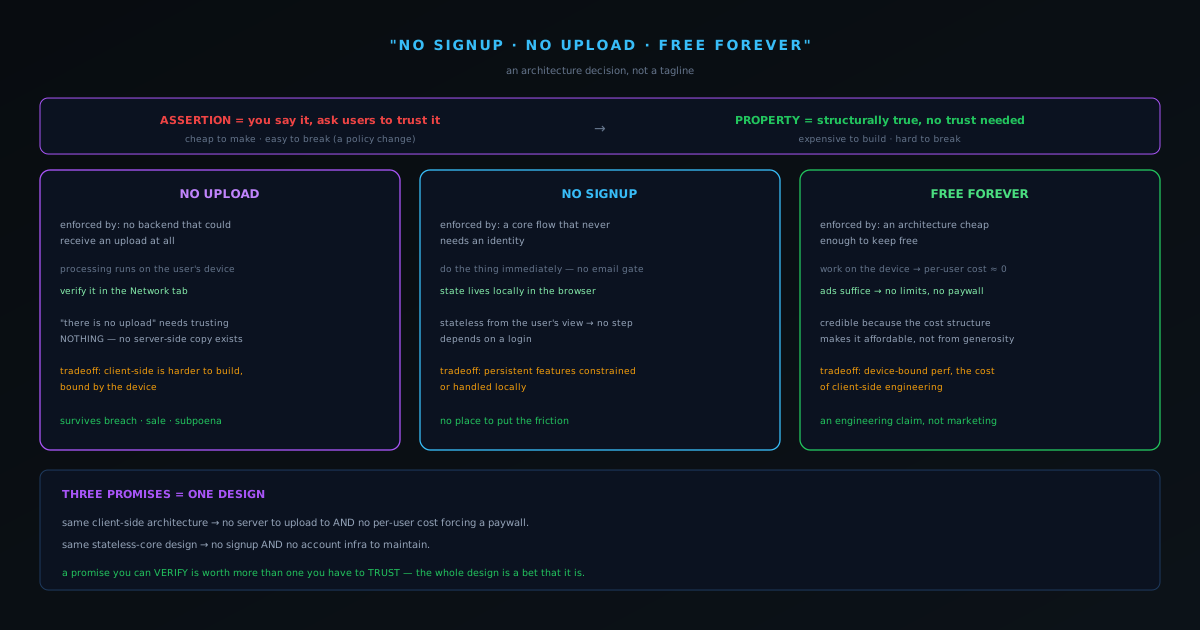
No signup. No upload. Free forever. Three phrases that look like the kind of thing every free tool puts on its landing page and half of them quietly walk back within a year. The difference for the Novus tools is that these are not claims layered on top of the product after the fact: they are constraints that were decided first and that shaped the entire technical design around them. A promise written into the footer can be broken by a policy change. A promise built into the architecture cannot be broken without rebuilding the product, which is exactly why building it in is what makes it real. This post is about how each of these three promises corresponds to a specific architectural decision, and the tradeoffs accepted to keep them true.
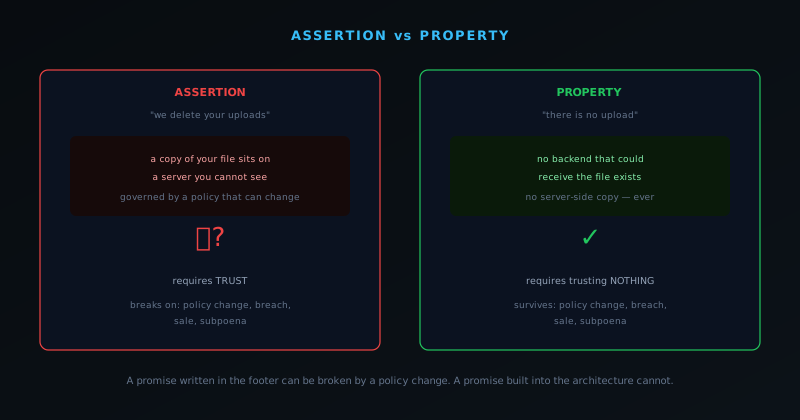
The general idea is that there are two kinds of product promises: assertions and properties. An assertion is something you say and ask the user to trust: "we delete your data," "we will always have a free tier." A property is something that is structurally true regardless of trust: the data was never collected, the tool literally has no payment gate. Assertions are cheap to make and easy to break; properties are expensive to build and hard to break. Turning each of the three promises from an assertion into a property is the work, and it is the difference between a tagline and a guarantee.
No upload: enforced by having no server to upload to
The strongest version of "we do not upload your files" is not a privacy policy: it is an architecture with no backend that could receive an upload. The Novus tools run their processing on the user's device: the background remover at bgremover.novusstreamsolutions.com/background-remover runs its AI model in the browser, and the visualizer at visualizers.novusstreamsolutions.com/editor does its analysis and encoding in the browser. There is no server-side processing endpoint, which means there is no upload, which means the promise is not something the company chooses to honor but something the system cannot violate. A user can confirm this directly by watching their browser's network activity and seeing that their file never leaves the machine, and the same stance is why a utility like bgremover.novusstreamsolutions.com/tools/metadata-remover can strip EXIF data without ever transmitting the file. The promise is enforced by the absence of the thing that would break it.
This is the clearest example of an assertion turned into a property. "We delete your uploads" requires trusting that the deletion happens, on a server you cannot see, governed by a policy that could change. "There is no upload" requires trusting nothing, because there is no server-side copy in the first place: not after processing, not during, not ever. The tradeoff accepted to get this property is real: client-side processing is harder to build than a server endpoint and is bound by the user's device performance. That cost bought a privacy guarantee that survives company changes, breaches, and legal demands, because none of those can reach a file that was never transmitted. The promise is structural.
No signup: enforced by having no account system in the core flow
No signup is a promise about friction, and the way to keep it is to design the core workflow so that it never needs an identity. The tools are built so that the primary thing a user comes to do (remove a background, make a visualizer) can be done immediately, with no account required, because the workflow does not depend on knowing who the user is. There is no gate that asks for an email before showing value, no "create an account to continue" interrupting the path to the result. This is an architectural choice as much as a UX one: a workflow that genuinely requires no account is one where no step depends on stored per-user state behind a login, which is a constraint on how the whole flow is built, not a setting you toggle.
The reason "no signup" has to be structural rather than a promise is that signup gates have a way of creeping in the moment any feature wants to remember something about a user. The defense is to keep the core flow stateless from the user's perspective (what state exists lives locally in their own browser, not in an account on a server), so there is never a point where the product needs them to identify themselves to proceed. The tradeoff is that features that genuinely benefit from persistent identity are constrained or handled locally rather than through accounts, which is a real limitation accepted in exchange for the property that a first-time user is never stopped at a registration wall. The friction promise is kept by building a flow that has no place to put the friction.
Assertions versus properties
The conceptual core of the whole approach is a distinction between two kinds of product promise: assertions and properties. An assertion is something a product says and asks you to trust: "we delete your data," "we will always have a free tier," "we respect your privacy." A property is something that is structurally true regardless of whether you trust anyone: the data was never collected, there is no payment gate in the code, the file physically never left your device. The difference is not rhetorical; it is the difference between a promise that depends on ongoing good behavior and a promise that holds because the alternative is structurally impossible. Assertions are cheap to make and easy to break; properties are expensive to build and hard to break.
This distinction is the lens that makes "no signup, no upload, free forever" meaningful rather than just another landing-page slogan. As assertions, those three phrases are indistinguishable from what every free tool claims and half of them later abandon. As properties (each enforced by a specific architectural decision rather than a stated intention), they become guarantees you can rely on without trusting anyone, because they are true by construction. The work of the product is turning each of the three from an assertion into a property, which is precisely the work that a tagline does not require and a guarantee does. Understanding the assertion-versus-property distinction is understanding why building the promises into the architecture is the entire point rather than an implementation detail.
A promise you can verify beats one you must trust
The decisive advantage of a property over an assertion is verifiability: a structural property can be confirmed by the user, whereas an assertion can only be trusted. "There is no upload" is verifiable: a user can watch their browser's network activity and confirm their file never leaves the machine, which means they do not have to trust the company at all to be sure of the guarantee. "We delete your uploads" is not verifiable: there is no way for a user to confirm what happens on a server they cannot see, so the promise rests entirely on trust in the company's ongoing behavior and the stability of its policy. The verifiable promise is stronger not because the company is more trustworthy but because trust is not required.
This matters enormously for a small, relatively unknown operation, because verifiable promises let a product earn adoption without first earning a reputation. A first-time visitor cannot know whether to trust an unfamiliar company's assertions, but they can check a verifiable property themselves in seconds, which means the product can make a credible strong claim from day one rather than having to build trust over years before its claims are believed. The architecture does the trusting for the user, which is exactly the bootstrap a small operation needs. Building promises as verifiable properties is therefore not just more honest but strategically smart for an operation that cannot yet trade on reputation: it lets the product's claims be believed immediately because they can be confirmed rather than merely asserted.
How signup gates creep in, and the defense
The no-signup property is under constant structural threat, because account gates have a way of creeping in the moment any feature wants to remember something about a user. A feature to save your work wants an account to save it to; a feature to sync across devices wants an identity to sync; a feature to personalize wants a profile. Each is individually reasonable, and each, if built the conventional way, introduces a point where the product needs the user to identify themselves, which is exactly the registration wall the no-signup promise exists to prevent. The threat is not a single decision to add a signup but the gradual accretion of features that each quietly assume one.
The defense is architectural: keep the core flow stateless from the user's perspective, with whatever state exists living locally in the user's own browser rather than in a server-side account. When work is saved locally, sync is handled without a mandatory account, and personalization lives in local storage, the features that would normally require identity are delivered without it, so there is never a point where the product needs the user to log in to proceed. This is a real constraint on how features are built (it rules out the easy server-side-account implementation of each), and that constraint is the price of the property. The no-signup promise is kept not by resisting the temptation to add a signup but by building features in a way that never creates the need for one, which is a structural defense against the gradual creep that would otherwise erode the promise feature by feature.
Why the three promises reinforce each other
The three promises are usually presented as a list, but they are better understood as three faces of one architectural decision, each making the others easier to keep. The decision to run the work on the user's device, with state kept local, simultaneously delivers all three: there is no server to upload to (no upload), no account system the core flow depends on (no signup), and no per-user server cost forcing a paywall (free forever). The promises are not three separate features that happen to coexist; they are three consequences of the same underlying choice, which is why they reinforce rather than compete with each other.
This mutual reinforcement is what makes the combination durable. Because the promises flow from one decision, keeping them is keeping that decision rather than maintaining three separate commitments that could individually erode. A product that tried to deliver these as three independent features (bolting on privacy, removing the signup, subsidizing the free tier) would find each under separate pressure and each separately vulnerable. A product where all three fall out of one architectural choice keeps them as a unit, because they stand or fall together on the soundness of the underlying design. The coherence is a strength: the same client-side, local-state architecture that makes the product private makes it accountless makes it sustainably free, so the three promises are held in place by each other and by the single decision they all express. Understanding them as one design rather than three features is understanding why they are credible together in a way they would not be apart.
The price of building properties instead of asserting them
Turning promises into properties is not free, and being honest about the cost is part of taking the approach seriously. Each of the three properties was bought with a real engineering tradeoff: the no-upload property cost the difficulty of client-side processing and binding to the user's device performance; the no-signup property cost the constraint that persistent features must be handled locally rather than through convenient server accounts; the free-forever property cost the harder architecture that keeps per-user costs near zero. None of these came for free: each is a place where the easier path was deliberately not taken because the easier path would have made the promise an assertion rather than a property.
This is the essential trade at the heart of the approach: properties are expensive to build, where assertions are cheap to make, and the whole bet is that the expensive thing is worth more than the cheap thing. A company could write "we never upload your files" in its footer for free; building a product that genuinely cannot upload them costs real engineering. The question the design answers with a yes is whether a promise the user can verify is worth the cost of building it as a structural property rather than asserting it as cheap copy. For the users who care about these guarantees (and for the credibility of a small operation that cannot trade on reputation), the answer is that a verifiable property is worth far more than a free assertion, which is exactly why the cost was paid. The price is real; the bet is that the trustworthiness it buys is worth more.
Why users have learned to distrust "free"
The reason these structural promises matter is that users have been trained, by long experience, to distrust the very claims the promises make, which means an assertion alone now carries little weight. People have seen countless tools promise free and then introduce limits, promise privacy and then monetize data, promise no catch and then reveal one, so the default response to a free tool's claims is wariness, not belief. In that environment, simply asserting "no signup, no upload, free forever" lands as noise, indistinguishable from the same words on tools that did not keep them. The claims have been devalued by the many products that made them falsely.
This is precisely why building the promises as verifiable properties is not just more honest but necessary to be believed at all. Against a backdrop of devalued assertions, the only way to make a strong claim credible is to make it checkable, so the user does not have to extend the trust they have learned to withhold. A property the user can confirm cuts through the accumulated skepticism in a way that no assertion can, because it does not ask to be believed: it can be verified. The structural approach is, in part, a response to the trust environment: because users rightly distrust free promises, the way to be the trustworthy exception is to make promises that do not require trust. The architecture is how a genuinely free, genuinely private tool distinguishes itself from the many that claimed to be and were not, which is a distinction that only a verifiable property, never an assertion, can actually establish.
Free forever: enforced by an architecture cheap enough to keep free
Free forever is the promise most often broken, because the economics usually win in the end: a free tool that costs money to run eventually has to charge, limit, or die. The only way to make "free forever" a property rather than a hope is to build the product so that keeping it free is economically sustainable, which means making the cost of serving each user low enough that ad support covers it. The client-side architecture that delivers the no-upload promise also delivers this one: because the expensive work runs on the user's device, the per-user cost to run the tool is near zero, so non-intrusive advertising is sufficient to sustain it without limits or paywalls. "Free forever" is credible here because the cost structure makes it affordable, not because the company is being generous against its own interests.
This is why the three promises are really one design rather than three features. The same client-side architecture that means there is no server to upload to also means there is no per-user server cost forcing a paywall, and the same stateless-core design that means no signup also means no account infrastructure to maintain and monetize. Each promise reinforces the others because they all flow from the same decision: do the work on the user's device, keep state local, and let the architecture make the promises true. The tradeoffs (device-bound performance, constrained persistent features, the engineering difficulty of client-side processing) are the price of turning three taglines into three properties. Whether that price is worth paying depends on whether you think a promise you can verify is worth more than a promise you have to trust, and the entire design is a bet that it is.
Frequently asked questions
Quick answers to common questions about this topic.
How can a tool be free forever with no signup and no upload?
By doing the work on the user's device. With no server processing each request, there is no per-use cost to recover and no file to collect, so "no upload" and "free" become properties of the architecture rather than promises.
Why does no-upload also enable free pricing?
Server-side tools pay for every image processed, which pushes them toward limits and paywalls. On-device processing has zero marginal cost, so more usage does not create more cost, removing the pressure to charge.
Is "no signup" just a convenience?
It is also a design stance: the core workflow is not gated behind registration, so a first-time user reaches a result immediately and can verify the privacy claims before trusting the company.
Related troubleshooting
Was this page helpful?
Your answer stays in this browser, it is not sent anywhere and no account or cookie is involved.