2026 · Novus Stream SolutionsAbout 13 min readNovus Stream Solutions
Free forever and still funded: how ad-supported tools actually work
A genuinely free tool with no paywall sounds unsustainable until you look at the structure underneath it. Here is how free-forever tools stay funded: the near-zero idle cost, the ad model, and where it breaks.
Contents
- 1.Overview
- 2.The puzzle: free forever, but how?
- 3.The structural trick: near-zero cost at idle
- 4.Ads as the funding model
- 5.Why ads fit free tools better than subscriptions
- 6.Non-intrusive ads and the trust tradeoff
- 7.What free-forever actually requires
- 8.When "free forever" is actually a lie
- 9.Free tools as the top of a wider ecosystem
- 10.The trust dividend of genuinely free
- 11.Is free-forever actually sustainable?
Overview
A genuinely free tool (no paywall, no trial that expires, no "free tier" that is really a demo) sounds like it cannot last. Someone is paying for the servers, the development, the bandwidth, so where does the money come from, and why would anyone keep a thing free forever when they could charge for it? The skepticism is reasonable, because plenty of "free" tools are really just the bait in a bait-and-switch toward a subscription. But genuinely free-forever tools do exist and do stay funded, and the way they manage it comes down to a structure that makes free economically viable rather than a charitable willingness to lose money. This is how that structure actually works, and where it breaks.
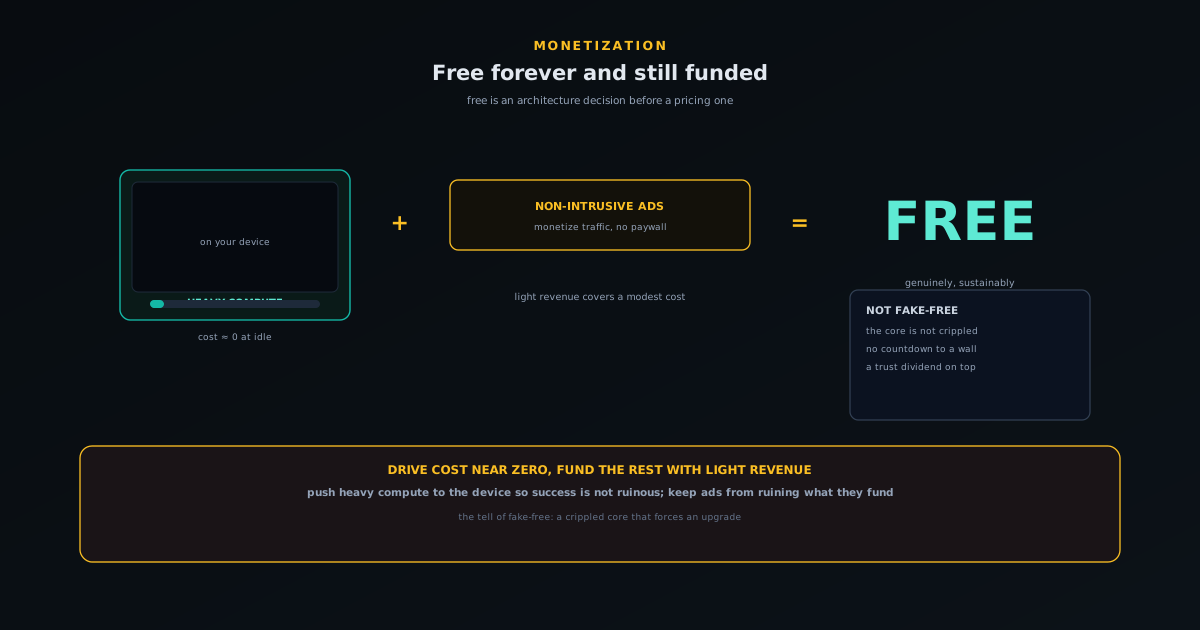
The short version is that free-forever is an architecture decision before it is a pricing decision. A tool can be free forever if it costs almost nothing to run when no one is using it and only modest amounts when people are, and if a light revenue source like advertising covers that modest cost. Get the cost structure right and free becomes sustainable; get it wrong and free is a subsidy you cannot afford and will eventually have to paywall. The tools that stay genuinely free are the ones built so that staying free is economically rational, not the ones run on goodwill. Understanding the structure explains both how free-forever works and why so many "free" tools are not.
The puzzle: free forever, but how?
The puzzle of free-forever is fundamentally a cost question. Every tool has costs (infrastructure, development, maintenance, bandwidth), and those costs have to be covered somehow, so a tool that charges nothing needs either a revenue source that does not depend on charging users for access, or a cost structure low enough that a light revenue source suffices. Most discussions of free tools focus on the revenue side (ads, sponsorship, an upsell) and skip the cost side, but the cost side is usually where free-forever is actually won or lost. A tool with high costs cannot be sustainably free no matter how it monetizes; a tool with near-zero costs can be free on very little revenue.
This is why the interesting question is not just "how does a free tool make money" but "how little does it need to make," which depends entirely on how cheaply it runs. A free tool that costs a fortune to operate needs substantial revenue to survive and will eventually be pushed toward paywalls; a free tool that costs almost nothing to operate needs only a trickle of revenue and can stay free comfortably. The puzzle of free-forever is solved primarily by driving costs down to where a light revenue source covers them, which is an architectural achievement as much as a business one. The tools that crack it are usually the ones that engineered their costs down, not just the ones that found clever revenue.
The structural trick: near-zero cost at idle
The key structural move behind sustainable free tools is making the cost near zero when the tool is idle and low even when it is busy, which usually means pushing the heavy work onto the user's own device rather than running it on servers you pay for. A tool that does its heavy lifting (image processing, AI inference, video rendering) in the user's browser, on the user's hardware, costs you almost nothing per use, because you are not paying for the compute. Your costs become mostly the modest, fixed expenses of hosting some static files and a lightweight backend, which stay low whether you have ten users or ten thousand.
This is the opposite of the typical cloud architecture, where every use costs the operator server compute that scales with usage, making free expensive precisely when the tool succeeds. A tool whose costs scale with usage faces a painful bind: success increases costs, so a popular free tool bleeds money faster, pushing it toward paywalls exactly when it is working. A tool whose heavy compute runs on the user's device escapes that bind (more users do not mean proportionally more cost), so success is sustainable rather than ruinous. The near-zero-at-idle, low-when-busy cost structure is what makes free-forever economically rational, and it is usually achieved by where the computation happens, not by clever accounting.
Ads as the funding model
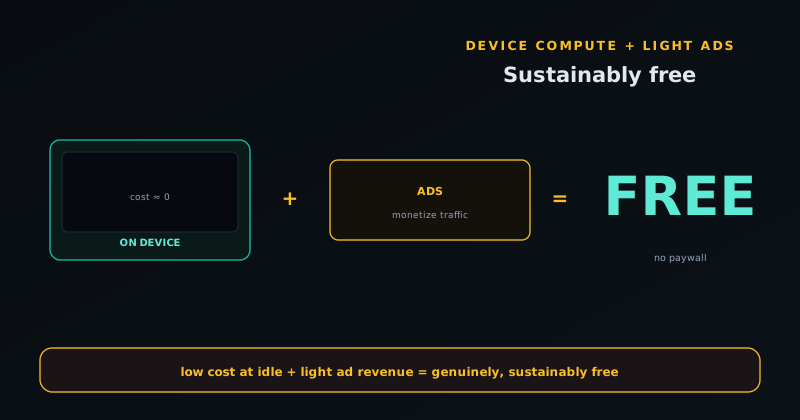
With costs driven down to a modest, mostly fixed level, a light revenue source can cover them, and for many free tools that source is advertising. Display ads generate revenue from traffic without charging users for access, which fits a free tool perfectly: the people who use the tool see some ads, the ads generate enough to cover the tool's low running costs, and access stays free for everyone. The revenue per visitor is modest, but because the tool's costs are also modest, modest revenue is enough. Ads turn traffic into the funding that keeps the tool free, without putting a price between users and the value.
The reason ads fit this model is that they monetize usage without restricting it, which aligns with the goal of staying genuinely free. A subscription monetizes by restricting access to those who pay; ads monetize by showing something to everyone who uses the free thing, so the tool can remain open to all while still generating revenue. For a tool whose whole proposition is being free and accessible, that alignment matters: the monetization does not undercut the value proposition the way a paywall would. The combination of low costs and ad revenue is the classic sustainable-free structure: cheap to run, funded by the traffic the free access generates.
Why ads fit free tools better than subscriptions
Subscriptions are the default monetization advice, but they fit free tools poorly for several reasons. A subscription requires restricting something to those who pay, which contradicts the free-and-open proposition; it requires the kind of ongoing, exclusive value that justifies a recurring charge, which a simple utility often does not have; and it requires building and maintaining subscription infrastructure and continually proving the recurring value. For a tool whose appeal is being free and instantly useful, bolting on a subscription either fences off the value (undermining the appeal) or fails to give people enough reason to pay (generating little revenue). The subscription model fights the free model rather than supporting it.
Ads, by contrast, monetize without restricting, scale with traffic rather than requiring conversion, and demand far less apparatus: you maintain content quality and reasonable ad placement rather than a subscription business. For a free tool or content site whose value is in being widely used and found, ad revenue grows naturally with that usage, without forcing the tool to compromise its openness. This is not to say ads are universally better (for genuinely exclusive, high-value, recurring offerings, subscriptions are right) but for the specific case of a free, broadly useful tool, ads fit where subscriptions fight. Matching the monetization to the product is the point, and for free tools, ads are usually the match.
Non-intrusive ads and the trust tradeoff
Ads come with a real cost to the user experience, and how a free tool handles that tradeoff largely determines whether the ad model strengthens or erodes the product. Intrusive ads (pop-ups, interstitials, ads that interrupt the task or degrade performance) generate more revenue per impression but damage the experience and the trust that keeps people coming back, which is self-defeating for a tool that depends on continued free usage. Non-intrusive ads (modest display placements that do not interrupt the core workflow) generate less per impression but preserve the experience, which sustains the traffic the model depends on. The trust tradeoff is real, and the sustainable choice is usually the restrained one.
The deeper point is that a free tool's long-term revenue depends on its continued use, so protecting the user experience is protecting the revenue, which argues for restraint even on purely economic grounds. A tool that maximizes ad revenue per visit by degrading the experience drives users away and shrinks the traffic that generates the revenue; a tool that keeps ads non-intrusive retains users and sustains the traffic. The honest framing for users is that the ads are what keep the tool free, and the honest commitment from the tool is to keep those ads from ruining the thing they fund. Getting that balance right (funded by ads, but not at the cost of the experience) is what makes the free-and-ad-supported model durable rather than a slow erosion of the product.
What free-forever actually requires
Pulling the structure together, genuine free-forever requires a few things in combination: a cost structure low enough that modest revenue covers it, usually achieved by keeping heavy compute off your own servers; a light revenue source like ads that monetizes usage without restricting access; restraint in how that revenue source is implemented so it does not erode the experience; and low enough overall overhead that the whole thing nets out sustainable. Miss any of these and free-forever becomes precarious: high costs force paywalls, heavy-handed ads drive users away, or bloated overhead makes the modest revenue insufficient. The model works as a system, not as a single trick.
This is why free-forever is more of an architectural and operational commitment than a pricing gesture. You design the tool so that staying free is economically rational (cheap to run, funded by light revenue, lean in overhead) rather than declaring it free and hoping to figure out the economics later. The tools that sustainably stay free are the ones built around the constraint of staying free from the start, where every decision respects the cost structure that makes it possible. Free-forever is not generosity; it is engineering and discipline arranged so that free is the sustainable equilibrium rather than a subsidy waiting to collapse.
When "free forever" is actually a lie
It is worth naming the common case where "free" is not genuine, because it is everywhere and it is the reason people are skeptical. Many tools labeled free are really the entry to a funnel: a free tier deliberately limited to push you toward paying, a free trial that expires, a "free" product that becomes useless without an upgrade. This is not free-forever; it is a sales tactic that uses the word free as bait. There is nothing inherently wrong with a freemium model honestly presented, but calling something free when it is engineered to extract payment is a different thing from a tool that is genuinely, sustainably free.
The tell is whether the free version stands on its own as genuinely useful, or whether it is deliberately crippled to force an upgrade. A genuinely free tool gives you real, complete value at no cost, funded by a model that does not depend on converting you; a fake-free tool gives you a frustrating taste designed to make you pay. The structural test is also revealing: a genuinely free-forever tool usually has the low-cost, ad-or-light-revenue structure that makes free sustainable, while a fake-free one usually has a cost structure that requires conversion to survive. When evaluating a "free" tool, ask whether the free version is genuinely sufficient and how the thing is actually funded; the answer tells you whether free means free or free means bait.
Free tools as the top of a wider ecosystem
Free-forever tools also make more sense when seen as part of a wider operation rather than as standalone revenue centers. A genuinely free, useful tool brings people into contact with the operation behind it (builds awareness, trust, and goodwill), which has value beyond the tool's own ad revenue. The free tool can be the welcoming front door to an ecosystem that includes other products, content, or offerings, where the tool's job is partly to be found and trusted rather than to be the sole source of income. Seen this way, the free tool does not have to fully fund itself in isolation; it contributes to a larger whole.
This reframes the economics in a healthy way. A free tool that covers its own low costs through ads and also brings people into a broader ecosystem is doing two jobs, and the second job (building trust and awareness for the operation) is genuinely valuable even though it does not show up as direct revenue. The free tools, the content, and any other offerings reinforce each other: the tools demonstrate quality, the content builds authority, and together they form an operation people encounter and trust. Free-forever tools are most sustainable when they are part of a coherent ecosystem that benefits from their reach, rather than isolated products expected to fully monetize on their own. The free tool earns its keep partly by being a door.
The trust dividend of genuinely free
There is a benefit to genuinely free tools that does not show up directly in the ad revenue but matters enormously: the trust dividend. A tool that is genuinely, sustainably free (no bait, no countdown to a paywall, no crippled core) earns a kind of goodwill and trust that paid or fake-free tools cannot, because users can sense the difference between a tool that is giving them real value freely and one that is angling to extract payment. That trust is valuable on its own terms: it builds loyalty, generates word of mouth, and creates a positive association with the operation behind the tool that extends well beyond the individual product. Genuinely free buys trust that money cannot easily replicate.
This trust dividend is part of why the genuinely-free model makes business sense even though it forgoes direct subscription revenue. A trusted free tool brings people into contact with the operation in a way that builds a durable relationship, and that relationship has value across everything else the operation does: other tools, content, future offerings. The goodwill generated by being genuinely free rather than extractive is an asset, even if it is not a line item, and it compounds as more people encounter and trust the free tools. Operations that treat free as a genuine gift rather than a bait tend to build a reservoir of trust that pays off in reach, loyalty, and reputation, which is exactly the kind of intangible-but-real value that makes the free-forever model worth more than its ad revenue alone suggests. The free tool funds itself through ads and builds the operation through trust.
Is free-forever actually sustainable?
The honest answer is that free-forever is sustainable when the structure supports it and unsustainable when it does not, which is why it is neither a myth nor a guarantee. A tool with near-zero idle cost, low cost at scale, light non-intrusive ad revenue, lean overhead, and a place in a wider ecosystem can genuinely stay free indefinitely, because staying free is the economically rational equilibrium for it. A tool missing those conditions cannot, and its "free" is either a subsidy that will end or a funnel that was never really free. Sustainability is not about willpower or generosity; it is about whether the numbers actually work.
For anyone building or choosing free tools, the takeaway is to look at the structure rather than the label. If you are building one, design for the cost structure and revenue model that make free sustainable from the start, because retrofitting free onto an expensive architecture rarely works. If you are choosing one, look at whether the free version is genuinely useful and how it is funded, because that tells you whether it will stay free. Free-forever is real, but it is real because of engineering and discipline, not because someone decided to be generous, and understanding the structure underneath is what separates the tools that will genuinely stay free from the ones that are quietly counting down to a paywall.
Frequently asked questions
Quick answers to common questions about this topic.
How do free tools make money?
Most free tools are funded by display advertising, affiliates, or an optional paid tier. Ad-supported tools earn on impressions, which lets the core product stay free to everyone.
How can a tool afford to be free forever?
By keeping costs near zero (on-device processing means no per-use server bill) and covering the rest with ads. When usage does not create cost, free use is sustainable.
Do ads make a free tool worse?
Not if they are non-intrusive. The Novus tools keep ads out of the workflow, so the product stays fully usable and the ads simply fund it.
Related troubleshooting
Was this page helpful?
Your answer stays in this browser, it is not sent anywhere and no account or cookie is involved.