2026 · Novus Stream SolutionsAbout 12 min readNovus Stream Solutions
The economics of a free-tool portfolio
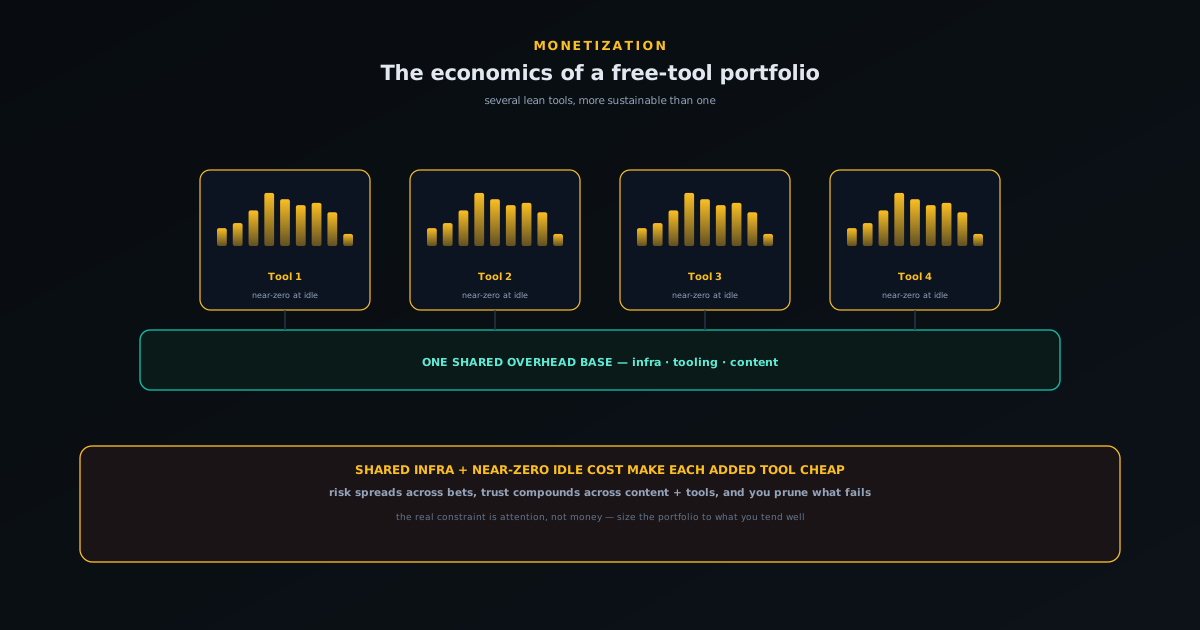
Running several free tools sounds like several times the cost. Done right, it is the opposite: shared overhead, spread risk, and compounding trust make a portfolio of lean free tools more sustainable than one.
Contents
- 1.Overview
- 2.Why a portfolio instead of one tool
- 3.Shared overhead across tools
- 4.Each tool must run near-free at idle
- 5.Spreading risk across several bets
- 6.The compounding of content and tools
- 7.When a tool does not earn its place
- 8.Maintenance is the cost people forget
- 9.Attention is the real constraint, not money
- 10.Is the portfolio model right for you?
Overview
Running several free tools sounds like a recipe for several times the cost and several times the work, which is why most operators focus everything on a single product. But under the right conditions, a portfolio of lean free tools is not more expensive and fragile than one tool; it is more sustainable, because the tools share overhead, spread risk, and compound trust in ways a single product cannot. The economics that make this work are specific and worth understanding, because they explain how a small operation can run multiple free products without multiplying its costs or its risk. This is the economic logic of a free-tool portfolio, and why it can be more resilient than betting everything on one.
The whole thing depends on a precondition: each tool has to run at near-zero cost when idle, which usually means the heavy compute happens on the user's device rather than on servers you pay for. Given that precondition, adding a tool to the portfolio adds very little marginal cost, which is what flips the economics from "several times the burden" to "shared burden, spread upside." Without that precondition (if each tool carried significant ongoing cost), a portfolio would indeed be several times the expense, and focusing on one would be wiser. The portfolio model is not universally right; it is right specifically when each tool is lean enough that running several is barely more than running one.
Why a portfolio instead of one tool
The case for a portfolio over a single tool rests on a different theory of how you find success. Betting everything on one product is a high-concentration strategy: if the one product wins, you win big, but if it does not, you have nothing, and you have no way to discover which product would have worked because you only tried one. A portfolio is a diversified strategy: you make several smaller bets, learn from each, and let the results tell you which to invest in further. For a small operation that cannot know in advance which idea will work, running several lean experiments is often a better way to find a winner than committing everything to a single guess.
This only makes sense if each bet is cheap, which is exactly what the near-zero-cost precondition provides. When each tool is lean enough to run for almost nothing, you can afford several simultaneous bets, each of which is a real product in the market generating real signal about whether it has demand. The portfolio becomes a way of asking several markets the same question (does anyone want this) and doubling down on the ones that answer yes. The diversification spreads the risk of any single tool failing, and the multiple bets increase the chance that at least one succeeds, all at a cost that the lean structure keeps manageable. The portfolio is a search strategy that only the right cost structure makes affordable.
Each tool must run near-free at idle
The non-negotiable precondition deserves emphasis because it is what the entire portfolio economics rests on: each tool must run at near-zero cost when idle and low cost even when busy. This is usually achieved by pushing the heavy work onto the user's device, so that the operator's costs are mostly the modest, shared, fixed expenses rather than per-use compute that scales with traffic. A tool that costs significant money per use would make a portfolio ruinous, because the costs would multiply across tools and scale with success; a tool that costs almost nothing per use makes a portfolio affordable, because adding tools and gaining users does not proportionally add cost.
This precondition also acts as a filter on what can join the portfolio, which is healthy. An idea that cannot run cheaply at idle (one that requires always-on infrastructure or heavy ongoing third-party costs) fails the precondition and should not be added, because it would break the economics that make the portfolio work. The discipline of only adding tools that meet the near-free-at-idle bar keeps the portfolio sustainable as it grows, preventing the accumulation of expensive tools that would individually be manageable but collectively sink the operation. The cost filter is what keeps a growing portfolio from becoming a growing liability, ensuring that every tool added preserves rather than degrades the shared economics.
Spreading risk across several bets
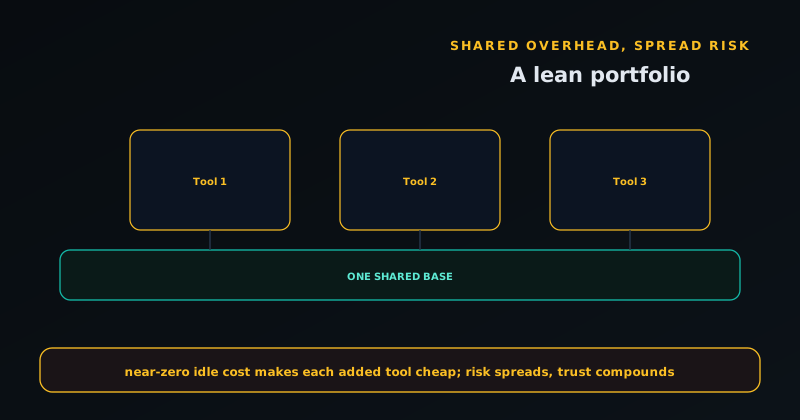
A portfolio spreads risk in a way that a single product cannot, which is one of its main resilience advantages. When you have one product, its failure is your failure; there is no fallback, and the concentration means a single bad outcome is catastrophic. When you have several, the failure of any one is contained, because the others continue, and a shelved tool is a contained experiment rather than the end of the operation. This spreading of risk means the portfolio as a whole is far more resilient than any single tool, because it does not depend on any one bet working out.
The risk-spreading also changes how you can treat individual tools, which is healthy for decision-making. Because no single tool is load-bearing for the whole operation, you can make honest keep-or-kill decisions about each one without existential stakes: a tool that is not earning its place can be shelved as a contained loss rather than clung to out of necessity. This freedom to kill underperforming tools, enabled by the risk-spreading of the portfolio, is itself an economic advantage, because it lets you stop spending on what is not working and concentrate on what is. A single-product operator cannot kill their one product; a portfolio operator can prune, which keeps the portfolio healthy and focused over time.
The compounding of content and tools
A portfolio of tools paired with a content operation produces compounding effects that neither would generate alone. The content (blog posts, documentation, tutorials) builds awareness, trust, and search traffic for the whole operation, and that audience can discover any of the tools, so the content benefits every tool rather than just one. Meanwhile, the tools demonstrate the quality and judgment that make the content credible, so the tools benefit the content. Each new piece of content and each new tool strengthens the whole, and because both are built on lean, low-marginal-cost foundations, this compounding happens without proportional cost increases.
This compounding is a large part of why the portfolio model rewards patience and accumulation. A single tool with no content is a product hoping to be found; a portfolio of tools surrounded by a growing body of content is an operation that becomes more discoverable and more trusted over time, with each addition reinforcing the rest. The content brings people who discover the tools; the tools impress people who then trust the content; the whole thing grows in awareness and authority as a unit. The economics of this compounding are favorable specifically because the marginal cost of more content and more lean tools is low, so the operation can keep accumulating the assets that compound without the costs compounding alongside them.
When a tool does not earn its place
A healthy portfolio requires the willingness to recognize when a tool is not earning its place and to shelve it, because keeping underperforming tools forever turns a portfolio into a maintenance burden. Every tool, even a lean one, carries some ongoing cost in attention and maintenance, so a tool that generates little use and little value is a small but real drag. The keep-or-kill discipline (honestly assessing whether each tool justifies its ongoing cost and shelving the ones that do not) is what keeps the portfolio from accumulating dead weight. This is not failure; it is the pruning that keeps the portfolio focused on what works.
The risk-spreading of the portfolio is what makes this pruning possible without drama. Because no single tool is essential to the operation, shelving one is a contained, rational decision rather than a crisis, which means you can make keep-or-kill calls on the merits rather than out of desperation. The result is a portfolio that stays healthy over time, concentrating resources on the tools that earn their place and shedding the ones that do not, rather than slowly bloating with maintenance obligations for tools no one uses. The discipline to kill is as important to the portfolio's economics as the discipline to keep costs low, because both are about ensuring that every part of the portfolio is genuinely pulling its weight.
Maintenance is the cost people forget
The cost that portfolio operators most often underestimate is not building tools but maintaining them, because every tool that exists requires ongoing attention: bug fixes, updates, support, keeping it working as the world changes around it. A portfolio of tools is a portfolio of maintenance obligations, and that ongoing cost, while low per lean tool, accumulates across the portfolio and must be accounted for. Underestimating maintenance is how a portfolio that looked affordable to build becomes a burden to sustain, with the operator stretched thin keeping too many tools alive. The economics have to include the long tail of maintenance, not just the upfront cost of building.
Managing maintenance is partly about the same leanness that controls other costs and partly about the discipline to limit the portfolio to what you can actually sustain. Lean tools with simple, robust architectures are cheaper to maintain than complex ones, so the same engineering choices that keep idle costs low also keep maintenance manageable. And the willingness to shelve tools that are not earning their place is partly a maintenance decision: removing the maintenance burden of a tool that does not justify it. A sustainable portfolio is sized to the maintenance the operation can actually carry, which means resisting the temptation to keep building new tools faster than you can sustain the existing ones. Maintenance is the quiet cost that determines whether a portfolio stays sustainable or slowly overwhelms its operator.
Attention is the real constraint, not money
When the tools run at near-zero idle cost, the binding constraint on a portfolio stops being money and becomes attention, which changes how you should think about growth. Because the marginal financial cost of another lean tool is low, the question is rarely "can we afford another tool" but "can we give another tool the attention it needs to be good and to be maintained." Attention (the time and focus to build well, maintain reliably, and decide wisely) is finite in a way that the near-zero running costs are not, which means the real limit on how many tools a portfolio can sustain is how much genuine attention the operation can give them, not how much they cost to run.
This reframing has practical consequences for portfolio management. It means the discipline of keep-or-kill is partly about reclaiming attention from tools that do not earn it, so the attention can go to ones that do, rather than purely about cost. It means resisting the temptation to keep adding tools faster than you can attend to them, because a portfolio of neglected tools is worse than a smaller portfolio of well-tended ones. And it means that the leverage from AI assistance and automation is valuable precisely because it stretches the attention constraint, letting a small operation give adequate attention to more tools than it otherwise could. Understanding that attention, not money, is the real constraint is what keeps a portfolio sized to what the operation can actually do well, which is the difference between a healthy portfolio and an overextended one.
It also reframes what success looks like for a portfolio operator. Success is not the largest possible number of tools but the right number, each given enough attention to be genuinely good and well-maintained, with the operation's finite focus concentrated where it produces the most value. A focused portfolio of a few well-tended tools, surrounded by content that compounds, will almost always outperform a sprawling one of many neglected tools, because attention is what makes any individual tool good and there is only so much of it to spread. The art of running a portfolio is therefore largely the art of allocating attention well: concentrating it on what is working, reclaiming it from what is not, and never overextending it across more than the operation can genuinely tend. Money sets the floor of what is possible; attention sets the ceiling of what is good.
Is the portfolio model right for you?
The portfolio model is powerful but not universal, and it is worth being honest about when it fits. It fits when you can build tools that run at near-zero idle cost, when you have the capability to build and maintain several lean products, and when the diversification and compounding genuinely serve your goals. It does not fit when each product carries significant ongoing cost (making a portfolio ruinously expensive), when you lack the capacity to maintain multiple tools (making the portfolio a burden), or when a single product genuinely warrants total focus. The model is a fit for a specific situation (lean, low-cost, multi-bet) not a universal prescription.
For the operations it fits, though, the economics are genuinely favorable in a way that is easy to miss from the outside. Shared overhead makes each additional tool cheap, the near-zero idle cost keeps the whole thing affordable, the risk-spreading makes it resilient, the keep-or-kill discipline keeps it healthy, and the content-and-tools compounding makes it grow in trust and reach over time. A portfolio of lean free tools is not several times the cost and risk of one tool; under the right conditions it is a more sustainable, more resilient, and more compounding structure than concentrating everything in a single bet. The Novus ecosystem is built on exactly this logic, and its economics are the quiet reason a small operation can run multiple free products without being crushed by the cost of any of them.
Frequently asked questions
Quick answers to common questions about this topic.
How does a portfolio of free tools make money?
Each tool earns ad revenue, and because on-device processing keeps costs near zero, more tools and more usage add revenue without proportional cost. The portfolio compounds reach across many small bets.
Why build many free tools instead of one paid product?
Diversification and compounding: each tool is a cheap experiment that can attract a different audience, and shared infrastructure spreads cost. A portfolio also survives any single tool underperforming.
What keeps a free-tool portfolio sustainable?
Low, near-zero marginal cost per tool (on-device compute), shared stack and skills, and ad funding. See Keeping monthly overhead low while running a portfolio of apps.
Related troubleshooting
Was this page helpful?
Your answer stays in this browser, it is not sent anywhere and no account or cookie is involved.