2026 · Novus Stream Solutions (hub)About 13 min readNovus Stream Solutions
Planning cash flow around seasonal ad revenue
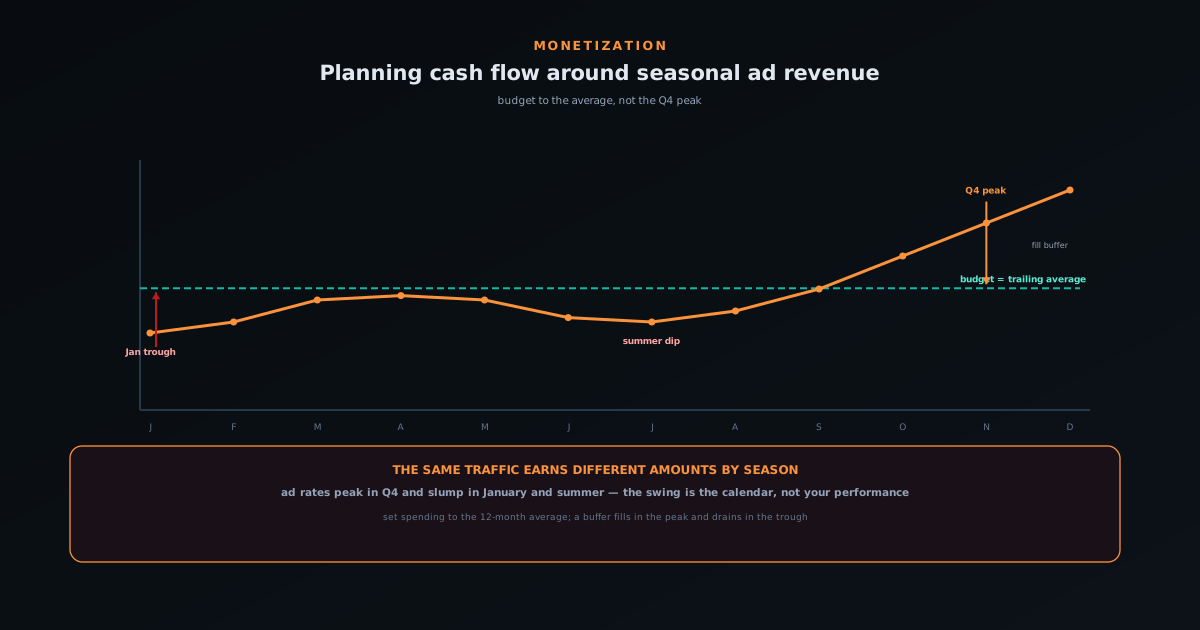
Display-ad revenue follows a calendar: advertiser demand peaks before the holidays and slumps in January and over the summer, so the same traffic earns very different amounts month to month. Plan as if the peak is normal and the trough will hurt. This is how to budget around a predictable cycle instead of being surprised by it.
Contents
- 1.Overview
- 2.Why ad rates swing regardless of your traffic
- 3.The danger of anchoring to the peak
- 4.Budget to a trailing average, not the latest month
- 5.Build a buffer that absorbs the trough
- 6.Separate the revenue cycle from your decisions
- 7.Diversify the mix so one cycle does not rule you
- 8.Time discretionary spending to the cycle
- 9.Judge growth year over year, not month to month
- 10.Keep a simple twelve-month model you actually update
Overview
A note before anything else: this is an explanation of a common business pattern, not financial advice, and every operation’s numbers are its own. With that said, anyone funding a project with display advertising eventually discovers a fact that is obvious in hindsight and surprising the first time it bites: ad revenue is seasonal, and quite dramatically so. The same number of visitors reading the same pages will earn meaningfully different amounts depending on the month, because what you are paid per view is set by advertiser demand, and advertiser demand follows the calendar. Your traffic can be perfectly flat and your revenue will still rise and fall on a schedule you did not set, which is a disorienting thing to learn from a bank balance.
The pattern is consistent enough to plan around, which is the good news buried in the bad. Advertiser budgets swell in the run-up to the holidays, so rates climb through the autumn and peak in the fourth quarter; then those budgets reset and demand collapses in January, recovering slowly before another soft patch over the summer. The shape repeats year after year. The mistake almost everyone makes once is to experience a strong Q4, conclude that the strong Q4 is the new normal, and build their spending around it, right before January arrives and the same traffic earns a fraction as much. This article is about not making that mistake: planning cash flow around a revenue cycle that is predictable if you are willing to look at it honestly.
Why ad rates swing regardless of your traffic
The seasonality is worth understanding mechanically, because understanding it is what lets you trust the pattern enough to plan around it rather than hoping each downturn is a fluke. Display ads are sold through auctions, and the price advertisers bid depends on how much they want to reach people right now. In the fourth quarter, retailers are spending enormous budgets to capture holiday shopping, so the auctions are crowded and the price per view is high. Come January, those campaigns end, the budgets are spent, and the auctions thin out, so the price per view drops, sometimes sharply, even though the audience on your site is exactly the same people doing exactly the same things.
This is why the revenue cycle is largely outside your control and not a reflection of your performance, which is the single most important thing to internalise. You can grow your traffic, improve your content, and optimise your ad placement, and you should, but layered on top of all of that is a seasonal multiplier you do not set, driven by global advertiser behaviour. A January dip is not you doing something wrong; it is the calendar. Confusing the seasonal swing with your own performance leads to exactly the wrong reactions: panic-cutting in the predictable trough, or over-celebrating the predictable peak. The mechanics of the rates themselves are covered in CPM, RPM, and what actually pays; the point here is that those rates move on a schedule you should expect.
The danger of anchoring to the peak
The specific trap that catches people is anchoring: treating the most recent or the highest number as the baseline. A strong December feels like an arrival, like the project has reached a new level, and it is psychologically very hard not to start thinking of that monthly figure as what the project earns. But December is the peak of the cycle, not the baseline of it, and budgeting as though the peak is normal guarantees a shortfall, because the very next month is one of the lowest of the year. Spending set to December income meeting January income is the classic seasonal cash crunch, and it is entirely self-inflicted: the trough was always coming and was always knowable.
The same trap runs in reverse and is worth naming, because the over-correction is its own mistake. A grim January can feel like the project is failing, like the revenue has permanently fallen off a cliff, and that can prompt drastic cuts or abandonment right before the natural recovery. Neither the peak nor the trough is the truth; they are the two ends of a swing around an average, and the average is the only honest figure to plan against. The discipline is to refuse to let either extreme become your mental baseline, and to feel the December high and the January low as predictable deviations from a center line, rather than as the new reality each time. The number that means something is the one in the middle.
Budget to a trailing average, not the latest month
The concrete practice that defends against anchoring is to budget against a trailing average rather than the latest month. Instead of asking “what did we earn last month”, ask “what have we earned on average over the last twelve months”, because a full year captures a whole cycle (every peak and every trough) and its average is a far more stable and honest basis for decisions than any single month. Plan your spending against that smoothed figure and the seasonality stops jerking your budget around: the peaks no longer tempt you into overcommitment and the troughs no longer trigger panic, because your plan was never pinned to either one in the first place.
A twelve-month window matters specifically because the cycle is annual; a shorter average would still be distorted by the season it happened to cover, so a three-month trailing average taken in December would be misleadingly high and the same average taken in February misleadingly low. Smoothing over the full year cancels the seasonality out, leaving the underlying trend, which is the thing you actually want to know, because the real question is not “are we up this month” but “is the center line moving up over time”. Budgeting to the trailing average turns a jagged, anxiety-inducing revenue chart into a single calm number you can plan a business around, and it makes genuine growth visible underneath the seasonal noise.
Build a buffer that absorbs the trough
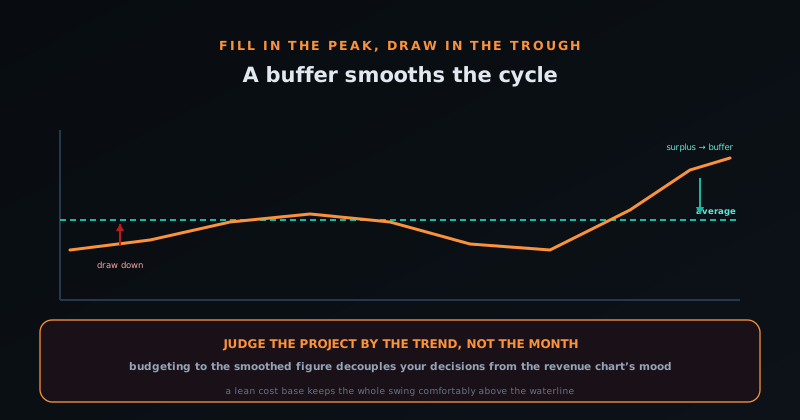
Budgeting to the average tells you how much you can sustainably spend, but it does not by itself solve the timing problem, because the money still arrives unevenly (a lot in Q4, much less in January) while your costs are roughly constant month to month. The bridge between uneven income and steady spending is a buffer: a reserve that fills during the high-revenue months and is deliberately drawn down during the low ones. In practice this means not spending the full Q4 surplus when it lands, but setting the portion above your average aside so that when the trough comes, you draw from the reserve to cover the gap rather than scrambling. The buffer turns the peak’s excess into the trough’s cushion.
This is simply the general-purpose cash buffer, discussed in A cash buffer and emergency fund for business owners, pointed at a known and scheduled need rather than a vague rainy day. That makes it easier to size and easier to maintain, because you are not guarding against the unknown: you know almost exactly when the draw-down comes and roughly how deep it goes, so you can fill the reserve deliberately during the peak with the surplus the peak provides. A buffer sized to cover the predictable shortfall of the slow months converts the entire seasonal cycle from a recurring crisis into a non-event: the revenue still swings, but your ability to operate does not, because the buffer is doing the smoothing the revenue refuses to.
Separate the revenue cycle from your decisions
The deepest benefit of planning this way is that it decouples your decisions from the emotional weather of the revenue chart. When you budget to a trailing average and hold a buffer for the trough, a strong month is no longer a signal to expand and a weak month is no longer a signal to retrench, because your operating plan is anchored to the smoothed underlying figure rather than the latest reading. Decisions about what to build, what to spend, and whether the project is working get made against the trend, which is the thing that actually carries information, instead of against a number that is mostly telling you what month it is. That separation is what keeps a seasonal business from lurching.
A lean cost base, as argued in Free forever and still funded: how ad-supported tools actually work, makes all of this dramatically easier, because the lower your fixed costs the shallower the buffer needs to be and the more the seasonal swing happens above the waterline rather than threatening it. The combination (budget to the average, hold a buffer for the known trough, keep costs low enough that the swing is comfortable, and judge the project by the trend rather than the month) turns ad-revenue seasonality from a yearly source of stress into a known rhythm you operate calmly through. The revenue will keep doing its predictable dance up and down the calendar; the goal is to build a plan steady enough that the dance never moves your feet. None of this is advice for your situation, but it is the pattern worth understanding before the first January arrives.
Diversify the mix so one cycle does not rule you
The most durable defence against ad-revenue seasonality is to not depend on ad revenue alone, because the swing is far easier to live with when it is one input among several rather than the whole picture. Different revenue lines have different rhythms: affiliate income tracks when your audience is buying rather than when advertisers are bidding, a digital product or a paid tier earns on its own schedule, and a sponsorship is a fixed sum that does not care what month it is. When several streams with uncorrelated timing sit side by side, a trough in one is partly offset by the others, so the combined revenue is steadier than any single line, and steadier revenue is easier to plan against than the deepest buffer.
This is not a reason to bolt on revenue lines that do not fit the product, which would be its own mistake; it is a reason to value the smoothing effect when a genuinely good fit exists, as discussed in Affiliate revenue alongside ads: adding a second income stream without selling out. A portfolio of free tools funded entirely by display ads feels every twitch of the advertiser calendar; the same portfolio with a modest affiliate line and a small paid tier feels it muffled, because the other streams are not peaking and troughing in lockstep with the ad auctions. Diversification does not eliminate the seasonal cycle (the ad portion still swings) but it shrinks that cycle’s share of the total, which is often a more comfortable and more achievable goal than trying to buffer a single volatile stream all the way to smooth.
Time discretionary spending to the cycle
Once you can see the cycle clearly, you can do more than endure it; you can schedule against it. Plenty of spending is discretionary in its timing even when it is not optional in its substance: a larger investment in tooling, a one-off contractor for a project, a push on something that costs money up front. The cycle says the calm time to commit to those is when the surplus is real and the buffer is full, in and just after the Q4 peak, and the time to be conservative is heading into and through the known trough. Spending big out of a flush December, with January’s dip already anticipated and buffered, is comfortable; spending big in a thin January on the hope of a rebound is how a predictable trough becomes a crisis.
This is simply matching the timing of controllable outflows to the timing of the income that funds them, and it is a quiet superpower of understanding the cycle rather than being surprised by it. You are not spending less overall (the trailing-average budget already governs that); you are choosing to place the lumpy, optional outlays in the part of the year when the money to cover them is actually present, rather than scattering them across months without regard to whether revenue is peaking or slumping. A business that schedules its discretionary spending to land in its strong season and holds back in its weak one rides the cycle instead of fighting it, and that alignment removes a whole category of self-inflicted cash stress that careless timing would create.
Judge growth year over year, not month to month
Seasonality wrecks month-to-month comparison as a measure of progress, and confusing the two is a reliable way to misread your own business. January will almost always look worse than December, and it tells you nothing about whether the project is growing, because the drop is the season, not the trend. The comparison that actually carries information is year over year: this January against last January, this December against last December, the same point in the cycle, one full rotation apart, so the seasonal multiplier is held constant and what is left is real change. If this January beats last January, the underlying business grew, even though it looks like a decline next to the December you just had.
Pairing the trailing-average view with year-over-year comparison gives you the two honest lenses on a seasonal business: the average smooths the within-year noise to show the current level, and the year-over-year comparison shows the direction by comparing like with like. Between them they answer the only questions that matter (how much does this earn, and is it growing) without ever being fooled by the calendar. The temptation will always be to react to the latest month, because the latest month is what the dashboard shows and what the bank balance feels like, but the latest month in a seasonal business is mostly a statement about the date. Look at the average for the level and the year-over-year for the trend, and the seasonal swing stops being something that clouds your judgement and becomes just the texture of a business whose real shape you can now see clearly. As with everything here, this is a pattern to understand rather than advice for your specific numbers.
Keep a simple twelve-month model you actually update
All of the discipline above (budgeting to the average, holding a buffer, judging growth year over year) depends on one humble artifact: a simple record of what you earned each month, kept current. It does not need to be sophisticated; a single sheet with a row per month, going back at least a full year, is enough to compute the trailing average, see the buffer fill and drain, and line this month up against the same month last year. The value is not in any spreadsheet wizardry but in the act of writing the numbers down monthly, because a cycle you can see on a chart is one you plan around calmly, while a cycle you only feel through your bank balance is one that surprises you every January.
The model earns its keep precisely at the emotional moments when you are most tempted to misread the cycle. When a strong December tempts you to expand, the sheet shows December sitting above a flat average line and reminds you the line, not the peak, is the budget. When a grim January tempts you to panic, the same sheet shows this January beating last January and confirms the underlying business is fine. A few minutes a month spent updating it buys a year-round defence against both over-confidence and over-correction, which for a project funded by seasonal income is worth far more than the effort it costs. As with the rest of this piece, the model is a tool for understanding your own pattern, not a substitute for advice suited to your specific situation.
Frequently asked questions
Quick answers to common questions about this topic.
Why does ad revenue change so much by season if my traffic is steady?
Because what you earn per view is set by advertiser demand, not just your traffic, and that demand follows the calendar. Display ads sell through auctions, and in Q4 retailers spend heavily for holiday shopping, crowding the auctions and pushing rates up; in January those budgets reset and demand collapses, so the same audience earns far less. The swing is largely outside your control and is not a reflection of your performance.
When are ad rates highest and lowest?
Rates typically climb through the autumn and peak in the fourth quarter around the holiday shopping season, then drop sharply in January as advertiser budgets reset, recover slowly through the spring, and often soften again over the summer. The exact shape varies by niche, but the broad annual cycle (Q4 high, January low) is consistent enough to plan around.
How should I budget around seasonal ad income?
Budget against a trailing twelve-month average rather than the latest month. A full year captures a whole cycle, so its average cancels out the seasonality and gives a stable basis for spending decisions. This keeps a strong Q4 from tempting you into overcommitment and a weak January from triggering panic, because your plan was never pinned to either extreme.
Why is treating a strong Q4 as normal a mistake?
Because Q4 is the peak of the cycle, not the baseline, and the very next month is one of the lowest of the year. Setting your spending to December’s income means meeting January’s much lower income with the same costs: the classic, self-inflicted seasonal cash crunch. The trough is always coming and always knowable, so the honest baseline is the annual average, not the high.
How does a cash buffer help with seasonality?
It bridges uneven income and steady spending. Because most of the money arrives in Q4 while costs are roughly constant, you set aside the surplus earned above your average during the peak and draw it down to cover the predictable shortfall in the slow months. Sized to the known trough, the buffer turns the seasonal cycle from a recurring crisis into a non-event: the revenue swings, but your ability to operate does not.
Related troubleshooting
Was this page helpful?
Your answer stays in this browser, it is not sent anywhere and no account or cookie is involved.