2026 · Novus Stream Solutions (hub)About 12 min readNovus Stream Solutions
CPM, RPM, and what actually pays
CPM, RPM, and CTR get thrown around as if they meant the same thing, and treating them that way leads to the wrong decisions. Here is what each one actually measures and which lever genuinely moves your earnings.
Contents
- 1.Overview
- 2.CPM: the price of a slot
- 3.CTR: clicks as an ingredient, not a goal
- 4.RPM: the number that actually matters
- 5.How the chain fits together
- 6.What drives RPM: niche and geography
- 7.What drives RPM: viewability and session depth
- 8.Why depth beats chasing volume
- 9.Why returning readers compound
- 10.What this means for how we operate
Overview
Ad-revenue metrics have a way of blurring together into a soup of three-letter acronyms, and the blurring is not harmless: it leads people to optimize the wrong number and draw the wrong conclusions about why a site earns what it does. CPM, RPM, and CTR each measure something specific and different, and once the differences are clear, a lot of confused advice about "boosting your ad revenue" sorts itself out. This is the plain-language version, written from the side that actually has to fund free tools with these numbers rather than sell a course about them.
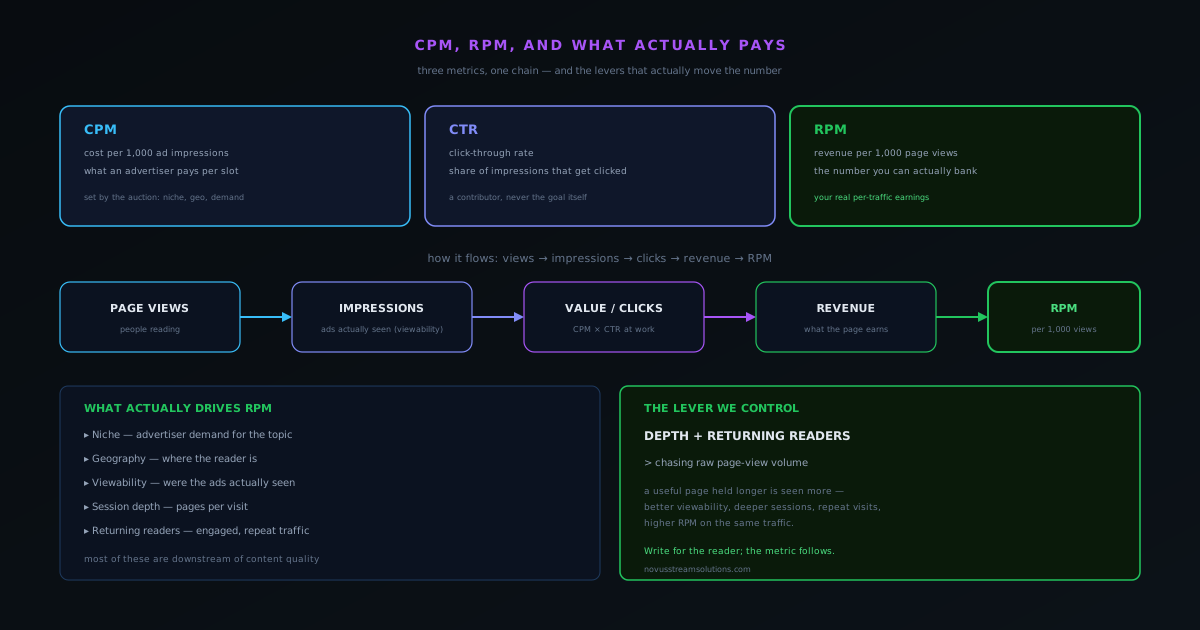
The short version, stated up front so the rest has a frame: CPM is a price set by advertisers, RPM is what your traffic actually earns, and CTR is one ingredient in between. The metric to care about is RPM, because it is the only one that tells you what a thousand readers are worth to you, and the most useful thing you can do about RPM has almost nothing to do with ad settings and almost everything to do with the content and the reader. We will get there, but it starts with keeping the three numbers separate.
CPM: the price of a slot
CPM stands for cost per mille (cost per thousand) and it is the price an advertiser pays for a thousand impressions of their ad. The "mille" is just Latin for thousand, a convention from the days when ad rates were quoted that way, and it has stuck. When you hear that a niche has a high CPM, it means advertisers are willing to pay a lot to put their ad in front of a thousand people in that context. CPM is fundamentally a price, set in an auction where advertisers bid for the chance to show their ad to your readers.
The crucial thing about CPM is that you do not set it; the market does. It rises and falls with how much advertisers want to reach your particular audience, on your particular topic, at that particular moment. A page about a commercially valuable subject (one where landing a customer is worth a lot to a business) will command higher CPMs than a page about something with no commercial intent behind it, because advertisers bid more aggressively where the payoff of a conversion is larger. CPM is a useful number to understand, but it describes the worth of a slot to an advertiser, not directly what you take home. For that, you have to follow the chain further.
CTR: clicks as an ingredient, not a goal
CTR (click-through rate) is the proportion of ad impressions that result in a click. If a hundred people see an ad and one clicks it, the CTR is one percent. For ad formats that pay per click, CTR is part of how impressions turn into revenue, which is why it gets so much attention. But attention is exactly the trap with CTR: because it sounds like the thing you want to maximize, people try to maximize it directly, and that almost always goes wrong.
The reason it goes wrong is that the easy ways to lift CTR are the bad ones. Place an ad where readers click it by accident (next to a button, disguised as content, in the path of a thumb) and your CTR will rise on clicks that represent no genuine interest. Those clicks are worth little, they annoy readers, and they are precisely the kind of invalid activity ad networks penalize. A healthy CTR is one that emerges from relevant ads shown to engaged readers who occasionally find one genuinely worth clicking. Treat CTR as a symptom of a good situation, not a dial to crank. The goal is engaged readers and relevant ads; a reasonable CTR follows, and a forced one usually does more harm than good.
RPM: the number that actually matters
RPM stands for revenue per mille (revenue per thousand page views) and it is the number that actually tells you what your traffic is worth. Unlike CPM, which is the price of one ad slot, RPM rolls the whole picture into a single figure: it accounts for how many ads each page shows, how often they get clicked, whether they are seen at all, and the CPMs they command, then expresses the result as earnings per thousand views of your pages. If you only track one ad metric, track RPM, because it answers the question that pays the bills: what does a thousand readers actually earn me?
It is worth being precise that RPM usually comes in two flavors that are easy to conflate. Page RPM is revenue per thousand page views; session RPM is revenue per thousand visits, where a single visit may include several page views. The distinction matters because it points at where the leverage is: a reader who views several pages in one visit produces more revenue per session than per page, which is why session depth shows up as one of the biggest drivers of overall earnings. Whichever flavor you look at, RPM is the honest scoreboard. CPM tells you what a slot is worth to an advertiser; RPM tells you what your content is worth to you, after everything that happens between an impression existing and it earning something.
How the chain fits together
These metrics are not rivals; they are links in a chain that turns readers into revenue. Page views come first: people arriving at your content. Each view can produce ad impressions, but only the impressions that are actually seen count for much, which is where viewability enters. Some of those seen impressions earn through clicks (CTR) and some through being shown at all, priced by the CPM the auction set. Sum the revenue across a thousand page views and you have RPM. Read in that order, the chain shows why RPM is the summary statistic: it is the end of the chain, the place where everything upstream has already been accounted for.
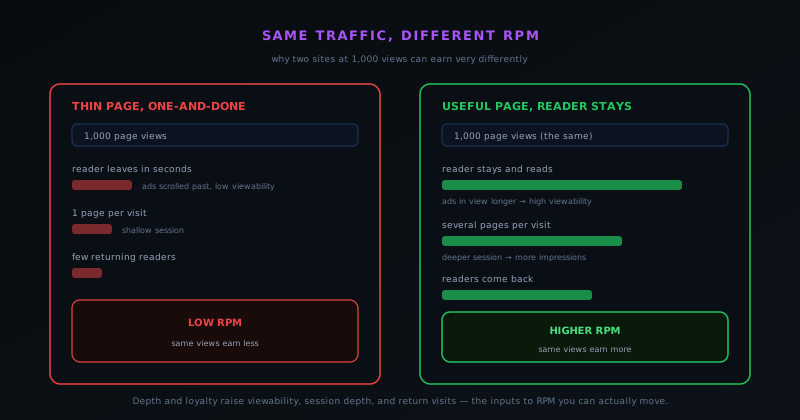
Seeing the chain laid out also explains the most confusing fact in this whole area: two sites with identical page-view counts can earn wildly different amounts. The view count is just the first link. If one site’s readers leave in seconds, its ads are scrolled past unseen (low viewability), its sessions are a single shallow page (few impressions per visit), and few readers ever return: every link after the first is weak, and the RPM is low. If the other site’s readers stay, read several pages, and come back, the same headline traffic produces far more seen impressions across deeper sessions, and the RPM is high. Same first link, very different chain. This is why "we get the same traffic" is not the same as "we earn the same," and why obsessing over the view count alone misses where the money is made.
- Page views → the raw arrivals, the first link only.
- Impressions → ads shown; only the seen ones (viewability) pay well.
- Clicks / value → CTR and CPM doing their work.
- Revenue → RPM, the end of the chain and the number to watch.
What drives RPM: niche and geography
Of the things that move RPM, two are largely structural, set by what you write about and who reads it. The niche is the big one. Some topics sit close to a commercial decision: an advertiser who reaches a reader in that context has a real shot at a valuable conversion, so they bid up the ad slots, and CPMs (and therefore RPM) run high. Other topics, however popular, have little commercial intent behind them, so advertisers bid less and the same volume of readers earns less. This is not about audience quality in a human sense; it is about how close the topic sits to something a business is willing to pay to influence.
Geography is the second structural factor. Advertisers value reaching audiences in some markets more than others, for reasons of purchasing power and competition, so where your readers are located affects what your impressions earn. A thousand views from a high-value market can be worth several times a thousand views from a lower-value one, purely because advertisers bid differently for them. Neither niche nor geography is something you can flip overnight (they follow from what your site is about and who it serves) but understanding them dissolves a lot of mystery about why RPMs differ so much between sites. A modest-traffic site in a commercial niche serving a high-value market can out-earn a large-traffic site in a non-commercial niche, and the metrics explain exactly why.
What drives RPM: viewability and session depth
The other two big drivers of RPM are the ones you can actually influence, and they both come down to engagement. Viewability is whether an ad is genuinely seen (on screen, for long enough to register) rather than instantly scrolled past or sitting below where the reader ever reaches. An impression that is technically served but never actually viewed is worth little, because advertisers increasingly pay for attention, not just for an ad being theoretically present. A page whose readers linger gives its ads time to be seen, which lifts viewability, which lifts RPM. A page whose readers bounce serves impressions that no one looks at, and those impressions barely pay.
Session depth is the companion lever: how many pages a reader views in a single visit. A reader who reads one page and leaves produces one page’s worth of impressions; a reader who follows a link to a second and third page produces several times that, from the same single arrival. This is why session RPM can dwarf the value of a one-and-done visit, and why internal links to genuinely relevant further reading do more for revenue than another ad unit would. Both viewability and session depth are downstream of the same thing (content good enough that people stay and keep reading) which is the quiet headline of this whole piece: the metrics you can move are moved by the content, not by the ad settings.
- Viewability: ads actually seen pay; ads scrolled past do not.
- Session depth: more pages per visit means more impressions per reader.
- Both rise when readers stay and keep reading.
- Both are downstream of content quality, not ad configuration.
Why depth beats chasing volume
The instinct when you want more ad revenue is to chase more page views, and volume genuinely does help, but it is the most overrated lever, because it ignores everything downstream of that first link in the chain. A flood of shallow traffic from readers who arrive, glance, and leave produces views with low viewability and single-page sessions, which means a low RPM, which means the revenue grows far less than the view count suggests it should. You can double your page views and barely move your earnings if the new traffic is shallow, because you have made the first link bigger while leaving every link after it weak.
Depth is the better investment because it strengthens the whole chain rather than just the start of it. A reader who stays longer sees more ads (viewability up), reads more pages (session depth up), and is more likely to return (engagement up), three RPM drivers improving at once, on traffic you already have. Raising RPM through depth means each visit is worth more, so the same audience earns more, and any new traffic you do attract earns at the higher rate too. Volume multiplies whatever your RPM is; depth raises the multiplier. Between adding shallow readers and earning more from engaged ones, the engaged path compounds, which is why "make the content worth staying for" outperforms "get more clicks to the page" over any serious horizon.
Why returning readers compound
Returning readers are the quiet engine behind a healthy RPM, and they deserve singling out because their effect compounds in a way one-time visitors’ does not. A reader who comes back is, by revealed preference, engaged (they found the content worth a second visit) and engaged readers do all the things that lift RPM: they stay longer, read more deeply, view more pages, and tolerate the ads because the experience earns it. A base of returning readers is therefore not just repeat traffic; it is repeat high-quality traffic, the kind whose every visit pays better than an average first-time glance.
The compounding is the important part. New traffic you have to win again every single day; a returning reader you won once keeps coming back, so the effort that earned them pays out repeatedly rather than once. Over time, a site with a real returning audience accumulates a floor of engaged, high-RPM visits that does not depend on constantly capturing fresh strangers. This is the deep reason the free tools and the content reinforce each other: a genuinely useful free tool earns the return visit, the return visit is a high-quality impression, and the impression funds keeping the tool free. The metric that looks like advertising (RPM) is really a measure of how well the content keeps people coming back, which is why the path to a better RPM runs through being worth returning to.
What this means for how we operate
Pulling it together, the metrics point to a way of operating that is almost the opposite of the ad-stuffing reflex. CPM we cannot set; it is the market’s price for our slots. CTR we deliberately do not chase, because the ways to force it are the ways that wreck trust and trip policy. RPM we care about, and the levers that move it (viewability, session depth, returning readers) are all earned by content good enough that people stay, read on, and come back. The honest conclusion is that the best thing we can do for ad revenue is the same thing we would do with no ads at all: make pages worth a reader’s time.
That is a comfortable place to land, because it means the revenue model and the reader’s interest point in the same direction. We do not have to choose between earning and being useful; the metrics reward usefulness, and the usefulness funds the free tools. So we write content with real depth, link readers to genuinely relevant further reading, place ads so they are seen without being intrusive, and aim to earn the return visit. The RPM follows from that, not from squeezing the page. CPM, RPM, and CTR are worth understanding precisely so you can see why the un-spammy path is also the paying one: chasing the metric directly fails, and serving the reader is what actually pays.
Frequently asked questions
Quick answers to common questions about this topic.
What is the difference between CPM and RPM?
CPM is what an advertiser pays per thousand ad impressions, a price set in the ad auction. RPM is your revenue per thousand page views, after accounting for how many ads each page shows, how often they are clicked, and whether they are actually seen. CPM describes the price of an ad slot; RPM describes what your traffic actually earns you, which is the number that matters.
What is CTR and how does it relate to revenue?
CTR is click-through rate, the share of ad impressions that get clicked. It is one input into revenue, not a goal in itself. Chasing CTR by placing ads where people click them by accident is both bad for readers and against ad policy, so it is better to treat CTR as a byproduct of relevant ads in front of engaged readers than as a target.
What actually drives RPM?
A handful of things, most of which trace back to content. The niche sets how much advertisers will pay; geography affects rates because some audiences are worth more to advertisers; viewability matters because ads that are never seen pay little; and session depth (how many pages a reader views) raises the impressions per visit. Engaged, returning readers improve nearly all of these at once.
Should I just chase more page views?
Volume helps, but it is the easiest lever to overrate. Ten thousand shallow views from readers who bounce in seconds can earn less than a smaller number of engaged visits, because shallow traffic has low viewability and shallow sessions. Depth and loyalty raise the RPM on the traffic you already have, which compounds in a way that chasing raw volume does not.
Why do two sites with the same traffic earn so differently?
Because RPM varies enormously with niche, geography, viewability, and engagement. A site whose readers stay, read deeply, and return will show ads longer, view more pages per visit, and come back, all of which lift RPM. A site with the same headline traffic but readers who leave instantly earns far less per thousand views, even though the view count looks identical.
Can I control any of these metrics directly?
Not the auction-set ones like CPM, but you can strongly influence the inputs to RPM. Writing genuinely useful content that holds attention raises viewability and session depth; earning returning readers raises engagement across the board. You do not set the price of an ad slot, but you very much shape how many quality, viewable impressions your content generates.
Related troubleshooting
Was this page helpful?
Your answer stays in this browser, it is not sent anywhere and no account or cookie is involved.