2026 · Novus Stream Solutions (hub)About 13 min readNovus Stream Solutions
A cash buffer and emergency fund for business owners
For a business owner with irregular income, a cash buffer is what turns a bad month into an inconvenience instead of a crisis. Here is how to think about sizing, building, and holding reserves, for the business and for you. Educational, not advice.
Contents
Overview
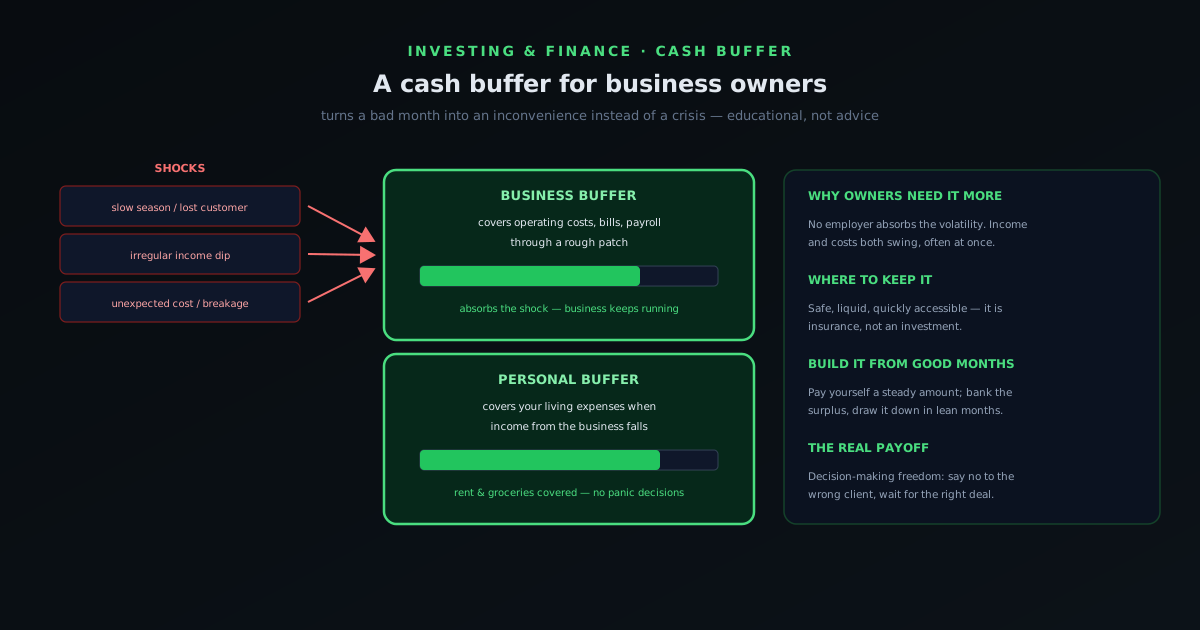
For someone with a steady paycheck, an emergency fund is standard financial advice; for a business owner, it is closer to a survival requirement, because the owner faces volatility on both sides at once (irregular income and unpredictable business costs) that an employee does not. A business owner can have a great month followed by a terrible one, can face a sudden equipment failure or a lost major customer or a slow season, and has no employer absorbing any of it. A cash buffer (reserves held specifically to absorb these shocks) is what turns a bad stretch from a crisis that can close the business into an inconvenience the business rides out. This guide covers how to think about buffers for a business owner, both for the business and for the owner personally, including sizing, where to hold the money, and how to build reserves from irregular income. It is educational: frameworks and mechanics, not personalized financial advice.
The reason this matters so much for owners specifically is that the lack of a buffer is one of the most common ways otherwise-viable businesses fail. A business can be fundamentally sound (profitable over a year, with real demand) and still be killed by a cash crunch in a single bad month if there are no reserves to cover the gap, because bills and payroll and the owner's own living costs do not pause for a slow period. The buffer is what provides the resilience to survive the inevitable rough patches that every business hits, giving the owner time to respond to problems rather than being forced into panic decisions or closure by an immediate cash shortage. Understanding buffers as the resilience layer that keeps a sound business alive through volatility (rather than as idle money that could be working harder) is the mindset that this guide builds.
Why owners need buffers more than employees
The case for a larger buffer as a business owner rests on the compounding of risks that owners carry and employees do not. An employee has a predictable income and, if they lose their job, typically some warning and possibly severance; a business owner's income fluctuates month to month with no guarantee, and the business can hit trouble suddenly. On top of income volatility, the owner faces business risks (a key customer leaving, a supplier problem, equipment breaking, a seasonal slump, an economic downturn hitting their market) any of which can sharply reduce income or impose a large unexpected cost, often with little notice. The owner absorbs all of this directly, because there is no employer between them and the volatility.
These risks also interact in ways that make a buffer more critical, not less. A downturn that reduces business income often coincides with the times an owner can least afford a financial shock, and business and personal finances are linked for most owners, so a business cash crunch quickly becomes a personal one. An employee facing a personal emergency still has their income; an owner facing a business emergency may simultaneously lose their income and need cash to address the business problem. This double exposure (to income loss and to cost shocks, on both the business and personal side at once) is why the standard emergency-fund advice scaled for employees is usually insufficient for owners, who need more reserve to cover a riskier, more volatile financial life. The buffer is the owner's substitute for the stability an employer provides, and building it larger reflects the larger risks being self-insured against.
Two buffers: the business and you
A business owner really needs to think about two distinct buffers, because the business and the owner have separate cash needs that should be reserved for separately. The business buffer covers the business's own obligations through a rough patch (its operating costs, its bills, its payroll if it has employees), so the business can keep running when revenue dips or an unexpected cost hits. The personal buffer covers the owner's living expenses when their income from the business falls, so a slow business month does not immediately threaten the owner's ability to pay rent and groceries. These are different reserves serving different purposes, and conflating them (treating one pool as covering both) leaves both underfunded and makes it hard to know whether either is adequate.
Keeping the two buffers separate depends on keeping business and personal finances separate in the first place, which is foundational financial hygiene for any owner and is covered in detail in Separating business and personal finances (and why it matters). With clear separation, the business holds its reserve in business accounts and the owner holds their personal reserve in personal accounts, each sized to its own purpose, and the owner can see at a glance whether the business can survive a lean stretch and whether they personally can. Without separation, the buffers blur together, the owner cannot tell what is really reserved for what, and a business expense can quietly drain the personal cushion or vice versa. The two-buffer framework is therefore both a sizing discipline (reserve for each need explicitly) and a clarity discipline (know which money protects which obligation), and it rests on the separation of finances that owners should maintain regardless.
Sizing the buffer
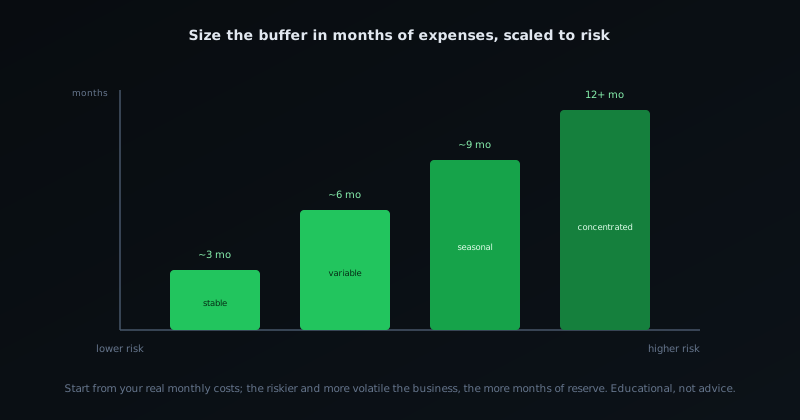
There is no single correct buffer size, because the right amount depends on the volatility and risk of the specific business and the owner's personal situation, but the sizing logic is consistent: the buffer should cover enough months of expenses to ride out a realistic bad stretch. The starting point for sizing is knowing your actual monthly costs (both the business's operating expenses and your personal living expenses), because the buffer is measured in months of those costs, and you cannot size it without knowing them. This is one reason understanding your real numbers matters; reading your own P&L tells you the business's monthly burn (see Reading a P&L for non-accountants: what each line is trying to tell you), and a personal budget tells you yours.
From that base, the buffer scales with risk: a business with stable, predictable income and low fixed costs can hold a smaller buffer, while a business with volatile income, high fixed costs, seasonality, or concentration in a few customers needs a larger one, because it faces bigger and more likely shocks. The conventional employee guidance of a few months of expenses is a floor for owners, not a target: the riskier and more volatile the business, the more months of reserve are prudent, with highly seasonal or concentrated businesses warranting substantially more to cover their predictable lean periods and their larger downside. The honest approach is to assess your specific risks (how volatile is income, how high are fixed costs, how concentrated are customers, how seasonal is demand) and size the buffer to cover a genuinely bad version of those risks, not an optimistic one. A buffer sized for the business you actually have, rather than a generic number, is what provides real resilience.
Where to keep the money
A buffer only works if the money is actually available when the shock hits, which dictates where it should be held: somewhere safe and accessible, not somewhere it can lose value or be hard to reach at the moment of need. The purpose of a buffer is liquidity and stability, not growth (it is insurance, not an investment), so the appropriate place is a safe, liquid account where the money is preserved and can be withdrawn quickly without penalty or loss. Putting buffer money into volatile investments defeats its purpose, because the value might be down exactly when you need it (downturns often hit business income and investment values at the same time), and the whole point is that the buffer is reliably there when called upon.
This is a different goal from the money you invest for long-term growth, and the distinction is worth holding clearly: buffer money is for safety and immediate access, accepting low or no return in exchange for being dependable; investment money is for growth, accepting volatility and illiquidity in exchange for higher expected returns over time. They should be held differently and not confused: the temptation to put the buffer somewhere it earns more is a temptation to undermine its function. Once the buffer is funded and reliable, additional reserves beyond it can be invested for growth, but the buffer itself stays in a safe, liquid form precisely so that it performs its job of being available in an emergency. The principle is to match where money is held to what it is for: the buffer is for resilience, so it lives somewhere resilient, even at the cost of the returns that growth-oriented money pursues.
Building a buffer from irregular income
The hardest part of buffer-building for many owners is the irregular income itself, because it is difficult to set aside a consistent amount when income swings month to month, yet that same irregularity is exactly why the buffer is needed, making the difficulty and the necessity two sides of one coin. The practical approach that works with irregular income is to treat good months as the time to build the buffer: when income is strong, deliberately set aside a portion into reserves rather than expanding spending to match the high month, so the surplus from good months accumulates into the cushion that carries you through the bad ones. This requires resisting the natural pull to let lifestyle and spending rise with a good month, which is the discipline that irregular-income earners most need and most often lack.
A useful mental model is to smooth your own income artificially: rather than spending whatever comes in each month, pay yourself a steady, sustainable amount and let the buffer absorb the difference (banking the excess in good months and drawing on it in lean ones), so your personal finances feel more stable than the raw business income is. This both builds the buffer (from the good-month excess) and uses it (in the lean months) for its intended purpose of smoothing volatility, while preventing the feast-or-famine spending that irregular income otherwise encourages. Building the buffer this way, from the surplus of strong periods set aside deliberately rather than from an impossible consistent monthly contribution, is how owners with lumpy income actually accumulate reserves. The connection to how much you pay yourself versus reinvest is direct, and the trade-offs there are explored in Reinvest or pay yourself? A profit allocation framework for small business owners, but the buffer should generally be funded before aggressive reinvestment, because it is the safety that makes everything else survivable.
The buffer as decision-making freedom
A cash buffer's value is not only that it helps a business survive emergencies; it is that it changes the quality of every decision the owner makes, by removing the desperation that a lack of reserves imposes. An owner without a buffer is forced into short-term, defensive decisions: taking bad clients because the cash is needed, accepting unfavorable terms, unable to walk away from a poor deal, unable to invest in an opportunity because every dollar is spoken for. An owner with a buffer can make decisions from a position of stability: declining the wrong customer, negotiating from strength, waiting for the right opportunity, and investing deliberately rather than reactively. The buffer buys the freedom to act in the business's long-term interest instead of being driven by immediate cash pressure.
This decision-making freedom compounds over time into a meaningfully better business, because the cumulative effect of being able to make good long-term choices (rather than desperate short-term ones) is a business built on better customers, better terms, and better-timed investments. The owner who can say no to the wrong thing and yes to the right thing at the right moment, because the buffer removes the pressure, ends up in a stronger position than the equally talented owner who is perpetually forced by cash constraints into expedient choices. So the buffer's return is not just survival insurance but the quality of decisions it enables, which is a large and underappreciated part of its value. Building and maintaining a buffer is therefore not money sitting idle; it is the foundation of the calm, long-term decision-making that distinguishes a resilient, growing business from one perpetually reacting to its own cash shortages.
A buffer versus relying on debt
A common alternative to holding a cash buffer is relying on credit to cover shortfalls when they arise, and understanding why a buffer is generally the stronger position clarifies what the buffer is really for. Debt can cover a shock, but it does so at a cost (interest, repayment obligations, and dependence on the credit remaining available), and it is often least available exactly when it is most needed, since lenders tighten in the same downturns that strain a business. A buffer, by contrast, is your own money, available immediately, with no interest and no dependence on a lender's willingness to extend it, which makes it a more reliable cushion precisely in the difficult conditions where reliability matters most.
This does not mean credit has no role (a line of credit can be a useful secondary backstop behind the buffer), but it means the buffer should be the first line of defense and credit a fallback, not the other way around. A business that relies on debt in place of a buffer is more fragile, because it enters every shock already needing to borrow, with the cost and availability of that borrowing outside its control. A business with a buffer absorbs most shocks from its own reserves and turns to credit only for the rare event that exceeds them, which is both cheaper and more dependable. The buffer is self-funded resilience; debt is borrowed and conditional, which is why building the buffer takes priority over leaning on credit. This is educational, not personalized financial advice.
Maintaining and replenishing it
A buffer is not built once and forgotten; it is maintained, because its whole purpose is to be drawn down in emergencies and then rebuilt, so a healthy relationship with the buffer includes both using it when needed and replenishing it afterward. When a shock comes (a slow season, an unexpected cost), the buffer does its job by being spent, and that is success, not failure; the failure would be having no buffer to spend. But once the rough patch passes, replenishing the buffer becomes a priority, restoring the reserve from the recovery so that it is ready for the next shock, because the next one will come eventually. Treating the buffer as a renewable resource (used and rebuilt across the cycles of the business) rather than a one-time achievement is what keeps it functional over the life of the business.
Maintenance also means revisiting the buffer's size as the business changes, since the right amount is not static. As the business grows, its monthly costs rise, so the same number of months of reserve requires more money; as the business's risk profile changes (more or less seasonal, more or less concentrated, higher or lower fixed costs), the appropriate buffer changes with it. Periodically reassessing whether the buffer still covers a realistic bad stretch, given the business as it now is, keeps the reserve adequate rather than letting it become too small relative to a grown business or unnecessarily large relative to a de-risked one. This ongoing attention (replenishing after use and resizing as the business evolves) is what makes the buffer a living part of the financial management of the business rather than a number set once and allowed to drift out of relevance. The buffer that keeps a business resilient is the one that is maintained as deliberately as it was first built.
Frequently asked questions
Quick answers to common questions about this topic.
Why do business owners need a bigger buffer than employees?
Owners face volatility on both sides (irregular income and unpredictable business costs) with no employer absorbing it. A downturn can cut income and impose costs at once, and business and personal finances are linked. The standard employee emergency fund is usually a floor, not a target, for owners.
How big should a business cash buffer be?
It is measured in months of real expenses and scales with risk. Stable, low-fixed-cost businesses can hold less; volatile, seasonal, or customer-concentrated ones need more. Start from your actual monthly business and personal costs, then size to cover a genuinely bad stretch, not an optimistic one.
Where should I keep buffer money?
Somewhere safe, liquid, and quickly accessible: the buffer is insurance, not an investment. Avoid volatile investments, which can be down exactly when you need the cash. Keep buffer money separate from long-term growth money; they serve different purposes and should be held differently.
How do I build a buffer with irregular income?
Build it from good months: set aside a portion of strong-month income into reserves instead of letting spending rise. Pay yourself a steady, sustainable amount and let the buffer absorb the difference. Fund the buffer before aggressive reinvestment. This is educational, not personalized financial advice.
Related troubleshooting
Was this page helpful?
Your answer stays in this browser, it is not sent anywhere and no account or cookie is involved.