2026 · Novus Stream Solutions (hub)About 12 min readNovus Stream Solutions
Setting aside money for taxes when you run a small business
When no employer is withholding taxes for you, the bill arrives all at once, and the business that spent the money it owed is the one that gets hurt. Here is an educational framework for setting tax money aside so the bill is never a crisis. Education, not advice.
Contents
- 1.Overview
- 2.Why the bill blindsides people
- 3.The set-aside habit: a slice off every dollar
- 4.Put it in a separate account
- 5.Think in quarters, not once a year
- 6.What share to set aside
- 7.Income tax is not the only tax
- 8.Deductions lower the bill, not the discipline
- 9.Setting aside when income is lumpy
- 10.Treat tax money as money that was never yours
Overview
A note before anything else: this is an educational explanation of a habit, not tax advice. Tax rules vary enormously by country, state, business structure, and situation, and the specifics of what you owe and when are questions for a qualified professional and your local tax authority. What this article covers is the universal behavioral problem underneath all those specifics: that running your own business changes who is responsible for setting tax money aside, and that the businesses which get hurt are the ones that did not. The framework here is about the discipline of reserving for a bill you know is coming, which holds regardless of the particular rates and rules where you operate.
The problem is structural and catches almost everyone the first time. When you are an employee, your employer withholds taxes from every paycheck and sends them on your behalf, so the money you owe never sits in your account tempting you to spend it; the bill is handled invisibly, a little at a time. When you run your own business, that machinery disappears. The money a customer pays you arrives whole, with nothing withheld, and it is entirely your responsibility to set aside the portion that is not actually yours to keep. Nobody does it for you, nothing reminds you, and the bill does not arrive until later, which is precisely the trap. This guide is about not falling into it: building the habit of separating tax money from spendable money the moment income arrives, so the eventual bill is already funded.
Why the bill blindsides people
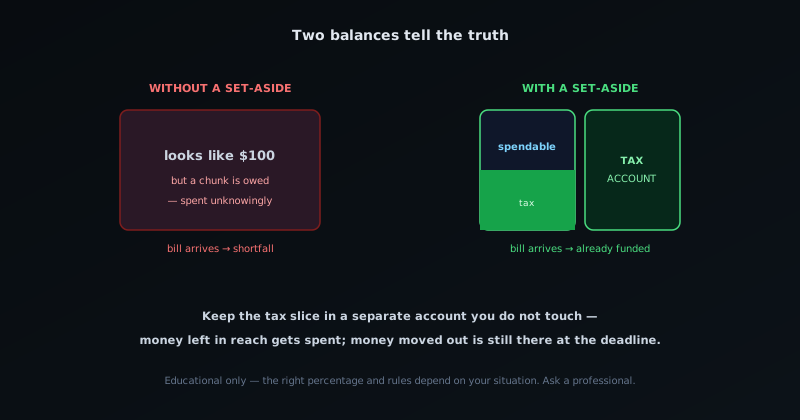
The reason tax bills sink small businesses is almost never that the owner did not know taxes existed; it is that the money arrived, sat in the account looking like income, got spent on real and reasonable things, and then the bill came due against money that was no longer there. Without withholding, every dollar a customer pays lands in your account as if it were all yours, even though a meaningful slice of it is spoken for. If you run the business out of that whole balance (paying yourself, covering costs, reinvesting), you are unknowingly spending the tax portion along with everything else, and the shortfall only becomes visible when the bill arrives and there is nothing set aside to pay it.
This is made worse by timing. Tax bills often arrive periodically and in lumps rather than continuously, so there can be a long gap between earning the money and owing the tax on it: plenty of time to forget that a portion was never yours and to build a lifestyle or a cost structure around a balance that was inflated by money you owe. The psychological error is treating revenue as profit and profit as fully spendable, when in reality a chunk of what looks like profit is a liability you are temporarily holding. The blindside is not ignorance of tax; it is the absence of the withholding that used to protect you from yourself, and the fix is to recreate that protection deliberately.
The set-aside habit: a slice off every dollar
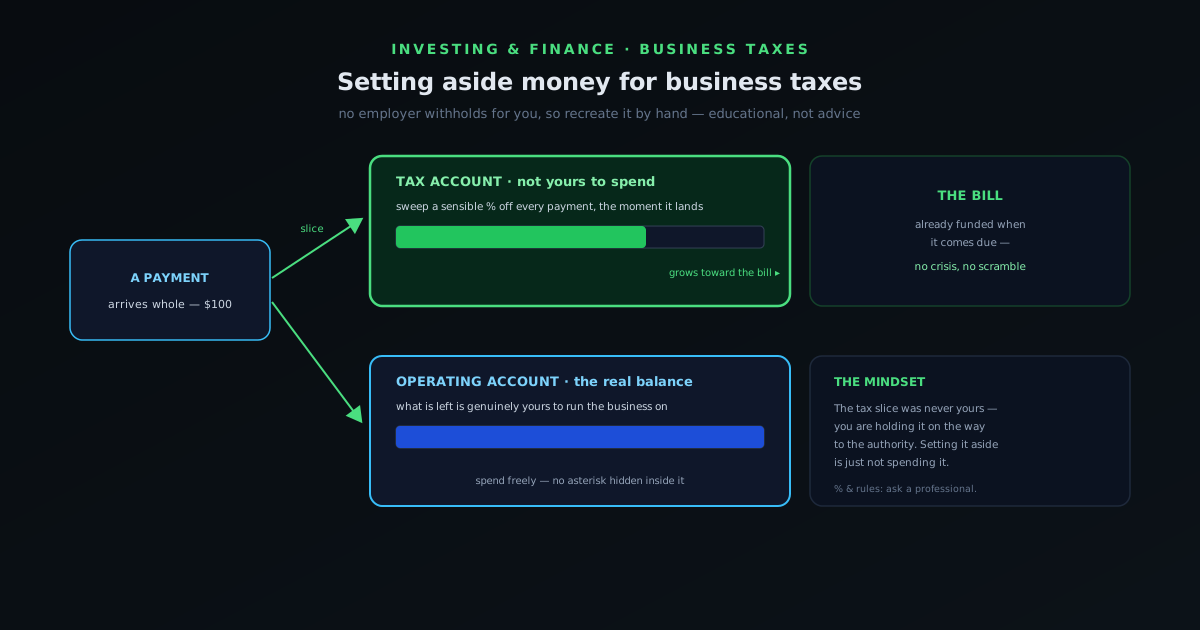
The core habit that prevents the crisis is simple to state: every time money comes into the business, immediately set aside a percentage of it for tax, before you think of any of it as available to spend. Instead of letting income pile up whole and reckoning with tax later, you withhold from yourself the way an employer would have, skimming a consistent slice off each payment and treating the rest as the real, spendable figure. Done at the moment income arrives, this converts the invisible, easy-to-spend tax portion into money that is visibly separated and off-limits, which is the entire point. The bill stops being a shock because it is being funded continuously, a little at a time, exactly as withholding did.
What percentage to set aside is the part that depends on your specifics: your income level, your business structure, your location, and the kinds of tax you owe all determine it, which is a conversation for a professional rather than a number to copy from an article. The behavioral principle, though, is independent of the number: pick a percentage informed by your actual situation, lean toward setting aside a little more rather than a little less so you are not caught short, and apply it consistently to every dollar of income. Setting aside slightly too much is harmless (the surplus is yours once the bill is paid) while setting aside too little recreates exactly the shortfall you are trying to avoid. The habit matters more than precision: a consistent set-aside at a sensible rate beats an exact rate applied erratically or not at all.
Put it in a separate account
A set-aside that lives in the same account as your spending money is a set-aside in name only, because money that is sitting in your operating balance gets spent, intentionally or not. The habit only works if the tax money physically leaves your reach, which in practice means a separate account: a dedicated tax savings account that you move the set-aside slice into and do not touch for anything else. When the tax portion of every payment is swept into an account you have mentally and practically marked as not-yours, the temptation and the accidental spending both disappear, and the operating balance you run the business from finally reflects money that is actually available.
This separation depends on a more basic discipline that is worth having anyway: keeping business and personal finances apart, with the business running through its own accounts. Once that structure exists, a tax account is a natural extension of it: one more clearly-labeled bucket with one clearly-defined purpose. The broader case for that separation, and how to set it up simply, is in Separating business and personal finances (and why it matters); the tax account is one of its highest-value applications. A bonus of holding the set-aside in a separate savings account is that it can earn a little while it waits, but the real value is not the interest; it is that money in a separate, purpose-named account is money you will still have when the bill comes, which is the whole game.
Think in quarters, not once a year
In many places, running your own business also changes the rhythm of when tax is paid: instead of a single annual reckoning, self-employed and business income often has to be paid in installments through the year, on a roughly quarterly basis. Whether and exactly how this applies to you is a specifics question for a professional, but the behavioral implication is broadly useful: thinking about tax as a recurring, periodic obligation rather than a once-a-year event keeps it present and prevents the long-gap forgetting that fuels the blindside. If you owe in installments, the set-aside account is what you pay each installment from, and the continuous skimming maps neatly onto the periodic paying.
Even where annual payment is the rule, adopting a quarterly mindset is a useful discipline. Reviewing your income and your set-aside every few months (checking that the percentage you are reserving still matches your actual profit, adjusting if the business has grown or your situation has changed) keeps the reserve calibrated rather than drifting. Income that rises over a year can mean the rate you set in January is too low by autumn, and a quarterly check catches that before it becomes a shortfall. The point is not to do your own taxes quarterly; it is to keep tax in regular view so it never accumulates into a surprise, treating it as an ongoing part of operating the business rather than an annual ambush. Knowing your real numbers for these check-ins is what basic bookkeeping provides, covered in Bookkeeping before you need an accountant: minimum viable books for a small business.
Income tax is not the only tax
A trap that catches new business owners is assuming the tax to plan for is just income tax, when in practice there are usually several, and missing one is how a reserve that looked adequate falls short. Depending on where and how you operate, you may owe self-employment or equivalent contributions on top of income tax, which can be a substantial additional slice that the unprepared simply do not account for. Lumping all of it under a single vague tax in your head is how the real, larger total blindsides you at filing time.
Sales tax deserves special mention because it is conceptually different and dangerous to misunderstand: when you collect it from customers, that money was never yours; you are holding it on behalf of the authority you will remit it to. Spending collected sales tax because it is sitting in your account is one of the most common and most serious small-business mistakes, because you will owe it regardless of whether you still have it. Keeping collected sales tax mentally and ideally physically separate from your revenue, as money you are merely holding, is the same not-yours discipline applied to the tax that most tempts people to forget it.
Deductions lower the bill, not the discipline
Legitimate business expenses reduce your taxable profit and therefore your bill, and tracking them carefully is genuinely worthwhile, but deductions change the size of the number, not the need for the discipline. The mistake is to assume deductions will shrink the bill enough that setting aside is unnecessary, and then to discover at filing time that the remaining liability is still real and still unfunded. Set aside first on your profit, and let deductions be the pleasant surprise that leaves you with a surplus, rather than the assumption that leaves you short.
Good expense tracking through the year is what makes deductions actually reduce the bill, because a deduction you cannot substantiate is one you cannot safely claim. This is where keeping clean books pays for itself, the broader case for which is in Bookkeeping before you need an accountant: minimum viable books for a small business: separate business spending, kept records, and categorised expenses turn a stressful year-end reconstruction into a straightforward summary. The combination that works is to reserve a considered share of profit, track expenses diligently so the eventual bill is as low as it legitimately can be, and treat any reduction as margin rather than as permission to reserve less.
Setting aside when income is lumpy
For many small and seasonal businesses, income does not arrive in steady monthly amounts but in lumps (a big month, a quiet stretch, a seasonal peak), and that irregularity is exactly what makes the set-aside habit so valuable, because it smooths an obligation the income does not. The discipline that survives lumpy income is to set aside your share from each payment as it lands, rather than waiting to see how the month or quarter shakes out, so that a windfall month automatically reserves its larger share and a lean month reserves less. The percentage does the adjusting for you.
The danger with lumpy income is treating a big month as fully spendable because it feels like abundance, when a chunk of it belongs to a tax bill that will arrive long after the money feels gone. Reserving off the top of every payment, the moment it arrives, defuses this: the windfall is recognised as partly not-yours before it can be mentally spent. Combined with thinking in quarters rather than once a year, the per-payment set-aside turns the feast-and-famine cash flow that defines so many small businesses from a tax liability into a managed, funded certainty.
The deeper benefit of all this is psychological as much as financial: once the tax money is reserved automatically off every payment and sitting in its own account, the bill stops being a looming threat and becomes a known quantity you have already funded. That removes one of the most common and most corrosive sources of small-business stress (the dread of a number you cannot pay) and replaces it with the quiet confidence of being prepared. The habit is small and slightly tedious, but the peace of mind it buys, year after year, is out of all proportion to the effort it takes to maintain.
Treat tax money as money that was never yours
The mindset that makes all of this effortless rather than effortful is to stop thinking of the tax portion as your money that you have to give up, and start thinking of it as money that was never yours in the first place. When a customer pays you, a slice of that payment is, in effect, tax you are collecting and temporarily holding on the way to the authority; it passed through your account but it was never yours to spend. Framed that way, setting it aside is not a sacrifice or a discipline of denial; it is simply not spending money that does not belong to you, which is far easier to sustain than treating it as your profit that you are nobly reserving.
This reframing is what separates owners who are never stressed about tax from those who dread it. The unstressed ones do not have lower bills; they have simply never counted the tax money as theirs, so the bill is paid from money they already mentally wrote off and the rest of the balance is genuinely available without an asterisk. The stressed ones counted all the revenue as theirs, lived against it, and now experience the bill as a loss. The bill is identical; the experience is opposite, and the difference is entirely the set-aside habit and the mindset behind it. Pair this known, fundable obligation with a reserve for the unknown shocks (the cash buffer covered in A cash buffer and emergency fund for business owners), and the two together turn the two biggest cash surprises in a small business, the expected bill and the unexpected hit, into things you have already handled. Again: this is the educational shape of the habit; the numbers and rules are for a professional and your tax authority.
Frequently asked questions
Quick answers to common questions about this topic.
Why do small business owners get surprised by tax bills?
Because no employer withholds tax for them. Customer payments arrive whole, look like spendable income, and get spent; then the bill comes due against money that is gone. The fix is to recreate withholding yourself by setting a slice of every payment aside the moment it arrives. (Educational, not tax advice.)
How much should I set aside for taxes?
The right percentage depends on your income, business structure, and location, so it is a question for a qualified professional and your tax authority rather than a number to copy. The universal principle: pick a sensible rate for your situation, lean toward a little more rather than less, and apply it consistently to every dollar of income.
Where should I keep money set aside for taxes?
In a separate, dedicated account you do not touch for anything else: a tax savings account you sweep each set-aside slice into. Money left in your operating balance gets spent; money moved out of reach is still there when the bill comes. It also pairs naturally with keeping business and personal finances separate.
Do I have to pay business taxes more than once a year?
In many places, self-employed and business income is paid in installments (often quarterly) rather than once a year, but whether and how this applies to you is a specifics question for a professional. Regardless, thinking of tax as a recurring obligation and checking your set-aside every few months keeps the reserve calibrated and the bill from becoming a surprise.
Related troubleshooting
Was this page helpful?
Your answer stays in this browser, it is not sent anywhere and no account or cookie is involved.