2026 · Novus Stream Solutions (hub)About 13 min readNovus Stream Solutions
Separating business and personal finances (and why it matters)
Mixing business and personal money is one of the most common and costly small-business mistakes. Here is why separating them matters (for taxes, liability, and clarity) and how to actually do it. Educational, not financial advice.
Contents
- 1.Overview
- 2.Why separation matters: three reasons
- 3.Start with a separate bank account
- 4.A business card and how money moves
- 5.The commingling problem in practice
- 6.Clean books and easier taxes
- 7.When to set it up: from the start
- 8.Tracking owner pay and money in
- 9.What separation does not require
- 10.Keeping the separation clean over time
Overview
Mixing business and personal money (paying for a business expense from your personal account, or buying groceries with business income) is one of the most common mistakes small business owners make, and one of the most costly in headaches down the line. It feels harmless and convenient at the start, when the business is small and it is all your money anyway, but the commingling creates problems that compound: messy books that make it impossible to know if the business is actually profitable, tax-time confusion and missed deductions, and, for businesses structured as separate legal entities, a real erosion of the liability protection that structure was supposed to provide. Separating business and personal finances is a foundational financial habit that prevents all of this, and it is far easier to set up from the start than to untangle later. This guide explains why the separation matters and how to actually do it. It is general educational material, not personalized financial, tax, or legal advice.
The reason this is worth doing deliberately rather than drifting into commingling is that the costs of mixing are mostly invisible until they hit: you do not feel the messy books until tax time or until you try to understand your numbers, and you do not feel the eroded liability protection until something goes wrong. By then, untangling months or years of mixed transactions is painful and the damage may be done. Setting up separation early (a separate account, a business card, clean records) is a small amount of upfront effort that prevents a large amount of future pain, which is exactly the kind of boring-but-foundational financial discipline that distinguishes a business that is manageable from one that is a perpetual mess. The separation is not bureaucracy for its own sake; it is what makes the business legible, compliant, and protected.
Why separation matters: three reasons
There are three main reasons to keep business and personal finances separate, and they are worth understanding because they explain why the habit is foundational rather than optional. The first is clarity: when business and personal money are mixed, it is impossible to know how the business is actually doing (whether it is profitable, what it really costs to run, how much it is making) because the numbers are tangled with personal spending. Separated finances give you a clean view of the business's actual performance, which is the basis of every financial decision you will make about it. The second is taxes: separated finances make tax time dramatically easier and help ensure you capture the deductions you are entitled to, because business expenses are cleanly identifiable rather than buried in personal transactions.
The third reason, which applies specifically to businesses structured as separate legal entities (like an LLC or corporation), is liability protection: the legal separation between you and the business that such structures provide depends on actually keeping the finances separate, and commingling funds can undermine it, potentially exposing your personal assets in ways the structure was meant to prevent. This is a significant and often-underappreciated risk for entity-structured businesses, where mixing personal and business money can weaken the very protection that was the point of the structure. Together, these three (clarity, taxes, and liability) make separation a foundational practice. The specifics, especially the legal and tax dimensions, vary by jurisdiction and business structure, so this is general education and the particulars warrant a qualified professional, but the principle that separation matters holds broadly.
Start with a separate bank account
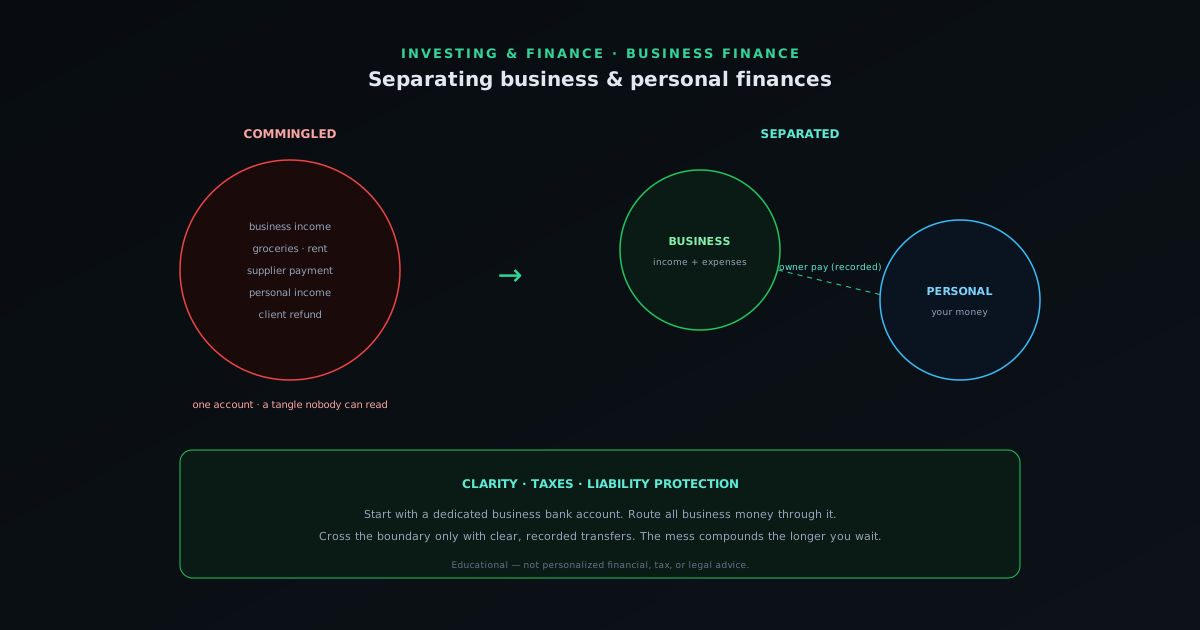
The single most important and foundational step in separating finances is opening a dedicated business bank account, separate from your personal accounts, through which all business income and expenses flow. This one account does most of the work of separation: business money comes into it, business expenses go out of it, and personal money stays in personal accounts. With this in place, the business's transactions are automatically segregated, which is the basis of clean books, easier taxes, and the financial separation that liability protection depends on. Everything else in separating finances follows from having this dedicated account as the hub of business money.
Opening a business account is straightforward and the requirements vary by where you are and your business structure, but the principle is universal: business money lives in its own account. Once it exists, the discipline is to route all business income into it and pay all business expenses from it, resisting the convenience of dipping into personal accounts for business costs or vice versa. This single habit (all business money through the business account) is the foundation that makes the finances genuinely separate rather than nominally so. For a new business, opening this account should be one of the first administrative steps, before the commingling habit forms, since it is far easier to start clean than to separate tangled finances later. The dedicated business bank account is where financial separation begins and largely lives.
A business card and how money moves
Complementing the business bank account, a dedicated business payment card (debit or credit) makes it easy to keep expense payments separate, since every swipe on the business card is automatically a business transaction recorded in the business account. This removes the friction that leads to commingling: instead of having to remember to treat a personal-card purchase as a business expense, the business card makes business purchases business purchases by default. The card and the account together create a system where business spending naturally flows through business channels, which is what makes separation a default rather than a constant act of discipline.
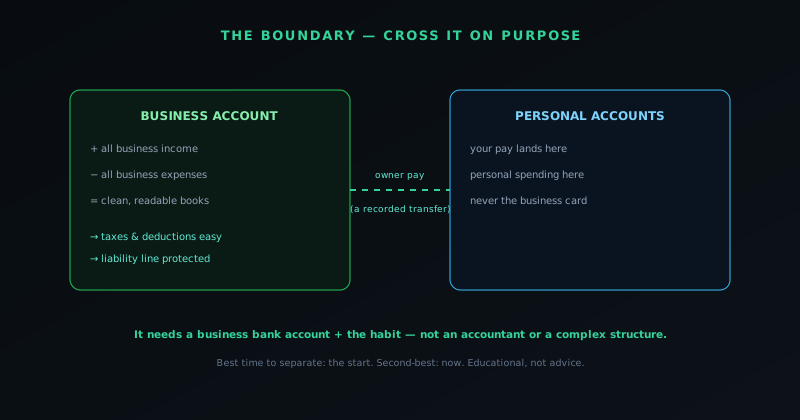
The other piece is being deliberate about how money moves between the business and you personally, which should happen through clear, intentional transactions rather than casual mixing. When you take money out of the business for yourself, that should be a defined transfer (a payment to yourself), and when you put personal money into the business, that too should be a clear transaction, so the boundary between business and personal money is maintained even when money legitimately crosses it. This is the difference between separated finances with intentional, recorded transfers across the boundary, and commingled finances where money sloshes between business and personal without distinction. Paying yourself properly through defined transfers, rather than dipping into business funds for personal use, is part of maintaining the separation. The companion guide at Reinvest or pay yourself? A profit allocation framework for small business owners covers how to think about paying yourself, which builds on having the separation in place.
The commingling problem in practice
To see why separation matters, it helps to picture the commingling problem in practice: a single account where business income, personal income, business expenses, and personal spending all mix together. At tax time, identifying which transactions were business expenses (and therefore deductible) means combing through months of mixed transactions, trying to remember which restaurant meal was a client meeting and which was dinner, which purchase was for the business and which was personal, a tedious, error-prone process that often results in missed deductions and uncertainty. Throughout the year, knowing whether the business is actually making money is impossible, because its income and costs are tangled with personal cash flow.
The commingling problem compounds over time, because every mixed transaction is a small entry in a growing mess that becomes harder to untangle the longer it goes. A business owner who commingled for a year faces a far worse cleanup than one who commingled for a month, and the one who never commingled faces none. This is why the advice is to separate from the start: the commingling problem is not a single bad transaction but an accumulating tangle that makes the business's finances progressively more opaque and its taxes progressively more painful. Seeing the practical reality of what commingling produces (a mess that obscures the business and complicates taxes) is the clearest motivation for the separation that prevents it, since the alternative to a little upfront setup is an ever-growing financial tangle.
Clean books and easier taxes
The most immediate payoff of separated finances is dramatically cleaner books and easier taxes, because when all business money flows through dedicated business accounts, the business's transactions are already segregated and identifiable. Bookkeeping becomes a matter of categorizing the business account's transactions rather than first separating business from personal across mixed accounts, which is the hard part. At tax time, the business expenses are cleanly identifiable, so deductions are easier to capture and substantiate, and the whole process is faster and less error-prone. The separation does much of the bookkeeping work in advance, just by keeping business money in its own place.
This connects directly to the broader practice of bookkeeping, which depends on separated finances to be feasible: you cannot keep clean books on commingled accounts without first untangling them, while separated accounts give you clean inputs to work with. The companion guide at Bookkeeping before you need an accountant: minimum viable books for a small business covers minimum-viable bookkeeping, which becomes straightforward once finances are separated. The relationship is foundational: separation enables clean books, clean books enable clear financial understanding and easy taxes, and the whole chain starts with keeping business and personal money apart. The easier-taxes benefit alone often justifies the separation, since the time and stress saved at tax time (and the deductions captured rather than missed) repay the small setup effort many times over, which is why separation is the foundation that the rest of a business's financial hygiene is built on.
When to set it up: from the start
The best time to separate business and personal finances is at the very start, before the business generates much activity and before the commingling habit forms, because separating from day one means there is never a tangle to untangle. A new business owner who opens a business account and gets a business card as part of setting up is starting with clean separation, which makes everything downstream (bookkeeping, taxes, understanding the numbers) straightforward from the beginning. Waiting until the business is established, or until tax time forces the issue, means facing a cleanup of accumulated mixed transactions that is far more work than the upfront setup would have been.
If you have already been commingling, the second-best time to separate is now, because the tangle only grows the longer it continues, and stopping the commingling limits the mess to what has already accumulated rather than letting it keep growing. Setting up the separation (opening the business account, moving business activity to it, going forward cleanly) stops the problem from compounding even if it cannot retroactively clean the past. For the past, an accountant or careful effort can help untangle what is needed for taxes, but the priority is to stop adding to the mess. The principle is that separation should happen as early as possible, ideally at the start, and failing that, immediately, because the cost of commingling grows with time while the cost of separating is a small, one-time setup. Earlier is dramatically easier, which is why "from the start" is the ideal and "now" is the answer if you have not yet.
Tracking owner pay and money in
A point that often confuses new business owners is how to handle the legitimate movement of money between the business and themselves once finances are separated, since money does need to cross the boundary: you take pay out, and sometimes you put personal money in. The answer is not to avoid these crossings but to make them clear, defined, recorded transactions rather than casual transfers. When you pay yourself, that is a specific transfer from the business to you, recorded as owner pay or a draw; when you contribute personal money to the business, that is a recorded contribution. The boundary is maintained not by never moving money across it, but by moving it deliberately and recording it, so the business's books reflect exactly what came in, what went out, and what was an owner transfer.
This matters because the clarity of separated finances depends on these crossings being legible rather than muddying the picture. A business account where the owner casually takes money whenever needed, without recording it as defined pay or draws, drifts back toward the commingled mess that separation was meant to prevent, because the books no longer clearly show what was a business transaction versus an owner withdrawal. Handling owner pay and contributions as clear, recorded transfers keeps the separation meaningful and the books clean, while also giving you an accurate picture of what you are actually paying yourself, which is its own useful information. The exact mechanics of how owner pay should be structured can have tax implications that vary by business structure and jurisdiction, so the specifics warrant a qualified professional, but the principle of making every crossing of the business-personal boundary a clear, recorded transaction holds broadly.
What separation does not require
It is worth clarifying what separating finances does and does not require, because the idea can sound more burdensome than it is and the perceived hassle stops some owners from doing it. Separation does not require an elaborate accounting system, an accountant from day one, or a complex business structure: at its core it requires a dedicated business bank account and the discipline to route business money through it, which is a modest, achievable setup. The foundational separation is genuinely simple: business money in the business account, personal money in personal accounts, clear transfers between them. The sophistication can come later as the business grows; the foundation is just the separate account and the habit.
This is worth emphasizing because the gap between the perceived complexity of "separating your business finances" and the actual simplicity of "open a business account and use it for business" is what causes many owners to delay or avoid a step that is both easy and important. You do not need to have figured out your entire financial system, chosen a business structure, or hired professionals to take the foundational step of separation: you need a business account and the habit of using it. Starting there, with the simple separation, and adding sophistication as the business warrants, is far better than waiting for a complete financial setup that never quite happens while commingling continues. Understanding that the essential separation is simple and achievable now, not a complex undertaking to defer, is what removes the perceived barrier to a step that genuinely benefits nearly every business owner from the start.
Keeping the separation clean over time
Setting up separated finances is the first step, but keeping them separate over time is what actually delivers the benefits, and it requires maintaining the discipline of routing business money through business channels and personal money through personal ones. The system (business account, business card, intentional transfers) makes this mostly automatic, but it still requires not slipping back into convenient commingling: not grabbing the personal card for a business expense because it is in your pocket, not paying a personal bill from the business account because the money is there. The infrastructure makes separation the default, but the habit of using it consistently is what keeps the finances genuinely separate.
The maintenance is easier than it sounds because the system does most of the work: with a dedicated business account and card, business transactions naturally flow through business channels, and the main discipline is simply using the right account or card for each purpose and handling the legitimate crossings (paying yourself, putting money in) as clear, recorded transfers. Over time this becomes second nature, and the payoff (clean books, easy taxes, protected liability, clear understanding of the business) accrues continuously. The separation is not a one-time setup but an ongoing practice that the right infrastructure makes nearly effortless, and maintaining it is what turns the foundational decision to separate into the lasting financial clarity and protection it promises. As always, this is general education; the specific tax, legal, and structural implications for your situation are worth confirming with a qualified professional, but the foundational habit of keeping business and personal money separate serves nearly every business owner.
Frequently asked questions
Quick answers to common questions about this topic.
Why should I separate business and personal finances?
For three reasons: clarity (you can actually see if the business is profitable), taxes (easier filing and captured deductions), and (for businesses structured as separate legal entities) liability protection, which commingling funds can undermine. Separation is a foundational financial habit. This is general education, not advice.
What is the first step to separating my finances?
Open a dedicated business bank account and route all business income and expenses through it. This single account does most of the work of separation; a business payment card complements it by making business purchases business transactions by default.
What is commingling and why is it a problem?
Commingling is mixing business and personal money in the same accounts. It makes books messy and the business's performance unreadable, complicates taxes and risks missed deductions, and can erode the liability protection of entity-structured businesses. The tangle compounds the longer it continues.
When should I separate my business finances?
Ideally from the very start, before commingling becomes a habit, so there is never a tangle to untangle. If you have already been mixing, the second-best time is now; separating stops the mess from growing even if the past still needs cleanup. Confirm specifics with a qualified professional.
Related troubleshooting
Was this page helpful?
Your answer stays in this browser, it is not sent anywhere and no account or cookie is involved.