2026 · Novus Stream SolutionsAbout 11 min readNovus Stream Solutions
Affiliate revenue alongside ads: adding a second income stream without selling out
Display ads pay for traffic; affiliate links pay for trust. Running both on the same site works, but only if you treat recommendations as editorial decisions first and monetization second. Here is the playbook, including what to refuse.
Contents
- 1.Overview
- 2.The economics: cents per visitor versus dollars per conversion
- 3.Picking programs: relevance, reliability, then rate
- 4.Disclosure: legally required, strategically underused
- 5.Placement: links where the decision happens, nowhere else
- 6.The review-content trap
- 7.Tracking what is actually earning
- 8.How the two streams settle into a whole
Overview
A content site running display ads has already made the basic monetization trade: attention for cents. Ads are the broadest possible revenue stream (every visitor contributes a little, regardless of what they came for) and that breadth is their virtue and their ceiling. The rates are what they are, they move with seasons and ad markets you do not control, and the only growth lever is more traffic. Sooner or later every operator of an ad-supported site looks at the numbers and asks the obvious question: is this all the value the audience generates? It is not. Affiliate revenue is usually the second stream, because it requires no product, no inventory, and no checkout, just the thing the site already has, which is readers who trust it enough to act on what it says.
That last clause is the entire subject of this guide. Affiliate income is rented trust. A reader clicks your link and buys because your site vouched for the thing; the commission is the fee for the vouching. Done honestly, it is among the most natural monetization models on the web: you were going to mention tools and products anyway, and the links pay for the lights. Done the way the worst of the industry does it (rankings ordered by commission, reviews of products never touched, superlatives for whatever pays) it converts the audience's trust into cash exactly once, after which both are gone. The playbook below is for the first version: what to join, where the links go, how to disclose, and the specific traps that turn honest sites into commission-chasing ones a little at a time.
The economics: cents per visitor versus dollars per conversion
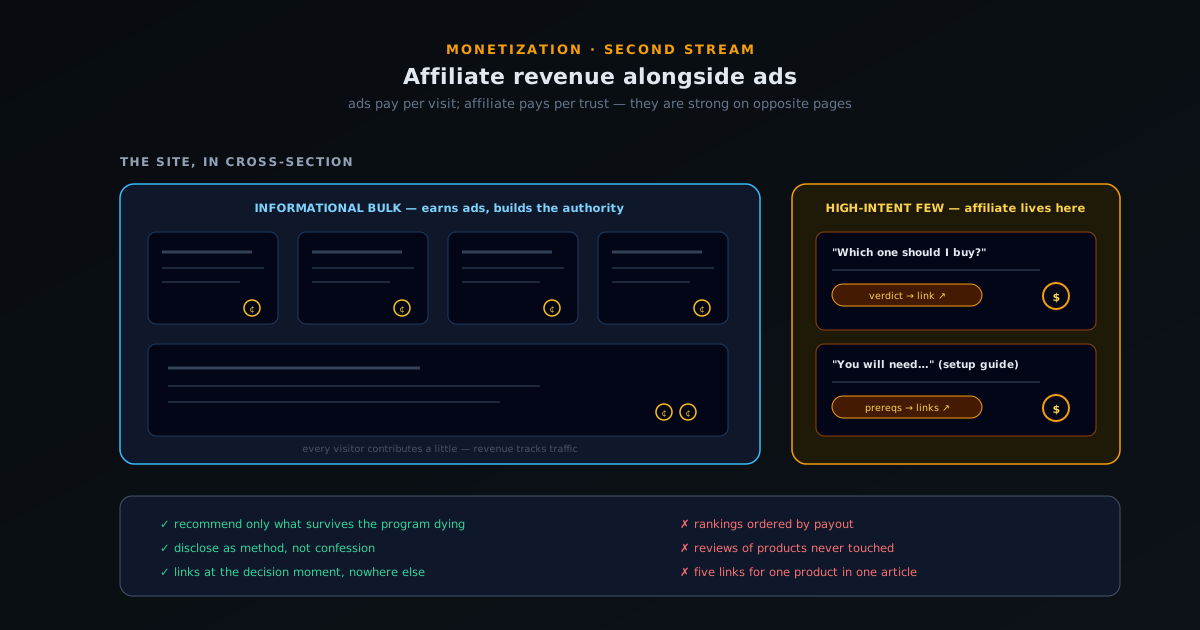
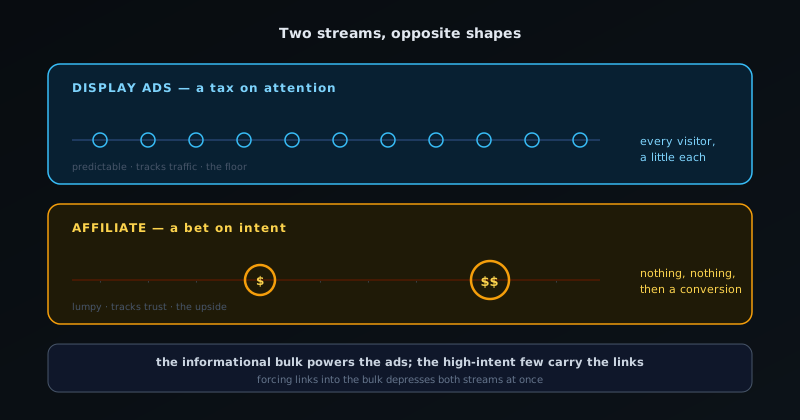
Understand how differently the two streams generate money, because the difference drives every strategic choice. Display ads monetize impressions: every visitor, every pageview, a fraction of a cent to a few cents each, summing to revenue that tracks traffic almost linearly. Affiliate monetizes conversions: nothing, nothing, nothing, then a purchase that pays anywhere from pennies to hundreds of dollars depending on the program. Ads are a tax on attention; affiliate is a bet on intent. This means the two streams are strong on opposite pages. An informational article read by ten thousand people with no purchase intent earns real ad money and near-zero affiliate money. A "which one should I buy" page read by three hundred people who are deciding right now can out-earn it tenfold through links while its ad revenue rounds to nothing.
The portfolio consequence: you do not spread affiliate effort evenly across the site, and you do not need affiliate-suitable topics everywhere. The bulk of a healthy content site remains informational, earning ads and building the authority that makes anyone care about its recommendations. A minority of pages (the comparisons, the setup guides that involve buying something, the "what we use" resources) carry intent, and that is where affiliate work concentrates. Trying to force links into the informational bulk produces the worst of both worlds: clutter that depresses the reading experience (and with it the ad-earning traffic) while converting nobody. The first practical step is simply an inventory: which of your existing pages have readers with wallets open? Those pages, usually a single-digit percentage, are the affiliate surface. Everything else is the trust engine that powers it.
Picking programs: relevance, reliability, then rate
Program selection is where the commission-chasing rot usually starts, so fix the selection criteria in advance, in writing if you have to. The first filter is relevance: the product must be something your audience genuinely needs in the context where you would mention it, and (the stricter version of the test) something you would link to anyway if no program existed. If a mention would not survive the program shutting down, it should not exist. The second filter is reliability, which has two faces: the product's (you cannot vouch for junk, whatever it pays) and the program's: tracking that actually attributes, cookies that last a realistic decision cycle, payouts that arrive, and terms that do not let the merchant retroactively re-rate your traffic to zero.
Commission rate comes third, and treating it third is not piety: it is math. A high-commission product your audience does not want converts at zero, and zero times a generous percentage is zero. A modest commission on something your readers were already going to buy, through a program that tracks honestly, compounds quietly for years. When two programs offer the same product (a merchant directly and a marketplace, say), then yes, compare rates, cookie windows, and payout reliability and take the better deal: optimizing the offer for an existing honest recommendation is just business. What the rate must never do is select which products get recommended or which gets the superlative. The moment ordering follows payout, the content has become advertising wearing a review costume, and audiences detect that costume faster than operators believe.
Disclosure: legally required, strategically underused
The legal baseline is not ambiguous: consumer-protection regulators in most jurisdictions (the FTC in the United States most prominently) require that material connections be disclosed clearly and conspicuously, meaning before or adjacent to the links, in plain language, not buried in a footer policy nobody opens. "Clearly" has teeth: a vague "this site may contain affiliate links" hidden below the fold does not satisfy anyone, and ad-network and program terms typically layer their own disclosure requirements on top. The compliance floor, then: a short, visible note at the top of any page containing affiliate links, plus the fuller policy page it links to. This is table stakes, and the sites that resent it are telling on themselves. The exact wording, the regulatory specifics, and where the notice physically goes get their own deep treatment in Affiliate disclosures done right: the rules, the wording, and where they go.
The strategic move is to stop treating disclosure as a confession and start writing it as a statement of method, because a good disclosure is one of the few places a site gets to explain its own incentives, and explained incentives are the foundation of credibility. Compare "this post contains affiliate links" with: "If you buy through links on this page we may earn a commission. It costs you nothing, it does not decide what we recommend (our picks are set before we check who has a program) and it is how this site stays free." The second version takes three sentences, satisfies every regulator, and actively builds the trust the links depend on. Readers do not punish sites for earning money; they punish sites for hiding how. The operators who have run both versions report the same result: honest, specific disclosure does not reduce click-through. It tends to raise it.
Placement: links where the decision happens, nowhere else
With programs chosen and disclosure written, placement is the craft that decides whether the stream actually flows. The principle: affiliate links belong at the moment of decision, in the reader's path, and almost nowhere else. In a comparison article, that is the verdict section and the per-product summaries: the places a decided reader looks for the door. In a tutorial, it is the prerequisites block ("you will need…") where the reader is literally assembling a shopping list. In a resources page, it is the entire page, which is fine, because the reader came to be pointed at things. What converts is the link that appears exactly when the reader has formed the intent the link serves.
What does not convert (and what corrodes) is everything else: the same product linked five times in one article, links on every passing mention of anything purchasable, exit popups, and the paragraph that exists only to justify a link's presence. Each is a small withdrawal from the reading experience, and the reading experience is what the ad half of your revenue and all of your return visits are built on. There is also a layout interaction worth managing deliberately: affiliate-heavy pages already carry your display ads, and stacking aggressive ad density on top of link density produces the cluttered, grabby page that converts worst of all. On high-intent pages, consider thinning the ad load and letting the links do the earning: per session, on those pages, they usually earn more than the impressions they displace.
The review-content trap
The strongest gravitational pull in affiliate publishing is toward review and best-of content, because that is where the high-intent queries are, and it is also where sites destroy themselves, so the trap deserves its own section. The trap has a mechanism: best-of pages earn, so you write more of them; the niche only contains so many products you genuinely know; so the next pages get written from spec sheets and other people's reviews; rankings start to drift toward programs and payouts because nothing else is anchoring them; and within a year the site is a commission catalog with a content site's former reputation. No single step felt like the decision. That is what makes it a trap rather than a choice.
The defenses are structural. Cap review content as a fraction of output and keep the informational majority: the cap protects the authority that makes reviews worth anything. Refuse to rank what you have not used; an honest "these are the three we have real experience with, and here is what we would look at among the rest" outperforms a confident fake top-ten on every timescale longer than a quarter, especially as search systems get steadily better at detecting experience-free review content and have made experience an explicit quality signal. Write the negative findings; a review corpus with no criticism reads as the catalog it is. And when a merchant offers a sponsored placement dressed as a review slot, recognize it as a different product entirely: that is advertising, it has its own disclosure rules, and mixing it into editorial rankings is the one-way door. The sites that hold these lines discover the compounding prize: in a niche full of catalogs, the one honest reviewer becomes the default recommendation engine, which is the entire affiliate game won.
Tracking what is actually earning
Affiliate dashboards tell you what each program paid; they do not tell you which page, which link, or which recommendation did the earning, and without that attribution you cannot manage the system: you can only watch it. The minimum viable instrumentation is link-level identifiers: most programs support a sub-ID or campaign parameter on the link, and the discipline of tagging every link with its page (and position, if you want finer grain) turns the payout report into a page-performance report. Combine it with your analytics' outbound-click events and you have the full funnel per page: visits, link clicks, conversions, revenue. The numbers that matter then fall out naturally: earnings per page, click-through per placement, conversion per program, and their trends.
What the numbers are for is pruning and doubling down, on a quarterly rhythm rather than a daily one (affiliate data is noisy; conversion lag and returns make short windows lie). Pages with traffic and intent but weak link clicks have a placement or copy problem: the recommendation is probably buried. Pages with clicks but no conversions have a program problem: broken tracking, a bad landing page on the merchant's side, or a product the audience inspects and rejects; test the link yourself and reconsider the program. Programs that quietly cut rates or stop converting get replaced under the same relevance-first rules that admitted them. And the occasional page that earns disproportionately is the strategy signal: it marks an intent-rich territory where your vouching carries weight, and it usually has siblings worth writing. The system, reviewed four times a year, steers itself.
How the two streams settle into a whole
Run honestly for a few quarters, the combined model usually settles into a recognizable shape: display ads as the floor (broad, passive, tracking traffic, paying for the infrastructure) and affiliate as the upside (concentrated, editorial, paying for the trust). The ratio varies enormously by niche; a site in a product-dense vertical may see affiliate match or pass ad revenue on a fraction of the pages, while a site in an advice-dense vertical may keep affiliate as a modest supplement forever. Both outcomes are fine. The point of the second stream was never to replace the first; it was to stop leaving the highest-intent fraction of the audience's value uncollected, and to diversify revenue that previously moved entirely with one ad market's mood.
The closing test is the one to keep: would the content survive the money disappearing? If every program shut down tomorrow, an honest site would lose income and keep every recommendation; a captured site would have nothing left to say. Periodically reread your own top-earning pages with that test in mind, because capture is gradual and self-administered audits are the cheap way to catch it. Recommend what you use, link where decisions happen, disclose like you mean it, cap the review gravity, and measure enough to prune. That is the entire playbook: unglamorous, durable, and compatible with the only asset that makes any of it work: an audience that still believes you.
- Join programs for things you already recommend; the link must survive the program dying.
- Concentrate links at decision moments; keep the informational majority clean.
- Disclose specifically and visibly: method, not confession.
- Never rank by payout; never review what you have not used.
- Tag every link, review quarterly, prune programs that stop converting.
Frequently asked questions
Quick answers to common questions about this topic.
Can I run affiliate links and display ads together?
Yes. They monetize different things (ads pay on impressions, affiliates on referred purchases) and can coexist. The key is keeping the page useful first so neither degrades the reader experience.
How do I add affiliate income without losing trust?
Only recommend things you would genuinely endorse, disclose the relationship clearly, and keep the content honest about downsides. Trust is the asset; an affiliate link that misleads spends it down fast.
Do I need to disclose affiliate links?
Yes. Clear disclosure is both an ethical norm and a legal requirement in many places. A short, visible note that a page contains affiliate links is standard practice.
Related troubleshooting
Was this page helpful?
Your answer stays in this browser, it is not sent anywhere and no account or cookie is involved.