2026 · Novus Stream Solutions (hub)About 11 min readNovus Stream Solutions
Affiliate disclosures done right: the rules, the wording, and where they go
Affiliate disclosure is the cheapest compliance work in online business and the most commonly botched. This is what the FTC and ASA actually require, where a disclosure has to sit, wording that reads like a person rather than a legal department, and why clear disclosure costs far less conversion than most site owners fear.
Contents
Overview
I earn affiliate commissions on this site, and I tell readers so before they click anything. That sentence took me about four seconds to write, costs me almost nothing in revenue, and puts me on the right side of two regulators and (more importantly) every reader who would have felt tricked discovering the relationship on their own. Yet affiliate disclosure remains the most consistently fumbled piece of compliance in small online publishing. Sites bury it in a footer page nobody visits, dress it in legalese nobody reads, or skip it entirely on the theory that everybody already knows how the internet works.
The fumbling is rarely malicious. Most operators genuinely intend to be upfront; they just absorbed their disclosure habits from other sites that were doing it wrong, and nobody ever showed them the actual rules. The actual rules turn out to be short, sensible, and easier to satisfy than the half-measures people invent to avoid them. A clear sentence in the right place beats a lawyered paragraph in the wrong one, every single time.
So this guide is the version I wish someone had handed me when I added my first affiliate link: what the FTC and the ASA actually require, what counts as a material connection, where on the page a disclosure has to live, how to word it so it sounds like you, and what the evidence says about the conversion cost, which is far smaller than the folklore suggests. It sits alongside the wider economics piece at Affiliate revenue alongside ads: adding a second income stream without selling out, which covers when affiliate income is worth adding at all.
What the regulators actually require
In the United States, the governing text is the FTC’s Endorsement Guides. Stripped of citations, they say one thing: if there is a material connection between you and a product you are endorsing (money, free stuff, a commission on sales), you must disclose it clearly and conspicuously, close enough to the endorsement that a reader sees both together. “Clearly and conspicuously” is the load-bearing phrase. A disclosure that technically exists but that an ordinary reader would miss does not count; the FTC has said explicitly that burying the notice in a terms page, below the fold, or behind a “more” link fails the standard.
In the UK, the ASA and CAP Code approach the same problem from a different angle: content that is remunerated and controlled by an advertiser must be obviously identifiable as advertising before the reader engages with it. For a typical affiliate arrangement (you choose what to write, the merchant just pays a commission), the bar is disclosure of the commercial relationship, and the regulator has been blunt that vague labels like “supported by” or a lone hashtag buried among twenty others do not make anything obvious. The EU’s consumer-protection rules and most other English-speaking jurisdictions land in roughly the same place.
Notice what neither regulator asks for: nobody requires a specific legal formula, a popup, an interstitial, or a paragraph of boilerplate. The entire requirement is honest, visible, timely. That is worth internalizing, because most bad disclosure practice is over-engineering in the wrong dimension (more words, less visibility) when the rules want the opposite: fewer words, more visibility.
The material-connection test
The threshold question is whether a material connection exists, because that is what triggers the duty. The test is simpler than people make it: would knowing about the relationship change how a reasonable reader weighs your recommendation? Cash obviously qualifies. So does a percentage commission on referred sales, which is the entire affiliate model. But the net is wider than money, and this is where honest operators get caught out.
A free product sent for review is a material connection even if no money changes hands and even if the sender attached no conditions. A heavily discounted subscription, an early-access arrangement, a contest entry for posting, an ownership stake, a family member on the vendor’s payroll: all of it qualifies. The unifying idea is that the reader is entitled to know anything that might be pulling your thumb toward one side of the scale, and then to discount your endorsement however they see fit.
What does not require disclosure is just as useful to know. A product you bought at retail with your own money and chose to praise carries no connection. A plain link to something with no tracking parameter and no commission is just a link. And you do not need to disclose on pages that contain no endorsement at all: a disclosure blanket-stapled to every page of a site is noise, and noise trains readers to skip the notice on the pages where it matters.
- Commission on referred sales: the core affiliate case, always disclosable.
- Free or discounted products, services, or subscriptions received from the vendor.
- Payment for placement, sponsored posts, or “review units” with or without strings.
- Equity, employment, or a close personal relationship with the company.
- Not disclosable: products you bought yourself, plain untracked links, genuine unpaid enthusiasm.
Where the disclosure has to go
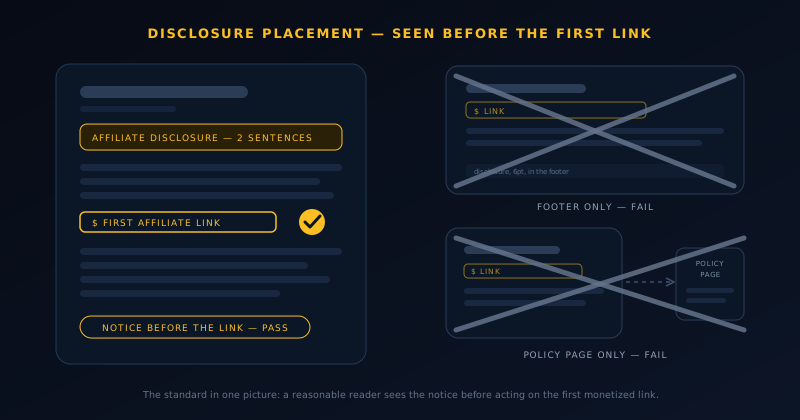
Placement is where most disclosure fails, so here is the operating rule I use: the reader must be able to see the disclosure before they can act on the first affiliate link. On an article, that means a short notice above the fold, before or immediately under the point where monetized links begin, not at the bottom of the post, not in the site footer, and never solely on a separate “disclosure policy” page. The policy page is fine as a supplement that explains the detail; it fails as the only notice because regulators judge what a reader actually encounters on the page they landed on.
Search and social traffic make this concrete. Most readers arrive mid-site, read one page, and leave; whatever disclosure exists only on your homepage or about page might as well not exist for them. The same logic applies within long pages: if a comparison table with affiliate links sits three screens down, a second short reminder near the table costs one line and removes any argument that the reader had scrolled past the notice and forgotten it.
Different surfaces have their own physics. In a video, the disclosure belongs in the spoken content or on screen, because descriptions go unread. In email, it belongs in the body near the links, not in the footer next to the unsubscribe. On social posts, the platform’s paid-partnership label or a leading #ad does the work, leading, because a hashtag buried at position nineteen is exactly the pattern the ASA keeps ruling against. The common thread across every format: proximity to the endorsement, visibility without effort.
Wording that sounds like a person
Once placement is right, wording is mostly a matter of resisting the urge to hide. The strongest disclosures are short, specific, and written in your own voice: “If you buy through links on this page, I earn a commission at no extra cost to you. I only recommend tools I actually use.” Two sentences, no legal department, and it does double duty: it satisfies the rule and it communicates editorial standards, which is why well-worded disclosure so often reads as a trust signal rather than a confession.
The failure modes are euphemism and fog. “This post may contain affiliate links” is weak on two counts: “may” pretends you do not know your own page, and the sentence never says what an affiliate link means for the reader. Abbreviations like “sp,” “spon,” or “collab” have been explicitly called out by regulators as inadequate. And a paragraph of defensive boilerplate is its own failure: readers skip long notices, and a skipped notice protects nobody.
One more wording principle earns its keep: state the reader’s cost, because that is the fact they care about. Affiliate commissions come out of the merchant’s margin, not the buyer’s price, and saying “at no extra cost to you” answers the question the disclosure just raised. Precision matters in the other direction too: if you did get the product free, say that plainly rather than folding it into generic commission language. Each connection gets named for what it is.
- Good: “If you buy through links here, we earn a commission at no extra cost to you.”
- Good: “The vendor sent us a free review unit; they had no say in this review.”
- Weak: “This post may contain affiliate links”, vague on both fact and meaning.
- Failing: “sp,” “collab,” “#ad” buried mid-hashtag-pile, or footer-only boilerplate.
The conversion fear, measured against reality
The reason disclosure gets buried is almost never ignorance of the rules; it is fear that a visible label will scare off clicks. Having run monetized pages for years, I think that fear misreads how readers actually behave. The person who arrives at a comparison page wants a recommendation; the disclosure does not change what they came for. What changes behavior is bad recommendations. In my own numbers, adding a clear top-of-page disclosure to previously under-labeled pages produced a click-through dip so small it disappeared into weekly noise, while pages with the strongest, most specific disclosures remain among the best converters, because specificity reads as confidence.
The intuition generalizes. Readers in 2026 know affiliate links exist; the disclosure rarely tells them anything they had not assumed. What it tells them is that you are the kind of operator who says so. Meanwhile the downside of concealment is not symmetrical: a reader who feels a page hid its incentives does not just skip one link, they discount the whole site, and occasionally they say so publicly. You are trading a rounding error of clicks against a tail risk to the asset that makes any of the clicks valuable.
It also helps to size the stakes honestly. For most content businesses the affiliate line is one stream among several; the arithmetic in CPM, RPM, and what actually pays makes the general point that per-visitor revenue is small and trust-dependent everywhere. A disclosure policy that shaved even a few percent off affiliate conversion, which is more than I have ever measured, would still be cheap insurance for the franchise. The same reasoning drives our display placements, covered in Ad placement that respects the reader: reader-hostile optimizations never pay for what they cost.
Build a system, not a habit
Good intentions decay, so disclosure should be structural. On this site the notice is a component: any article flagged as containing monetized links renders the disclosure block above the body automatically, with the standard wording in one place so improving it once improves it everywhere. If your stack is a CMS, the equivalent is a reusable block plus an editorial checklist item; if your content lives in code the way ours does, it is a field on the post type. The goal is that a compliant page is the default output of your pipeline, not an act of remembering.
Two supporting pieces round out the system. First, a real disclosure policy page (linked from the short in-article notice) where you explain which programs you belong to and how you choose what to recommend; supplemental, remember, never the sole notice. Second, a periodic audit: once a quarter I search the site for the affiliate domains and tracking parameters we use and check each hit against the pages that carry the disclosure component. It takes twenty minutes and it has caught real gaps, usually old posts that gained a link in a later edit.
If you syndicate or repurpose content, the system has to travel with it. An article that is compliant on your domain can become non-compliant when its middle section is republished in a newsletter without the header, or when a excerpt lands on social with the links intact and the label gone. The check is simple: wherever the monetized link goes, the disclosure goes.
The mistakes I still see everywhere
A short field guide to the recurring failures, so you can pattern-match your own site against them. The footer-only disclosure: present, invisible, non-compliant. The policy-page-only disclosure: same defect at one remove. The post-position disclosure, where the notice appears after the last affiliate link; timing matters, and a label the reader meets on the way out disclosed nothing. The hover disclosure, where the relationship is revealed only in a tooltip or title attribute; regulators evaluate what an ordinary reader sees, and nobody hovers.
Subtler variants: the disclosure that is technically above the fold but styled into camouflage, six-point gray-on-gray in a region banner blindness has taught everyone to skip. The “may contain” hedge on a page you wrote and monetized yourself. The disclosure written once in 2022 that no longer matches the programs you actually run. And the inverse mistake, over-disclosure: stapling warnings to every page including the ones with nothing to disclose, which converts a meaningful signal into wallpaper.
None of these failures survives contact with the one-sentence standard the rules boil down to: a reasonable reader, on this page, sees the notice before acting on the link, and understands what it means. Hold every page to that sentence and the rest of the guidance is commentary. It is genuinely rare, in the compliance world, for the right thing to also be the cheap thing; the full reference for how we run the rest of the portfolio honestly lives at Documentation, but disclosure is the piece I would fix first on any site, because it costs a sentence and buys back the asset everything else depends on.
Frequently asked questions
Quick answers to common questions about this topic.
Do I legally have to disclose affiliate links?
In the US, yes: the FTC’s Endorsement Guides require clear and conspicuous disclosure of any material connection, and a sales commission is a material connection. The UK’s ASA and CAP Code, EU consumer-protection rules, and most comparable jurisdictions impose an equivalent duty. Enforcement against small publishers is rare, but the rules apply regardless of size, affiliate networks require compliance in their terms, and the practical cost of complying is a single visible sentence, so the risk-reward on skipping it is terrible.
Where should an affiliate disclosure be placed on the page?
Before the reader can act on the first affiliate link: in practice, a short notice near the top of the article, above or immediately below the point where monetized links begin. A site-footer notice or a separate disclosure-policy page does not satisfy the standard on its own, because readers arriving from search see only the page they landed on. For long pages, add a one-line reminder near link-heavy sections like comparison tables; for video, email, and social, put the disclosure where that format’s reader actually looks.
What wording should I use for an affiliate disclosure?
Short, specific, and in your own voice. Something like: “If you buy through links on this page, we earn a commission at no extra cost to you. We only recommend tools we actually use.” Avoid “this post may contain affiliate links” (it is vague about both the fact and the meaning) and avoid abbreviations like “sp” or “collab,” which regulators have called inadequate. If you received a free product rather than a commission, say that specifically instead of using generic wording.
Will a visible disclosure hurt my affiliate conversion?
Far less than the folklore claims, and possibly not at all. Readers arriving at a recommendation page already assume monetization; a clear label rarely tells them anything new, while it does signal editorial honesty. In my own testing, moving disclosures from buried to prominent produced changes indistinguishable from weekly noise. The asymmetry is what matters: the measurable cost of clarity is near zero, while a reader who feels deceived discounts the entire site, which is the asset every future click depends on.
Do I need to disclose a product I received for free?
Yes. A material connection is anything that might reasonably affect how a reader weighs your endorsement, and a free review unit qualifies even if no money changed hands and the vendor attached no conditions. The same goes for deep discounts, early access, contest entries, equity, or a close relationship with the company. What you never need to disclose is a product you bought at full price with your own money: genuine unpaid enthusiasm carries no connection and needs no label.
Related troubleshooting
Was this page helpful?
Your answer stays in this browser, it is not sent anywhere and no account or cookie is involved.