2026 · Novus Stream Solutions (hub)About 12 min readNovus Stream Solutions
Landing pages that convert without dark patterns
Fake countdowns, confirm-shaming, and hidden fees can nudge a click, and quietly cost you the trust that drives real conversion. Honest landing pages convert better over time. Here is what actually works and why dark patterns backfire.
Contents
Overview
There is a persistent belief that high-converting landing pages require manipulation (the fake countdown timer, the "no thanks, I don't want to save money" opt-out, the price that balloons with hidden fees at checkout), and it is both wrong and costly, because these dark patterns extract a short-term click at the expense of the trust that drives real, durable conversion. A dark pattern is a design that tricks or pressures a visitor into doing something they would not freely choose, and while such tactics can produce a momentary bump in a narrow metric, they damage the relationship with the visitor in ways that cost more than they gain over any meaningful time horizon. The premise of this guide is that you do not need them: honest landing pages convert better over time, by earning the trust that makes a visitor comfortable saying yes.
The reason this matters beyond ethics is that dark patterns are a bad business strategy even setting ethics aside, because they optimize for the wrong thing (the immediate coerced action) while undermining the trust, reputation, and repeat relationship that determine long-term results. A visitor manipulated into a purchase converts once and resents it; a visitor genuinely persuaded by a clear, honest page converts and trusts you, returning and recommending you. This guide covers what dark patterns are and why they backfire, then turns to what actually drives conversion honestly: clarity about the offer, trust signals, a genuinely strong value proposition, and the removal of real friction. The throughline is that the techniques that convert sustainably are the ones that respect the visitor, and the manipulation that seems clever is actually the expensive path that trades durable results for a fragile short-term lift.
What dark patterns are and why they backfire
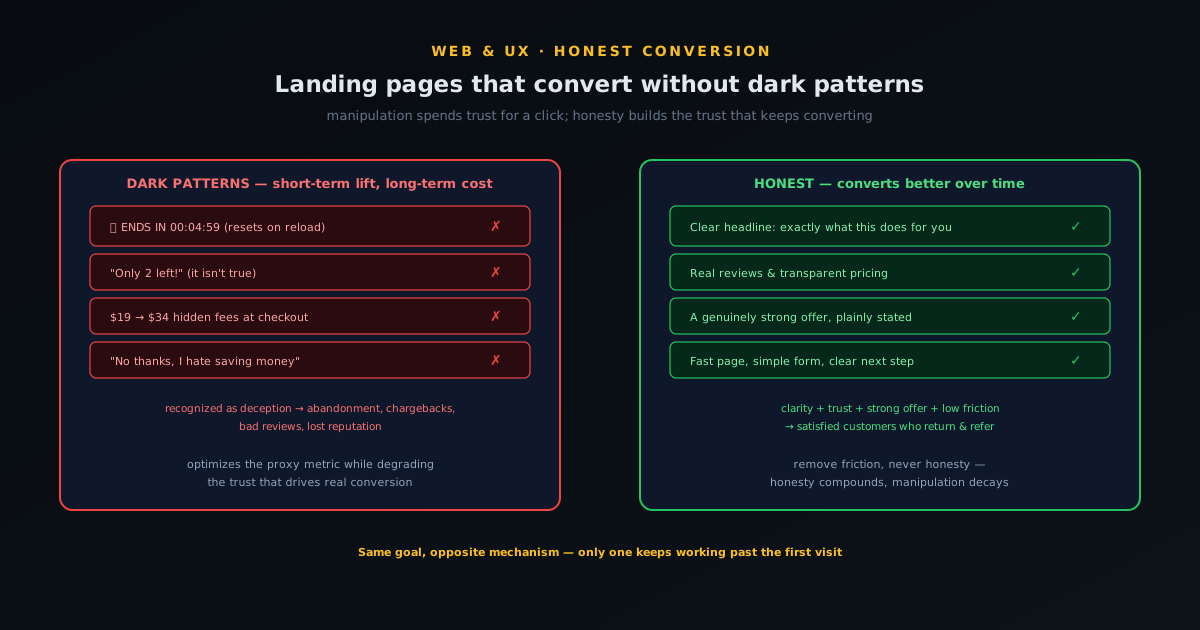
Dark patterns are design choices engineered to manipulate rather than to inform: fake urgency (countdown timers that reset, "only 2 left" claims that are untrue), confirm-shaming (opt-out language designed to make declining feel bad), hidden costs (fees revealed only at the last step), forced continuity (hard-to-cancel subscriptions), and misdirection (making the action you want prominent and the alternative obscured). What they share is that they work against the visitor's interest and informed choice, pressuring or tricking them into an action rather than persuading them to choose it. They can move a short-term metric because pressure and deception do sometimes produce the immediate click, which is why they tempt marketers chasing conversion-rate numbers.
They backfire because the visitor is not actually fooled for long, and the damage outlasts the brief gain. A fake countdown that the visitor recognizes as fake (and many do) instantly signals that the business is willing to lie, poisoning trust in everything else on the page; a hidden fee discovered at checkout produces abandonment and resentment; a manipulated subscription generates chargebacks, cancellations, and angry reviews. The short-term metric improves while the things that actually drive a business (trust, reputation, repeat purchases, word of mouth) degrade, and these degrade in ways that do not show up in the immediate conversion number but show up painfully in the longer-term results. Dark patterns are thus a classic case of optimizing a proxy metric at the expense of the real goal: they make the conversion rate look better today while making the business worse, which is why they are not just unethical but genuinely counterproductive for anyone thinking past the next week.
Clarity converts
The most underrated driver of conversion is simple clarity: a visitor converts when they quickly and easily understand what is being offered, what it does for them, and what they are being asked to do, and they fail to convert when any of that is confusing; confusion is one of the largest, most common conversion killers, and it is entirely honest to fix. A landing page that clearly communicates its value proposition, explains the offer in plain terms, and makes the desired action obvious converts far better than one that is cluttered, vague, or hard to parse, not because of any trick but because clarity removes the uncertainty that makes visitors hesitate and leave. Many pages with poor conversion do not have a persuasion problem; they have a clarity problem, and the visitor left simply because they could not easily tell what was on offer.
Achieving clarity is honest work that respects the visitor's time and intelligence: a clear headline that states the core value, concise copy that explains the offer without jargon or hype, a visible and obvious call to action, and a clean layout that guides attention rather than overwhelming it. None of this manipulates; all of it helps the visitor understand, which is exactly what lets them make the decision to convert. The contrast with dark patterns is instructive: dark patterns assume the visitor must be tricked into acting, while clarity assumes the visitor will act if they understand the value, and the second assumption is both more respectful and, for any genuinely good offer, more effective. Investing in making a page genuinely clear is usually the highest-return conversion improvement available, and it is the opposite of manipulation: it is helping the visitor see clearly enough to choose. The copy craft behind this clarity is covered in Writing product descriptions that actually sell.
Trust is the real conversion lever
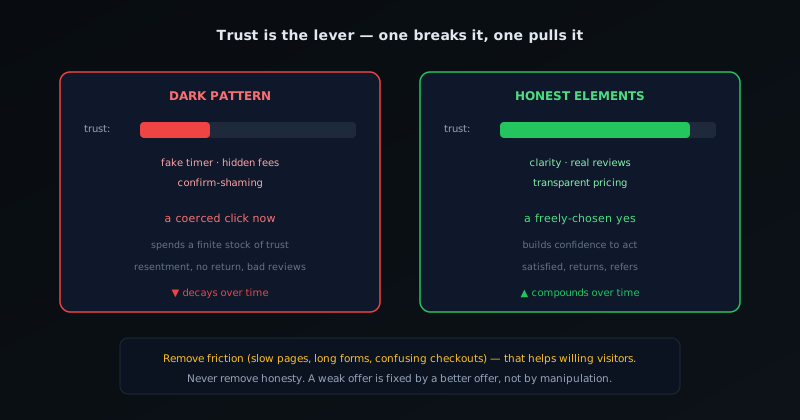
Underneath every conversion is a question of trust (does the visitor trust the business enough to give it their money or their information), and building genuine trust is the most powerful and most honest conversion lever there is, the direct opposite of the trust-destroying dark patterns. A visitor who trusts the business converts readily; a visitor who does not will hesitate regardless of how clever the page's tricks are, and in fact the tricks themselves erode the trust that would have produced the conversion. Honest trust signals (real customer reviews and testimonials, clear and fair policies on returns and privacy, transparent pricing with no surprises, visible evidence that the business is legitimate and reliable) build the confidence that lets visitors say yes, and they do so durably because they are true.
The crucial point is that real trust signals and dark patterns are not just different but opposed: every honest trust signal builds the confidence that drives conversion, while every dark pattern spends that confidence for a short-term click, so a page that relies on manipulation is undermining the very lever that would convert better. Transparent pricing converts better than hidden fees because it builds trust rather than betraying it at checkout; genuine reviews convert better than fake urgency because they are credible rather than insulting; clear policies convert better than forced continuity because they reassure rather than trap. The businesses that convert best sustainably are those that have made themselves genuinely trustworthy and made that trustworthiness visible, which is why investing in real trust (and displaying it honestly) outperforms any manipulation over time. Trust is the lever; dark patterns break it; honest trust signals pull it, and the choice between them is the choice between a fragile short-term bump and durable conversion.
A genuinely strong offer
No amount of page optimization, honest or otherwise, compensates for a weak offer, and one reason businesses reach for dark patterns is that they are trying to manipulate visitors into accepting something that is not actually compelling: the manipulation substitutes for the persuasion that a strong offer would not need. The most fundamental conversion driver is the strength of what is being offered: a product or service that genuinely solves a problem, at a fair price, presented so its value is clear, converts because visitors actually want it, which is the only sustainable basis for conversion. When the offer is strong, the page's job is simply to communicate it clearly and build the trust to act on it; when the offer is weak, no page can honestly sell it, and the temptation to resort to tricks grows.
This reframes a lot of conversion struggle: a page converting poorly may not need better tactics but a better offer, and effort spent on manipulative optimization would be better spent making the underlying offer more compelling: improving the product, sharpening the value proposition, adjusting the price, or better matching the offer to what the audience actually wants. The strongest landing pages are strong largely because they present strong offers clearly and trustworthily, not because of conversion trickery layered on top. So the honest path to conversion starts before the page, with the offer itself, and a business confident that it has something genuinely worth buying can convert with nothing but clarity, trust, and the removal of friction; no manipulation required, because the offer does the persuading. The businesses tempted by dark patterns are often those trying to compensate for an offer that is not compelling enough, and the better fix is almost always to strengthen the offer rather than to manipulate visitors into accepting a weak one.
Remove friction, not honesty
There is real, legitimate conversion work in removing friction (the unnecessary obstacles, confusions, and difficulties that cause visitors to abandon before completing an action they were willing to take) and this is entirely distinct from, and opposed to, the manipulation of dark patterns. Friction is the slow-loading page, the overlong form asking for information you do not need, the confusing checkout, the unclear next step, the technical glitch, all things that cost conversions not because the visitor did not want to convert but because the path to converting was needlessly hard. Removing this friction (simplifying forms, speeding up the page, clarifying the flow, fixing what is broken) lifts conversion honestly, by making it easy for willing visitors to do what they already wanted to do.
The distinction between removing friction and using dark patterns is the distinction between helping the visitor and exploiting them: friction removal serves the visitor by clearing the path, while dark patterns disserve the visitor by pressuring them down it. Both affect conversion, but in opposite ways and with opposite long-term effects: friction removal builds a smooth, respectful experience that visitors appreciate and return to, while manipulation builds resentment. Speed in particular is a friction issue with outsized conversion impact: a page that loads slowly loses visitors before any copy can persuade them, so making pages fast is one of the most reliable honest conversion improvements, as covered in Making a browser tool feel instant: the performance budget we hold. The honest conversion playbook is therefore to relentlessly remove the friction that obstructs willing visitors while never removing the honesty that earns their trust, making conversion easy without making it manipulative, which is exactly the combination that converts well and keeps converting.
Test honestly and measure what matters
Improving conversion honestly still benefits from testing, but the discipline is to test honest variations and to measure the outcomes that actually matter rather than the immediate proxy a dark pattern would inflate. A/B testing clearer headlines, stronger trust signals, simpler forms, and better-articulated offers reveals what genuinely helps visitors decide, and because these variations are all honest, whichever wins improves the page without any hidden cost. The contrast with testing dark patterns is that a manipulative variation might win the immediate metric while losing on the metrics that matter, so an honest testing program is one that improves the page on its merits and can trust its results, because they were not bought with trust spent elsewhere.
Measuring what matters means looking past the single-session conversion rate to the outcomes that reveal whether conversions are healthy (whether converted visitors stay satisfied, return, and do not charge back or churn) because a tactic that lifts the immediate rate while raising refunds and complaints has not actually helped. Over a longer horizon, the honest page that converts slightly fewer visitors into far more satisfied customers outperforms the manipulative page that converts more visitors into resentful ones, and only by measuring the downstream outcomes does this become visible. Building a measurement habit that tracks the quality of conversions, not just their count, is what keeps honest optimization honest and prevents the slide toward proxy-chasing that dark patterns represent.
This honest testing discipline also guards against a subtle trap: letting a series of individually small, seemingly harmless optimizations drift collectively toward manipulation. Each tweak that nudges the metric a little (a slightly more urgent phrasing, a marginally more obscured opt-out) can seem defensible alone while the accumulation crosses the line into the dark patterns the page set out to avoid. Measuring the downstream quality of conversions is what catches this drift, because the manipulative accumulation shows up as rising dissatisfaction even as the immediate metric improves. Honest testing is therefore not only about testing honest variations but about watching the right outcomes closely enough to notice if the optimization is quietly trading long-term trust for short-term numbers, the same failure mode as an outright dark pattern, arrived at gradually.
Why honesty compounds
The deepest argument for honest landing pages is that honesty compounds over time while manipulation decays, which means the gap between them widens the longer the time horizon you consider. An honest page that converts through clarity, trust, a strong offer, and low friction produces customers who are satisfied, who return, who recommend the business, and who build its reputation, each honest conversion contributing to a growing base of trust that makes future conversions easier. A manipulative page that converts through tricks produces customers who are dissatisfied, who do not return, who leave bad reviews, and who damage the reputation, each manipulated conversion spending down a finite stock of trust that gets harder to draw on. Over time, the honest approach accumulates advantages while the manipulative one accumulates liabilities.
This compounding is why the choice between honest and manipulative conversion is not a close call once you look past the immediate metric. In a single A/B test measured over days, a dark pattern might win; across the life of a business measured in reputation and repeat customers, honesty wins decisively, because it is building an asset (trust) rather than spending one. The businesses that endure and grow are overwhelmingly those that earned their conversions honestly and compounded the resulting trust, not those that manipulated their way to short-term numbers and exhausted their reputation. So the practical and the principled align: build landing pages that convert through clarity, trust, strong offers, and low friction (respecting the visitor at every step), because that respect is not a constraint on conversion but the foundation of the durable kind, the kind that keeps working and keeps compounding long after the dark patterns would have burned out the trust they depend on. Honest conversion is the better business strategy, not despite being honest but because of it.
Frequently asked questions
Quick answers to common questions about this topic.
What are dark patterns on a landing page?
Design choices that manipulate rather than inform: fake countdown timers, "only 2 left" claims that are untrue, confirm-shaming opt-outs, hidden fees revealed at checkout, and hard-to-cancel subscriptions. They pressure or trick visitors into actions they would not freely choose.
Do dark patterns actually hurt conversion?
They can lift a short-term metric but backfire over any real time horizon. Visitors recognize fake urgency and hidden fees, which destroys trust, drives abandonment and chargebacks, and damages reputation and repeat business, degrading the very things that drive durable conversion.
What converts honestly?
Clarity (a visitor who easily understands the offer converts), genuine trust signals (real reviews, transparent pricing, fair policies), a genuinely strong offer, and the removal of real friction (fast pages, simple forms, clear flows). These respect the visitor and convert better over time.
Is removing friction the same as manipulation?
No. They are opposites. Removing friction helps willing visitors do what they already want by clearing unnecessary obstacles (slow pages, overlong forms, confusing checkouts). Dark patterns exploit visitors by pressuring them. One serves the visitor; the other uses them. Remove friction, never honesty.
Related troubleshooting
Was this page helpful?
Your answer stays in this browser, it is not sent anywhere and no account or cookie is involved.