2026 · Novus Stream Solutions (hub)About 12 min readNovus Stream Solutions
Idempotency and safe retries: no-code automations you can re-run without fear
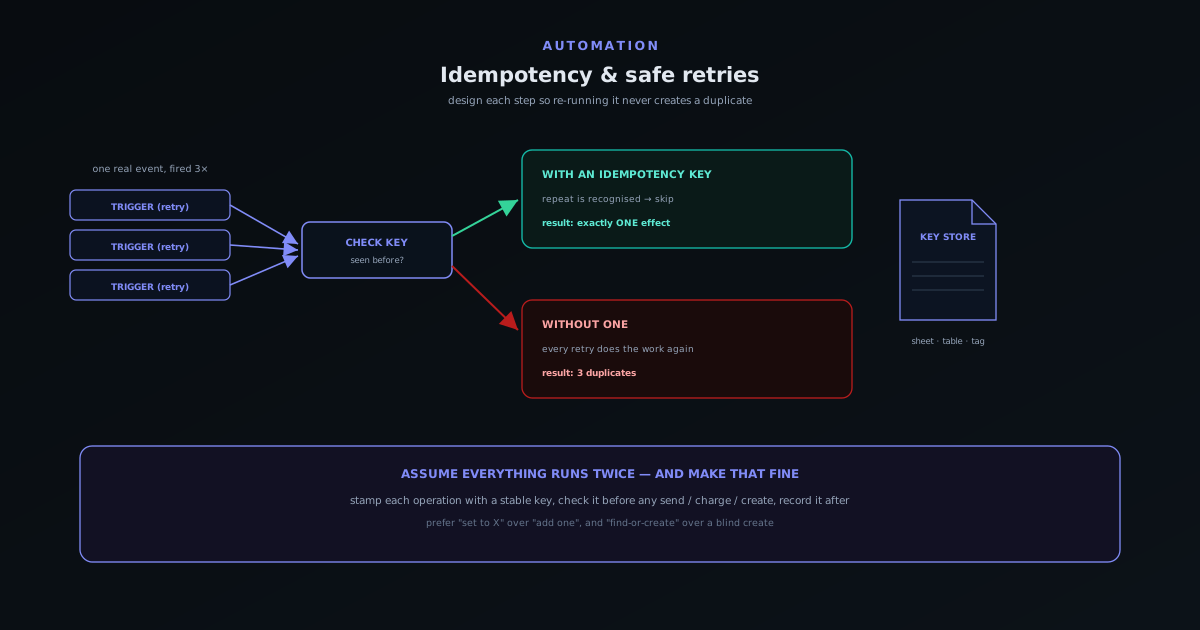
Every no-code automation eventually fails halfway, times out, or fires twice, and the difference between a minor blip and a customer-facing disaster is whether you can safely re-run it. This is a practical, jargon-light guide to idempotency: designing each step so retrying it never creates a duplicate.
Contents
- 1.Overview
- 2.Why your automations fire twice in the first place
- 3.The idempotency key: the one idea to internalise
- 4.Designing each step to be safe to repeat
- 5.Handling the steps you do not control
- 6.A worked example: the welcome email
- 7.Deduplicating at the front door
- 8.Reconciliation: the backstop when prevention fails
- 9.Testing that a step is really safe to repeat
- 10.The mindset shift that prevents the bug
- 11.A practical safe-retry checklist
Overview
There is a quiet category of small-business disaster that almost always traces back to the same root cause: an automation that ran twice. A customer gets the welcome email three times. An order webhook creates two records, so the same parcel ships twice. A "charge the card" step times out, gets retried, and now the customer is charged twice and furious. None of these come from the automation being wrong, exactly; each step did what it was told. They come from the automation not being safe to repeat, and almost every automation eventually does repeat, because the systems they run on retry by design.
The concept that prevents all of this has an intimidating name (idempotency) and a genuinely simple meaning: an operation is idempotent if running it twice has the same effect as running it once. Pressing a floor button in an elevator is idempotent; the floor does not get more selected if you press it five times. Sending an email is not idempotent by default; send it twice and two emails go out. The whole craft of reliable automation is turning the steps that are not naturally idempotent into ones that are, so that when a retry happens (and it will) nothing bad results. This guide is a practical, plain-language walk through how to do that in the no-code tools a small team actually uses, without needing to be an engineer. The same safe-to-repeat discipline carries straight over when you graduate to actual scripts: a batch image pipeline you can re-run without mangling files, for instance, which I build in Automating image workflows with scripts: resize, convert, rename.
Why your automations fire twice in the first place
It helps to understand that retries are not a bug; they are how reliable systems are built, and you benefit from them constantly. When one service calls another over the internet, the call can fail in two very different ways. It can fail cleanly (the other side says "no") in which case nothing happened and a retry is safe. Or it can fail ambiguously: the request went out, but the response got lost, so the caller has no idea whether the work happened. Faced with that ambiguity, well-built systems retry, because the alternative (silently dropping work that might not have completed) is usually worse. The cost of that choice is that the receiving end sometimes sees the same request twice.
In no-code land this shows up everywhere even if you never see the plumbing. A webhook provider that does not get a fast "200 OK" back will resend the event, sometimes several times, so a slow workflow can trigger itself repeatedly on one real event. An automation platform that errors partway through a multi-step flow may re-run from the start when you or it retries. A user double-clicks a submit button. A scheduled job overlaps with its previous run. The unifying lesson is that you should assume every trigger can fire more than once and every step can run more than once, and design so that is fine, rather than assuming the happy path and being surprised when it is not.
The idempotency key: the one idea to internalise
The workhorse technique is the idempotency key, and once it clicks you will see uses for it everywhere. The idea is to attach a stable, unique identifier to each logical operation (derived from the thing itself, not from the moment it ran) and to check whether you have already processed that identifier before doing the work again. For an incoming order, the key might be the order ID. For a "send welcome email" step, the key might be the customer ID combined with the word "welcome". The rule is that the key is the same every time the same logical event recurs, so a repeat is recognisable as a repeat.
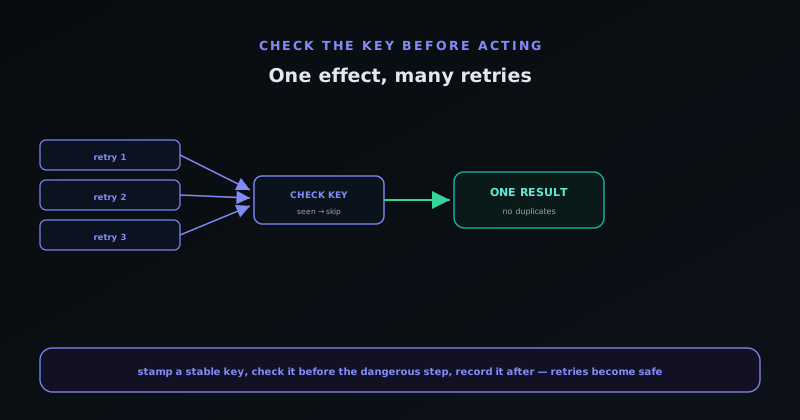
With a key in hand, the pattern is: before doing the work, look up whether this key has been handled; if it has, stop and treat it as already done; if it has not, do the work and record the key as handled. That record can live wherever your no-code stack can store a row: a spreadsheet, an Airtable, a database table, even a tag on the customer record. The technique converts "did this already happen?" from an unanswerable question into a lookup. Payment processors lean on this so heavily that they let you pass an idempotency key with a charge precisely so a retried charge is recognised and not duplicated, which is exactly the protection you want to replicate for your own steps.
Designing each step to be safe to repeat
Beyond the key, it helps to classify your steps by how dangerous a repeat is, because that tells you how much protection each one needs. Some steps are naturally idempotent and need nothing: "set this customer status to active" produces the same state no matter how many times it runs, because it is setting a value rather than incrementing one. Prefer this style wherever you can: "set to X" is safer than "add one" or "append". Some steps are merely wasteful when repeated, like recomputing a value; those you can leave alone or guard lightly. And some steps are genuinely dangerous when repeated (sending messages, charging money, creating records, shipping goods), and those are the ones that must be wrapped in an idempotency check.
A related habit is to make creation steps check-then-create rather than blindly create. Instead of "create a new customer record", do "find a customer with this email; if none exists, create one". Instead of "add a row for this order", do "find a row for this order ID; if none exists, add one". This single reframing eliminates a huge fraction of duplicate-record problems, because the create only happens when the thing genuinely does not exist yet. It is slightly more work to build, but it is the difference between an automation you can re-run with confidence and one you are afraid to touch. The broader point (that the boring operational disciplines are what keep a small business alive) is made in The boring operations that keep a small store alive, and safe retries are squarely one of them.
Handling the steps you do not control
Not every step is yours to make idempotent; you are often calling someone else service, and they may or may not give you the tools. The first thing to do is check whether the service supports idempotency keys natively; many payment, email, and messaging providers do, and using their native support is always better than reinventing it, because they handle the edge cases. Where a provider sends you webhooks, check whether each event carries a unique event ID you can use as your key; most do, and deduplicating on that ID at the very front of your workflow stops a resent event from triggering everything twice.
Where a service offers no help at all, you fall back to your own key store: before calling the uncontrolled step, check your record of what you have already done, and only call it if this is genuinely new. It is also worth designing your workflow so the dangerous, hard-to-undo steps come as late as possible and behind the strongest checks, while the cheap, safe steps come first: that way a retry that re-runs the early steps does little harm before reaching the protected one. And for the genuinely high-stakes actions, consider whether a human checkpoint belongs there at all rather than full automation, a judgement the ecosystem explores in Support automation that stays human: macros, AI drafts, and escalation paths.
A worked example: the welcome email
It helps to walk one common automation all the way through, because the abstract rule becomes obvious once it is attached to a concrete case. Suppose a new customer should receive a welcome email exactly once. The trigger is a new-customer event, which (as established) can fire more than once: the provider might resend it, or a sync might replay it. The dangerous step is the send. So the key is something stable that identifies this logical send, such as the customer identifier combined with the label welcome. Before sending, the automation checks whether that key has been recorded as sent; if it has, it stops; if it has not, it sends and records the key.
The payoff is that no matter how many times the new-customer event fires, the customer gets exactly one welcome email, because the second and third attempts find the key already recorded and quietly do nothing. Notice what the key is not: it is not the time, not a random number, and not the event delivery identifier, because those change on each retry and would let every retry through. It is derived from the thing itself (this customer, this welcome) so that the same logical action always produces the same key. Get that one choice right and the rest of the pattern follows almost mechanically.
Deduplicating at the front door
A particularly high-leverage place to apply the idea is the very entrance of a workflow, before any steps run, because catching a duplicate there protects everything downstream at once. Most webhook providers include a unique identifier for each event they send, and crucially they reuse that identifier when they resend the same event after a missed acknowledgement. So the first action in a webhook-triggered workflow can be: record this event identifier; if it was already recorded, stop the whole workflow here. A resent event then never reaches the steps that would otherwise have run twice.
This front-door dedupe is worth building even when individual steps are already guarded, because it is cheaper and simpler than protecting every step, and it handles the most common cause of double-firing (the resent webhook) in one place. It also makes the workflow easier to reason about: past the front door, you can mostly treat the event as having arrived once, which is a far simpler mental model than assuming every step might run twice. Defence in depth is fine, but a single guard at the entrance does most of the work for the most frequent failure mode.
Reconciliation: the backstop when prevention fails
No prevention is perfect, and a mature approach pairs the up-front guards with a periodic reconciliation that catches anything that slipped through. Reconciliation is simply a scheduled check that looks for the symptoms of a duplicate (two records with the same logical identifier, two charges for one order, two emails logged for one customer) and either flags them for a human or cleans them up automatically. It runs on a cadence rather than in the moment, so it is cheap, and it is the safety net for the rare cases where a key was missed or a race slipped a duplicate past the front door.
The reason to have reconciliation even with good idempotency is that the two operate at different times and catch different failures: the keys prevent duplicates as work happens, while reconciliation detects the residue afterwards. Together they give you both prevention and detection, which is the combination that lets you genuinely trust an automation with money or customers. A small business does not need an elaborate version of this (a daily query that surfaces suspicious duplicates is often enough), but having any backstop turns the rare escaped duplicate from a silent problem into a caught one.
Testing that a step is really safe to repeat
The only way to be confident a step is genuinely idempotent is to test it the way reality will: run it twice and confirm the second run changes nothing. This sounds trivial and is routinely skipped, which is why duplicate bugs are so common. Deliberately fire the same trigger twice, replay the same webhook, or run the workflow from the start a second time on the same input, and then check that exactly one effect resulted: one email, one record, one charge. If two appear, the step is not safe yet, and you have found the bug in testing rather than in front of a customer.
It is worth testing the ambiguous-failure case specifically, since that is the one that bites in production: simulate a step that does its work but fails to report success, then let the retry happen, and confirm the retry does not duplicate. That scenario (work done, acknowledgement lost) is exactly what real retries are responding to, and a step that handles it correctly is one you can genuinely leave unattended. Building this quick double-run check into how you ship automations is the habit that turns idempotency from a concept you understand into a property your workflows actually have.
The mindset shift that prevents the bug
Underneath all the techniques is a single mindset shift that prevents most duplicate bugs before they are written: stop assuming the happy path. The default mental model when building an automation is that the trigger fires once, each step runs once, and everything completes, and that model is wrong often enough to cause real damage. Replacing it with the assumption that any step might run more than once changes how you build from the first line, because you naturally reach for keys, checks, and find-or-create the moment you accept that repetition is normal rather than exceptional.
This is the same shift experienced engineers make about distributed systems generally: failures and retries are not exceptional, they are the ordinary weather, and robust systems are built to be fine in that weather rather than surprised by it. You do not need to understand the theory to get the benefit; you just need to internalise the one assumption and let it guide your defaults. An automation built by someone who assumes everything runs twice is quietly robust in a way that one built on the happy path never is, no matter how carefully the happy path was tested.
A practical safe-retry checklist
Pulling it together, a small set of habits will prevent the overwhelming majority of double-fire incidents without turning you into an engineer. Treat them as a checklist you run when building any automation that touches customers, money, or records. The goal is not theoretical perfection; it is that when a retry happens, the worst case is a harmless no-op rather than a duplicate the customer notices.
The discipline pays for itself the first time a webhook storm hits or a step times out at the wrong moment, because the automation simply shrugs and does the right thing instead of generating a mess you have to apologise for and clean up by hand. Build it in from the start, since retrofitting idempotency after a duplicate-charge incident is far more painful than designing for it up front. And remember the simplest version of the whole idea: assume everything runs twice, and make sure that is fine.
- Assume every trigger can fire more than once and every step can run more than once.
- Give each logical operation a stable idempotency key derived from the thing, not the time.
- Check the key before any dangerous step (send, charge, create, ship); skip if already handled.
- Prefer "set to X" over "add one"; prefer "find-or-create" over blind "create".
- Use providers native idempotency and webhook event IDs wherever they exist.
- Put hard-to-undo steps last, behind the strongest checks; consider a human checkpoint for the highest stakes.
Frequently asked questions
Quick answers to common questions about this topic.
What does idempotency mean in plain terms?
An operation is idempotent if running it twice has the same effect as running it once. Pressing an elevator button is idempotent; sending an email is not. The goal of reliable automation is to make the steps that are not naturally idempotent safe to repeat, because automations inevitably re-run.
Why do my automations fire twice if I only triggered them once?
Because the systems they run on retry by design. When a network call fails ambiguously (the request went out but the response was lost), well-built systems resend it rather than risk dropping work. Webhook providers resend events that do not get a fast acknowledgement, platforms re-run failed flows, users double-click, and scheduled jobs overlap.
What is an idempotency key and how do I make one?
It is a stable, unique identifier for a logical operation, derived from the thing itself rather than the moment it ran, for example an order ID, or a customer ID combined with "welcome" for a welcome email. Before doing the work you check whether that key was already handled; if so you skip, if not you do the work and record the key.
Where do I store the record of handled keys in a no-code tool?
Anywhere your stack can store and look up a row: a spreadsheet, Airtable, a database table, or even a tag on the customer record. The only requirement is that you can check "have I seen this key?" before acting and record the key afterwards.
How do I prevent duplicate records specifically?
Use find-or-create instead of blind create: "find a customer with this email; if none exists, create one" rather than "create a customer". The create only fires when the thing genuinely does not exist yet, which eliminates most duplicate-record problems.
What about steps in a third-party service I do not control?
Check whether the service supports idempotency keys natively (many payment and messaging providers do) and use that. Deduplicate incoming webhooks on their unique event ID. Where there is no help, guard the call with your own key store, and put the most dangerous steps last behind the strongest checks.
Related troubleshooting
Was this page helpful?
Your answer stays in this browser, it is not sent anywhere and no account or cookie is involved.