2026 · Novus Stream Solutions (hub)About 12 min readNovus Stream Solutions
The email automation flows every small store needs
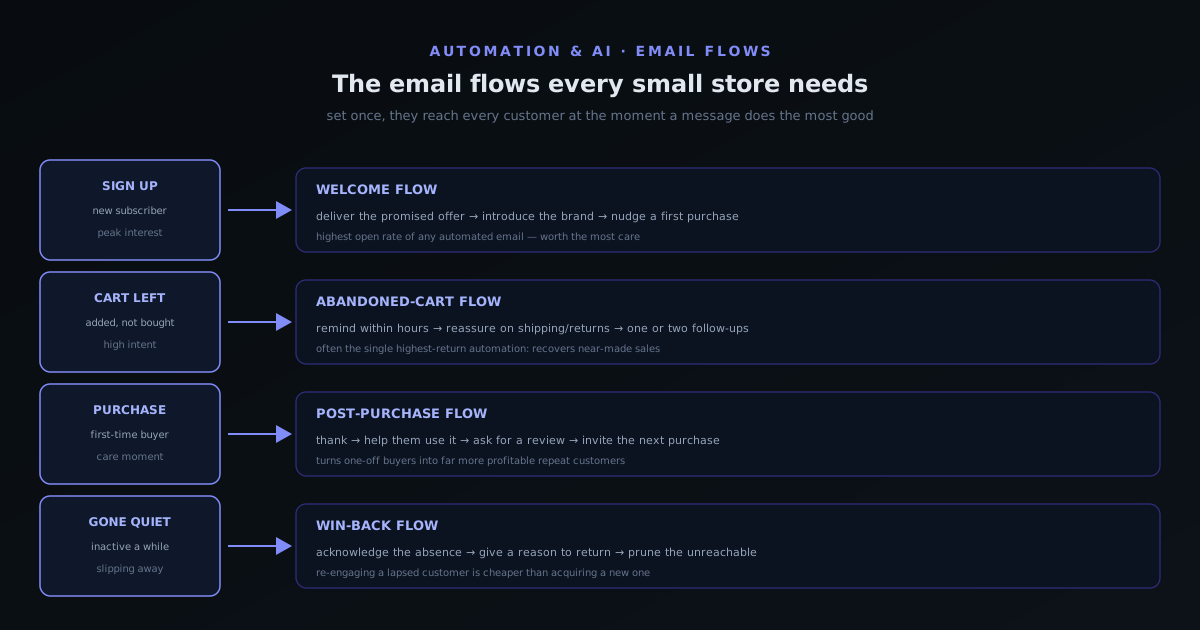
A few automated email flows do the work of a marketing team in the background: welcoming new subscribers, recovering abandoned carts, following up after purchase, and winning back the lapsed. Here is the small-store starter set.
Contents
- 1.Overview
- 2.The welcome flow: start the relationship right
- 3.The abandoned-cart flow: recover lost sales
- 4.The post-purchase flow: turn buyers into repeat buyers
- 5.The win-back flow: re-engage the lapsed
- 6.Automate the timing, keep the human voice
- 7.Start simple and expand
- 8.Segmentation: the natural next step
- 9.Measure, then refine
Overview
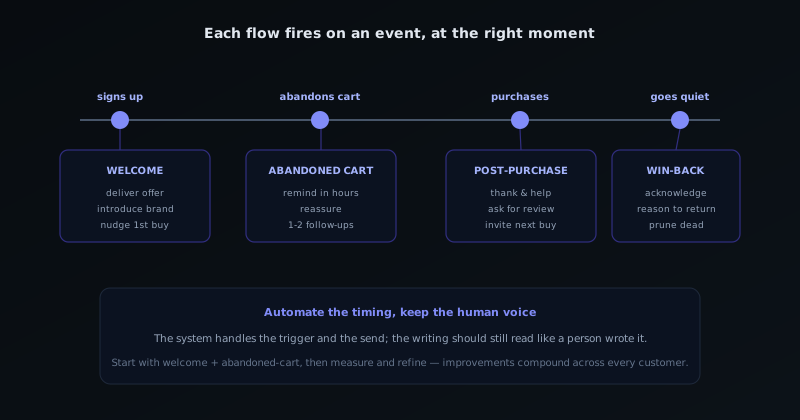
A small store cannot staff a marketing team to email the right message to the right customer at the right moment, but it does not need to, because a handful of automated email flows do exactly that in the background once they are set up. An automation flow is a sequence of emails triggered by a customer action (signing up, abandoning a cart, making a purchase, going quiet) that sends itself, without anyone composing a message each time. Set up once, these flows run continuously, welcoming every new subscriber, chasing every abandoned cart, following up after every purchase, and reaching out to every customer who lapses, recovering revenue and building relationships that a small store would otherwise leave on the table simply because no one had time to send the email manually.
The leverage here is substantial and underused. These flows reach customers at the precise moments they are most receptive (right after they showed interest, right after they bought, right when they are slipping away), which is when an email does the most good, and they do it automatically at any scale, for every customer, without ongoing effort. A store that sends none of these flows is leaving the most valuable, best-timed marketing opportunities unaddressed; a store that sets up even the core few captures revenue and retention that compound over time. This guide covers the starter set of flows every small store should have (welcome, abandoned cart, post-purchase, and win-back): what each does, why it works, and how to approach setting them up without a team, so the automation does the timing and the sending while you do everything else.
The welcome flow: start the relationship right
The welcome flow triggers when someone joins your list, and it is the most important automation because it reaches a brand-new subscriber at the peak of their interest, the moment they just chose to hear from you. At minimum it delivers whatever you promised at signup (a discount code, a guide, early access), but the flow can do more than a single email: a short sequence that welcomes the subscriber, introduces your brand and story, highlights your best products, and gently encourages a first purchase converts new subscribers into first-time buyers while their interest is hot. Because welcome emails see by far the highest engagement of any automated message, this is the flow worth investing the most care in getting right.
A good welcome flow balances warmth and purpose: it makes the new subscriber glad they signed up, sets clear expectations about what they will receive, and creates a natural path to a first purchase without being a hard sell. For a store offering a signup discount, the flow is the vehicle that delivers the code and nudges its use before it is forgotten; for a store offering content, it delivers the content and builds the relationship toward an eventual purchase. The structure can be as simple as a single excellent email or a short sequence of two or three spaced over the first days, but the principle is constant: capitalize on the peak of interest a signup represents by making a strong, welcoming, purposeful first impression. The welcome flow is where a list of addresses begins to become a list of customers, which is why it is the first automation to build. (The list it runs on comes first; see Building an email list from day one for a small store.)
The abandoned-cart flow: recover lost sales
The abandoned-cart flow is, for many stores, the single highest-return automation, because it recovers sales that were nearly made and then lost. Cart abandonment is extremely common (most people who add items to a cart do not complete the purchase in that session, for reasons ranging from distraction to comparison shopping to second-guessing), and the abandoned-cart flow reaches those people shortly after they leave, reminding them of what they left behind and nudging them to finish. Because these are people who demonstrated strong purchase intent by getting all the way to a cart, recovering even a fraction of them adds meaningful revenue from sales that would otherwise simply vanish.
An effective abandoned-cart flow is well-timed and helpful rather than nagging: a first reminder sent within hours of abandonment, when the intent is still warm, often followed by one or two more spaced over the next day or two, each reminding the shopper of the items and making it easy to return and complete the purchase. The messaging can address common abandonment reasons (reassuring on shipping or returns, answering likely hesitations), and some stores include a modest incentive in a later email to tip the wavering shopper over, though leading with an incentive can train shoppers to abandon deliberately. The flow works because of its timing and its targeting: it reaches high-intent shoppers at the moment a gentle reminder is most likely to recover the sale. For a small store, setting up the abandoned-cart flow is often the fastest way to add recovered revenue, which is why it ranks alongside the welcome flow as a must-have.
The post-purchase flow: turn buyers into repeat buyers
The moment after a purchase is one of the most valuable and most neglected in the customer relationship, and the post-purchase flow is what captures it. Triggered when someone buys, this flow confirms the order and sets expectations, but its real value is in what comes after the transactional confirmation: thanking the customer, ensuring they have a good experience with what they bought, asking for a review at the right moment, and laying the groundwork for a repeat purchase. A first-time buyer who has a good post-purchase experience is far more likely to become a repeat customer, and repeat customers are dramatically more profitable than new ones because acquiring them costs nothing, which makes the post-purchase flow a direct investment in the retention that sustains a store.
A thoughtful post-purchase flow does several jobs across a short sequence: it reassures the buyer about their decision, provides any helpful information about using or caring for the product, requests a review once they have had time to experience the purchase (which builds the social proof future buyers rely on), and gently introduces relevant next purchases or invites them back. The tone matters (this is a relationship-building moment, not a moment to immediately upsell hard), because a customer who feels well-cared-for after a purchase trusts the store more and returns more readily. The post-purchase flow is how a store stops treating each sale as a one-off and starts building the repeat-purchase relationships that turn a customer base into a durable asset. Neglecting it means re-acquiring customers from scratch each time; running it well means each purchase strengthens a relationship that produces more purchases.
The win-back flow: re-engage the lapsed
Customers drift away (a buyer who was active goes quiet, a subscriber stops opening), and the win-back flow is the automation that reaches out to re-engage them before they are lost for good. Triggered when a customer has been inactive for a defined period, the win-back flow acknowledges the absence and gives the lapsed customer a reason to return: a reminder of what they are missing, news of what is new, or an incentive to come back. Re-engaging a lapsed customer is usually far cheaper than acquiring a new one, because they already know and have bought from the store, so the win-back flow recovers value from a relationship that took effort to build and is otherwise quietly decaying.
A win-back flow also serves a second, healthful purpose: it helps you identify and clean the genuinely disengaged from your list. If a sequence of win-back emails fails to re-engage someone, that is a signal they are no longer interested, and removing or suppressing them keeps the list engaged and protects deliverability, since continuing to email people who never open drags down your sender reputation. So the win-back flow both recovers the recoverable and prunes the unrecoverable, leaving a healthier, more engaged list. For a small store, this combination (reclaiming lapsing customers and maintaining list health) makes the win-back flow a valuable part of the automation set, even though it fires less often than the welcome or abandoned-cart flows. It closes the loop on the customer lifecycle: welcome brings them in, abandoned-cart and post-purchase convert and retain them, and win-back reaches for them when they start to slip away.
Automate the timing, keep the human voice
The word "automation" can suggest cold, robotic emails, but the best automated flows do not feel automated at all; they feel like a thoughtful business reaching out at the right moment, because the automation handles the timing and the sending while the messages themselves are written with a human voice. The flow is automated; the writing should not read like it. A welcome email can be warm and personal, an abandoned-cart reminder can be helpful and human, a post-purchase message can express genuine care, all while being sent automatically. The customer does not need to know (and should not feel) that a system triggered the email; they should feel that the business is attentive and human, which a well-written automated flow accomplishes perfectly.
This principle (automate the repetitive mechanics, preserve the human touch in the content) is the key to automation that strengthens rather than cheapens the customer relationship. The mechanical part (detecting the trigger, sending at the right time, doing it for every customer) is exactly what software should handle, freeing you from the impossibility of manually emailing every customer at every right moment; the relational part (the voice, the care, the genuine helpfulness) is what you invest in once when writing the flow, and it then carries to every customer the flow reaches. The same logic governs good support automation, where the goal is to automate the routine while keeping help human; see Support automation that stays human: macros, AI drafts, and escalation paths. For email flows, getting this balance right is what makes the difference between automation customers appreciate and automation that makes a store feel impersonal and spammy.
Start simple and expand
Faced with the full range of possible flows, a small store can feel it must build an elaborate automation system before getting any benefit, but the opposite is true: starting with one or two core flows captures most of the available value, and the rest can be added over time. The highest-return flows to build first are the welcome flow (because it converts new subscribers at peak interest) and the abandoned-cart flow (because it recovers high-intent lost sales), and a store that sets up just these two already captures a large share of what automation offers. There is no need to build all four flows, let alone the more advanced segmentation and personalization, before seeing returns: the core flows pay off immediately and independently.
Starting simple also makes setup manageable, which matters because the barrier to automation is often the perceived complexity rather than the actual difficulty. Email platforms provide templates for these common flows, so setting up a welcome or abandoned-cart sequence is more a matter of writing good messages and configuring the trigger than of building anything from scratch. Once the core flows are running and proving their value, expanding (adding the post-purchase and win-back flows, then refining with segmentation and better personalization) becomes a natural, incremental improvement rather than a daunting upfront project. The discipline is to resist the urge to either skip automation because it seems complex or to over-engineer it before validating the basics; instead, ship the one or two flows with the highest return, let them run, and grow the system from there. The flows compound, so even a simple start beats the common alternative of no automation at all.
Segmentation: the natural next step
Once the core flows are running, the natural way to make them more effective is segmentation (sending more relevant versions of a flow to different groups within the audience rather than the same message to everyone), because relevance lifts engagement and conversion. A new subscriber, a repeat customer, and a lapsed buyer are in different relationships with the store, and a flow that acknowledges that difference (a welcome for the new, a loyalty note for the repeat, a win-back for the lapsed) lands better than a one-size message. Segmentation does not require a complex system to begin; even splitting flows by a few meaningful distinctions (first-time versus returning, engaged versus quiet) makes the automation noticeably more relevant.
The reason to add segmentation after the core flows rather than before is that the core flows capture the bulk of the value with the least complexity, and segmentation is a refinement layered on top once the basics are working. Trying to build a highly segmented system from the start adds complexity that can stall the whole effort, whereas shipping the core flows first and then segmenting them as the list grows and patterns emerge is both more achievable and better informed. Segmentation is best seen as the second phase of email automation (the move from sending the right message at the right time to sending the right message, at the right time, to the right segment), which deepens the returns the core flows already produce.
Measure, then refine
Automated flows are not set-and-forget forever; they are set, then measured and refined, because the data they generate shows you what is working and what to improve. Each flow produces metrics: how many recipients open, click, and (most importantly) convert, and for revenue-driving flows like abandoned-cart, how much revenue the flow recovers. Watching these tells you whether a flow is performing and where it is leaking (a welcome flow with low conversion might have a weak offer or unclear path to purchase; an abandoned-cart flow with low recovery might be mistimed or unconvincing), which points to specific improvements rather than guesswork. The automation runs continuously, so improvements you make compound across every future customer the flow reaches.
Refining flows is high-leverage precisely because of that compounding: a change that lifts an abandoned-cart flow's recovery rate improves every recovered sale from then on, not just one campaign. This makes the flows worth periodically revisiting (testing different timing, messaging, subject lines, or offers, and keeping what performs better), because each improvement permanently raises the flow's ongoing return. The contrast with one-off campaigns is instructive: a one-off email is sent once and done, but an improvement to an evergreen flow pays off indefinitely. For a small store, this means the automation set is not just a thing to build and forget but an asset to maintain and improve, where modest ongoing refinement compounds into substantially better performance over time. Set the flows up to capture the timing-based opportunities, then treat them as living systems whose returns grow as you measure and refine them, which is what turns a basic automation set into a steadily improving revenue and retention engine.
Frequently asked questions
Quick answers to common questions about this topic.
Which email automation flows should a small store set up first?
Start with the welcome flow and the abandoned-cart flow; they capture most of the available value. Welcome converts new subscribers at peak interest; abandoned-cart recovers high-intent lost sales. Add post-purchase and win-back flows next as you expand.
Does an abandoned-cart email actually recover sales?
Yes. Most shoppers who add to a cart do not complete the purchase that session, and an abandoned-cart flow reaches these high-intent shoppers shortly after they leave. Recovering even a fraction adds meaningful revenue from sales that would otherwise vanish.
Do automated emails feel impersonal to customers?
Not when done well. The automation handles the timing and sending; the messages themselves should be written with a warm, human voice. Customers should feel a business is being attentive, not that a robot triggered an email. Automate the mechanics, keep the human touch.
Is email automation too complex for a small store?
No. Email platforms provide templates for these common flows, so setup is mostly writing good messages and configuring the trigger. Start with one or two core flows rather than building everything at once; they pay off immediately and you can expand over time.
Related troubleshooting
Was this page helpful?
Your answer stays in this browser, it is not sent anywhere and no account or cookie is involved.