2026 · Novus Stream Solutions (hub)About 13 min readNovus Stream Solutions
The first 100 customers: traction without an ad budget
The first 100 customers rarely come from ads; they come from manual, unscalable effort that ads cannot replace. Here are the zero-budget channels that work early and a repeatable loop to run them.
Contents
- 1.Overview
- 2.Why ads fail at the start
- 3.Do things that do not scale
- 4.Channel one: direct, personal outreach
- 5.Channel two: communities where your customers already are
- 6.Channel three: turning customers into referrers
- 7.A repeatable weekly outreach loop
- 8.Start with the network you already have
- 9.Early customers are your research team
- 10.When to start scaling
Overview
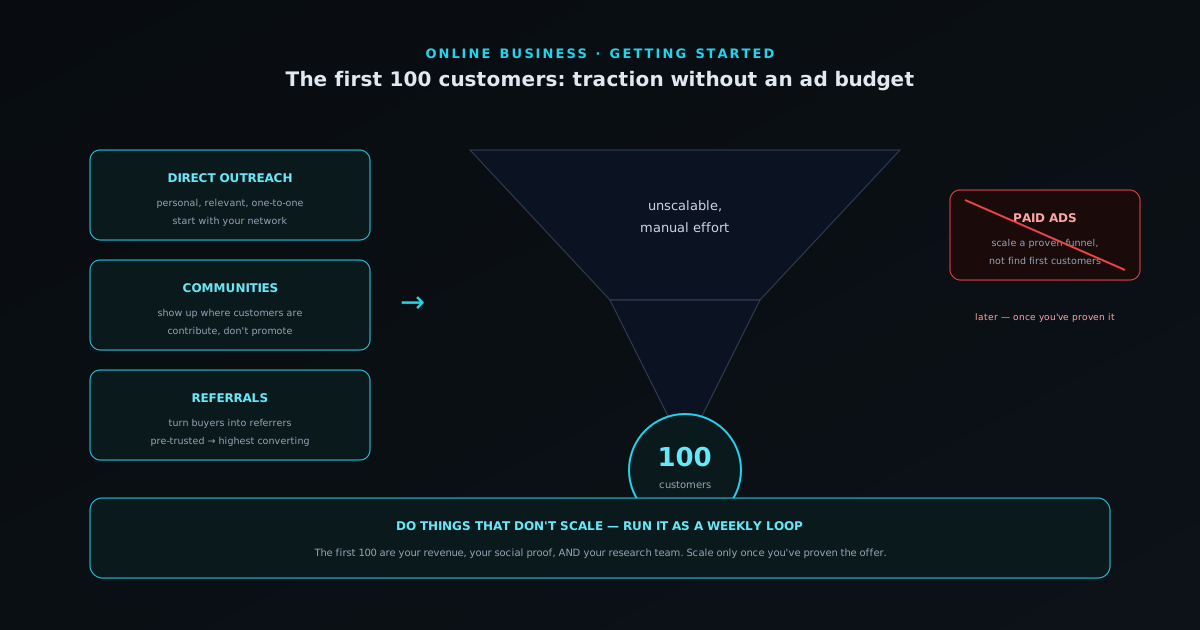
The first 100 customers are different from the next thousand, and the most common early-stage mistake is treating them the same, reaching for ads and scalable tactics when what actually works at the very start is manual, unscalable effort that ads cannot replace. Early on you have no reputation, no reviews, no social proof, and usually no budget, which is exactly the situation where paid acquisition performs worst, because you are paying to send strangers to a business that has not yet earned anyone's trust. The first 100 customers come from the founder doing things that do not scale: reaching out directly, showing up in the communities where the right people already are, and turning every early customer into a source of the next ones. This guide is about those zero-budget channels and a repeatable loop to work them, because getting to 100 is a fundamentally different game than scaling past it.
The reason this matters beyond just saving ad money is that the first 100 customers are also your most important source of learning, and the manual approach that gets them is also what teaches you the most. Reaching out directly and talking to early customers tells you why they buy, what they object to, and how they describe the value: the exact information you need to refine the offer before you spend anything scaling it. Ads at this stage not only convert poorly but also skip the learning, sending you anonymous traffic that tells you little. The unscalable, manual path to the first 100 is therefore not a limitation to escape as fast as possible but the right approach for the stage, doing double duty as both acquisition and research.
Why ads fail at the start
Paid advertising is a scaling tool, not a starting tool, and understanding why it fails early prevents the expensive mistake of burning a small budget before you are ready for it. Ads work by paying to put your offer in front of strangers, which only converts when the offer is proven, the landing experience is optimized, and there is enough trust signal (reviews, social proof, a track record) to overcome a stranger's skepticism. At the very start you have none of these, so paying to send cold traffic to an unproven offer with no social proof produces poor conversion at a cost you cannot yet afford, and it does so without teaching you why people are not buying.
There is also a sequencing problem: ads are most useful once you know your offer converts and you want to pour more volume into a working funnel, which is precisely the knowledge the first 100 customers give you. Running ads before you have that knowledge means optimizing a funnel you have not yet validated, which is slow and expensive guesswork. The right time for ads is after the manual approach has gotten you to product-market signal (when you know who buys, why, and what message converts) at which point ads can scale a process you have proven by hand. Reaching for ads first inverts this, trying to scale before there is anything proven to scale, which is why early ad spend so often disappears with little to show for it.
Do things that do not scale
The defining principle of early customer acquisition is to do the things that do not scale: the manual, personal, high-effort tactics that you could never sustain at a thousand customers but that are exactly right at the first ten or hundred. This means reaching out to potential customers individually and personally, having real conversations, giving unusually attentive service, and doing by hand what you will later automate. These tactics do not scale, and that is fine, because at this stage you do not need scale; you need your first customers and the learning they bring, both of which the personal approach delivers far better than any automated one.
The reason unscalable tactics work so well early is that they convert through genuine human connection and attention, which is the one advantage a tiny new business has over a large established one. A personal message from a founder who clearly understands your problem converts better than any ad, and a level of service no big company could afford to give earns loyalty and word of mouth. These advantages disappear as you grow (you cannot personally onboard the ten-thousandth customer) but at the start they are your edge, and using them fully is how you get the traction that makes scaling possible later. The founders who get stuck are often the ones who skip this phase, reaching for scalable tactics before they have earned the right to scale, when the unscalable work is exactly what the stage rewards.
Channel one: direct, personal outreach
The most reliable early channel is direct, personal outreach to specific people you have reason to believe have the problem you solve, not spam but genuine, individualized contact with people who would plausibly want what you offer. This starts with your existing network and expands to people you can identify as likely fits: members of relevant communities, people discussing the problem publicly, contacts of contacts. The message that works is short, personal, clearly relevant to that specific person, and focused on their problem rather than your product: the opposite of a mass blast, which is why it does not scale and why it converts.
Direct outreach feels uncomfortable to many founders, which is part of why it is underused and therefore effective: the people willing to do it have an edge. The key is to make each contact genuinely relevant and helpful rather than a sales pitch: reach out because you believe you can solve a problem this specific person has, lead with that, and be willing to have a real conversation rather than just pushing for a sale. Done this way, outreach is not spam but a useful offer to someone who needs it, and even the contacts who do not convert often give you valuable information about why. This channel alone can supply a meaningful share of the first 100 customers, and it doubles as the research that refines everything else. Keeping that outreach organized (who you contacted, what they said, what happens next) is exactly what a one-tab spreadsheet pipeline is for, which I set up step by step in A simple CRM in a spreadsheet: the one-tab pipeline for a tiny operation.
Channel two: communities where your customers already are
Your potential customers already gather somewhere (forums, subreddits, Discord servers, professional groups, niche communities organized around the problem you solve or the audience you serve) and showing up genuinely in those communities is one of the strongest zero-budget channels. The approach that works is participation, not promotion: become a genuinely helpful member, answer questions, contribute value, and let your expertise and your product surface naturally through being useful, rather than dropping promotional links that get you ignored or banned. Communities reward genuine contribution and punish self-promotion, so the founders who win here are the ones who actually help.
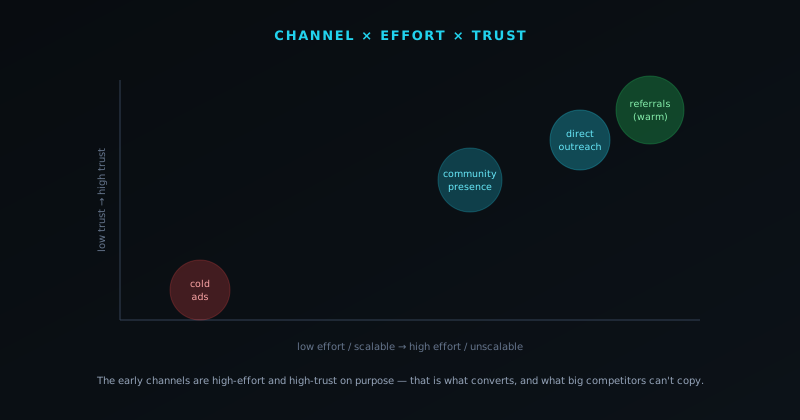
The reason community participation works so well early is that it puts you in front of a concentrated group of exactly the right people, in a context where trust is built through contribution rather than bought through ads. A founder who becomes known in a relevant community as the helpful person who deeply understands the problem earns customers as a byproduct of that reputation, and those customers arrive already trusting them. This is slow, manual, and unscalable (you cannot be genuinely active in a hundred communities), which is exactly why it fits the early stage and why it is hard for larger competitors to replicate. Choosing one or two communities where your customers genuinely are and becoming a real, valuable member of them is a high-return early channel that also teaches you how your audience talks about their problem.
Channel three: turning customers into referrers
Every early customer is not just a sale but a potential source of more customers, and the founders who get to 100 fastest are the ones who systematically turn buyers into referrers. This starts with delivering an experience good enough to be worth talking about (unusually attentive service, a genuinely useful product, a problem actually solved) because referrals only happen when the experience exceeds expectations. From there, it is about making referral easy and natural: asking satisfied customers if they know others with the same problem, making it simple for them to introduce you, and giving them a reason to (gratitude, a genuine fit for their contact, sometimes an incentive).
Referrals are the highest-quality early channel because a referred customer arrives pre-trusted, having been vouched for by someone they know, which converts far better than any cold approach. They also compound: each happy customer who refers one more bends the growth from linear to something faster, which is how a slow start accelerates toward 100. The foundation is the experience (referrals cannot be manufactured from a mediocre product) so the early focus on unscalable, attentive service is also an investment in referrals. Asking for referrals explicitly, rather than hoping for them, is the move many founders miss; a satisfied customer is usually happy to help but will not think to unless asked. Building the referral ask into how you work with every early customer is what turns the first customers into the engine for the next ones.
A repeatable weekly outreach loop
The manual channels work best run as a repeatable loop rather than sporadic bursts, because consistency is what turns scattered effort into steady traction toward 100. A simple weekly loop: each week, identify a set of specific people to reach out to directly, contribute genuinely in your chosen communities, follow up with previous contacts and recent customers, and ask satisfied customers for referrals. Running the same loop every week makes the effort cumulative (the contacts, the community presence, and the referral asks build on each other) rather than starting cold each time, which is how sporadic outreach usually fizzles.
The loop also makes the work measurable and improvable: by tracking how many people you reached out to, how many converted, and where the customers came from, you learn which channels and which messages work for your specific business, and you double down on those. The early stage is as much about learning your acquisition as about the customers themselves, and a consistent loop generates the data to learn from. The discipline of running the loop weekly, even when it feels slow, is what compounds into the first 100, because each week adds to a growing base of contacts, community standing, and referral sources rather than resetting. Treating early acquisition as a repeatable process you run and refine, not a one-time push, is the operational difference between the founders who grind to 100 and the ones who stall after the easy first handful.
Start with the network you already have
The very first customers almost always come from the network you already have, and founders who overlook this in favor of reaching strangers miss the easiest early wins. Your existing connections (former colleagues, friends in the industry, people who know your work, contacts from previous roles) already have some trust in you, which is the scarcest commodity at the start. Reaching out to them about what you are building, not as a hard sell but as a genuine "here is what I am working on, do you or anyone you know have this problem," surfaces both direct customers and warm introductions far more reliably than cold outreach to strangers who have never heard of you.
The reason the existing network is the right starting point is that trust, not awareness, is the binding constraint early on, and your network is where trust already exists. A stranger has to be convinced you are legitimate before they will even consider your offer; someone who knows you starts past that hurdle. This does not mean leaning on relationships to make pity purchases (that helps no one) but rather that your network is the most efficient place to find genuine early customers and, crucially, referrals into their networks. The warm introduction from a trusted contact is the highest-converting first contact there is, which is why mapping and thoughtfully working your existing connections is the right first move before expanding to communities and cold outreach. Many founders skip this out of a misplaced sense that "real" customers must be strangers, when the network is exactly where the first traction usually lives.
Early customers are your research team
Beyond the revenue they bring, the first 100 customers are the most valuable research resource the business will ever have, and treating them as such (talking to them, listening closely, learning why they bought and what almost stopped them) compounds far beyond the individual sales. Each early customer is a source of the information you most need: how they describe the problem, what made them trust you, which features matter and which do not, what nearly made them walk away. This is the raw material for refining the offer, the messaging, and the product, and it is available in high fidelity at this stage precisely because the relationships are personal and the numbers are small enough to engage each one.
The manual, unscalable acquisition approach is what makes this research possible, which is another reason it is right for the stage: reaching customers personally means you are in conversation with them, learning, in a way that anonymous ad-driven traffic never allows. A founder who treats the first 100 as a research team (asking questions, capturing the patterns in why people buy and object, feeding that learning back into the offer) emerges from the early stage with a far sharper understanding of their market than one who simply counted the sales. That understanding is what makes the eventual scaling work, because you scale a message and an offer you have validated and refined through real customer conversations. The first 100 customers are simultaneously your revenue, your social proof, and your research, and the founders who extract all three from them, rather than just the revenue, build the foundation that the next phase of growth depends on.
When to start scaling
The manual approach to the first 100 is the right tool for the stage, but it is not the tool forever, and knowing when to transition toward scalable channels matters as much as knowing to start manual. The signal to begin scaling is product-market signal: when you know who your customer is, why they buy, what message converts, and you have a proven offer with real testimonials and referrals, you have the foundation that makes scalable channels (ads, content, partnerships) actually work. At that point, the knowledge and the social proof the first 100 gave you are exactly what cold traffic needs to convert, so ads and content can pour volume into a funnel you have validated by hand.
The mistake on this side is the mirror of starting with ads: continuing to rely solely on unscalable tactics past the point where they can grow the business, because the manual channels that get you to 100 cannot get you to 10,000. The transition is gradual, and you keep the high-value manual work (referrals never stop mattering) while layering in scalable channels built on what you learned, but it is a real transition, from doing things that do not scale to building things that do. Getting to 100 by hand earns the right and the knowledge to scale; recognizing when you have that foundation, and beginning to build the scalable engine on top of it, is what carries a business from its first traction to real growth. The first 100 are the proof; the next phase is building the machine that the proof justifies.
Frequently asked questions
Quick answers to common questions about this topic.
How do I get my first customers with no marketing budget?
Through manual, unscalable effort: direct personal outreach to people who plausibly have the problem you solve, genuine participation in the communities where your customers already are, and turning every early customer into a referrer. These zero-budget channels convert better early than ads do.
Why do ads fail for a brand-new business?
Ads pay to put your offer in front of strangers, which only converts with a proven offer and trust signals like reviews, exactly what you lack at the start. Ads are a tool for scaling a validated funnel, not for finding your first customers, so early ad spend usually disappears with little to show.
What does "do things that do not scale" mean?
Doing the personal, high-effort tactics you could never sustain at scale but that are perfect early: individual outreach, real conversations, unusually attentive service. They convert through human connection, which is a tiny new business's one advantage over large competitors.
When should I start running ads?
Once you have product-market signal from the first 100 customers: you know who buys, why, what message converts, and you have testimonials and referrals. That knowledge and social proof are what cold ad traffic needs to convert, so ads scale a funnel you have already validated by hand.
Related troubleshooting
Was this page helpful?
Your answer stays in this browser, it is not sent anywhere and no account or cookie is involved.