2026 · Novus Stream SolutionsAbout 12 min readNovus Stream Solutions
Start a lean online business in 30 days (the realistic version)
Not the hustle-bro version: a realistic, low-overhead plan for getting a small online business from idea to first real customer in about a month, built on things that run cheaply at idle.
Contents
- 1.Overview
- 2.Before day one: the only idea filter that matters
- 3.Week 1: validate before you build anything
- 4.Week 2: build the embarrassingly small version
- 5.Week 3: launch small and on purpose
- 6.Week 4: learn, then decide to keep or kill
- 7.What to deliberately skip in the first month
- 8.Finding your first customers without an audience
- 9.Pricing the first version: why "free" is a trap here
- 10.After the 30 days: what a real signal looks like
Overview
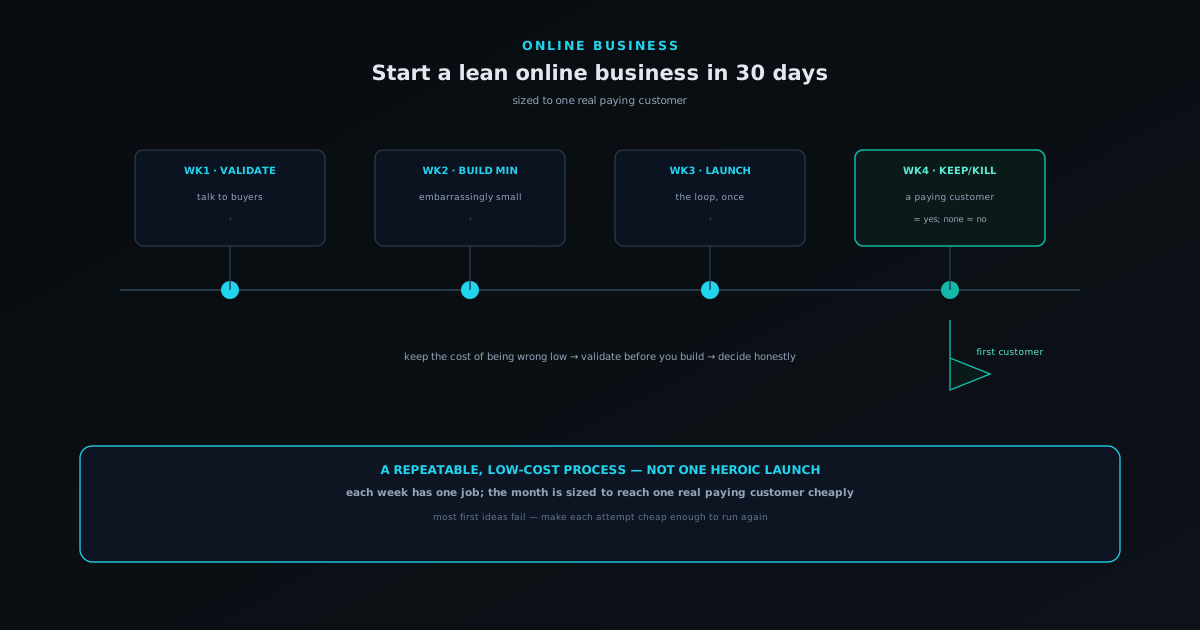
Most thirty-day business plans are either fantasy or burnout fuel. They promise a full-time income from a standing start, or they assume you can pour every waking hour into a launch. This is neither. It is a realistic plan for getting a lean online business from a vague idea to its first real, paying customer in about a month, while keeping your overhead near zero and your sanity intact. The goal at the end of thirty days is not riches; it is a single honest signal that someone other than you will pay for the thing you made. Everything is sized to that goal, because that first real customer is the only validation that actually means anything.
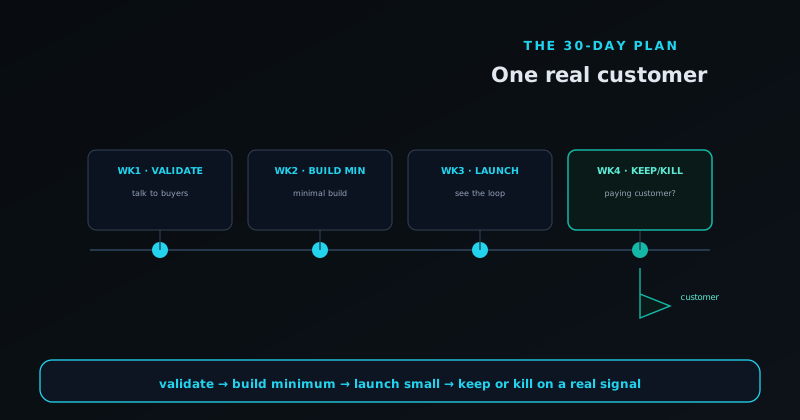
The plan rests on one principle that shapes every decision: keep the cost of being wrong low. A lean online business is not about being cheap for its own sake; it is about structuring things so that a failed idea costs you a few weeks and a few dollars rather than your savings and a year. That means validating before building, building the smallest possible version, launching to a small audience first, and only committing more once a real customer has said yes with their wallet. The thirty days are organized into four weeks, each with one job, and the entire arc is designed so you can run it alongside a job rather than instead of one.
Before day one: the only idea filter that matters
Before the clock starts, run your idea through a single filter: can this run cheaply when no one is using it? This is the structural question that separates businesses you can start lean from ones that will quietly bleed you. An idea whose costs scale with usage but sit near zero at idle (a digital product, a service, a tool that does its work on the customer's side, a small batch of physical goods) can be started and tested without a large standing bill. An idea that requires always-on infrastructure, expensive third-party services running constantly, or significant inventory before you have a single sale fails the filter, because it charges you whether or not anyone shows up.
This filter is not about ambition; it is about survivability during the period when you have no revenue, which is most of the early life of any business. If being wrong is cheap, you can afford to be wrong several times until you are right, and that tolerance for iteration is the real advantage a lean operation has. If being wrong is expensive, your first mistake might also be your last. So before you invest a single day of the thirty, make sure the idea is one whose costs you can actually carry while it has no customers, and if it is not, reshape it until it is, or pick a different one. Getting this right up front is worth more than any amount of execution speed later.
Week 1: validate before you build anything
The first week is for talking and testing, not building. The single biggest waste in starting a business is building something nobody wants, and the only cure is to find evidence of demand before you invest in supply. That means describing your idea to the specific people you think would buy it and watching their real reaction, not polite encouragement, but whether they lean in, ask when they can have it, or try to pay you on the spot. You are looking for pull, not permission. A handful of genuine "I would buy that today" responses from your actual target is worth more than a hundred likes from people who will never purchase.
Concretely, week one is conversations, a simple landing page that describes the offer clearly, and the smallest possible test of willingness to pay: a pre-order, a waitlist with a deposit, a single manual sale you fulfill by hand. The aim is to replace your assumption that people want this with evidence, before you spend week two building it. If you cannot find anyone who wants it during a week of honest effort, that is not a failure of the plan; it is the plan working, saving you three weeks you would have spent building the wrong thing. Pivot the idea and validate again. The discipline of refusing to build until something pulls is what keeps the whole month lean.
Week 2: build the embarrassingly small version
With evidence in hand, week two is for building the minimum thing that delivers the core value, and it should feel embarrassingly small. The instinct is to build the full vision; the discipline is to build only the part that solves the one problem you validated, and nothing else. A first version that does one thing well and looks plain will teach you more than a polished version that took three months, because you can put it in front of a real customer this week instead of next quarter. Every feature you add before launch is a bet placed without information; every feature you defer is a question you let the market answer for you.
Lean building also means using the cheapest tools that work rather than the most impressive ones. Manual processes are fine at this stage: if you can fulfill the first orders by hand, do, because automating something you have not validated is premature optimization. The point of week two is to get a working version of the core promise into existence, not to build the company. Resist the urge to set up elaborate systems, branding, or infrastructure; those are problems you earn by having customers, and you do not have any yet. Build the small thing, keep it cheap, and get it ready to put in front of the people who said they wanted it.
Week 3: launch small and on purpose
Week three is launch, but a deliberately small one. The temptation is to wait until everything is perfect and then launch to the whole world; the reality is that a small, controlled launch to the people who already expressed interest teaches you what you need to know without the pressure of a big audience watching you stumble. Go back to the people from week one who said they wanted it, and let them buy. A launch to ten interested people who convert is infinitely more useful than a launch to a thousand strangers who scroll past, because the ten will actually use the thing and tell you what is wrong with it.
The purpose of the small launch is learning, not scale. You want to see the whole loop work once (someone hears about it, decides to buy, pays, receives the thing, and uses it) because every step of that loop has failure points you cannot see until a real person walks through it. Watch where people hesitate, where the offer confuses them, where fulfillment breaks. These first real transactions are data you cannot get any other way, and they are worth far more than the small amount of revenue they generate. Launch small precisely so you can see clearly, then fix what the launch revealed before you ever try to scale it.
Week 4: learn, then decide to keep or kill
The final week is for honest assessment. By now you have at least a few real transactions, or you have learned that you cannot get them, and either outcome is a result you can act on. Look at what actually happened versus what you assumed: did people buy, did they use it, did anyone come back or refer someone, and what did the whole process cost you in money and time? The question at the end of thirty days is not "is this a success" but "is there enough of a real signal here to justify another month?" A genuine paying customer who used the thing and would buy again is a yes; a month of effort with no one willing to pay is a clear, valuable no.
This is where the lean structure pays off, because keeping your costs low is exactly what makes an honest keep-or-kill decision possible. If the month cost you very little, you can walk away from a dead idea without it being a disaster, and you can double down on a live one without having already overcommitted. The willingness to kill an idea that did not earn its place is not failure; it is the discipline that lets you start the next one. Most first ideas do not work, and the lean approach is designed around that reality: it makes each attempt cheap enough that you can afford the several tries it usually takes to find one that does.
What to deliberately skip in the first month
Just as important as what you do is what you refuse to do. In the first thirty days, skip the logo agonizing, the perfect domain hunt, the business cards, the elaborate brand guidelines, the custom-built everything, the legal structure beyond the bare minimum, and the social media presence on six platforms. None of these get you closer to a first paying customer, and all of them are comfortable forms of procrastination that feel like progress while producing none. The work that matters early is unglamorous: talking to potential customers, building the small thing, and making sales. The work that feels like starting a business (the branding, the setup, the tools) is mostly avoidance dressed up as preparation.
You should also skip premature automation and scaling. It is tempting to build systems for a volume of customers you do not have, but automating an unvalidated process just makes you faster at doing the wrong thing. Do things manually until the manual version hurts, because the pain of the manual version is exactly the information you need to automate the right part later. The general rule for the first month is to spend your limited time only on things that move you toward evidence of real demand, and to ruthlessly defer everything else. The business does not need to look like a business yet; it needs to find out whether anyone wants what it makes.
- Skip: logo perfectionism, brand guidelines, business cards, six social platforms.
- Skip: custom-built infrastructure for volume you do not have yet.
- Skip: premature automation; do it manually until the manual version hurts.
- Do: talk to buyers, build the minimum, make real sales, measure honestly.
Finding your first customers without an audience
A common objection to launching in thirty days is that you do not have an audience to launch to, and it is a fair one, but it misunderstands what the first launch needs. You are not trying to reach thousands of people; you are trying to reach the small number who have the specific problem you solve, and those people are findable without a following. They gather in places: communities, forums, group chats, local networks, the comment sections of content about the problem, the replies to people complaining about the thing you fix. The work of week one is partly to locate those places, because they are where your first customers already are, waiting for someone to offer a solution.
The honest way to find first customers without an audience is to be useful in those places before you sell anything. Answer the questions people are already asking about the problem, share what you know, and let the offer come up naturally when someone describes exactly the pain your thing addresses. This does not scale, and it is not supposed to: the first ten customers almost never come from scalable channels, they come from direct, unscalable effort: messages, conversations, showing up where the problem is discussed. That direct effort is also the best possible market research, because you hear the problem in customers' own words, which makes both the product and the eventual marketing sharper. The audience comes later; the first customers come from going to where they already are.
Pricing the first version: why "free" is a trap here
When you launch the first small version, charge for it (even a little) because the most important thing you are testing is not whether people like the idea but whether they will pay for it, and those are completely different signals. Free things attract people who would never pay, which gives you flattering usage numbers and no real validation; a price, even a modest one, filters for genuine demand and gives you the only evidence that matters at this stage. The goal of the thirty days is a paying customer specifically because payment is the proof that the value is real to someone other than you. A pile of free users tells you almost nothing about whether you have a business.
This is different from the free-first model that some mature products use to drive adoption, and the distinction matters. A free tier as a deliberate growth strategy is a choice you can earn later, once you understand your economics and have a way to convert or monetize attention. Defaulting to free at the validation stage, before you know any of that, is usually just fear of asking for money dressed up as strategy. Set a real price for the first version, watch whether people pay it, and treat every actual sale as the signal it is. You can always adjust pricing, add a free tier, or change the model once you have evidence; what you cannot do is learn whether people value your work if you never ask them to pay for it.
After the 30 days: what a real signal looks like
If you reach the end with a genuine paying customer and a workable process, the next thirty days are about doing it again, slightly bigger, and watching whether the signal holds. One customer can be luck; a repeatable pattern of people finding, buying, and returning is a business. The lean discipline does not stop at launch; it carries forward into every decision about what to add, automate, or spend on, always weighing the cost of being wrong against the strength of the evidence. The same filter that started the month keeps applying: does this still run cheaply when usage is low, and is each new investment justified by a real signal rather than a hope?
And if you reach the end without that signal, you have lost a month and very little money, and gained a clear answer plus the experience of having run the whole loop once. That is a genuinely good outcome, because it frees you to start the next idea from a stronger position. The realistic version of starting an online business is not one heroic launch that works; it is a repeatable, low-cost process for testing ideas until one earns the right to grow. Thirty days is enough to run that process once, honestly, and the whole point is to make running it again cheap enough that you actually will. For a working example of the operating model behind this (small, lean, honest, kept-or-killed on merit), the rest of the Novus ecosystem is built the same way.
Frequently asked questions
Quick answers to common questions about this topic.
Can you really start an online business in 30 days?
You can get a real, minimal business live and making first sales in 30 days: one clear offer, a simple storefront, and a way to take payment. What you cannot do is build a polished, scaled operation; the goal is a working start, not a finished business.
What should I focus on in the first month?
Picking a specific offer, getting a lean storefront live, and reaching real potential customers. Skip the logo-and-branding rabbit hole until you have proof someone will buy.
What is the most common first-month mistake?
Over-building before validating: perfecting a site nobody has visited. Get the offer in front of people fast and let their response guide what to build next.
Related troubleshooting
Was this page helpful?
Your answer stays in this browser, it is not sent anywhere and no account or cookie is involved.