2026 · Novus Stream Solutions (hub)About 13 min readNovus Stream Solutions
How much traffic a free tool needs to pay for itself
A free tool funded by ads is a small business with one question hanging over it: how many visitors does it take before the ads cover the bills? The answer is a back-of-envelope calculation once you know the two numbers that matter, and it is usually lower than founders fear and slower to arrive than they hope.
Contents
- 1.Overview
- 2.The number that matters is RPM, not visits
- 3.The cost side is smaller than you think
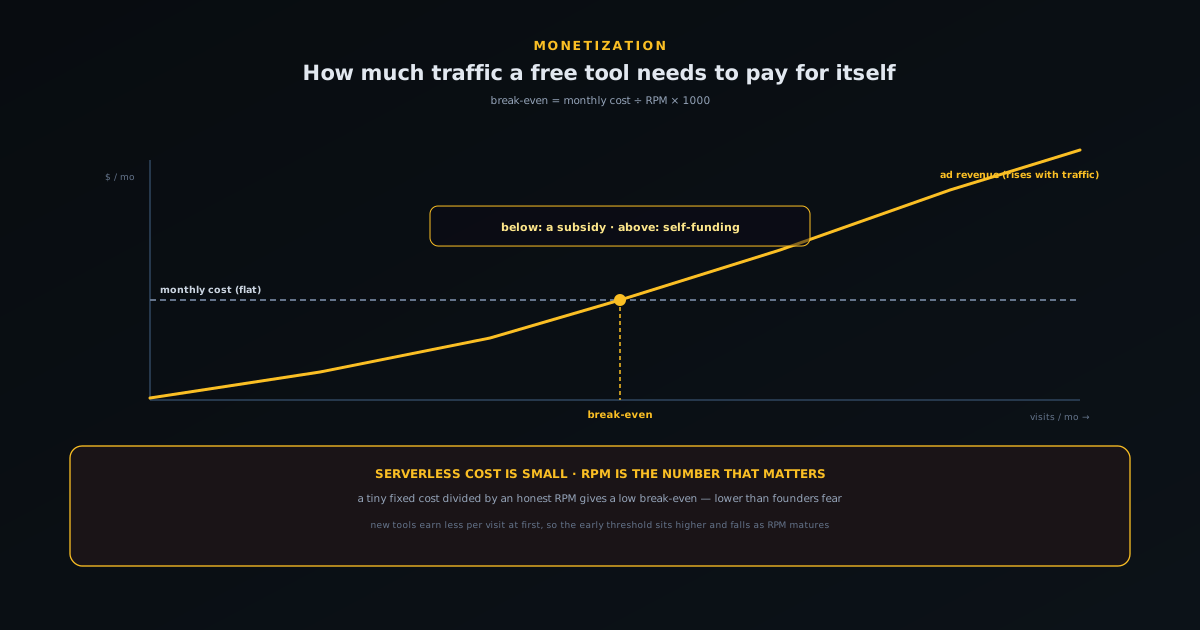
- 4.The break-even math, in plain terms
- 5.Why a new tool earns far less per visit at first
- 6.Traffic quality changes the answer as much as quantity
- 7.Evergreen content makes the climb compound
- 8.What to do while you are still below the line
- 9.Break-even is a milestone, not the goal
- 10.Protect the revenue per visit by protecting the page
- 11.A single tool is often the wrong unit to measure
Overview
A quick disclaimer before the numbers: this is an explanation of how the economics of a free, ad-supported tool tend to work, not financial advice, and every project’s figures are its own. With that said, anyone who builds a genuinely free tool and funds it with advertising is running a small business whether they think of it that way or not, and that business has one defining question hanging over its first year: how many people have to use this thing before the advertising covers what it costs to keep running. Below that threshold the tool is a hobby you subsidise; above it, the tool pays for itself and then begins to fund the next one. Knowing roughly where that line sits turns a vague anxiety into a concrete target.
The good news is that the calculation is not mysterious. Break-even is just the point where monthly revenue equals monthly cost, and both sides reduce to a small number of figures you can estimate on the back of an envelope. The revenue side comes down almost entirely to one number (how much you earn per thousand visits) and the cost side, for a well-built serverless tool, is usually far smaller than people expect. This article walks through both sides honestly, including the parts that are less flattering: why the per-visit revenue is much lower at the start than the averages you read about, and why traffic quality can change the answer as much as traffic quantity.
The number that matters is RPM, not visits
The instinct is to think about ad revenue in terms of clicks or impressions, but the figure that actually governs everything is RPM: revenue per thousand visits, sometimes called page RPM. It rolls up all the messy underlying detail (how many ads show, how often they are seen, what advertisers pay for each, how many visitors click) into a single number that answers the only question you care about: for every thousand people who use the tool, how many dollars land in the account. Once you have an honest RPM, the rest of the break-even math is arithmetic, which is why pinning down that one figure is the whole game.
RPM varies enormously by audience, topic, and geography, and it is important to be realistic rather than aspirational about yours. A tool used heavily by visitors in high-value advertising markets, on commercial topics where advertisers compete hard, will earn a multiple of what the same tool earns from a globally distributed, lower-commercial-intent audience. The mechanics of why are covered in CPM, RPM, and what actually pays, but for the purpose of estimating break-even the key discipline is to use a conservative RPM based on what you actually earn or what comparable tools report, not the highest figure you have seen quoted. An optimistic RPM produces a flatteringly low break-even that reality then refuses to honour.
The cost side is smaller than you think
The other half of break-even is monthly cost, and here a serverless, in-browser tool has a structural advantage that makes the whole question far less daunting. Because the work happens on each visitor’s own device and the app is just static files served from a content network, there is no fleet of servers scaling with traffic, no database humming around the clock, no per-user compute bill that grows with success. The dominant costs are a domain name, a hosting plan that is often free or nearly so at modest scale, and whatever tooling you choose to pay for. For many small tools, the real monthly cost is startlingly low: the price of a coffee or two, not a salary.
This is the quiet reason the break-even traffic for a serverless tool is so much lower than for a product with real backend costs. When each additional thousand visitors costs you essentially nothing to serve, every bit of RPM is close to pure contribution toward covering a small fixed cost, rather than racing against a variable cost that rises with usage. The architecture choice (push the work to the client, ship static files, avoid a backend) is therefore also a monetization choice, because it collapses the cost side of the equation. The full argument for why a lean cost base is what makes free-first sustainable is in Free forever and still funded: how ad-supported tools actually work; the point for break-even is that a small denominator of cost makes the target traffic small too.
The break-even math, in plain terms
With those two numbers, the calculation is a single division. Break-even monthly visits equals your monthly cost divided by your RPM, times a thousand, because RPM is revenue per thousand visits. Put concretely: if a tool costs a modest fixed amount each month to run and earns a given RPM, you divide the one by the other to get the thousands of visits per month at which revenue catches cost. The arithmetic is deliberately simple, and that simplicity is the point: the threshold is not a mystery requiring a spreadsheet model, it is a ratio of two quantities you can estimate today.
It helps to walk the logic rather than just the formula. Each thousand visits brings in one RPM’s worth of revenue; your costs are a fixed monthly figure; so you need enough thousands of visits that their combined RPM covers that fixed figure. The lower your costs and the higher your RPM, the fewer visits you need, which is why the serverless cost advantage and an honest, decent RPM compound in your favour. To make the estimate trustworthy rather than flattering, work it through with deliberately cautious inputs:
- Use a conservative RPM: what you actually earn, or the low end of what comparable tools report, not a best-case quote.
- Count all the real monthly costs: domain, hosting beyond any free tier, paid tooling, and anything else recurring.
- Divide cost by RPM and multiply by a thousand to get break-even visits per month.
- Sanity-check it against your current traffic so the target is a real distance away, not an abstract number.
- Re-run it whenever your RPM or costs change materially, because both move over time.
Why a new tool earns far less per visit at first
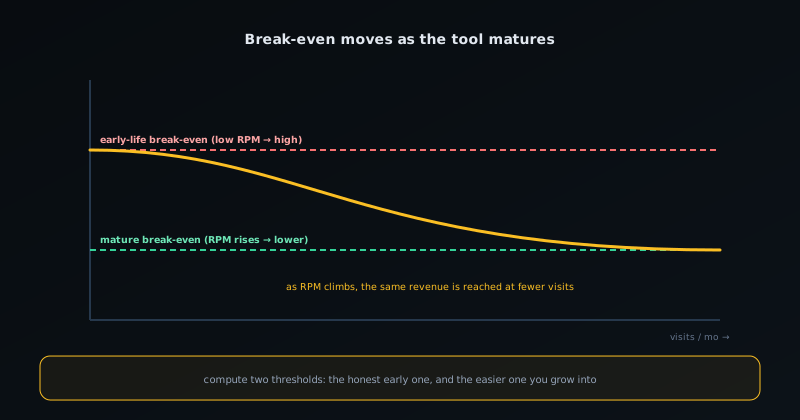
Here is the part the cheerful averages leave out: a brand-new tool almost never earns its eventual RPM in its early months, so plugging a mature RPM into the formula will badly understate how much traffic you actually need at the start. Ad systems take time to learn a new site and optimise what they show; advertiser demand for an unproven property is thin; and the highest-paying ad formats and relationships tend to come later. The realistic early-life RPM can be a fraction of what the same tool will command once it is established, which means the real early break-even traffic is correspondingly higher than the steady-state number.
The right way to hold this is to compute two break-even points: the honest early one using your actual current RPM, and the eventual one using the RPM you can reasonably expect at maturity. The first tells you what it takes to stop losing money this quarter; the second tells you the easier target you grow into as the tool establishes itself. Expecting the mature RPM from day one is how founders conclude a tool has failed when it is simply early, and pulling the plug right before the per-visit revenue would have climbed. Patience with the RPM ramp is part of the calculation, not separate from it.
Traffic quality changes the answer as much as quantity
Two tools with identical visitor counts can sit on opposite sides of break-even, because not all traffic is worth the same to advertisers. A visitor researching a commercial decision in a high-value market is worth many times a visitor who bounces in from a low-intent search in a market where ads pay little, and that difference flows straight into your RPM. This means the break-even question cannot be answered in raw visits alone; it depends on who those visitors are. Ten thousand high-value visits can clear a threshold that fifty thousand low-value visits miss, which is humbling if you have been counting only the headline number.
The practical implication is to think about the composition of your audience, not just its size, when you judge whether a tool can pay for itself. A tool that naturally attracts visitors with commercial intent (people in the middle of a task that advertisers want to reach) will break even at lower traffic than one that attracts curiosity clicks, even if the second is "bigger". This is not a reason to chase only lucrative audiences at the expense of being useful, but it is a reason to be honest that a large, low-value audience may need to be very large indeed to cross the line, while a smaller, well-targeted one can get there sooner. Quantity sets the ceiling; quality sets how fast you climb to it.
Evergreen content makes the climb compound
The traffic that gets a free tool to break-even rarely arrives as a single spike; it accumulates, and the shape of that accumulation matters. A tool surrounded by genuinely useful, evergreen content (guides, how-tos, comparisons that answer the questions its users actually search) builds traffic that compounds, because each piece keeps earning long after it is published and the whole library lifts the tool with it. This is the opposite of campaign-driven traffic that spikes and decays; evergreen content is an asset that keeps paying, and it is why the climb toward break-even tends to accelerate rather than stall.
This compounding is also why patience is rational rather than merely consoling. In the early months the traffic is small and the RPM is low, so revenue looks discouraging; but if the content base is sound, both numbers climb together, and the gap to break-even closes faster than a straight-line projection from the early figures would suggest. The strategy that makes this work (clusters of related content that reinforce each other and funnel toward the tool) is the topic-cluster approach, and a tool that invests in that content base is buying a traffic curve that bends in its favour. Break-even is not a fixed mountain you climb at a constant rate; with compounding content it is a line that rises to meet you.
What to do while you are still below the line
Being below break-even is the normal starting condition, not a failure, and the months spent there are best treated as an investment phase with a clear job: get the cost base as low as it can sustainably go, and grow the traffic and its quality as fast as honest effort allows. On the cost side, that means resisting the urge to pay for infrastructure a serverless tool does not need, since every dollar of avoided fixed cost lowers the break-even traffic directly. On the revenue side, it means building the useful content and the genuinely good tool experience that earn durable traffic, rather than chasing spikes that inflate the visitor count without moving the kind of traffic that pays.
It also means being clear-eyed about the time horizon. A free tool that will break even is usually one whose traffic and RPM are both trending up quarter over quarter, even if it is not there yet; a free tool that will not is usually one where the traffic has plateaued well below the line and the RPM is as good as it will get. Watching those trends honestly (and comparing them against the two break-even points you calculated) is how you tell the difference between a tool that is early and a tool that is stuck. The first deserves continued investment; the second deserves an honest conversation about whether to keep subsidising it, which is exactly the keep-or-kill discipline a portfolio of free tools depends on.
Break-even is a milestone, not the goal
It is worth ending by putting break-even in its proper place. Covering its own costs is a meaningful milestone for a free tool (it marks the moment the project stops being a subsidy and becomes self-sustaining) but it was never the actual goal, which is to be genuinely useful to the people who use it and, ideally, to throw off enough surplus to fund the next useful thing. Break-even is the floor that makes everything above it possible: once a tool pays for itself, its continued existence no longer depends on anyone’s willingness to keep funding it, which is what lets it stay free without quietly becoming a burden.
So the honest framing for anyone building a free, ad-supported tool is that the break-even traffic is knowable, usually lower than feared because the cost base of a serverless tool is small, and slower to reach than hoped because the early RPM is low and the traffic has to compound. Estimate it with conservative numbers, compute the early and the mature versions, keep your costs lean, and judge the project by whether its trends are bending toward the line. Do that, and the question that hangs over every free tool (can this pay for itself) stops being a source of dread and becomes a target you can see, plan for, and eventually cross. None of which is advice for your particular numbers; it is the shape of the calculation everyone running a free tool eventually does.
Protect the revenue per visit by protecting the page
There is a temptation, when a tool is below break-even, to squeeze the revenue side by stacking more ads, larger ads, and more intrusive formats onto the page, on the theory that more ad inventory means more income. In practice this often backfires on both sides of the ledger at once. A page buried in ads is slower, and a slower page hurts the very Core Web Vitals that influence how the page ranks and how long visitors stay, so the heavy ad load can quietly cost you the traffic that was the whole point. Visitors who find a tool unpleasant to use do not come back and do not recommend it, which erodes exactly the durable, compounding traffic that gets a tool to break-even in the first place.
The healthier mental model is that revenue per visit and respect for the visitor are not opposites but partners over any horizon longer than a week. A clean, fast page with sensible, non-intrusive ad placement keeps the audience growing and keeps each visit worth a fair amount, whereas an aggressive layout trades a small short-term lift for a shrinking, resentful audience. The discipline of placing ads where they earn without wrecking the experience is its own subject, but for break-even the point is simple: do not try to reach the line by degrading the thing that brings the traffic, because that is a way to move the line further away while feeling like you are chasing it.
A single tool is often the wrong unit to measure
It is worth questioning whether one tool in isolation is even the right thing to hold to a break-even standard, because for many small studios the real unit is the portfolio, not the individual app. Several free tools sharing a domain, a content base, and a set of cross-links can be jointly self-funding even when one of them, measured alone, has not yet crossed its own line. A flagship tool that earns well can carry a newer, useful tool through its early, low-RPM months, and the cross-promotion between them grows all of their traffic together, so the portfolio breaks even as a whole before each piece does individually.
This reframing matters because it changes what counts as a healthy tool below break-even. Judged alone, an early tool losing a little money each month looks like a problem; judged as part of a portfolio that is collectively self-funding and growing, the same tool is a sensible investment in tomorrow’s flagship. The economics of running several free tools together (shared fixed costs, cross-promotion, and the way a content base lifts everything attached to it) are laid out in The economics of a free-tool portfolio. For the break-even question, the lesson is to compute the threshold for the individual tool by all means, but to make keep-or-kill decisions against the portfolio, because that is the unit that actually has to pay for itself.
Frequently asked questions
Quick answers to common questions about this topic.
How do I calculate the break-even traffic for a free tool?
Divide your monthly running cost by your RPM (revenue per thousand visits) and multiply by a thousand. That gives the monthly visits at which ad revenue equals cost. Use a conservative RPM and count every real recurring cost, so the threshold is honest rather than flattering. The math is deliberately simple: break-even is just a ratio of two numbers you can estimate today.
What is RPM and why does it matter more than clicks?
RPM is revenue per thousand visits: it rolls up impressions, ad rates, and clicks into the single number that answers “for every thousand visitors, how many dollars do I earn?”. Because break-even is cost divided by RPM, that one figure governs the whole calculation. Pin down an honest RPM (what you actually earn, not a best-case quote) and the rest is arithmetic.
Why is the break-even traffic for a serverless tool so low?
Because the cost side is tiny. An in-browser tool runs on each visitor’s device and ships as static files, so there is no server fleet, database, or per-user compute bill scaling with traffic. The real monthly cost is often just a domain and modest hosting, and a small fixed cost divided by a decent RPM yields a low break-even: the architecture choice doubles as a monetization advantage.
Why does my new tool earn so much less per visit than the averages suggest?
New sites earn a fraction of their eventual RPM because ad systems take time to learn the site, advertiser demand for an unproven property is thin, and the best-paying formats come later. Compute two break-even points: an honest early one with your current low RPM, and a lower mature one as RPM climbs. Expecting the mature RPM from day one makes a tool look failed when it is simply early.
Does the kind of traffic matter, or just the amount?
It matters as much as the amount. Visitors with commercial intent in high-value advertising markets earn many times what low-intent visitors in low-paying markets do, and that flows straight into RPM. So a smaller, well-targeted audience can break even before a much larger low-value one. Think about who your visitors are, not just how many, when judging whether a tool can pay for itself.
Related troubleshooting
Was this page helpful?
Your answer stays in this browser, it is not sent anywhere and no account or cookie is involved.