2026 · Novus Stream Solutions (hub)About 15 min readNovus Stream Solutions
Designing a fair free tier: where the usage limits go
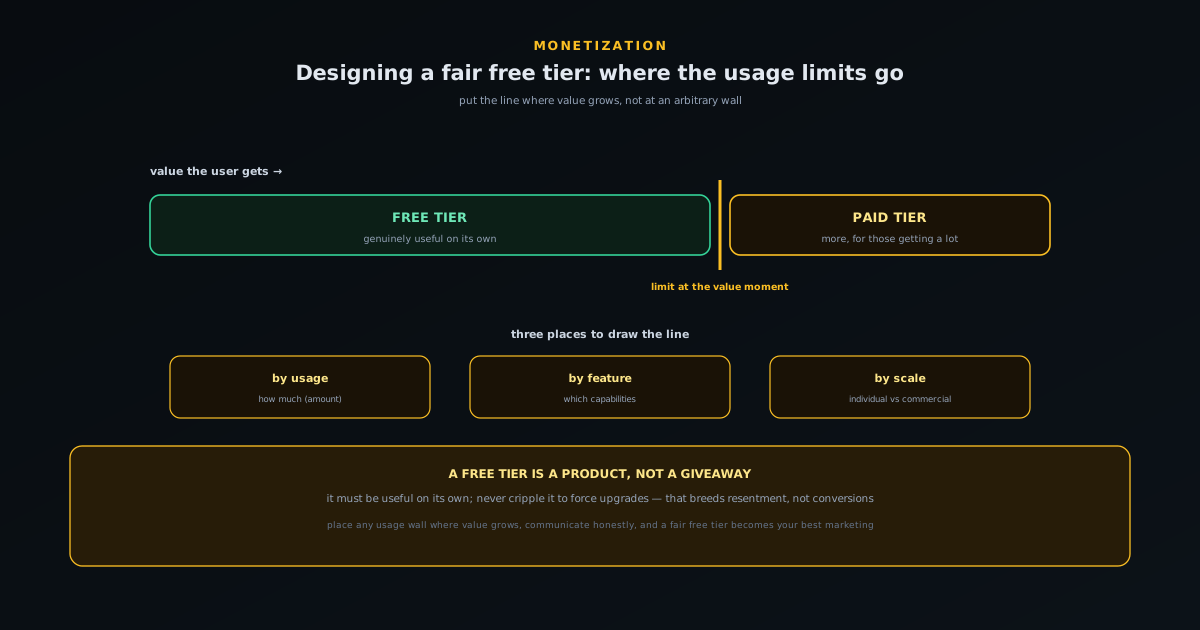
Where you draw the line between your free tier and your paid one is one of the most consequential product decisions you make, and the most commonly botched. A free tier crippled to force upgrades breeds resentment; one that is genuinely useful builds the goodwill that makes upgrades happen. Here is how to place the limits fairly.
Contents
- 1.Overview
- 2.The free tier is a product, not a giveaway
- 3.What a free tier is actually for
- 4.Two philosophies for the line
- 5.Three places to draw the line
- 6.The fairness test: useful on its own
- 7.Do not cripple the free tier to force upgrades
- 8.Put limits at the value moment, not an arbitrary wall
- 9.Protect your costs without punishing users
- 10.Communicate the limits honestly
- 11.Evolve the line as you learn
- 12.A fair free tier is the best marketing you have
Overview
Where you draw the line between what is free and what costs money is one of the most consequential decisions in a product, and one of the most routinely mishandled. Get it right and the free tier becomes your best marketing: a genuinely useful thing that builds goodwill, earns word of mouth, and makes the people who need more happy to pay for it. Get it wrong and the free tier becomes a source of resentment, a deliberately hobbled tease that annoys the people it was supposed to attract and makes the paid tier feel like a ransom rather than an upgrade. The same feature set, with the line drawn in two different places, produces either an advocate or a detractor out of the same user.
The core mistake is treating the free tier as a giveaway to be minimised (the least you can offer while still luring people toward paying) rather than as a product in its own right that has to stand on its own merits. A free tier is a product decision, and the question is not "how little can we give away?" but "what is the genuinely useful free experience that makes people trust us and want more?" This article is about answering that well: what a free tier is actually for, where to place the limits so they feel fair, the difference between a free tier that is useful and one that is crippled, and how to protect your costs without turning the free experience into a hostage situation.
The free tier is a product, not a giveaway
The reframe that fixes most free-tier mistakes is to stop thinking of it as charity or bait and start thinking of it as a product you are shipping to a real audience who will judge you by it. Most people who use your free tier will never pay, and that is not a failure: it is the design. The free users are not freeloaders draining value; they are your reach, your reputation, your word of mouth, and the top of the funnel from which the minority who do pay eventually emerge. A free tier designed with contempt for the people who use it for free is designed with contempt for the very thing that makes the product grow.
This means the free tier deserves real design attention, not the minimum effort that "it is free anyway" invites. It should be genuinely good at the job it does, polished, and complete enough that a free user gets real value and forms a real opinion, because that opinion is what they share, and what they carry into the eventual decision about whether to pay. The ecosystem’s own stance, described in Free-first, ad-supported: delivering paid-tier features without a paywall, takes this to its conclusion: the core is genuinely free, no paywall, because the free experience is the product, and the goodwill it builds is worth more than the upgrades a crippled version might extract. Even where you do charge for more, the free tier earns its keep as the thing that makes the rest possible.
What a free tier is actually for
Being clear about the job of the free tier is what lets you design it well, and it does several real jobs at once. It is acquisition: the lowest-friction way for someone to try what you offer, removing the risk and the commitment that a paid-only product demands up front. It is trust-building: letting someone experience that the product actually works and actually helps before they are asked for anything, which is worth more than any amount of marketing copy claiming the same. And it is reach: free users spread the word, link to you, and bring others, building the audience from which everything else (paid conversions, ad revenue, reputation) ultimately flows.
Holding those jobs in mind reframes the apparent cost of generosity. A free user who never pays still did real work for you: they tried it without you having to overcome a payment barrier, they formed and shared an opinion, and they widened the top of the funnel. Designing the free tier to do its jobs well (easy to start, genuinely useful, worth talking about) is therefore not money left on the table; it is investing in the acquisition, trust, and reach that make the paid side viable at all. A free tier optimised only to push people toward paying, at the expense of being good, sabotages the very jobs that justify having a free tier in the first place.
Two philosophies for the line
There are broadly two philosophies for where the free-versus-paid line goes, and being clear about which you are following prevents a muddled tier that does neither well. In the free-as-the-product philosophy, the core thing you do is genuinely free and complete, and you charge for things around it (extra capacity, advanced or professional features, convenience, or support) so that no one is ever blocked from the core value, and paying is about getting more rather than getting in. In the free-as-a-trial philosophy, the free tier is a limited taste designed mainly to demonstrate value and move people toward a paid plan that holds most of the real utility.
Both can be legitimate, but they imply very different line-drawing, and the danger is accidentally landing in the worst of both: a free tier too limited to be genuinely useful but too generous to push upgrades, satisfying no one. The free-as-the-product approach tends to build more goodwill and reach and suits ad-supported or portfolio models, where the free usage itself has value; the free-as-a-trial approach can convert better in the short term but risks the resentment that comes from a free tier that feels like a tease. The key is to choose deliberately and design the line consistently with the choice, rather than splitting the difference into a tier that frustrates free users and underwhelms prospective payers alike.
Three places to draw the line
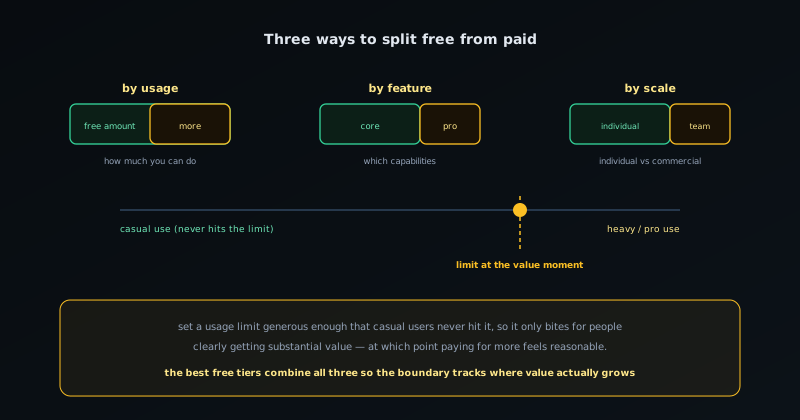
Once you know the philosophy, there are three main dimensions along which to place the limit, and the best free tiers usually combine them thoughtfully rather than relying on one crude wall. You can limit by usage: how much someone can do (a number of operations, a volume of output, a quantity per period) which lets everyone access the full capability but caps the amount. You can limit by feature: which capabilities are available (keeping the core free and reserving advanced or professional features for paying) which lets everyone do the main thing fully while charging for the extras. And you can limit by scale: free for individuals or small use, paid as needs grow into team, commercial, or high-volume territory.
Each dimension has a different feel to the user, and choosing among them is really choosing what experience the free user has. A usage limit lets a free user do everything, just not endlessly, which often feels fairest because nothing is withheld in kind, only in quantity. A feature limit lets a free user do the core thing completely while seeing that more exists, which works when the free core is genuinely whole. A scale limit aligns payment with the point where someone is clearly getting professional value, which feels fair because the people who pay are the people getting the most. The art is matching the dimension to where the value actually grows, which the next sections develop.
The fairness test: useful on its own
The single best test of a free tier is whether it is genuinely useful on its own, for someone who will never pay. If a free user can accomplish something real and complete (get an actual job done, not just a frustrating taste of one) the free tier passes, and everything good about a free tier follows: the goodwill, the word of mouth, the trust that makes the eventual upgrade feel earned. If the free tier only works as a teaser that cannot actually do anything useful without paying, it fails the test, no matter how clever the conversion funnel, because it generates resentment instead of advocacy and people share that resentment as readily as they would have shared delight.
Applying this test is clarifying because it cuts through the temptation to maximise short-term conversions at the expense of the free tier’s real job. A free user who got genuine value and chose not to pay is a success, not a leak: they are reach and reputation working as designed. The line should be placed so that the free tier is a real, complete, useful thing, and the paid tier is more of it for people whose needs have outgrown free. When the free tier passes the useful-on-its-own test, the upgrade becomes a natural step for people getting a lot of value rather than a toll extracted from people getting too little, and that distinction is the whole difference between a free tier that builds a business and one that quietly poisons it.
Do not cripple the free tier to force upgrades
The most damaging free-tier mistake is deliberately crippling it to push people toward paying: withholding obviously-essential functionality, setting limits so tight the tier is useless, or engineering constant friction designed to make the free experience just annoying enough to nudge an upgrade. This backfires badly, because users feel the manipulation, and a free tier that is obviously a hostage situation generates resentment rather than the conversions it was engineered for. People do not respond to artificial frustration by paying; they respond by leaving and telling others the product is a tease, which costs you the reach and reputation that were the free tier’s actual value.
The distinction that matters is between limits that reflect real value differences and limits that are purely punitive. Charging more for more (more capacity, professional features, commercial-scale use) is fair, because the paid tier genuinely offers something proportionate to its price. Hobbling the free tier in ways that serve no purpose except to make free unpleasant is unfair, and users can tell the difference instantly. A limit that says "free covers a generous amount; pay when you need much more" reads as reasonable; a limit that says "free is deliberately broken until you pay" reads as contempt. Design the line around genuine value, not engineered frustration, and the upgrades you do get will be from satisfied users rather than coerced ones.
Put limits at the value moment, not an arbitrary wall
When you do limit by usage, where you set the threshold determines whether it feels fair or arbitrary, and the principle is to place it at a point that tracks real value rather than at a number chosen to maximise upgrade pressure. A good usage limit is generous enough that casual and individual users essentially never hit it, so the limit only bites for people doing enough volume that they are clearly getting substantial value, at which point paying for more feels reasonable, because they are paying in proportion to the value they are extracting. A limit set so low that ordinary use bumps into it constantly feels like a wall placed to extract money, not a fair boundary, and it generates exactly the resentment to avoid.
The ideal is that the user hits the limit at the same moment they recognise they are getting serious value (the heavy user who has built the tool into their workflow, the professional running real volume) so that the upgrade prompt arrives as a natural "you are clearly getting a lot out of this; here is how to get more" rather than an interruption of casual use. That alignment between where the limit falls and where the value is being realised is what makes a usage limit feel fair. The pricing side of placing this line (how much to charge and how to structure the tiers above free) is its own subject, covered in Pricing a free tier: where the upgrade line goes; the design side is simply to put the wall where value grows, not where it is easiest to extract a payment.
Protect your costs without punishing users
There is a legitimate reason for limits that has nothing to do with conversion: protecting yourself against the real costs and abuse that an unlimited free tier can invite. If serving free usage carries genuine cost, or if an open-ended free tier could be exploited at scale, then reasonable limits are sensible business protection rather than manipulation, and framing them honestly as such is part of designing a fair tier. The distinction from punitive limits is intent and placement: a limit that protects against abuse and runaway cost sits far out where only extreme or commercial-scale usage hits it, leaving normal users entirely unaffected.
This is where a serverless, low-cost architecture quietly helps, because when serving an additional free user costs almost nothing, the pressure to limit free usage for cost reasons largely disappears, and you can be far more generous than a product with heavy per-user costs could afford. The economics of running free tools cheaply, discussed in The economics of a free-tool portfolio, are what make a genuinely generous free tier sustainable rather than a loss leader you must constrain. But whatever the cost structure, the principle holds: set protective limits where they guard against abuse and real cost, communicate that they exist for that reason, and keep them far enough out that the ordinary user (the one whose goodwill you want) never feels them at all.
Communicate the limits honestly
How you communicate the free-versus-paid line matters almost as much as where you draw it, because the same limit can feel fair or manipulative depending on how it is presented. Being upfront about what is free, what is paid, and why builds trust; hiding the limits until a user slams into them unexpectedly, or disguising a paywall as something else, breeds the resentment that undermines the whole free tier. A user who understood the deal from the start and chose to use the free tier on those terms feels respected; a user ambushed by a limit they did not see coming feels tricked, and tricked users are the ones who leave loudly.
Honest communication also makes the upgrade path feel like an offer rather than a trap. When the boundaries are clear and the value of paying is stated plainly, a user who reaches the limit understands exactly what they are being offered and why, and can make a clean decision. There is no sense of having been led into a corner, because the corner was visible all along. This transparency costs nothing and protects the goodwill the free tier exists to build: it is the difference between "here is the deal, take it or leave it" and "gotcha." A fair free tier that is also clearly communicated turns the moment of hitting a limit from a betrayal into a straightforward choice, which is exactly what you want it to be.
Evolve the line as you learn
The free-versus-paid line is not a decision you make once and freeze; it is something you tune as you learn how people actually use the product and where the genuine value boundaries turn out to be. Early on you are guessing at where casual use ends and serious use begins, and real usage data will refine that, showing you whether your limits are biting the right users, whether the free tier is generous enough to do its acquisition job, and whether the paid tier offers enough genuine extra value to justify its price. Treating the line as a living decision lets you correct a tier that turned out too stingy or too loose before it does lasting reputational damage.
The caution is to evolve the line carefully and in the user-friendly direction wherever possible, because changing a free tier is sensitive: taking away something that was free, or tightening a limit people relied on, generates far more resentment than never having offered it. Loosening limits, adding value to the free tier, or grandfathering existing users through a change all build goodwill; tightening the screws on people who trusted the original deal burns it fast. So the healthy pattern is to start a touch more generous than you think you need, learn where the real value lines are, and adjust mostly by adding rather than removing, letting the free tier and the boundary mature toward fairness rather than toward extraction as you understand your users better.
A fair free tier is the best marketing you have
The throughline is that a free tier is not money you are giving away; it is the most effective marketing and trust-building you can do, provided you treat it as a real product rather than bait. A genuinely useful free tier brings people in without friction, proves the product works before asking for anything, and builds the reputation and reach from which every other form of value (paid conversions, ad revenue, word of mouth) eventually flows. The people who use it for free and never pay are not a cost to be minimised; they are the audience that makes the whole thing work, and designing the free tier to serve them well is designing the business to grow.
So the design, in sum, is principled rather than extractive: treat the free tier as a product that must be useful on its own; know which jobs it is doing and which philosophy you are following; place the limits along usage, feature, or scale so they track where value actually grows; never cripple the free experience to force upgrades; put any usage wall at the value moment, not an arbitrary low number; set protective limits far enough out that ordinary users never feel them; communicate the whole deal honestly; and tune the line over time mostly by adding. Do that and the question of where the limits go stops being a tug-of-war between giving away too much and extracting too much, and becomes what it should be: drawing a fair line that makes the free tier genuinely good and the paid tier genuinely worth it. The fairest free tier is usually also the most effective one, which is the happy resolution this decision can reach when it is made with the user in mind.
Frequently asked questions
Quick answers to common questions about this topic.
How do I decide where to put the line between free and paid?
Choose a philosophy first, either free-as-the-product (the core is genuinely free, you charge for more around it) or free-as-a-trial (a limited taste toward a paid plan), then place limits along one or more of three dimensions: usage (how much), feature (which capabilities), or scale (individual versus commercial). The best free tiers combine them so the boundary tracks where real value grows, not where a payment is easiest to extract.
What is the test for a good free tier?
Whether it is genuinely useful on its own for someone who will never pay. If a free user can get a real, complete job done, the tier passes and the goodwill, word of mouth, and trust follow. If it only works as a teaser that cannot do anything useful without paying, it fails: it breeds resentment instead of advocacy, no matter how clever the conversion funnel.
Why is crippling the free tier to force upgrades a mistake?
Because users feel the manipulation and respond by leaving and telling others it is a tease, costing you the reach and reputation that are the free tier’s real value. Artificial frustration does not convert; it repels. Charging more for genuinely more (capacity, professional features, commercial scale) is fair; hobbling free in ways that serve no purpose but to make it unpleasant reads as contempt, and users can tell the difference instantly.
Where should a usage limit actually sit?
At the value moment, not an arbitrary low number. Set it generous enough that casual and individual users essentially never hit it, so it only bites for people doing enough volume that they are clearly getting substantial value, at which point paying for more feels reasonable. A limit ordinary use bumps into constantly feels like a wall to extract money; one aligned with heavy, valuable use feels fair.
Is it ever legitimate to limit a free tier?
Yes: to protect against real costs and abuse, which is sound business rather than manipulation as long as the limits sit far out where only extreme or commercial-scale usage hits them, leaving normal users unaffected. A low-cost, serverless architecture reduces the cost pressure to limit at all, allowing a more generous free tier; whatever the case, communicate protective limits honestly and keep them away from ordinary use.
Related troubleshooting
Was this page helpful?
Your answer stays in this browser, it is not sent anywhere and no account or cookie is involved.