2026 · Novus Stream Solutions (hub)About 13 min readNovus Stream Solutions
One post, five formats: repurposing that doesn’t feel recycled
Repurposing has a bad reputation because most of it is done by copy-paste: the same paragraphs shoved into five channels, each looking like leftovers. The fix is not more originality: it is translation. One argument, restated natively for each format, sequenced deliberately, with every derivative pointing home to a single canonical post.
Contents
- 1.Overview
- 2.Pick a source post that can survive translation
- 3.Format one: the thread argues, it doesn’t excerpt
- 4.Format two: the email gets the private layer
- 5.Format three: the sixty-second script starts at the end
- 6.Formats four and five: the carousel and the FAQ harvest
- 7.Sequencing: spread the drops so the channels feed each other
- 8.Canonical linking: one URL absorbs all the credit
- 9.The whole system in one sitting
Overview
The word “repurposing” makes creators wince for a good reason: most of what travels under that name is reheating. Someone pastes four paragraphs of a blog post into a thread, screenshots the intro for a carousel, reads the same text at a camera, and wonders why every channel underperforms while the audience quietly concludes they have already seen this. The failure is real, but the diagnosis is usually wrong. The problem was never that one idea appeared in five places: every teacher repeats their best material for years. The problem is that one *format* appeared in five places wearing four disguises.
The version that works treats each format as a translation, not a copy. A long-form post, a thread, an email, a sixty-second video, a carousel, and a set of FAQ snippets are different rhetorical machines: they hook differently, pace differently, and reward different kinds of density. When you restate one argument natively in each machine, the audience does not experience repetition: they experience reinforcement, and the minority who encounter it in two formats mostly feel recognition, not fatigue. I publish daily across our own blog and channels, and this five-format system (plus the sequencing and canonical-linking discipline that holds it together) is how one good week of thinking becomes two weeks of distribution without a single reheated paragraph.
Pick a source post that can survive translation
Not every post can carry five formats, and forcing a weak one through the pipeline produces five weak derivatives, so the system starts with selection. What survives translation is a post with a spine: one arguable claim, three to five load-bearing points, at least one number or concrete example per point, and a stance somebody could disagree with. News-shaped posts decay before the fifth format ships; announcement posts have nothing to argue; round-ups have no spine at all. The evergreen, opinionated explainer is the ideal donor, which is one reason to write more of those in the first place, a habit we covered from another angle in Repurposing one piece of content into ten.
Before touching any format, I extract the spine into a short skeleton file: the claim in one sentence, each supporting point in one line, every statistic and example worth keeping, and the single most quotable sentence in the piece. This ten-minute step is what makes the difference between translating and pasting, because every derivative gets written *from the skeleton*, not from the prose. The original wording stays in the original post, where it belongs. The skeleton is also an audit: if you cannot fill it in (if there is no one-sentence claim, no disagreeable stance) you have learned the post is not a donor, and you have learned it before wasting a week of channel slots on it.
How often you run the pipeline matters as much as what you feed it. Not every post deserves the treatment (forcing it weekly turns translation back into grind) and my working ratio is roughly one full five-format cycle per three or four posts published. The skeleton step doubles as the selector: I build one for anything that might qualify, and the posts whose skeletons come out sharp get the full run while the rest ship solo. Twice a year I re-audit the archive, because evergreen pieces earn second cycles: a post that ran the pipeline in March can run a fresh translation in October to an audience that has half turned over, with updated numbers standing in for novelty. Old arguments restated well outperform new arguments stated badly, and the archive is where the proven ones live.
Format one: the thread argues, it doesn’t excerpt
A thread built by chopping the post into 280-character chunks reads exactly like what it is, because prose paragraphs and thread beats are different units. Prose builds context patiently; a thread is a chain of individually-standing claims, each one earning the tap to the next. So the translation works from the skeleton: the opening beat states the claim in its most provocative honest form (the disagreeable version, not the balanced version) and each following beat delivers one point as a self-contained assertion with its number or example welded on. Trim every “as I mentioned” and every connective that assumes memory of the previous beat; thread readers arrive mid-chain constantly.
The thread’s job in the wider system is to be the argument’s sharpest edge, and its ending is where the canonical discipline starts. The final beat links to the original post, framed as depth for the readers the argument hooked (“the full version, with the math, is here”), never as a bait-and-switch that withheld the point. The thread must be complete on its own; a thread that obviously exists to farm clicks gets punished by both the algorithm and the audience. Complete, sharp, and linked: that combination lets the thread stand alone for the 95% who never click while quietly routing the most engaged 5% to the page that carries the full argument.
Format two: the email gets the private layer
The email derivative fails when it is a summary with a button, because subscribers can smell an RSS feed wearing a newsletter costume. Subscribers gave you the most valuable thing anyone gives a creator (standing permission to appear in their inbox, the owned channel we argued for in Email vs social media for owning your audience) and the translation that honors it is addition, not compression. My email version leads with the layer the public post could not carry: the doubt I had while writing it, the counterexample a reader sent, the number that changed after publish, what I would say more bluntly if the piece were not competing for strangers in search results. Then two or three sentences bridge into the post’s claim, and one plain link carries whoever wants the full argument.
This private layer costs fifteen minutes and transforms the economics of the whole system, because it converts the email from a distribution channel into a relationship channel. Readers who already saw the thread get something the thread did not have, so the overlap audience (the people most likely to feel the “recycled” sting) are precisely the ones receiving the most new material. Over time this trains an expectation that the email is where the honest margins live, which is the single strongest reason people stay subscribed to a one-person operation. The post is the argument; the email is the author. Nobody unsubscribes from the author.
Format three: the sixty-second script starts at the end
Short video is the translation writers get most wrong, because writing builds to a conclusion and short video must open with one. The script formula that works for a repurposed argument: state the conclusion in the first three seconds as a hook (“Most repurposing fails because you’re copying formats, not translating them”), spend the middle thirty-five seconds on the two strongest points from the skeleton (not all five, the two with the best numbers) and close by naming where the full breakdown lives. Sixty seconds of speech is roughly 150 words, which is a brutal and clarifying budget: the script is not the post shortened, it is the post’s best 6% performed.
Production is where solo creators stall on this format, so the system keeps it deliberately cheap: one take direct to camera or a screen recording over the post itself, captions always (most viewers watch muted) and a visual change every few seconds even if it is only a zoom or an on-screen number. This is the slot in the pipeline where our own tools carry their weight: the same workflow we use for music promotion assets in One recording, a week of content: a repurposing system for solo creators applies to talking-head clips, and a caption pass plus a clean background takes minutes in a browser rather than an evening in an editor. The bar is not cinematic. The bar is watchable, captioned, and shipped in under an hour.
Formats four and five: the carousel and the FAQ harvest
The slide carousel is the skeleton made literal, and that is why it works: slide one carries the claim as a title card, each middle slide carries exactly one point with its number in large type, and the final slide carries the takeaway plus where to find the full piece. Ten slides maximum, one idea per slide, type big enough to read on a phone held at arm’s length. The discipline the carousel enforces (no slide may depend on the previous one being remembered) is the same one the thread taught, but visually, and it makes the carousel the format most likely to be saved and shared, because it functions as a reference card rather than a performance.
The fifth format is the quietest and the most durable: FAQ snippets. Every strong post implicitly answers four or five questions people actually type into search boxes, and extracting them (question phrased the way a stranger would ask it, answer in 60 to 110 self-contained words) produces assets with more lifespan than every other derivative combined. They become the FAQ block on the post itself (with FAQPage structured data, which is how our own posts earn rich results), answers in community threads, replies to reader emails, and seeds for the next post’s research. Threads and carousels decay in days; a well-phrased FAQ answer keeps matching queries for years. It is the only format on this list that compounds.
Both of these formats reward templates in a way the others do not. The carousel wants a fixed slide skeleton (title card, point slides, takeaway card) with type sizes and margins decided once, so that assembling number five costs twenty minutes instead of a design session; ours is a saved layout where only the words and the accent color change. The FAQ harvest wants a standing habit instead: while drafting the original post, any sentence that answers a question a stranger would type gets flagged in the moment, because retrofitting questions onto finished prose is twice the work of noticing them during writing. Neither template makes the output generic: the argument changes every time. They make the container boring, which is exactly where boredom belongs.
Sequencing: spread the drops so the channels feed each other
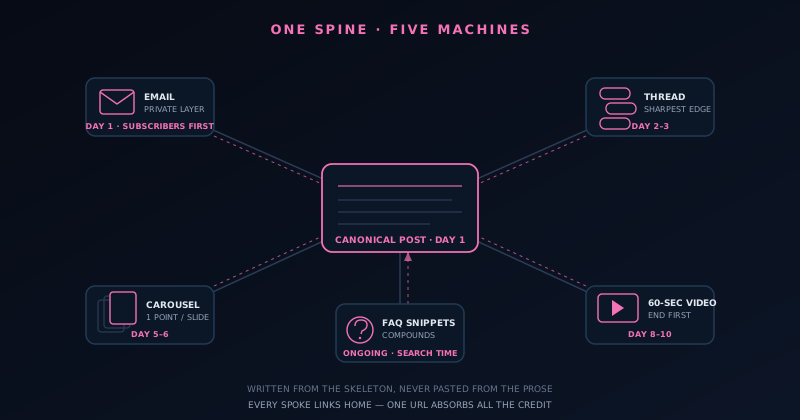
Publishing all five derivatives on launch day is the second-most-common repurposing mistake after copy-paste, because it maximizes the overlap audience’s exposure to the idea in its most concentrated, most fatiguing burst, and then goes silent. The sequence that works spreads the formats across roughly two weeks and orders them by temperature. Day one: the post itself, plus the email, because subscribers earn first access and their early clicks and replies tell you which points land. Day two or three: the thread, sharpened by whatever the email replies taught you. The carousel follows near the end of week one, the video early in week two, and the FAQ snippets go live on the post whenever they are ready, since search does not care about your calendar.
Sequencing this way turns repetition into rhythm. Each drop reaches a mostly-different slice of the audience, the small overlap encounters the idea a few days apart in a genuinely different form, and every derivative benefits from data the previous one generated: the thread leads with the point the email audience responded to, the video leads with the beat the thread proved out. It also converts one week of writing into two weeks of presence, which is the difference between a content calendar you sprint and one you sustain; the scheduling mechanics slot straight into the system we described in A content calendar that survives a busy week. The pipeline is not extra work on top of publishing. Done in this order, it is the publishing.
- Day 1: canonical post + email with the private layer; subscribers go first.
- Day 2–3: the thread, tuned by early email replies.
- Day 5–6: the carousel, built straight from the skeleton.
- Day 8–10: the sixty-second video, leading with the proven point.
- Ongoing: FAQ snippets added to the post; they work on search time, not calendar time.
Canonical linking: one URL absorbs all the credit
Underneath the creative work sits a piece of plumbing that decides whether five formats strengthen one asset or dilute it into six: every derivative must point at a single canonical URL, and any republished text version must say so in markup. The native derivatives (thread, video, carousel) handle this socially, by linking home in their final beat or slide. The risk case is republishing the post’s text on a second platform, where a duplicate now competes with your original in search. Platforms that support a canonical tag let you declare “the real one lives here,” so links and ranking signals consolidate on your domain instead of splitting; Google’s canonicalization documentation is short and worth the ten minutes, because the mechanics are unforgiving of guesswork.
The payoff of this discipline is cumulative and invisible until you look for it: every thread that travels, every carousel that gets saved, every video that outperforms sends its residue (clicks, links, brand searches) to one URL that gets stronger for years, instead of to five orphans that each got one day of sunlight. That is also the honest answer to “doesn’t repurposing hurt SEO?”: duplication hurts; consolidation helps; the difference is entirely in the linking. On our own site every derivative we ship points back to the post it came from, and the posts that received a full five-format treatment are, almost without exception, the ones that still pull search traffic a year later. The formats are the fireworks. The canonical URL is the asset.
The whole system in one sitting
Here is the honest cost accounting, because a playbook you cannot afford is not a playbook: the skeleton takes ten minutes, the email fifteen, the thread twenty-five, the carousel forty, the script and one-take video an hour, the FAQ extraction twenty minutes. Call it three hours for a two-week distribution footprint: less time than most creators spend producing one net-new piece for one channel, and the three hours are low-stakes hours, because every hard creative decision was already made in the original post. That asymmetry is the entire economic argument: thinking is expensive, translation is cheap, and most creators price them backwards by treating every channel as a fresh thinking problem.
A note on what to skip, because the system is meant to flex: if you have no audience on a channel, do not manufacture a derivative for it out of completeness. The formats exist to serve distribution you already have (an email list of two hundred beats a carousel posted into a void) and the pipeline’s order of operations should follow your actual reach, not this article’s. Start where your people are, prove the translation discipline there, and add channels only when there is somebody on the other end. Repurposing multiplies attention. It cannot create attention from zero.
Start smaller than the full system if the full system feels heavy: pick your single best evergreen post from the last year, build the skeleton, and ship just the thread and the email this week. If the mechanics hold (if the thread stands alone and the email adds its private layer) layer in the carousel next time, then the video, then make FAQ extraction a standing habit. Within a few cycles the pipeline runs on rails, and the question flips from “what do I post this week” to “which argument deserves the full treatment”, which is a better question, asked from a calmer place, and it is the question the rest of our playbooks in Creator playbooks are built to answer.
Frequently asked questions
Quick answers to common questions about this topic.
Does repurposing content hurt SEO?
Repurposing itself does not; duplication without consolidation does. Native derivatives like threads, videos, and carousels live on other platforms and simply link back, which helps rather than hurts. The risk case is republishing the post’s text elsewhere, where a copy can compete with your original in search. Handle that with a canonical tag pointing at your URL wherever the platform supports it, and by making every derivative link home. Done that way, five formats concentrate links and attention on one page instead of splitting them across six.
How do I repurpose a blog post without it feeling repetitive?
Translate instead of pasting. Extract the post’s skeleton (the claim, the three to five load-bearing points, the best numbers) and write each format natively from that skeleton: a thread argues in self-contained beats, an email adds a private layer the public post lacks, a video opens with the conclusion, a carousel puts one point per slide. Then sequence the drops across roughly two weeks. Audiences experience an idea restated in a genuinely different form as reinforcement, not repetition; what they punish is the same format pasted everywhere at once.
Which formats should I repurpose a post into first?
Start with the email and the thread. The email is fifteen minutes of work and serves the audience you actually own, and its replies tell you which points resonate before you invest in anything heavier. The thread is the argument’s sharpest edge and travels furthest for the effort. Add the carousel once those two are habitual, then the sixty-second video, and make FAQ extraction a standing step: it is the least glamorous format and the only one that keeps compounding through search for years.
How long should the gap be between repurposed posts on different channels?
Spread the five formats across about two weeks rather than dropping them together. Subscribers get the post and email on day one, the thread follows a day or two later refined by early replies, the carousel lands late in week one, and the video early in week two. FAQ snippets join the post whenever ready since search traffic is not calendar-driven. The spacing keeps the overlap audience from seeing the idea three times in one afternoon, and lets each drop borrow performance data from the previous one.
What kind of post is worth repurposing into multiple formats?
One with a spine: a single arguable claim, three to five supporting points, at least one concrete number or example per point, and a stance someone could disagree with. Evergreen, opinionated explainers are ideal donors. News posts decay before the last format ships, announcements have nothing to argue, and list round-ups have no through-line to translate. If you cannot state the post’s claim in one sentence while building the skeleton, that is the system telling you to pick a different donor, before you spend the channel slots.
Related troubleshooting
Was this page helpful?
Your answer stays in this browser, it is not sent anywhere and no account or cookie is involved.