2026 · Novus Stream Solutions (hub)About 13 min readNovus Stream Solutions
A content calendar that survives a busy week
Almost everyone starts a content calendar in a good week and abandons it in a bad one. The calendars that survive are built for the bad weeks from the start, with a backlog buffer, batched production, and a cadence low enough to keep even when everything else is on fire. This is how to build one that lasts.
Contents
- 1.Overview
- 2.Why most content calendars fail
- 3.Design for your worst week, not your best
- 4.Build a backlog buffer
- 5.Reduce the decisions with themes and a format
- 6.Separate creation from publishing
- 7.Pick a cadence you can actually keep
- 8.Batch the production, drip the publishing
- 9.Keep the calendar itself simple
- 10.Recover from a miss without spiralling
- 11.Consistency beats intensity
Overview
Nearly everyone who starts a content calendar starts it in a good week. The energy is high, the ideas are flowing, and committing to publish on a regular schedule feels entirely doable, because the week you are committing in is calm enough to support it. Then a busy week arrives (a deadline, a crisis, a stretch where the actual business demands everything you have) and there is no time to create anything, so nothing gets published, the streak breaks, and the momentum that consistency was building quietly evaporates. The calendar did not fail because the plan was bad; it failed because it was designed for the good week and met a bad one, which it always eventually will.
The content calendars that actually survive are the ones built from the start for the weeks when you cannot create anything new. That sounds defeatist, but it is the opposite: it is the recognition that consistency is the entire value of a content calendar, and consistency is tested precisely in the weeks when creating is impossible. A system that keeps publishing through a terrible week (because the work was done in advance and the decisions were made ahead of time) is worth vastly more than an ambitious one that collapses the first time life gets in the way. This article is about building that resilient version: designed for your worst week, fuelled by a buffer, and low enough to keep no matter what.
Why most content calendars fail
The common failure mode is not laziness or lack of ideas; it is a structural mistake in how the calendar couples creating and publishing. In the naive version, publishing depends on creating in the same window (you write the post this week to publish it this week) so the moment a week has no room to create, it has nothing to publish, and the chain breaks at its weakest link. Because every week eventually gets busy, a calendar that requires fresh creation every period is guaranteed to break; it is only a question of when. The design has a single point of failure, and that point is your own availability, which is exactly the thing a content calendar cannot assume.
The second failure mode is overcommitment born of optimism. Setting a cadence in a good week tempts you to promise more than your average week can sustain (daily posts, multiple platforms, ambitious formats) and an over-ambitious cadence is one missed deadline away from the demoralising spiral where falling behind makes catching up feel hopeless and you quit entirely. Both failures share a root cause: the calendar was calibrated to your best self in your best week, rather than to the realistic average across good weeks and bad. Fixing it means inverting that assumption and building for the floor instead of the ceiling, which is what the rest of this is about.
Design for your worst week, not your best
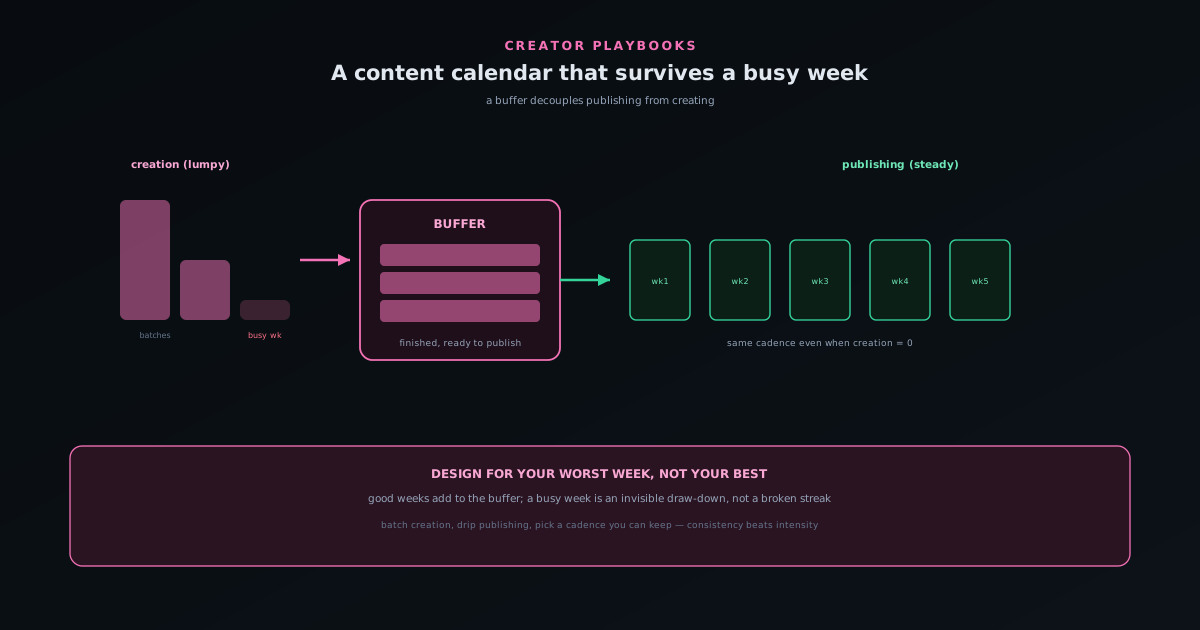
The single most important principle is to design the whole system around your worst plausible week rather than your best. Ask not "how much could I produce when everything is going well?" but "what can I guarantee gets published in a week where I have essentially no time to make anything?", and build the calendar to honour that answer no matter what. This reframing changes every downstream decision: the cadence you commit to, the buffer you hold, the formats you choose, the way you separate creation from publishing. It feels like aiming low, but it is actually aiming for the only thing that matters, which is a streak that does not break.
The reason this works is that consistency compounds and gaps reset it. An audience and an algorithm both reward reliability (the sense that new work shows up dependably) and both punish the disappearances that an over-ambitious calendar produces. A modest cadence held without fail for a year beats an ambitious one that runs hot for a month and then goes dark, because the steady one is still there building trust while the ambitious one is explaining where it went. Designing for the worst week is how you make the steady version the realistic one, and it is the difference between a calendar that is a source of compounding momentum and one that is a recurring source of guilt.
Build a backlog buffer
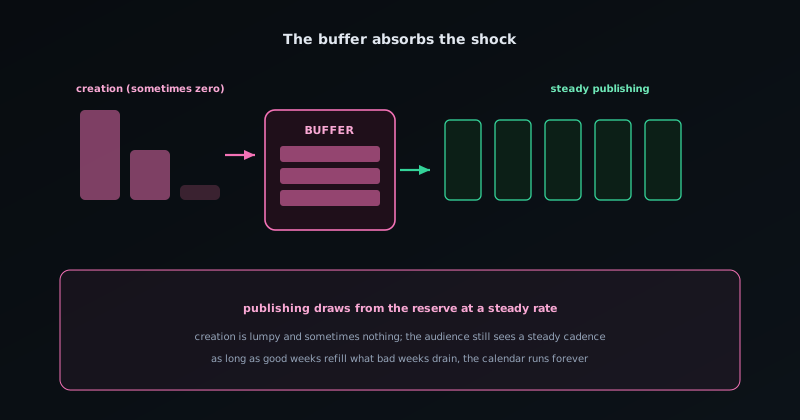
The mechanism that makes a worst-week-proof calendar possible is a backlog buffer: a stock of finished, ready-to-publish content held in reserve, so that publishing draws from the buffer rather than from this week’s creation. When you have several finished pieces banked, a week where you create nothing is no longer a week where you publish nothing: you simply draw from the reserve, and the audience sees the same steady cadence whether or not you made anything new. The buffer decouples the act of publishing from the act of creating, which removes the single point of failure that breaks naive calendars.
Building the buffer is front-loaded work that pays back permanently. Before you start publishing on a schedule, get ahead: produce a handful of pieces so you launch with a reserve rather than from empty, and treat refilling the buffer as the real ongoing job rather than feeding each week hand-to-mouth. The goal is that the buffer never empties: in good weeks you produce more than you publish and the reserve grows; in bad weeks you produce nothing and it shrinks; and as long as the good weeks refill what the bad weeks drain, the calendar runs forever. The buffer is the shock absorber that turns the inevitable bad week from a break in the chain into a quiet, invisible draw-down.
Reduce the decisions with themes and a format
A hidden reason content calendars feel exhausting is the sheer number of decisions each piece demands (what to make, what angle, what format, what visuals) and decision fatigue is a real tax that makes the work feel heavier than it is. You can remove most of that tax by deciding once, in advance, rather than every time. Assigning themes to days or weeks, and settling on a small set of repeatable formats, means that when it is time to create you are filling a known template rather than inventing the whole thing from scratch, which is dramatically faster and far less draining. The constraint is liberating: a defined shape to fill beats a blank page every time.
Repeatable formats also make batching and buffering easier, because similar pieces are faster to produce in a run and simpler to schedule interchangeably. When every piece is a bespoke creative project, you cannot batch them and you cannot easily swap one for another in the schedule; when they share a format, you can produce five in the time one bespoke piece would take and slot any of them into any open day. This is the same logic as a production line, covered in Building a repeatable content production line: standardise the format so the work becomes repeatable, and repeatable work is what you can actually keep up with through a busy stretch. Decide the shape once; spend your scarce energy on the substance.
Separate creation from publishing
The buffer only works if you genuinely treat creating and publishing as two separate activities that happen on different schedules, rather than two halves of one weekly scramble. Creation is lumpy, energy-dependent, and best done in concentrated sessions when you have the time and the focus; publishing is steady, low-effort, and best done on an unvarying schedule regardless of how you feel. Conflating them (creating and publishing in the same breath each week) is precisely the coupling that makes a calendar fragile. Pulling them apart is what lets the steady output continue while the lumpy input pauses.
In practice this means publishing should be nearly automatic: scheduled in advance, or a trivial action of pushing the next buffered piece live, so that it requires almost nothing from you in the moment and can happen even in a week consumed by other things. The creative work, meanwhile, happens whenever you have a real block of time, decoupled entirely from the publish dates. The mental shift is to stop thinking "this week I will make and post a thing" and start thinking "I make things in batches when I can, and the schedule posts them steadily on its own." That separation is the operational heart of a calendar that survives, because it removes your week-to-week availability from the publishing path.
Pick a cadence you can actually keep
Choosing the cadence is where most people sabotage themselves, because the temptation is to commit to the frequency they admire in others rather than the one they can sustain. The right question is not "what cadence would be impressive?" but "what is the most frequent schedule I am confident I can maintain through a realistically bad stretch, given my buffer and my batching?", and the honest answer is usually less than the aspirational one. It is far better to commit to a lower cadence and never miss than to commit to a higher one and break, because the streak, not the frequency, is what compounds.
A sustainable lower cadence also leaves room to over-deliver, which is strictly better than the reverse. If you commit to a modest schedule and some weeks publish more, the audience experiences pleasant surprises on top of reliable baseline; if you commit to an aggressive schedule and some weeks publish less, they experience disappointment and the sense that you are slipping. Under-promising and occasionally over-delivering builds trust; over-promising and frequently under-delivering erodes it. So set the cadence at a level you could keep even in a bad month, treat anything above it as a bonus, and let the consistency do the compounding work that a brittle, ambitious schedule never gets the chance to.
Batch the production, drip the publishing
The most efficient way to fill the buffer is to batch production: make many pieces in a single focused session rather than one at a time across many sessions. Batching exploits the setup cost that every creative task carries (getting into the headspace, opening the tools, assembling the materials) by paying it once and then producing several pieces while you are warmed up, which is far more efficient than paying that setup cost repeatedly for one piece each. A single recording session can yield a week or more of clips; one design session can produce a month of visuals; one writing session can draft several posts. The batch is how lumpy creation outpaces steady publishing.
This pairs naturally with tools and tactics built for multiplication. A single recording turned into many shareable pieces, as in One recording, a week of content: a repurposing system for solo creators, or one core piece repurposed into ten formats, as in Repurposing one piece of content into ten, are both ways to make a batching session produce far more than its raw effort suggests. Free tools that process assets in bulk (generating visuals, turning audio into video) are the practical fuel here, letting one session of effort fill many slots in the calendar. The rhythm to aim for is concentrated bursts of batched creation that more than refill the buffer, feeding a steady, undramatic drip of publishing that the audience experiences as perfect consistency.
Keep the calendar itself simple
It is easy to spend more energy maintaining an elaborate content calendar than creating the content, which is a self-defeating trap: a calendar so complex it becomes its own project is one more thing to abandon in a busy week. The calendar should be the simplest thing that tells you what is scheduled, what is in the buffer, and what gaps need filling, and it should fit on one screen at a glance. A single board or sheet with the upcoming publish slots and the banked pieces is plenty; the sophistication should live in the production system, not in the tracking of it.
Simplicity here is not just aesthetic preference, it is resilience. A lightweight calendar is one you will actually keep updated, and a calendar you keep updated is one that accurately tells you whether the buffer is healthy or running low, which is the one signal you most need in a busy stretch. An overwrought system, by contrast, falls out of date exactly when things get hectic, leaving you blind to whether you are about to run dry. Keep the calendar humble and the buffer visible, and you always know, at a glance, whether the machine has enough fuel to coast through the next bad week, which is the only question the calendar really needs to answer.
Recover from a miss without spiralling
Even a well-built system will eventually miss (the buffer runs dry during an exceptional stretch, or something slips through) and how you respond to a miss matters more than the miss itself. The destructive pattern is the spiral: one missed post triggers guilt, the guilt makes the calendar feel like a source of failure, and the avoidance that follows turns a single gap into permanent abandonment. The healthier response is to treat a miss as a normal event the system is allowed to absorb, not a verdict on the whole project. You resume the next scheduled slot and refill the buffer; you do not try to retroactively make up the gap or punish yourself into a frantic catch-up.
This forgiveness is part of the design, not a concession to weakness. A calendar built for the worst week already expects that the worst week will sometimes exceed even its buffer, and the recovery plan is simply to keep going from the next slot rather than to declare the streak ruined and quit. The audience barely notices a single missed post; they very much notice a creator who disappears entirely after one. So the rule is: protect the buffer so misses are rare, and when one happens anyway, absorb it and continue without drama. A system that can take a hit and keep running is the entire point of designing for the worst week, and the ability to recover calmly from a miss is what separates a durable calendar from a brittle one.
Consistency beats intensity
The lesson underneath all of this is that consistency, not intensity, is what content rewards, and a system designed for the worst week is simply a system optimised for consistency. The creator who publishes steadily for years, through good weeks and terrible ones, will compound an audience and a body of work that the sporadic burst-and-disappear creator never will, even if the sprinter produces more in their best month. The tortoise wins because the race is long and the algorithm and the audience both reward showing up reliably over showing up impressively. A calendar that survives busy weeks is how you become the tortoise on purpose.
So the build is coherent and it is humble: design for your worst week, hold a backlog buffer so publishing never depends on this week’s creation, reduce the per-piece decisions with themes and formats, separate the steady act of publishing from the lumpy act of creating, batch production to fill the buffer faster than it drains, pick a cadence you can keep even in a bad month, keep the calendar itself trivially simple, and forgive the occasional miss without spiralling. None of it is glamorous, and that is precisely why it works: it is engineered to keep running when motivation, time, and inspiration all fail, which they will. The calendar that survives a busy week is the one that was never counting on a good one.
Frequently asked questions
Quick answers to common questions about this topic.
Why do content calendars usually fail?
Because they couple creating and publishing in the same window, so a week with no time to create is a week with nothing to publish, and every week eventually gets busy. They are also often set in a good week at a cadence the average week cannot sustain. Both failures come from calibrating to your best self in your best week rather than to a realistic worst week.
What is a backlog buffer and why does it matter?
It is a stock of finished, ready-to-publish pieces held in reserve, so publishing draws from the buffer rather than from this week’s creation. It decouples publishing from creating, which removes the single point of failure that breaks naive calendars: a week where you make nothing is just a quiet draw-down from the reserve, and the audience still sees a steady cadence.
How do I choose a sustainable posting cadence?
Ask what you could maintain through a realistically bad stretch given your buffer and batching, not what frequency looks impressive. Commit to that lower number and treat anything above it as a bonus. Under-promising and occasionally over-delivering builds trust; over-promising and frequently slipping erodes it. The streak compounds, not the raw frequency.
How does batching help a content calendar survive?
Batching produces many pieces in one focused session by paying the setup cost (headspace, tools, materials) once instead of per piece. A single recording or design session can fill a week or a month of slots, and repurposing multiplies each piece further. Concentrated bursts of batched creation refill the buffer faster than steady publishing drains it.
What should I do when I miss a scheduled post?
Absorb it and resume at the next slot; do not spiral. The destructive pattern is letting one miss trigger guilt, avoidance, and total abandonment, turning a single gap into a permanent disappearance. The audience barely notices one missed post but very much notices a creator who vanishes. Protect the buffer so misses are rare, and when one happens, keep going calmly.
Related troubleshooting
Was this page helpful?
Your answer stays in this browser, it is not sent anywhere and no account or cookie is involved.