2026 · Novus Stream Solutions (hub)About 13 min readNovus Stream Solutions
Business loans and lines of credit, explained
For a small business, debt is neither salvation nor sin: it is a tool with a cost, useful for some jobs and dangerous for others. This is a plain-English explainer of term loans and lines of credit: what each is for, what borrowing actually costs, the traps to watch, and the simple test for when it makes sense. Educational, not financial advice.
Contents
- 1.Overview
- 2.Debt is a tool, not a verdict
- 3.Term loan versus line of credit
- 4.What a line of credit is for
- 5.What a term loan is for
- 6.What borrowing actually costs
- 7.Secured, unsecured, and the personal guarantee
- 8.When borrowing makes sense
- 9.When it does not
- 10.What lenders look at, and the alternatives
- 11.Borrow against a return, not against hope
Overview
A clear disclaimer first, because this topic warrants it: this is general educational information about how small-business borrowing works, not financial advice, and the right decision for any specific business depends on its numbers and circumstances and ideally a conversation with a qualified advisor. With that established: there is a lot of unhelpful emotion around business debt. One camp treats any borrowing as reckless, a sign you cannot run a business on its own merits; another treats debt as free money, the obvious way to grow faster. Both framings are wrong, because debt is neither a moral failing nor a magic accelerant. It is a tool with a defined cost, well suited to some jobs and actively dangerous for others, and the useful skill is knowing which is which.
The two financing tools a small business most commonly encounters are the term loan and the line of credit, and they are built for genuinely different purposes that newcomers often confuse. Used for the job it fits, each can be a sensible, even smart, part of running a business; used for the wrong job, each can dig a hole that is hard to climb out of. This article explains, in plain language, what each tool is, what it is actually for, what borrowing really costs once you look past the headline rate, the traps worth knowing about, and the simple underlying test for when borrowing makes sense at all. The goal is to make debt a deliberate, understood choice rather than either a taboo or a reflex.
Debt is a tool, not a verdict
The most useful reframing is to strip the morality out of the decision entirely and treat borrowing as a straightforward economic question: does taking this money, at this cost, to do this specific thing, leave the business better off after the cost of the debt is paid? Framed that way, there is nothing virtuous about refusing all debt and nothing reckless about taking the right debt: the question is purely whether the use of the money produces more than the money costs. A loan that funds something which earns more than its interest is a good trade; a loan that funds something which earns less, or nothing, is a bad one, regardless of how the borrowing feels.
This economic framing also defuses the two emotional traps. The fear that all debt is dangerous keeps some sound businesses from making investments that would clearly pay for themselves, leaving growth on the table out of an instinct that is really about feeling rather than math. The opposite belief, that debt is easy fuel, leads others to borrow against optimism for things that do not generate a return, and to discover the cost only when the repayments arrive regardless of whether the bet paid off. Seeing debt as a priced tool (useful exactly when the return beats the cost) is what lets you use it deliberately, neither avoiding it out of superstition nor reaching for it out of impatience.
Term loan versus line of credit
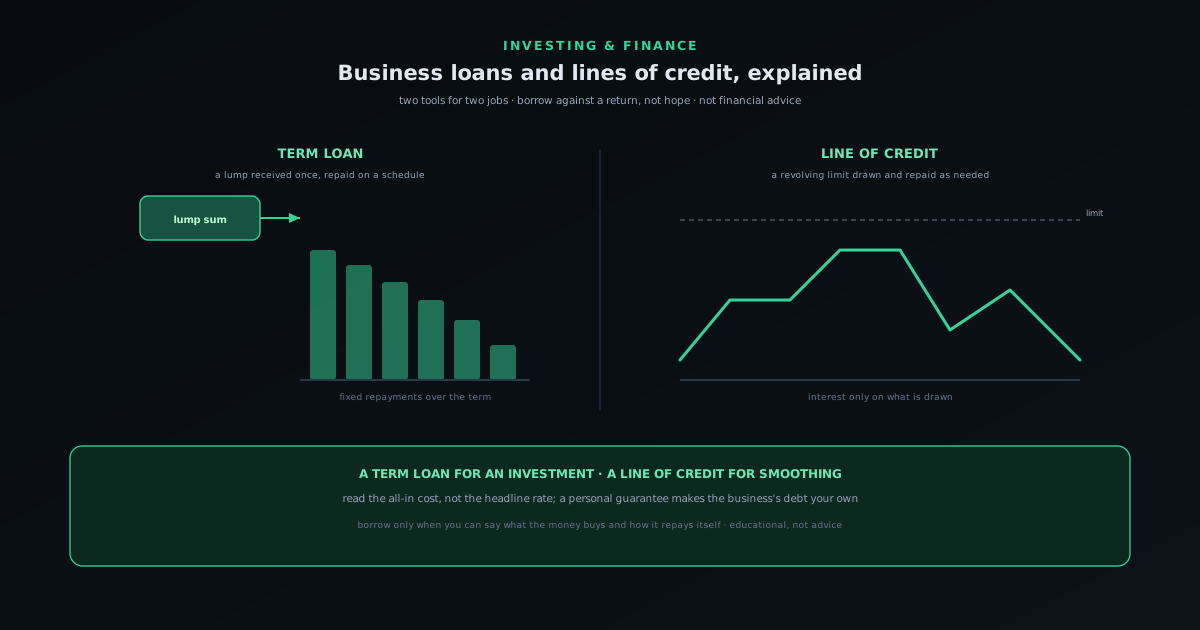
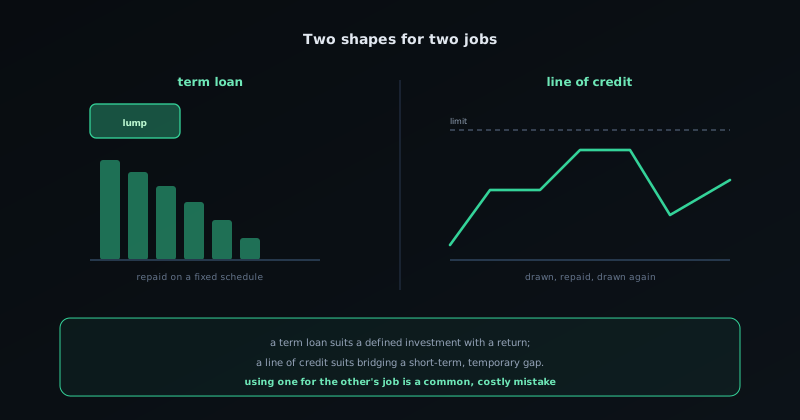
The two tools differ in shape, and the shape is what makes each suited to a different job. A term loan is a lump sum you receive all at once and repay over a fixed term on a set schedule, usually with regular payments of principal and interest until it is gone. You borrow a specific amount for a specific purpose, you get it in one piece, and you pay it back predictably over months or years. It is a single, defined transaction with a beginning and an end, and its predictability is its virtue: you know exactly what you borrowed, what it costs, and when it will be repaid.
A line of credit is different in kind: it is a revolving limit you can draw from as needed, repay, and draw from again, paying interest only on what you have actually drawn at any given time. It is less a single transaction than a standing facility: a financial cushion you can dip into when you need it and pay down when you can, available again the moment you repay. The mental models are distinct: a term loan is like buying something on a fixed instalment plan, while a line of credit is like a flexible reserve you tap and refill. Confusing the two (using a line of credit for what wants a term loan, or vice versa) is one of the most common and costly small-business financing mistakes.
What a line of credit is for
A line of credit is built for smoothing: bridging short-term, temporary gaps between money going out and money coming in, where you are confident the incoming money is real and merely mistimed. The textbook use is working capital: covering payroll or supplier payments in a lean stretch when you know revenue is arriving shortly, or financing a seasonal inventory build that will sell through and repay the draw. In these cases you are not funding a loss, you are bridging a timing mismatch, and the line gets drawn and repaid within a short cycle, with interest paid only on the brief period the money was actually out.
The danger with a line of credit is precisely that its flexibility makes it easy to misuse, because there is no fixed repayment forcing discipline. A line drawn to bridge a temporary gap and promptly repaid is healthy; a line drawn to cover ongoing losses, never repaid, and slowly maxed out is a business quietly financing its own decline and calling it cash flow. The tell is whether the draws get repaid: a revolving facility that revolves is doing its job, while one whose balance only ever climbs is masking a problem the borrowing cannot fix. A cash buffer, discussed in A cash buffer and emergency fund for business owners, reduces how often you even need the line, which is the healthiest position: the line as backup rather than crutch.
What a term loan is for
A term loan is built for a specific, larger investment that you expect to generate a return over time: the kind of purchase too big to fund from cash flow but clearly worth more than it costs. Buying equipment that increases capacity, financing a defined expansion, acquiring inventory for a known large order, or making a capital improvement with a measurable payoff are the classic fits. The defining feature is that you can point to the specific thing the money buys and make a reasonable case that it will produce more value than the loan’s total cost, repaid predictably over the term. The fixed schedule suits this because the investment, too, plays out over time.
The test for a sensible term loan is concrete: can you articulate what the money buys, and is the expected return on that specific thing comfortably greater than the all-in cost of the loan, with margin for things going less well than hoped? If yes, the loan is a lever that lets you make a value-creating investment sooner than cash flow alone would allow, and paying for it out of the returns it generates is a clean trade. If you cannot point to a specific return-generating use (if the loan is really to cover general shortfalls or to fund hope) then a term loan is the wrong tool, and its fixed repayments will arrive whether or not the vague plan pays off. A term loan wants a specific job with a believable payoff.
What borrowing actually costs
Understanding the real cost of borrowing means looking well past the headline interest rate, because the advertised rate is often only part of the price. Origination fees, ongoing fees, the way interest is calculated, and the term over which you repay all affect what the money truly costs, and two loans with the same stated rate can cost meaningfully different amounts once everything is counted. The annualised, all-in cost (the figure that rolls fees and interest into a single comparable rate) is the number to compare across offers, because it is the one that reflects what you will actually pay rather than the one chosen to look attractive in an advertisement.
The other half of cost is the repayment burden against your actual cash flow, which is where financial literacy meets financing. A loan whose payments your business can comfortably service from its real earnings is sustainable; one whose payments strain or exceed what the business reliably generates is a slow-motion crisis, regardless of how good the rate looked. Reading your own profit-and-loss honestly, as covered in Reading a P&L for non-accountants: what each line is trying to tell you, is what tells you whether a given repayment is comfortable or dangerous. The discipline is to evaluate any borrowing on both its all-in cost and its fit with your real cash flow, never on the headline rate alone, because the rate is the advertisement and the all-in cost against your cash flow is the reality.
Secured, unsecured, and the personal guarantee
Borrowing comes secured or unsecured, and the distinction carries real risk for a small-business owner. A secured loan is backed by collateral (an asset the lender can take if you do not repay) which usually means a lower rate because the lender’s risk is lower, but also means you can lose the pledged asset. An unsecured loan has no specific collateral and typically carries a higher rate to compensate the lender for that risk. So far this is a straightforward risk-versus-cost trade, and neither is inherently wrong; the higher rate of unsecured borrowing is the price of not pledging an asset.
The trap that catches small-business owners specifically is the personal guarantee, which is common on small-business borrowing and quietly dissolves the protection many founders think their business structure gives them. A personal guarantee makes you personally liable for the business’s debt, so if the business cannot repay, the lender can come after your personal assets: the separation between business and personal finances that you carefully maintained, as discussed in Separating business and personal finances (and why it matters), does not shield you from a debt you personally guaranteed. This is not a reason never to sign one, since many small businesses cannot borrow without it, but it is a reason to understand exactly what you are risking: a personally-guaranteed loan is, in substance, you borrowing the money, and it should be sized and considered accordingly.
When borrowing makes sense
Pulling the threads together, borrowing makes sense when a specific, identifiable use of the money will generate more value than the debt costs, and when your business can comfortably service the repayments from its real cash flow even if things go somewhat worse than planned. That is the whole test, and both halves matter: a great return that you cannot service if a bet goes sideways is still dangerous, and easily-serviced debt that funds nothing productive is still waste. The clearest cases (a term loan for equipment that demonstrably increases earnings, a line of credit to bridge a genuine timing gap before known revenue) share the property that you can point to where the money goes and trace how it more than pays for itself.
There is also a margin-of-safety dimension that separates prudent borrowing from gambling. Because the repayments are fixed and arrive regardless of how the investment performs, sensible borrowing leaves room for the return to disappoint without the debt becoming a crisis: you borrow an amount the business can service even in a worse-than-expected scenario, not an amount that only works if everything goes right. Borrowing that requires the optimistic case to materialise just to make the payments is borrowing against hope, and hope is not a repayment source. The prudent version borrows against a return you are confident in, sized so that even a disappointing outcome is survivable, which is what makes debt a tool rather than a gamble.
When it does not
The mirror image is just as important: borrowing does not make sense when it is funding a hole rather than an investment. Using debt to cover ongoing operating losses, to pay for things that generate no return, or to sustain a business that is not working in the hope that more time fixes it, is the most dangerous use of borrowing, because it adds fixed repayment obligations on top of a problem the borrowing does not solve. Debt does not fix a business that loses money on its operations; it postpones the reckoning and enlarges it, since now the underlying problem remains and there is a loan to repay on top of it. A loan can buy time, but only borrowing that buys time to fix a fixable, temporary problem is sound; borrowing to delay confronting a structural one just deepens the hole.
The honest signal to watch for is whether you are borrowing toward something or away from something. Borrowing toward a specific investment with a return is the tool working as intended; borrowing away from a problem (to avoid cutting costs, to avoid admitting a line is not viable, to keep the lights on without a plan for how the borrowing gets repaid) is the tool being misused in the most damaging way. The same flexibility that makes a line of credit useful for smoothing makes it dangerous here, because it can quietly fund a slow decline while feeling like cash management. When the answer to "what does this money buy and how does it repay itself?" is vague, the right move is almost always not to borrow.
What lenders look at, and the alternatives
For completeness, it helps to know roughly what qualifying for small-business borrowing involves, because it shapes what is realistically available. Lenders generally look at the business’s revenue and its history, its cash flow and ability to service the debt, the owner’s personal credit (especially for newer businesses), and any collateral on offer, and a young business with little track record will usually face higher rates, smaller limits, and a personal guarantee, simply because it is riskier to lend to. None of that is a moral judgment; it is the lender pricing uncertainty, and understanding it sets realistic expectations rather than leaving you surprised by the terms a new venture is offered.
It is also worth remembering that borrowing is not the only path, and for many small businesses the default should be to fund growth from retained earnings where possible: the bootstrap approach of reinvesting profits, discussed in Reinvest or pay yourself? A profit allocation framework for small business owners, avoids both the cost and the risk of debt entirely. Borrowing earns its place when the opportunity is real and time-sensitive enough that waiting to self-fund would cost more than the interest, or when a genuine timing gap needs bridging. Holding a cash buffer reduces how often you need to borrow at all. The sensible posture is debt as a deliberate tool reached for when the math clearly favours it, not as the default way to fund a business that could grow more slowly and safely on its own earnings.
Borrow against a return, not against hope
If a single principle survives from all of this, it is the test that borrowing should be against a return, not against hope. Debt used to fund a specific thing whose payoff comfortably exceeds the cost, sized so the business can service it even if the payoff disappoints, is a sound and even shrewd part of running a business: the term loan for the equipment that pays for itself, the line of credit that bridges a real and temporary gap. Debt used to fund a hole, to delay a reckoning, or to chase an optimistic case the business needs to come true just to make the payments, is how borrowing turns from a tool into a trap.
So the practical literacy is modest but valuable: know that a term loan suits a defined investment and a line of credit suits short-term smoothing; read the all-in cost rather than the headline rate; understand that a personal guarantee makes the business’s debt your own; check every borrowing against your real cash flow and a margin for things going wrong; and reach for debt only when you can clearly answer what the money buys and how it repays itself. Held that way, business borrowing stops being either a taboo or a temptation and becomes what it actually is: a priced tool, useful for the right jobs and avoidable for the wrong ones. And, once more, this is educational background rather than advice for your situation, which your own numbers and a qualified advisor are the ones to settle.
Frequently asked questions
Quick answers to common questions about this topic.
What is the difference between a term loan and a line of credit?
A term loan is a lump sum received once and repaid over a fixed term on a set schedule, suited to a specific, larger investment with a return. A line of credit is a revolving limit you can draw from, repay, and draw again, paying interest only on what is drawn, suited to smoothing short-term, temporary gaps between money going out and coming in. Using one for the other’s job is a common, costly mistake.
When does it make sense for a small business to borrow?
When a specific, identifiable use of the money will generate more value than the debt costs, and the business can comfortably service the repayments from real cash flow even if things go somewhat worse than planned. Both halves matter. Borrow against a return you are confident in, sized so a disappointing outcome is still survivable, not against an optimistic case the business needs to come true just to make the payments.
How do I judge the real cost of a loan?
Look past the headline interest rate to the all-in annualised cost, which folds in origination and ongoing fees and how interest is calculated: two loans with the same stated rate can cost very differently. Then weigh that against your actual cash flow: a payment your business can comfortably service is sustainable, one that strains real earnings is a slow-motion crisis regardless of the rate.
What is a personal guarantee and why does it matter?
A personal guarantee makes you personally liable for the business’s debt, so if the business cannot repay, the lender can pursue your personal assets, dissolving the separation your business structure seemed to provide. It is common on small-business borrowing and not always avoidable, but it means a guaranteed loan is in substance you borrowing the money, so it should be sized and considered with that personal risk fully in view.
When should a small business avoid borrowing?
When the debt would fund a hole rather than an investment: covering ongoing operating losses, paying for things with no return, or sustaining a business that is not working in the hope time fixes it. Debt does not fix unprofitable operations; it adds fixed repayments on top of the problem and enlarges the eventual reckoning. If you cannot clearly say what the money buys and how it repays itself, the answer is usually not to borrow.
Related troubleshooting
Was this page helpful?
Your answer stays in this browser, it is not sent anywhere and no account or cookie is involved.