Novus Learn
Read the citations: verify claims and judge sources in Novus Learn
The heart of source-grounded reading: how Novus Learn attaches a source identity to every topic and a citation to individual claims, how to follow a single statement to the reference behind it, and how to judge whether that reference actually holds the claim up.
Every tool in this category will hand you a fact. What separates Novus Learn is that it also hands you the reference that fact rests on, attached to the specific claim rather than pooled in a vague list at the bottom of the page. Because the text you read is drawn from official Wikipedia and Wikimedia sources rather than composed by a model, the citations are not decoration added afterward to lend authority: they belong to the passage they sit beside, and they point at where the statement actually came from.
This guide is about the one skill that turns that design into a habit: reading the citations, not just the prose. You will learn how source identity frames a topic before you read a word, how to follow an individual claim to its reference, and (the part most people skip) how to judge whether the reference genuinely supports the claim or merely sits near it. Done well, this is the difference between knowing a fact and being able to defend it.
Contents
Two ways to finish
Follow a claim
Move from a statement in the article to the exact reference it stands on.
Judge the source
Decide whether that reference actually holds the claim up before you rely on it.
- 1
1. Know what a citation means here
In an answer engine, a citation is frequently a link appended after the fact to make generated text feel trustworthy, and it sometimes points at a page that does not contain the claim it is attached to. Novus Learn works the other way around. The passage you are reading is the source, carried across with attribution rather than paraphrased into something new, so the reference beside a claim is the origin of that claim rather than a badge stapled on to reassure you.
That inversion is the whole reason to read the citations at all. When the text is a rewrite, checking the reference is optional theater; when the text is the source, the reference is the point, and following it is how you actually verify. Everything else in this guide follows from that single distinction, so it is worth holding onto: in Novus Learn the citation is not evidence that someone did their homework, it is the homework, left in place for you to check.
- Citations belong to the passage: they are the origin, not decoration.
- Because nothing is generated, a citation cannot be invented or misattributed to fill a gap.
- 2
2. Read the source identity before the article
Before you read the first sentence, look at where the topic comes from. Every page in Novus Learn carries its source identity: which Wikipedia edition and page you are reading, shown rather than buried. This tells you whether you are looking at a mature, heavily edited article or a much thinner one, and it is the frame around everything below it. Provenance is not a footnote here; it is the first thing to read.
This matters because the same subject is not equally documented everywhere. A topic can be rich and exhaustively referenced in one edition and short in another, and knowing which one you are on changes how much weight the article can bear. Reading the source identity first is a small habit that saves you from mistaking a thin stub for the settled account of a subject; you know what kind of source you are standing on before you decide how far to trust it.
- 3
3. Follow a single claim to its reference
Pick one statement that actually matters to what you are doing (a date, a figure, a cause-and-effect claim) and follow it to the reference behind it. Novus Learn keeps citations at the level of the individual claim, so verification is granular: you check the one sentence you doubt, not the whole article at once. This is a single motion rather than an investigation, which is precisely what makes it something you can do routinely instead of only when a claim already looks suspicious.
Build the habit around the claims you intend to rely on. Anything you plan to repeat, quote in your own work, or make a decision on is worth one step to its source. The goal is not to audit every sentence on the page; it is to stop treating the claims that matter as settled just because they are printed confidently. Follow the ones that carry weight, and let the rest be ordinary reading.
- 4
4. Judge whether the source holds the claim up
Following a claim is only half the skill; the other half is reading the reference critically once you arrive. A source can do three different things to a claim, and telling them apart is the point. It can confirm it outright, which is the easy case. It can qualify it: the reference turns out to support a narrower or more caveated version than the summary implied. Or it can fail to hold it up at all, resting on a weak citation or a single reference doing more work than one source should.
So arrive at a reference asking a question rather than looking for a rubber stamp. Does this actually say what the claim says, or something softer? Is a whole section leaning on one citation? Is the reference itself solid or shaky? Novus Learn puts the source in reach so you can ask these questions in seconds, but it cannot ask them for you: judging the source is the reader's job, and it is the job that separates careful work from confident guessing.
Arrive at a citation with a question: does the source confirm the claim, qualify it, or fail to hold it up? - 5
5. Notice where the sources are thin
There is a quieter benefit to reading this way. When you can see the reference behind every claim, you also start to see where the sources themselves are thin: a statement leaning on a weak citation, a section that rests on a single reference, a subject that is richly documented in one language and sketchy in another. An answer engine irons all of that out into one uniform tone of confidence. Novus Learn leaves the texture visible, so the gaps are part of what you read.
That texture is often the more useful thing to know before you repeat something. Learning that a subject is well documented is reassuring; learning that a claim you were about to rely on stands on a single shaky reference is more valuable still, because it stops you making a confident statement the record cannot actually support. Reading the citations is how you come away knowing not just the subject, but how well the subject is really documented.
- A weak or single citation under a big claim is a signal, not a detail.
- Coverage varies by edition; thin in one language does not mean thin everywhere.
- Knowing how well a subject is documented is often as useful as the subject itself.
- 6
6. Fit citations into the rest of your workflow
Reading the citations connects to everything else in Novus Learn. The topics you verify this way are exactly the ones worth saving to your local library, so a claim you have already checked reopens with its references still attached rather than needing to be re-verified from memory. And because the app never generates or paraphrases an answer, the source is always there to return to; verification is never blocked behind a summary that hid the reference from you.
When you want the mechanics in more depth, the guide at https://learn.novusstreamsolutions.com/help/sources-and-citations covers how sources and citations work in detail, alongside https://learn.novusstreamsolutions.com/help/searching-topics for choosing the right page in the first place and https://learn.novusstreamsolutions.com/help/getting-started for orientation. The underlying discipline stays the same everywhere: read the source identity, follow the claims that matter, and judge whether the reference truly supports them before you carry the fact anywhere else.
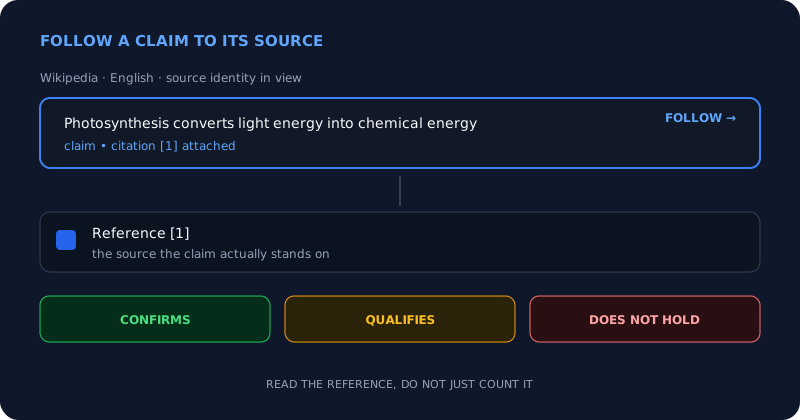
Follow the claim, then interrogate the source
The skill Novus Learn rewards is not just following a citation but reading it critically once you get there. Check the source identity before the article, follow the specific claims you intend to rely on, and ask of each reference whether it confirms the claim, quietly qualifies it, or fails to support it at all. Because nothing is generated, the source is always there to check; treat every claim that matters as one step from verified rather than assumed.
Frequently asked questions
Quick answers to common questions about this topic.
What does "claim-level citation" mean?
It means the granularity of a reference is the individual assertion, not the whole article. If a paragraph makes several factual claims, you can follow each one to the source behind it, rather than trusting a single blanket reference at the bottom that may not cover the sentence you actually doubt.
Can a citation in Novus Learn be wrong or invented?
Novus Learn does not generate text, so it cannot fabricate a citation the way an answer engine can. The references are the ones the underlying Wikipedia and Wikimedia material already uses. Your job is still to read them critically, because a real source can fully support a claim, only partly support it, or be weak; following it is how you tell.
How do I judge whether a source is strong?
Read the reference and ask whether it actually says what the claim says, whether a whole section is leaning on a single citation, and whether the source itself looks solid. A big claim resting on one weak reference is a signal to be cautious before repeating it.
Why do some topics have thinner citations than others?
Because coverage varies by edition and subject. The same topic can be richly documented in one Wikipedia language and sketchy in another. Reading the source identity first tells you which kind of page you are on, and following the claims shows you where the references are thin.
Related workflow
From a source you can cite to a study pack you can hand out
Read from the source rather than a summary of it, then turn what you verified into a document someone else can use.
- Find the source and check the claim against itNovus Learn: The study material is extractive, not generative: what you get back is what the source says, which is the only kind you can safely cite.
- Assemble and finish the packNovus PDF Studio: Merge the pieces, add the fields a learner fills in, and sign it locally, so unpublished material stays unpublished.
Related troubleshooting
Was this page helpful?
Your answer stays in this browser, it is not sent anywhere and no account or cookie is involved.