2026 · Novus Stream Solutions (hub)About 10 min readNovus Stream Solutions
Usage-based vs seat-based pricing for software
A software business charges either for access (a price per user, per seat) or for consumption (a price per unit of usage). The choice looks like a billing detail and is really a strategic decision that shapes revenue predictability, how fairly price tracks value, how the business grows inside its customers, and how it loses them. Here is how to think it through.
Contents
- 1.Overview
- 2.How each model actually works
- 3.Predictability: the seat model’s home advantage
- 4.Value alignment: the usage model’s home advantage
- 5.Expansion and churn behave very differently
- 6.Predictability cuts both ways: the customer feels it too
- 7.Choosing: let the value metric decide
- 8.Why mature products often blend the two
Overview
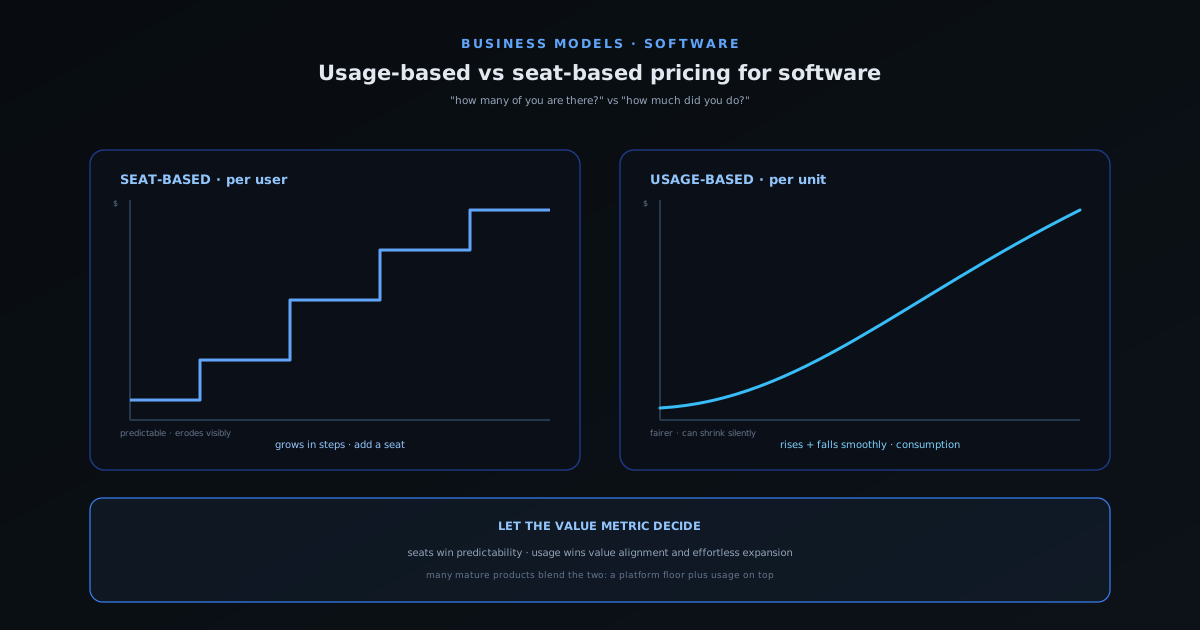
When a software business decides how to charge, it is really choosing between two fundamentally different ideas about what the customer is paying for. In seat-based pricing (the model most people picture when they think of software subscriptions), the customer pays for access, a recurring fee per user or per seat, and the price scales with how many people in their organisation use the product. In usage-based pricing, sometimes called consumption pricing, the customer pays for what they actually use (a price per unit of whatever the product meters, whether that is messages sent, gigabytes stored, jobs run, or some other measure of consumption), and the price scales with activity rather than headcount. The distinction sounds like a billing technicality and is in fact one of the most strategic decisions the business will make.
It is strategic because the pricing model is not just how you collect money; it shapes which customers you attract, how predictable your revenue is, how fairly your price tracks the value a customer gets, how the account grows over time, and how and when it shrinks. Two companies with the identical product can have completely different trajectories depending on whether they charge per seat or per usage. This article compares the two honestly across the dimensions that matter (predictability, value alignment, expansion, and churn) explains why neither is universally superior, and offers a way to choose based on how your particular product creates value, before noting why so many mature products end up blending the two.
How each model actually works
Seat-based pricing charges a recurring amount for each person who can use the product, usually with tiers that bundle features at different per-seat prices. Its defining quality is that the bill is tied to how many people have access, not to how hard they work the tool: a team of ten pays for ten seats whether those ten use the product constantly or barely at all. That makes the model beautifully simple to understand and to budget (a customer knows that adding a person costs one more seat, full stop), and it is why seat pricing became the default for collaboration and productivity software, where the value really does scale with the number of people involved.
Usage-based pricing charges for consumption of some metered unit, so the bill rises and falls with activity rather than headcount. A customer who runs a lot of jobs this month pays more than one who runs few, regardless of how many people are on the account. Its defining quality is that cost tracks intensity of use, which makes it the natural fit for products where the value is in the work performed rather than the number of people with logins: infrastructure, APIs, communications, anything where one user might generate a thousand times the load of another. The two models are answering different questions: seat pricing asks "how many of you are there?" and usage pricing asks "how much did you do?"
Predictability: the seat model’s home advantage
For the business, the biggest practical difference is how predictable the revenue is, and here seat-based pricing has a clear structural edge. Because customers pay a fixed amount per seat, the revenue for the coming period is largely knowable in advance: you know how many seats are active and what they cost, so you can forecast with confidence, which makes planning, hiring, and the whole financial picture calmer. That stability is also why investors have historically loved seat-based recurring revenue: it is the smooth, contracted, repeatable income that the standard SaaS metrics were built to measure, and it makes the business easier to value and to run.
Usage-based revenue is fairer but bumpier, because it moves with customer activity and customer activity is not a flat line. A usage-priced business can see revenue swing with its customers’ seasons, launches, and lulls, which makes forecasting harder and a soft quarter for your customers into a soft quarter for you. This is not a fatal flaw (usage revenue can grow explosively when customers do) but it does mean a usage-based business has to be more comfortable with variability and more attentive to the leading indicators of consumption. The trade is real and worth naming plainly: seat pricing buys predictability, usage pricing trades some of that predictability for a tighter link between what customers do and what they pay.
Value alignment: the usage model’s home advantage
If predictability is where seats win, fairness (the alignment between price and value) is where usage wins, and it is a genuine advantage rather than a slogan. Under usage pricing, a customer who gets a little value pays a little and a customer who gets a lot pays a lot, which feels just to buyers and lowers the barrier to starting, because a new customer can try the product at trivial cost and only pays meaningfully once they are getting meaningful value. That low-friction on-ramp is a real growth lever: it lets the product land small and prove itself before the bill grows, rather than asking for a per-seat commitment before the value is established.
Seat pricing can misalign price and value in both directions, and the misalignments are worth seeing clearly because they create friction. A customer with many occasional users overpays (they buy seats for people who barely use the tool), which tempts them to ration access and underuse the product, the opposite of what you want. A customer with a few power users who each generate enormous value underpays relative to what they extract, leaving money on the table. Usage pricing smooths both: light users cost the customer little, heavy users pay in proportion to the load they create. The cost is the predictability already discussed; the benefit is a price that feels fair to the customer and that captures value from your heaviest users instead of capping it at a seat count.
Expansion and churn behave very differently
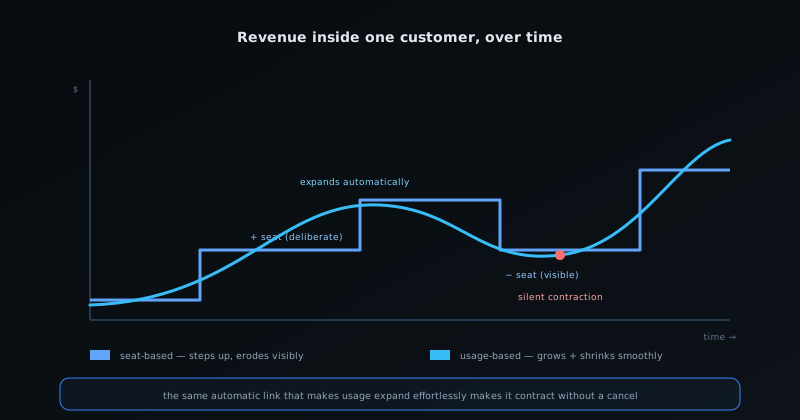
How an account grows is one of the most important and least obvious differences between the models. Under seat pricing, expansion happens in discrete steps: the account grows when the customer adds seats, which usually requires a human decision, a budget line, and sometimes a renewal conversation. Growth is therefore lumpy and somewhat gated by procurement. Under usage pricing, expansion can happen continuously and almost automatically: as the customer uses the product more (because it is working and they are doing more with it), the revenue rises without anyone needing to decide to buy more. A successful usage-based product grows inside its customers as a by-product of their success, which is the appealing engine behind strong net-revenue-retention stories.
Churn is the mirror image and cuts the other way, which is the part optimists underrate. Seat-based revenue is sticky on the downside: cancelling means a deliberate act of removing seats or ending a contract, so revenue tends to erode slowly and visibly. Usage-based revenue can soften silently: if a customer simply does less this month (a quiet season, a paused project, reduced activity), their bill falls automatically, with no cancellation and often no warning. That means a usage-based business can lose revenue without losing a logo, and has to watch consumption trends closely because declining usage is churn in slow motion. The same automatic link that makes usage expand effortlessly makes it contract effortlessly too, and a healthy usage business manages both ends of that sensitivity deliberately.
Predictability cuts both ways: the customer feels it too
It is easy to frame predictability purely as the seller’s concern, but the customer experiences it just as sharply, and that side of the ledger should inform the choice. Seat-based pricing gives the buyer a bill they can predict and budget for: they know what each seat costs and that the total will not move unless they decide to add people, which finance departments and small owners alike find reassuring because the line item is stable and explainable in advance. Usage-based pricing hands the customer a bill that moves with their own activity, which is fair but can also feel unnervingly variable: a heavy month brings a heavy invoice, and a customer who has not internalised that link can be startled by a number they did not see coming.
This is why the clarity of the usage metric matters so much for the customer relationship and not just for the billing system. A usage meter the customer can understand and forecast (one tied to something they already track and can watch climbing) lets them predict their own bill and feel in control of it, which defuses most of the anxiety that variable pricing can create. A meter that is opaque or surprising does the opposite, turning every invoice into a small shock that erodes trust even when the total is perfectly fair. So part of choosing usage pricing responsibly is committing to a metric the customer can reason about, and to the transparency that lets them see the bill coming, because a fair price that arrives as a surprise still damages the relationship it was meant to keep honest.
Choosing: let the value metric decide
The way out of an abstract debate is to stop asking which model is better and start asking how your product creates value, because the right pricing model is the one whose meter most closely tracks that value. If the value your product delivers scales with the number of people using it (collaboration, communication, anything where more participants means more benefit) then seats are a natural proxy for value, and seat pricing will feel fair and read simply. If the value scales with the amount of work performed rather than the number of people (processing, storage, transactions, compute, anything where one user can generate vastly more value than another) then a usage metric tracks value far better than a seat count ever could, and usage pricing will align price with worth.
A good usage metric, when you go that route, has a few properties worth aiming for: it should correlate tightly with the value the customer receives, be easy for the customer to understand and predict so the bill never feels arbitrary, and be something the customer is happy to do more of as they succeed. A metric that grows when the customer wins is a metric that makes your incentives and theirs point the same way. The mistake to avoid is choosing a model for its effect on your revenue profile rather than its fit with your value (picking seats because the predictability flatters your forecast, or usage because the growth story sounds exciting) when the durable choice is the one your customers experience as fair because it mirrors what they actually get.
Why mature products often blend the two
The honest conclusion is that the binary framing softens as products mature, because many of the most successful software businesses end up combining the models rather than picking one and stopping. A common shape is a platform fee or per-seat base that secures a floor of predictable revenue and covers the cost of access, layered with usage-based charges for the consumption-heavy parts of the product that scale with value. This hybrid tries to capture the best of both: the seat or platform component supplies the forecastability the business needs to plan, while the usage component supplies the fairness and the effortless expansion that pure seat pricing lacks. It is more complex to build and to explain, which is the cost, but it lets the price track value without surrendering all predictability.
For a small software business choosing today, the practical path is to start with the model that most honestly fits how your product creates value and that your customers will find simplest to understand, and to resist over-engineering the pricing before you have customers to learn from. You can evolve toward a hybrid later, once usage patterns and customer feedback have shown you where the pure model strains: where seat pricing is leaving value uncaptured, or where usage pricing is making revenue too jumpy to plan around. The strategic point to carry away is that this is not a billing checkbox but a decision that shapes predictability, fairness, growth, and churn all at once, so it deserves to be made deliberately, with your product’s real source of value, not your preferred revenue chart, as the deciding vote.
Frequently asked questions
Quick answers to common questions about this topic.
What is the difference between usage-based and seat-based pricing?
Seat-based pricing charges a recurring fee per user or seat, so the bill scales with how many people have access. Usage-based (consumption) pricing charges per unit of activity (messages, storage, jobs, compute), so the bill scales with how much the product is used. Seat pricing asks "how many of you are there?"; usage pricing asks "how much did you do?"
Which pricing model is more predictable?
Seat-based pricing. Because customers pay a fixed amount per seat, the coming period’s revenue is largely knowable in advance, which makes forecasting and planning easier. Usage-based revenue is fairer but bumpier, since it moves with customer activity, so a usage business trades some predictability for a tighter link between what customers do and what they pay.
Why is usage-based pricing considered fairer?
Because price tracks value: a customer who gets a little value pays a little, and one who gets a lot pays a lot. It also lowers the barrier to starting, since a customer can try the product at trivial cost and only pays meaningfully once they are getting meaningful value. Seat pricing can make occasional-user-heavy customers overpay and power users underpay relative to the value they extract.
How do expansion and churn differ between the models?
Seat revenue expands in deliberate steps (adding seats) and erodes visibly (removing seats or cancelling). Usage revenue expands continuously and almost automatically as customers do more, but can also contract silently when they do less: no cancellation, just a smaller bill. So usage can grow effortlessly and shrink without losing a logo, which is why usage businesses watch consumption trends closely.
How should I choose between them?
Let your value metric decide. If value scales with the number of people using the product, seats are a fair proxy and read simply. If value scales with the amount of work performed, a usage metric tracks value far better. Choose the model whose meter most closely mirrors the value customers receive (not the one that flatters your revenue forecast) and consider a hybrid as you mature.
Related troubleshooting
Was this page helpful?
Your answer stays in this browser, it is not sent anywhere and no account or cookie is involved.