2026 · NSS Background RemoverAbout 12 min readNovus Stream Solutions
The privacy cost of free AI tools
When an AI tool is free and runs in the cloud, your data is often part of the deal. How to spot the privacy cost, and how free-and-private is still possible.
Contents
- 1.Overview
- 2.The upload is the exposure
- 3.What to look for
- 4.Free does not have to cost privacy
- 5.The three ways your data can pay the bill
- 6.Model training: your content improving their product
- 7.The aggregation risk you do not see
- 8.Reading a privacy policy in two minutes
- 9.Matching caution to the sensitivity of the content
- 10.Ad-supported versus data-supported free
- 11.Why the cost is so often invisible
- 12.How to default safely without overthinking
- 13.Free that actually respects you
- 14.A simple rule of thumb
Overview
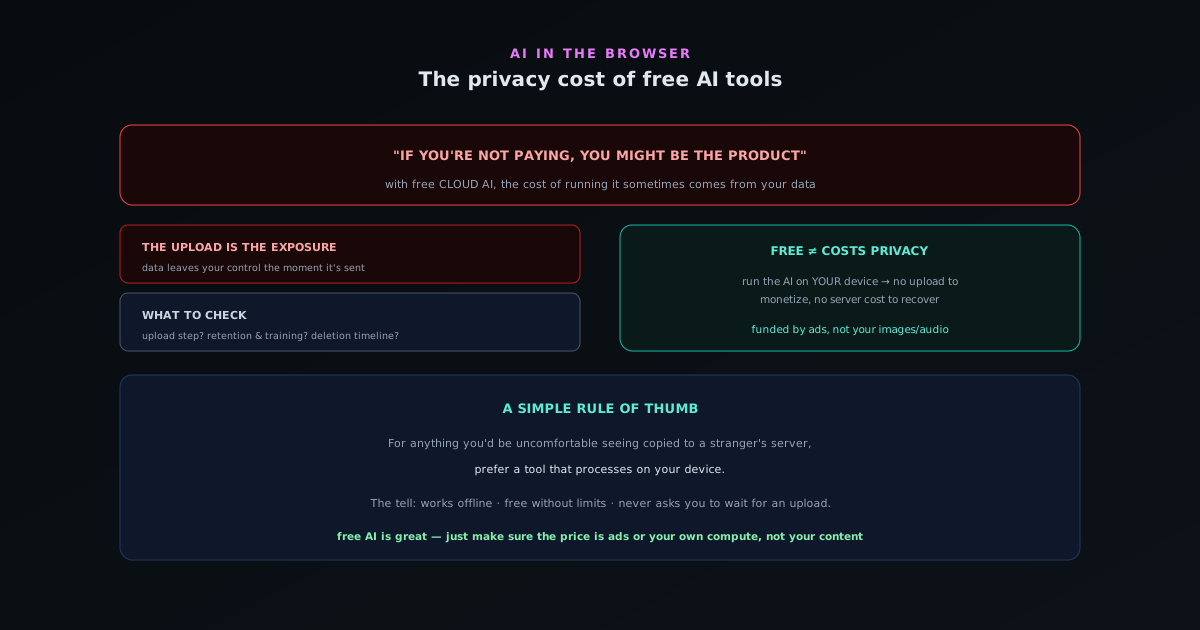
There is an old line: if you are not paying for the product, you are the product. It is not always true, but with free cloud AI tools it is worth taking seriously. When a tool is free and runs on someone else's servers, the cost of running it has to come from somewhere, and sometimes that "somewhere" is your data. This guide is about spotting the privacy cost and knowing it is avoidable.
The upload is the exposure
The moment a tool uploads your image, audio, or document to its server, that data has left your control. What happens next depends entirely on the provider: some delete it promptly, some retain it, some use it to improve their models, and some are vague about it. Even the most careful provider has now created a copy of your data that can be breached, subpoenaed, or affected by a future policy change.
None of that requires bad intent. The exposure is inherent in the upload itself: the data moved from your device to theirs.
What to look for
Before you upload anything sensitive to a free AI tool, check a few things. Does the tool require an upload at all, or does it process locally? What does the privacy policy say about retention and model training? Is there a clear statement that your content is deleted, and on what timeline? Vague or missing answers are a signal to be cautious with anything you would not want copied.
For genuinely sensitive material (client work, unpublished products, personal photos, anything with faces or documents) the safest answer is a tool that never uploads in the first place.
- Is there an upload step at all?
- What does the policy say about retention and training?
- Is deletion stated clearly, with a timeline?
Free does not have to cost privacy
The good news: free and private are not mutually exclusive. When the AI runs on your device instead of a server, the tool can be free without your data being part of the bargain, because there is no upload to monetize and no server cost to recover. The Novus apps work this way: free, ad-supported, and on-device, so your content never leaves your machine. You can see the model in action at bgremover.novusstreamsolutions.com/background-remover.
The funding comes from non-intrusive advertising on the page, not from your images or audio. That is a fundamentally different deal than a free tool that pays for itself with your uploads.
The three ways your data can pay the bill
When a cloud AI tool is free, its costs are real and have to be covered somehow, and understanding the common ways your data can be the currency helps you see what you might be paying. The first is model training: your uploaded content is used to improve the provider's models, turning your images or audio into raw material that makes their product more valuable. The second is retention and analysis: your data is kept and studied, building profiles or datasets beyond the immediate task. The third is the exposure itself: even without active misuse, the existence of your data on their servers is a standing liability that can be breached or compelled.
These are not always present, and a free cloud tool is not automatically exploitative, but they are the mechanisms by which "free" can be funded with data rather than money. Knowing them lets you ask the right questions of a tool: is my content used to train their models, how long is it kept, what is it analyzed for. A tool that gives clear, reassuring answers may be perfectly fine; one that is vague across all three is asking you to fund it with your data on terms it would rather you not examine. The phrase "if you are not paying, you are the product" is shorthand for exactly these mechanisms, and recognizing them turns a vague unease into specific things to check.
Model training: your content improving their product
Of the three, training deserves its own attention because it is the least visible and the most consequential. When a provider uses uploaded content to train or refine their models, your data does not just get processed and discarded: it becomes part of the system, contributing to a product the provider owns and profits from. For ordinary snapshots this may be inconsequential, but for original creative work, proprietary product imagery, or distinctive personal content, having it absorbed into someone else's model is a meaningful loss of control over material that was yours.
What makes this especially worth watching is that it is often buried in terms most people never read, phrased in ways that grant broad rights to use uploaded content for improving services. The practical defense is twofold: check whether a tool reserves the right to train on your uploads, and for anything you would not want contributing to a third party's model, prefer a tool that never receives your content in the first place. On-device processing forecloses the training question entirely (content that is never uploaded cannot be added to a training set) which is why, for original or sensitive work, local processing is not just more private but more protective of your ownership. Your data cannot improve their product if it never reaches them.
The aggregation risk you do not see
Beyond any single upload, there is a subtler cost in what a provider can learn from your activity over time, which individual privacy decisions tend to overlook. Each upload to a cloud tool is a data point, and across many uses a provider can accumulate a picture: what kinds of images you process, how often, when, possibly tied to an account or device. No single removal or transcription feels sensitive, but the aggregate can reveal patterns about your work, your habits, or your interests that you never intended to disclose. The exposure is not in any one file but in the accumulation.
This aggregation risk is invisible precisely because it builds up quietly from actions that each seem harmless, which is what makes it easy to discount. On-device processing avoids it structurally: because nothing is uploaded, no provider accumulates a record of your usage, and there is no aggregate to build. Your pattern of use stays as local as the content itself. For anyone whose body of work or habits would reveal something if compiled (a designer's client mix, a creator's unreleased pipeline, a researcher's subjects) the absence of any server-side record is a real protection. Thinking only about individual files underestimates what a stream of uploads can disclose in aggregate, and local processing is what keeps that stream from existing at all.
Reading a privacy policy in two minutes
Privacy policies are long and tedious, but you can extract the parts that matter for an AI tool in a couple of minutes if you know what to look for, and doing so beats either reading every word or ignoring them entirely. Search the document for a few specific things: whether content is uploaded or processed locally, how long uploads are retained, whether your content may be used to train or improve their models, and whether and how you can request deletion. These four questions cover most of the privacy-relevant substance, and the answers (or their absence) tell you most of what you need.
The pattern of the answers is as informative as the answers themselves. Clear, specific, reassuring statements suggest a provider that has thought about privacy and is comfortable being held to its words; vague, broad, or missing answers on these points suggest the opposite. A policy that explicitly reserves wide rights to use your content, or that is silent on retention and training, is telling you something even in what it does not promise. This quick scan is not a substitute for a careful read where stakes are high, but it is far better than the common alternatives of blind trust or blind avoidance, and it equips you to make an informed call about whether a given free tool deserves your sensitive content.
Matching caution to the sensitivity of the content
Not all content carries the same stakes, and a sensible approach scales your caution to what you are actually processing rather than applying one rule to everything. A casual photo you would happily post publicly has little to lose from a cloud upload; a client deliverable under confidentiality, an unreleased product, a document with personal information, or an image of someone's face carries real stakes if exposed. The privacy cost of a free cloud tool is the same in mechanism across these, but its consequences scale enormously with sensitivity, so the appropriate level of care does too.
This framing avoids both overreacting to trivial cases and underreacting to serious ones. You do not need to treat every snapshot as a state secret, but you do need to recognize when content crosses into territory where an upload would be a genuine risk, and for that content, defaulting to a tool that processes locally is the safe, simple choice. The habit worth building is a quick sensitivity check before uploading anything to a free AI tool: would I mind if a copy of this ended up on a stranger's server? If the answer is yes, that is the signal to reach for on-device processing. Matching the precaution to the content keeps privacy practical rather than paranoid.
Ad-supported versus data-supported free
There is a crucial distinction between two kinds of free that the single word obscures: free funded by advertising and free funded by your data. An ad-supported tool covers its costs by showing ads on the page, which is a transaction that does not require taking your content: the advertising pays the bills, and your images or audio are not part of the deal. A data-supported free tool covers its costs by extracting value from what you upload, through training, retention, or analysis. Both are "free" to your wallet, but only one is free to your privacy.
This distinction is especially clear when the ad-supported tool also processes on-device, because then there is no upload to monetize even if it wanted to: the funding comes entirely from the page's advertising, and your content never leaves your machine to be part of any bargain. That is a fundamentally different and more honest deal than a free tool that pays for itself with your uploads: the cost is your attention to some ads, not your private content. Recognizing that "free" splits into these two models lets you seek out the kind that respects your data, rather than assuming all free tools extract the same hidden price. Free can be genuinely free of privacy cost when it is funded by ads and runs locally.
Why the cost is so often invisible
A defining feature of the privacy cost of free AI tools is that, unlike a watermark or a price, it is usually invisible at the moment of use, which is exactly what makes it easy to incur without noticing. You upload an image, you get a clean result, nothing appears to have been taken: the cost, if any, is in what happens to your data afterward, out of sight, on servers you cannot see. There is no immediate feedback that anything was given up, so the transaction feels costless even when it is not, and the absence of a visible price lulls people into uploading content they would think twice about if the cost were shown.
This invisibility is why the privacy cost requires deliberate attention in a way a monetary cost does not. A price tag forces a decision; a silent data cost does not, so it gets paid by default unless you stop to consider it. The defense is to make the invisible visible by asking the questions the moment does not prompt (what happens to this upload, is it kept, is it trained on) before sending anything sensitive. The cost being hard to see does not make it unreal; it makes it the kind of cost you have to choose to notice. Building the habit of noticing is what keeps the convenience of free AI from quietly costing you more than you realized.
How to default safely without overthinking
All of this can sound like it demands constant vigilance, but in practice a simple default makes safe behavior effortless: when content is anything you would not happily make public, prefer a tool that processes on your device. That single rule handles the great majority of cases without requiring you to investigate every tool's policy, because on-device processing forecloses the entire privacy-cost question at once: no upload means no training, no retention, no aggregation, no exposure. Defaulting to local for sensitive content is the low-effort way to stay safe without becoming a part-time privacy auditor.
The beauty of this default is that it is easy to apply and rarely costs you anything, because capable on-device tools exist for the common tasks. You do not have to weigh each tool's privacy policy in the moment; you reach for the local tool for anything sensitive and save the cloud tools for content you do not mind sharing or for capabilities only the cloud can provide. This turns privacy from a constant analysis into a simple habit (local by default for anything that matters) which is sustainable in a way that scrutinizing every tool is not. The goal is not paranoia but a sensible default that protects you without effort, and "process sensitive things on your device" is exactly that.
Free that actually respects you
The encouraging conclusion of all this is that the privacy cost of free AI is avoidable, not inevitable, because a genuinely respectful kind of free exists. A tool that runs on your device and funds itself with non-intrusive advertising gives you the full capability (unlimited, without watermarks, without an account) while never touching your content, because there is no upload to monetize and the page's ads, not your data, pay the bills. This is free that respects you: the exchange is your attention to some ads, which you can see and judge, rather than your private content, which you cannot follow once it leaves.
Recognizing that this model exists changes the framing from "free AI inevitably costs privacy" to "choose the kind of free that does not." You are not forced to trade your data for capability, because tools built on local processing and honest advertising deliver capability without the trade. The existence of this option is what makes the whole privacy-cost discussion actionable rather than merely cautionary: there is somewhere good to go, not just things to avoid. Free AI is genuinely wonderful when its price is ads and your own compute instead of your private content, and seeking out that arrangement lets you enjoy the convenience of free tools without quietly funding them with the very material you most want to protect.
A simple rule of thumb
For anything you would be uncomfortable seeing copied to a stranger's server, prefer a tool that processes on your device. You can usually tell: it works offline, it is free without limits, and it never asks you to wait for an upload. Those are the signs that your data is staying put.
Free AI is wonderful. Just make sure the price is ads or your own compute, not your private content.
Frequently asked questions
Quick answers to common questions about this topic.
Are free AI tools safe to upload my files to?
It depends entirely on whether they process on a server or on your device. Server-based free tools upload your file and rely on a retention policy you cannot audit; on-device tools never upload it, so there is nothing to retain. Check before uploading anything sensitive.
What is the real cost of a free AI tool?
If the tool runs in the cloud, your data is often part of the cost, used to cover server expenses through analytics, training, or ads tied to what you upload. An ad-supported on-device tool funds itself without needing your files.
Does "we delete your uploads" actually protect me?
It is better than nothing, but it is a promise about a copy of your file on a server you do not control. A tool that never uploads the file removes the question entirely: there is no copy to delete.
Related workflow
Product photo to a transparent image every channel accepts
One photograph, cut out once, then re-encoded for a storefront, a marketplace listing and a social post without redoing the cutout each time.
- Cut the background out and check the edgesNSS Background Remover: Hair, glass and drop shadows are where automatic cutouts fail. Fix them once, on the master, before anything downstream copies the mistake.
- Re-encode and resize per destinationNovus Convert: Transparency survives PNG and WebP and dies in JPEG. Convert validates the file it hands back, so a listing never rejects a silently broken upload.
Related troubleshooting
Was this page helpful?
Your answer stays in this browser, it is not sent anywhere and no account or cookie is involved.