2026 · NSS Background RemoverAbout 12 min readNovus Stream Solutions
Free vs paid background removers: what you actually give up
Most "free" background removers quietly cost you something: watermarks, low resolution, upload requirements, or per-image limits. Here is what to look for, and what free can actually mean.
Contents
- 1.Overview
- 2.The four common catches
- 3.Why most paid removers charge
- 4.How free can actually be free
- 5.Why "free" is the most gamed word in this space
- 6.Watermarks: the catch you see
- 7.Resolution caps: the catch you might miss
- 8.The catch that costs privacy, not money
- 9.Daily limits and the funnel
- 10.How ad-supported differs from freemium
- 11.What you genuinely give up with truly-free
- 12.When paid is genuinely worth it
- 13.Red flags before you even export
- 14.The hidden cost of choosing wrong
- 15.A quick evaluation checklist
Overview
"Free background remover" is one of the most searched phrases in this space, and one of the most misleading. Many tools advertised as free are freemium funnels: free to try, but the actual output you want is gated. This guide is about reading the fine print so you know what a given "free" really means.
It is written from the perspective of a genuinely free, ad-supported tool (NSS Background Remover, at bgremover.novusstreamsolutions.com/background-remover), but the checklist applies to any remover you evaluate.
The four common catches
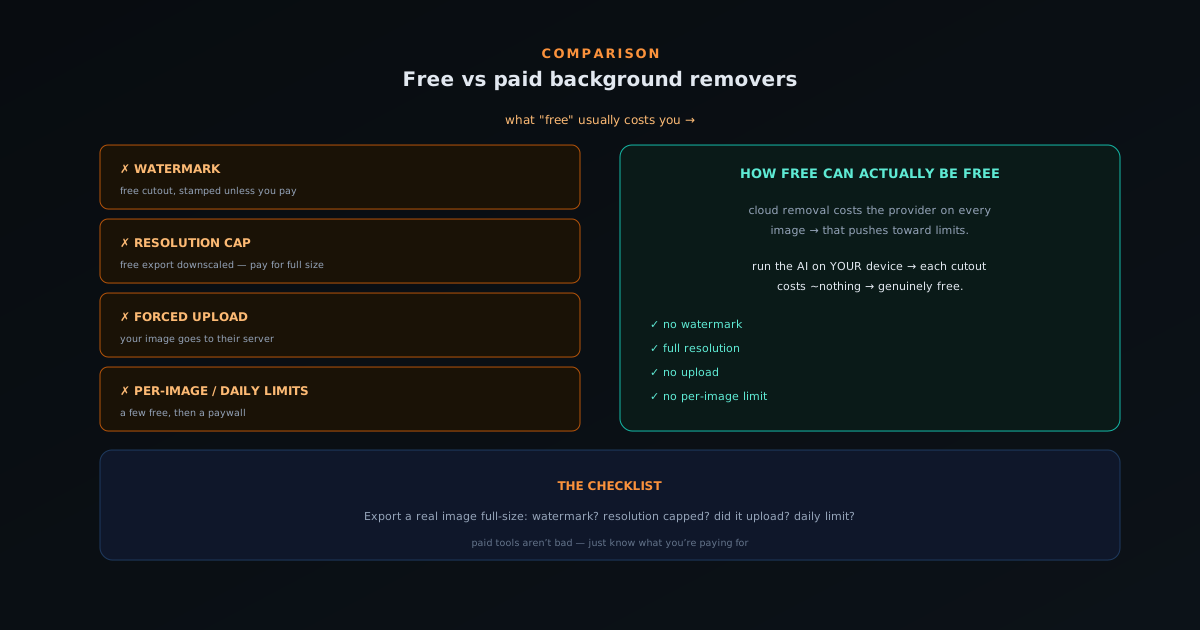
Watch for these. Watermarks: the cutout is free but stamped unless you pay. Resolution caps: the free export is downscaled, so you need to pay for full-size. Upload requirements: free, but your image goes to their server (a privacy cost, not a money cost). Per-image or daily limits: a few free, then a paywall.
None of these are necessarily wrong (providers have costs to cover), but they are the difference between "free" and "free to preview." Knowing which catch applies tells you whether a tool fits your work.
- Watermark on the output.
- Downscaled/low-res free export.
- Mandatory upload to their server.
- Per-image or daily caps.
Why most paid removers charge
Most removers run the AI in the cloud, which costs the provider money on every single image. To cover that, they meter usage. So the business model and the architecture are linked: server-side processing pushes toward subscriptions and limits, because each free image is a real expense.
This is not greed; it is economics. If every cutout costs the provider money, "unlimited free" is hard to sustain without something giving.
How free can actually be free
The way out of that trap is to remove the per-image cost. When the AI runs on your device instead of a server, each cutout costs the provider essentially nothing, so it can be free, full-resolution, watermark-free, and unlimited, sustained by non-intrusive ads rather than your wallet. That is how NSS Background Remover works: no signup, no upload, no watermark, no cap. The same economics let the rest of the toolset at bgremover.novusstreamsolutions.com/tools stay free too.
The tradeoff is that your device does the work (so a very old machine is slower) and the first load downloads the model. For most users that is a fair trade for genuinely free, private removal.
Why "free" is the most gamed word in this space
Background removal is one of the most searched free-tool categories on the web, which means it is also one of the most commercially contested, and that competition has turned "free" into a word that often means its opposite. When a category has high search demand and a real cost to serve, providers have a strong incentive to attract users with the word "free" and then recover their costs by gating the part you actually want. The result is a landscape where "free background remover" frequently leads to a tool that is free to operate but not free to get a usable result from.
This is not necessarily dishonest (a tool can be genuinely free to try and still charge for the output), but it makes the word unreliable as a signal, so you have to look past it. The practical consequence is that you cannot take "free" at face value in this category; you have to test what free actually delivers in each case. Understanding that the word is gamed, and that the gaming usually takes one of a few predictable forms, is what lets you cut through the marketing and judge a tool by what it actually gives you rather than by what its landing page claims.
Watermarks: the catch you see
The most visible catch is the watermark: the tool removes your background for free, but stamps the result with its logo or a pattern unless you upgrade. This is the freemium model at its most transparent: you get a real, full preview of the capability, with a visible reminder that the clean version costs money. For evaluating intent, the watermark is honest in a way, because it shows you exactly what you would get and exactly what you would pay to remove, with nothing hidden.
The problem with a watermarked free tier is simply that the output is unusable for most real purposes. A cutout with a logo across it cannot go on a product listing, into a design, or in front of a client, so the "free" result is really just an advertisement for the paid one. There is nothing wrong with a provider choosing this model, but you should recognize it for what it is: a preview, not a deliverable. If your work needs a clean cutout, and almost all real work does, a watermarking tool is a paid tool with a demo, regardless of how prominently it says free.
Resolution caps: the catch you might miss
Subtler than a watermark, and easier to miss, is the resolution cap: the free export is quietly downscaled, so you can only get the full-size image by paying. This one is sneaky precisely because the result looks clean (there is no logo to tip you off) and you might not notice the reduced dimensions until you try to use the image at the size you actually need, at which point it is too small or soft. The catch is hidden in a property of the file you may not check until it is inconvenient.
This is why testing a free remover means exporting a real image and checking its actual dimensions, not just glancing at the on-screen preview. A tool that produces a clean-looking cutout but caps it at a low resolution has gated exactly the thing that makes the output professionally usable, just less visibly than a watermark does. For anything destined for print, a large display, or any use where size matters, a resolution cap is as limiting as a watermark; it just announces itself later. Knowing to look for it is what keeps you from discovering the limit only after you have committed to the tool.
The catch that costs privacy, not money
Not every catch is about money; one of the most significant is paid in privacy. Many free removers are genuinely free of watermarks and resolution caps but require uploading your image to their server to do the work, which is a cost of a different kind: your image, and whatever it depicts, has left your control. For a casual photo this may not matter, but for a client deliverable, an unreleased product, or anything sensitive, the upload is a real exposure that the word "free" does nothing to flag.
This catch is easy to overlook because it does not affect the output at all (the cutout is clean and full-resolution and unwatermarked), so a money-focused evaluation misses it entirely. But "free" should be understood to include the question of what the tool does with your data, not just what it charges your wallet. A tool that is free in dollars but requires handing your images to a third party has a cost; it is simply denominated in privacy rather than money. Weighing that cost is part of an honest evaluation, especially for anyone whose images are not theirs to freely share.
Daily limits and the funnel
A fourth common structure is the usage limit: a handful of free removals, then a paywall, or a daily cap that resets. This is the classic freemium funnel: give enough for free to demonstrate value and create a habit, then convert the user to paid once they rely on the tool. The free tier is real but deliberately insufficient for sustained use, calibrated to be enough to hook you and not enough to satisfy you, which is precisely the point of a funnel.
Whether this is acceptable depends entirely on your volume. If you need to remove one background occasionally, a daily-limited tool may serve you fine and never hit the wall. If you are doing any real volume (a catalog, regular content, batch work), you will hit the cap quickly, at which point the tool is effectively paid. The limit is not hidden, exactly, but its impact depends on use you might not anticipate when you start. Recognizing a usage-capped tool as a funnel rather than a free tool helps you predict whether it will actually meet your needs or convert into a subscription the moment you start relying on it.
How ad-supported differs from freemium
There is a genuinely different model that produces a genuinely free result: ad-supported. Instead of gating the output to convert users to paid, an ad-supported tool sustains itself through non-intrusive advertising and gives the full capability away: clean, full-resolution, unwatermarked, unlimited output, with the revenue coming from ads rather than from your wallet or your data. This is not a funnel toward a paid tier, because there is no paid tier the free experience is steering you toward; the free experience is the whole product.
The distinction matters because it changes the incentive structure. A freemium tool is designed to make the free tier just frustrating enough to drive upgrades, which means the limitations are features of the business model. An ad-supported tool has no reason to cripple the free experience, because that experience is how it serves everyone and earns its keep; making it good is aligned with the model rather than opposed to it. Understanding that ad-supported and freemium are fundamentally different (one gives the full thing supported by ads, the other gates the thing to sell it) is what lets you recognize when "free" actually means free.
What you genuinely give up with truly-free
Honesty cuts both ways, so it is worth being clear about what a genuinely free, on-device, ad-supported tool does ask of you, because nothing is truly costless. The two real trade-offs are that your device does the processing (so a very old or weak machine will be slower than a server would be) and that the first time you use the tool, it downloads the model, which is a one-time transfer before the local processing begins. These are real, and pretending otherwise would be its own kind of dishonesty.
But weigh what those trade-offs buy: full-resolution, watermark-free, unlimited output, with your images never leaving your device, at no cost. For the vast majority of users on reasonably modern hardware, a one-time model download and processing that runs on their own machine is a more than fair exchange for genuinely free and private removal. The trade-offs of truly-free are about where the work happens and an initial download, not about gating the result, which is a categorically better deal than the watermarks, caps, and uploads that the freemium "free" extracts. Knowing the honest cost of each model is what lets you see that the on-device trade is the favorable one.
When paid is genuinely worth it
None of this means paid tools are bad or that you should never pay; for some workflows a polished paid pipeline is genuinely worth the money, and pretending free always wins would be as misleading as the gamed "free" itself. A paid tool that integrates deeply into a larger professional suite, offers dedicated support, guarantees service levels for a business pipeline, or provides specialized capabilities a free tool lacks can absolutely justify its cost for the right user. Paying for software that materially improves a professional workflow is a sound decision.
The point of evaluating honestly is not to conclude that free always wins but to ensure you know what you are paying for and what free can actually deliver. If you choose a paid tool, choose it for real advantages (integration, support, specialized features) rather than because you assumed free meant compromised. And know that for the common case of a person cutting out images, "free and unlimited" is genuinely achievable when the processing happens on the device, so you are not forced to pay for the basic capability. The goal is an informed choice: pay when paying buys something real, and do not pay for what an honest free tool already provides.
Red flags before you even export
Some signals of a gated "free" tool appear before you produce a single result, and learning to spot them saves time. A prominent "upgrade" or "go premium" button, a sign-up wall before you can use the tool at all, an account requirement to download your result, or pricing tiers featured prominently on the landing page all suggest that the free experience is a funnel toward a paid one rather than the product itself. None of these are disqualifying on their own, but together they paint a picture of a tool whose business model is conversion to paid, which usually means the free tier is calibrated to be insufficient.
Contrast that with the signals of a genuinely free tool: no sign-up requirement, no account needed to export, no prominent upgrade path, and a straightforward statement that the output is yours without limits. The absence of conversion machinery is itself a signal that the tool is not trying to funnel you anywhere. Reading these cues before you invest time lets you predict, fairly reliably, whether a tool will deliver a usable free result or hit you with a catch at the export step. The structure of the landing page often tells you the business model before you have processed a single image.
A quick evaluation checklist
When you try any "free" remover, export a real image at full size and check: is there a watermark? Is the resolution capped? Did it upload your image? Is there a daily limit? The answers tell you what you are actually getting.
Paid tools are not bad; for some workflows a polished paid pipeline is worth it. But you should know what you are paying for, and know that "free and unlimited" is genuinely possible when the processing happens on your device.
Frequently asked questions
Quick answers to common questions about this topic.
Is a free background remover good enough, or do I need a paid one?
For most product shots, portraits, and content work, a quality free tool is enough: the NSS Background Remover is free with no watermark, no credits, and full-resolution straight-alpha export. Paid tools mostly charge for cloud convenience and volume, not better core results.
What do you give up with free background removers?
With many free tools you give up resolution, transparency quality (halos from premultiplied alpha), or get watermarks and per-image credits. The trick is choosing a free tool that does not impose those compromises rather than assuming all free tools do.
Why are some background removers paid?
Server-side tools pay a real per-image cost to run models on their hardware, so they meter usage to cover it. An in-browser tool runs on your device with no per-image cost, which removes the economic pressure to charge.
Related workflow
Product photo to a transparent image every channel accepts
One photograph, cut out once, then re-encoded for a storefront, a marketplace listing and a social post without redoing the cutout each time.
- Cut the background out and check the edgesNSS Background Remover: Hair, glass and drop shadows are where automatic cutouts fail. Fix them once, on the master, before anything downstream copies the mistake.
- Re-encode and resize per destinationNovus Convert: Transparency survives PNG and WebP and dies in JPEG. Convert validates the file it hands back, so a listing never rejects a silently broken upload.
Related troubleshooting
Was this page helpful?
Your answer stays in this browser, it is not sent anywhere and no account or cookie is involved.