2026 · Novus Stream SolutionsAbout 11 min readNovus Stream Solutions
Taking a local service business online: the digital storefront for plumbers, cleaners, and everyone in between
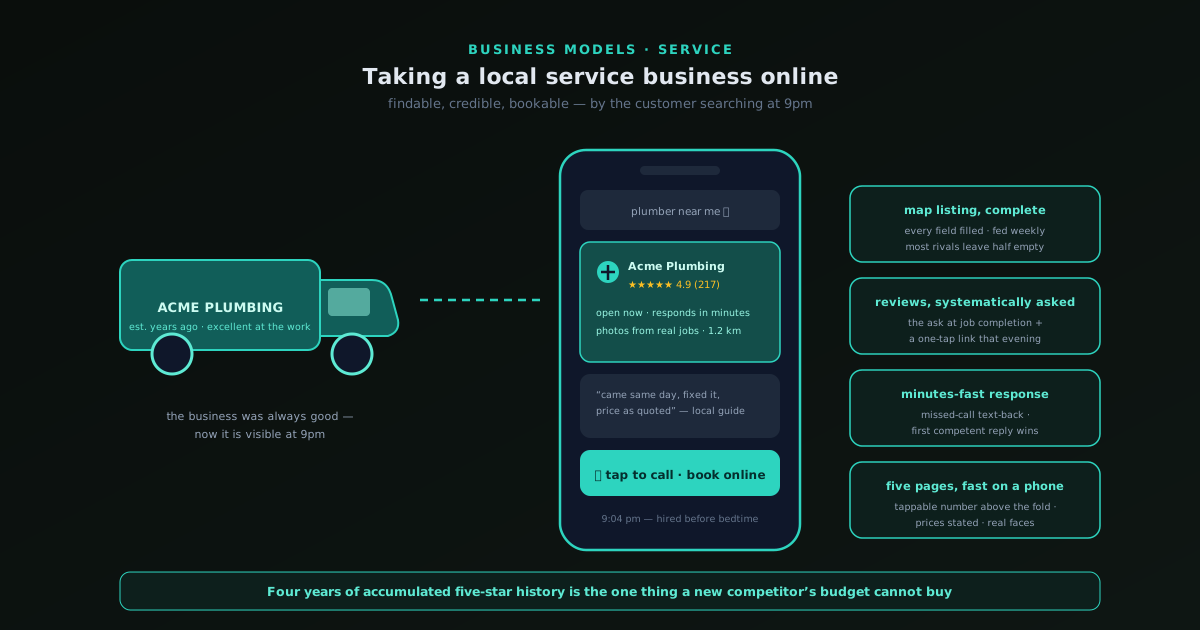
A local service business does not need to "go digital"; it needs to be findable, credible, and bookable by the customer searching at 9pm. Here is the practical sequence, in order of payoff.
Contents
- 1.Overview
- 2.The map listing: the highest-leverage asset online
- 3.Reviews: the currency everything trades in
- 4.The five-page website that actually converts
- 5.Booking and responsiveness: where jobs are actually won
- 6.Local content: optional, but unfairly effective
- 7.What to skip, and the pitches to hang up on
- 8.The weekend setup, in order
- 9.The compounding neighborhood
Overview
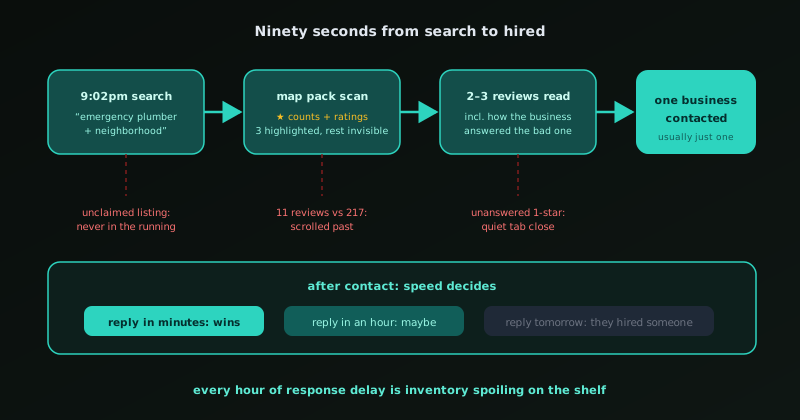
The customer who decides which plumber, cleaner, tutor, or landscaper gets the job is, increasingly, not calling around on a weekday morning. They are on a phone at nine in the evening, searching the service plus their town, scanning a map with star ratings, reading two or three reviews, and contacting exactly one business, usually the one that looked credible and made contact effortless. Local service businesses that are invisible or unconvincing in that ninety-second evaluation do not lose the job; they were never in the running, and the owner never knows. The work was won and lost on screens the business does not look at.
The good news is how small the winning surface actually is. Local service is the one corner of the internet where a one-person business can decisively beat bigger competitors with a weekend of setup and an hour a week of maintenance, because the deciding factors (proximity, reviews, responsiveness, and basic credibility) are all things a small operator can win on merit. This playbook covers the sequence in order of payoff, which is emphatically not the order most agencies sell it in.
The map listing: the highest-leverage asset online
For a local service, the business profile on the dominant map platform is worth more than the website, and it is free. When someone searches "emergency plumber" plus a neighborhood, the map pack (those three highlighted local results with stars and photos) captures the majority of clicks before the regular results begin. Getting into it is not mystical: claim and verify the listing, then complete every field the platform offers: exact service categories, service area, hours including emergency availability if real, phone number, photos, and the services menu. Completeness itself is a ranking input, and most local competitors leave half the fields empty, which means thoroughness alone moves you up.
The listing then becomes a publishing surface most owners never use. Add photos continuously (real jobs, real van, real team, because authentic photos dramatically outperform stock imagery for trust) and post occasional updates, which signal to the platform that the business is alive. Answer the public questions. Keep hours accurate to the day, especially around holidays, because a "closed when it said open" experience generates exactly the one-star review that costs the most. The whole asset takes an afternoon to build and perhaps fifteen minutes a week to feed, and for many trades it will source more work than everything else in this article combined. It is also the asset most vulnerable to neglect: an unclaimed or stale listing quietly fills with other people's photos, wrong hours, and unanswered complaints: your storefront, curated by strangers.
Reviews: the currency everything trades in
Reviews are not a nice-to-have in local services; they are the primary credential, outweighing years in business, certifications, and website polish in the customer's actual decision process. The operational insight is that review counts are not a measure of customer satisfaction; they are a measure of asking. Satisfied customers rarely review unprompted; mildly annoyed ones occasionally do, which is why passive businesses drift toward thin, skewed profiles. The fix is a system, not a hope: at the moment of completed work and visible satisfaction, the ask happens: verbally, plus a follow-up message the same evening with a direct link that opens the review form in one tap. Asked this way, a meaningful fraction of happy customers follow through, and the profile compounds at a rate the unasking competitor cannot match.
Negative reviews deserve a protocol rather than a panic. Respond to every review, positive and negative, briefly and professionally, because future customers read the responses as a sample of what hiring you is like, which means the response to an unfair one-star is performed for an audience of hundreds, not an argument with one person. Acknowledge, state your side factually and without heat if the facts matter, offer to resolve offline, done. A profile of uniformly perfect scores with no responses reads as suspicious; a profile of mostly excellent reviews with calm, human responses to the rare bad one reads as trustworthy, which is the entire goal. And never purchase or fake reviews: platforms detect patterns more reliably every year, and the penalty (suppression or removal of the listing) lands on the asset doing most of your customer acquisition.
The five-page website that actually converts
The website's job, in local services, is narrower than the web industry wants it to be: confirm credibility and make contact effortless for the person the map listing or a referral already sent. That job is done by five pages. A home page that states, above the fold, what you do, where you do it, and how to reach you, with the phone number tappable and visible without scrolling, because a meaningful share of visitors arrive mid-problem. A services page (or one page per major service) describing what is included and, wherever possible, honest pricing or ranges: price transparency filters time-wasters and builds more trust than it loses jobs. An about page with real names and real faces, doing the trust work this series has covered elsewhere. A reviews page pulling in the words customers already wrote. And a contact page with every channel you actually monitor, plus the service area stated plainly.
What the site does not need is everything agencies upsell: no blog at launch, no animation, no brand video, no chatbot. It needs to load fast on a phone, work with one thumb, and contain the schema basics: business name, address, phone, and service descriptions in clean text the search engines can read, consistent everywhere the business appears online, because inconsistent listings erode local rankings. The realistic budget is a few hundred dollars and a weekend on any modern site builder, or modestly more delegated to a freelancer with the five-page brief above. Beware the local-agency package that charges hundreds monthly for "SEO" on a five-page site; the maintenance a site like this needs is measured in minutes per month, and the ranking work that matters is the map listing and the reviews, both of which you control directly, for free.
Booking and responsiveness: where jobs are actually won
Speed of response is the most underrated variable in the entire local stack. The customer with a burst pipe or a moving date contacts more than one business and hires the first competent responder, and studies of lead conversion across service industries keep finding that response within minutes multiplies win rates versus response within hours. For a solo operator who cannot answer mid-job, the practical fixes are mechanical: text-back automation on missed calls ("On a job. What do you need? I reply within the hour"), a shared inbox checked on breaks, and honest response-time promises on the site that you then beat. Every hour of response delay is inventory spoiling on the shelf.
Online booking, where the service shape allows it, converts responsiveness into structure. Fixed-scope services (standard cleanings, tune-ups, inspections, consultations) can be booked from a calendar directly, capturing the nine-pm customer at the moment of intent with zero back-and-forth; this is the productized-service logic from elsewhere in this series, applied locally, and it quietly extends business hours to all twenty-four. Variable-scope work books a quote visit instead, which preserves the calendar while still converting intent immediately. Either way, the booking layer doubles as the operational record: jobs, contact details, and history accumulate in one place instead of a text-message archaeology dig, and the follow-up that drives reviews and repeat work (the off-season reminder, the annual service nudge) becomes a checklist instead of a memory feat.
Local content: optional, but unfairly effective
Once the foundation runs, the optional layer is content, and in local niches it is almost unfairly effective, because the competition is so thin. A page or post answering each question customers actually ask ("what does a water heater replacement cost in [region]", "how often should gutters be cleaned here", "what to do before movers arrive") can rank for years against competitors whose sites have not changed since they were built. The formula is unglamorous: real questions from real jobs, answered plainly with local specifics, one page each, accumulated at whatever pace is sustainable; even monthly compounds. Each page works the same shift as the map listing: it is on duty at nine pm, being credible, while you are not.
The same material feeds every other channel without extra creation: the answer becomes a social post, the before-and-after photos feed the map listing and the site gallery, the seasonal reminder becomes the yearly email to past customers. That last channel deserves its own sentence: the customer list is the owned audience this series keeps advocating, and in local services it is gold that businesses leave unmined: past customers already trust you, repeat and referral work costs nothing to win, and a twice-yearly useful email (seasonal checklist, early-booking window) keeps the business the default answer when the neighbor asks "do you know anyone who…". None of this requires becoming a content creator. It requires noticing that every job already generates the raw material, and routing it.
What to skip, and the pitches to hang up on
The local-digital market is thick with vendors selling complexity to businesses that need the basics, so the skip list is as practical as the to-do list. Skip the five-hundred-dollar-a-month "local SEO retainer" for a five-page site: the recurring work that actually moves local rankings (listing upkeep, review accumulation, response speed) lives in your hands, not an agency's, and the monthly report such packages produce is mostly screenshots of things that would have happened anyway. Skip the social media management package that posts generic content to an audience of nobody; local customers find you through search and referrals, not through a brand voice on platforms you do not enjoy. Skip the chatbot, the app ("your business needs an app" is the most reliable tell of a vendor to avoid), the premium directory listings sold by cold call, and any guarantee of first-position ranking: a promise no honest practitioner can make and a standard line from the dishonest ones.
The discernment rule underneath the list: pay for things you cannot do and that compound, be cautious about renting things you could own. A well-built five-page site is worth paying a freelancer for once, because it is a one-time artifact you then own outright. Photography of your best work, likewise. But the ongoing activities (the review ask, the photo upload, the hours update, the seasonal email) are fifteen-minute habits attached to work you are already doing, and outsourcing them buys mostly the feeling of delegation. The local businesses that get burned are rarely the ones that spent too little online; they are the ones that spent confidently on the wrong layer, mistaking invoices for progress while their unclaimed map listing sat there, free, doing nothing. Run the foundation yourself for six months before believing any pitch that says it needs professionals.
The weekend setup, in order
Sequenced by payoff, the whole digital storefront looks like this, and the first three items outweigh everything after them:
- Claim and completely fill the map listing: categories, service area, hours, services, real photos.
- Install the review system: the ask at job completion, the same-evening link, responses to everything.
- Fix responsiveness: missed-call text-back, an honest response-time promise, beaten consistently.
- Ship the five-page site: home with tappable number, services with price ranges, about with faces, reviews, contact.
- Make name, address, and phone identical everywhere the business appears online.
- Add booking for fixed-scope services, or quote-visit booking for variable work.
- Start the customer list and the twice-yearly useful email.
- Then, optionally, one local question answered per month, forever.
The compounding neighborhood
Everything in this playbook compounds, which is what makes the early investment so asymmetric. The map listing accrues photos, reviews, and ranking signal with every job. The review base grows monotonically: competitors can match your prices tomorrow but cannot match four years of accumulated five-star history. The content pages stack. The customer list lengthens. Eighteen months of unremarkable consistency produces a digital presence that a new competitor with a bigger budget genuinely cannot buy their way past, because the assets that decide local trust are all denominated in time and accumulated proof rather than spend.
And the deeper reframe is the one this series keeps returning to: none of this is "marketing" as a separate activity bolted onto the trade. The review ask is part of finishing a job well. The photo is taken standing in front of work you are proud of. The seasonal email is the same advice you give customers anyway, written once. The online layer is simply the business's existing excellence, made visible to the person searching at nine pm, and for the local operator who sets it up, the permanent competitive advantage is that most rivals never will. The bar is low, the assets compound, and the customer is already searching. The only question is who they find.
Frequently asked questions
Quick answers to common questions about this topic.
How do I move a local service business online?
Start with a simple site that states what you do, where you serve, and how to book, then add Google Business Profile, reviews, and online booking. The goal is to be findable and bookable, not to build a fancy site.
What matters most for local SEO?
A complete, accurate Google Business Profile, consistent name/address/phone across the web, genuine reviews, and pages that name your services and service areas. Local intent rewards clarity and proximity.
Do trades really need a website?
A presence, yes: even a one-page site plus a Business Profile. It is where reviews, hours, and booking live, and it is increasingly where customers decide whether to call.
Related troubleshooting
Was this page helpful?
Your answer stays in this browser, it is not sent anywhere and no account or cookie is involved.