2026 · Novus Stream Solutions (hub)About 13 min readNovus Stream Solutions
Subscription boxes as a business model
The subscription box is one of the most appealing-sounding retail models (predictable recurring revenue, paid upfront) and one of the most operationally demanding, because it puts physical fulfilment on a relentless monthly clock and lives or dies on churn. This is an honest look at how the model actually works and who it suits.
Contents
- 1.Overview
- 2.What a subscription box actually is
- 3.The appeal: predictable recurring revenue
- 4.Churn is the whole game
- 5.Lifetime value has to beat acquisition cost
- 6.The operations are relentless
- 7.The cash-flow advantage is real
- 8.Inventory under a known subscriber count
- 9.Who it works for, and who it does not
- 10.Start small and validate before scaling
- 11.Recurring revenue is earned every month
Overview
The usual disclaimer applies and matters here: this is an explanation of how the subscription-box model tends to work, not financial advice, and any specific venture’s numbers are its own. With that out of the way: the subscription box is one of the most seductive-sounding business models in retail. The pitch is irresistible: instead of fighting to win each sale over and over, you win a customer once and they pay you every month, automatically, giving you the predictable recurring revenue that makes a business feel stable and plannable. Curated boxes of products, delivered on a schedule, paid for in advance: it sounds like the best of retail and the best of subscriptions combined, and that is exactly why so many people are drawn to it.
The reality is more demanding, and understanding the gap between the pitch and the practice is the whole point of looking at this model honestly before committing to it. A subscription box marries the appeal of recurring revenue to the relentlessness of physical fulfilment, and it lives or dies on a metric most newcomers underweight: churn. The model can absolutely work and be genuinely good when it fits, but it punishes the operator who only sees the recurring-revenue upside and not the monthly operational treadmill and the unforgiving retention math underneath it. This article walks through both (the real appeal and the real demands) so the model can be judged for what it is rather than what it sounds like.
What a subscription box actually is
At its simplest, a subscription box is a business where customers pay a recurring fee (usually monthly) to receive a package of physical products on a schedule. Beyond that shared skeleton, the category splits into two quite different shapes that have very different economics and appeal. A curation box delivers a changing selection each period, where the value is discovery and surprise: the customer is paying to be introduced to things they would not have chosen themselves, and the novelty is the product. A replenishment box delivers the same essentials on a schedule, where the value is convenience: the customer is paying to never run out of something they reliably need and would otherwise have to remember to rebuy.
The distinction matters because the two types live or die on different things. A curation box has to keep being interesting, which is a relentless content-and-sourcing challenge: the moment the novelty fades, the reason to stay evaporates. A replenishment box has to keep being convenient and reliable, which is an operational and pricing challenge: the moment it is cheaper or easier to just buy the thing normally, the reason to stay evaporates. Both can work, but they demand different strengths from the operator, and conflating them is a common early mistake. Knowing which kind you are building, and therefore which challenge is yours, is the first clarifying decision in the model.
The appeal: predictable recurring revenue
The genuine attraction of the model is real and worth stating clearly, because it is what makes the operational demands worth tolerating. Recurring revenue is qualitatively better than one-off sales for planning a business: instead of starting each month at zero and having to re-earn all of it, you start with a known base of subscribers who will pay again, and you build on top of that. That predictability makes everything downstream easier (forecasting, inventory, hiring, deciding whether you can afford an investment) because the revenue is no longer a monthly mystery but a number you can reasonably project from your current subscriber base and your churn rate.
This is the same fundamental advantage that makes subscription software so prized, applied to physical goods, and it belongs to the broader family of recurring-revenue models discussed in Recurring revenue for non-software businesses: retainers, memberships, and subscriptions that actually hold. A business with a solid recurring base is more stable, more valuable, and easier to operate than an equivalent one living sale to sale, and that is not an illusion: it is the legitimate prize the model offers. The catch, which the next sections develop, is that this recurring revenue is not as locked-in as it feels: every subscriber can cancel, and the comfortable predictability is only as good as your ability to keep them, which is where the model gets hard.
Churn is the whole game
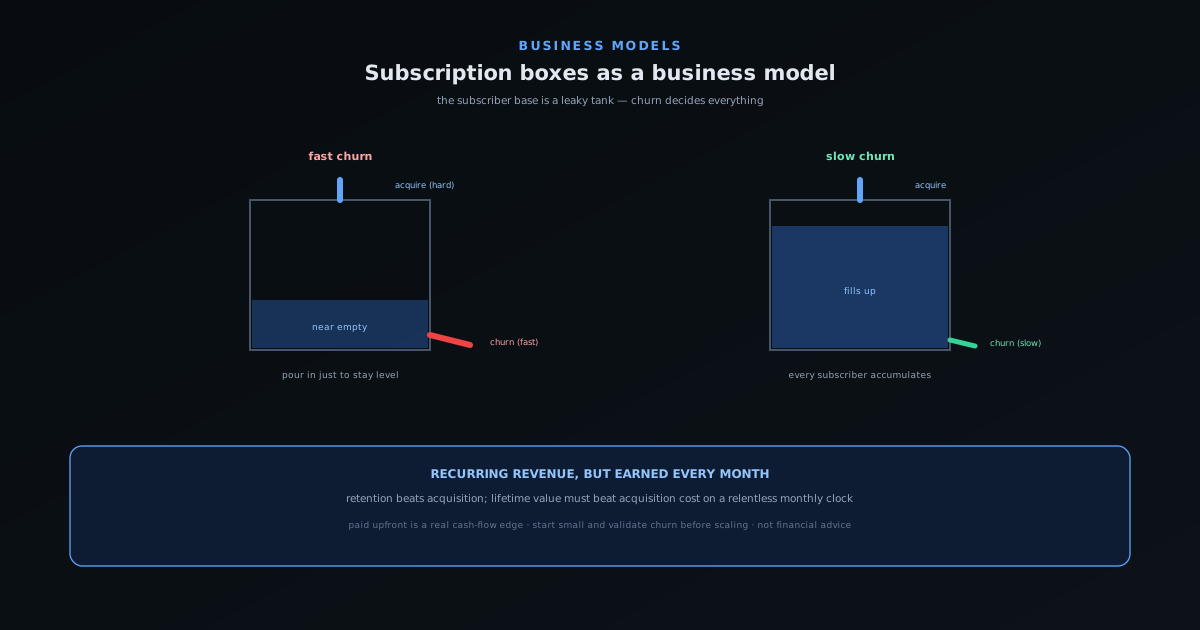
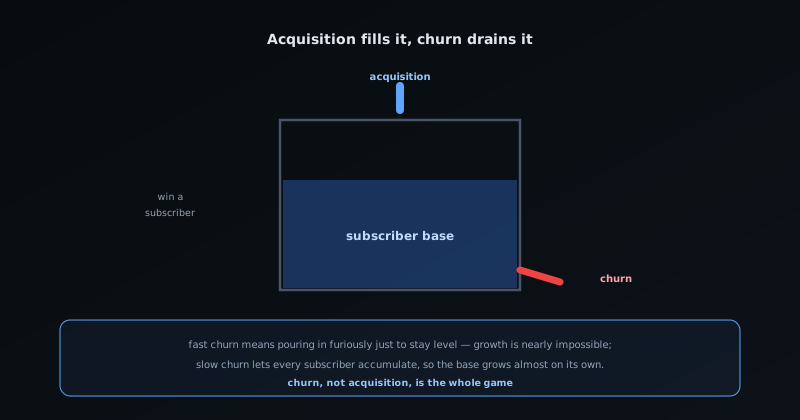
Here is the truth that separates people who understand the model from people who are seduced by it: in a subscription business, churn (the rate at which subscribers cancel) is the number that decides everything, far more than acquisition. The reason is arithmetic. Your subscriber base is a leaky tank; acquisition pours new subscribers in, and churn drains existing ones out. If the drain is fast, you have to pour in furiously just to stay level, and growth becomes nearly impossible because you are running to stand still. If the drain is slow, every subscriber you acquire accumulates, and the base grows almost on its own. Two boxes with identical acquisition and wildly different churn have completely different futures.
This is why obsessing over acquisition while ignoring retention is the classic subscription-box mistake. Pouring money into winning new subscribers who then cancel after a box or two is filling a leaky bucket: expensive, exhausting, and ultimately futile, because the cost of acquiring each subscriber is only recovered if they stay long enough to pay it back. The operators who win are the ones who treat retention as the primary discipline: making each box good enough, and the overall experience compelling enough, that subscribers stay for many cycles. A modest acquisition rate with low churn beats a torrent of acquisition with high churn, every time, because the first compounds and the second leaks. Churn is not a metric to monitor; it is the metric the business is about.
Lifetime value has to beat acquisition cost
Churn connects directly to the central economic test of any subscription business: the lifetime value of a subscriber must comfortably exceed what it costs to acquire one. Lifetime value is, roughly, how much a subscriber pays you in profit over the whole time they stay subscribed, and it is driven directly by churn: low churn means a long average stay means high lifetime value, while high churn means subscribers leave before they have paid back the cost of winning them. Acquisition cost is everything you spend to get a subscriber in the first place: advertising, promotions, the discounted or free first box many boxes use to convert. The model only works when the first number clears the second with margin to spare.
These are the same metrics that govern subscription software (covered in Understanding SaaS metrics: MRR, churn, CAC, LTV, and how they interlock) and they are just as decisive for a physical box, with the added weight of real product and fulfilment costs eating into the margin on every single shipment. That last point is crucial and easy to miss: unlike software, where serving an extra month costs almost nothing, every box you ship has real cost, so the per-box margin is thinner and the lifetime value is harder-won. A subscription box therefore needs both healthy retention and disciplined unit economics, because a long subscriber life at a per-box loss is just a slower way to lose money. The interaction of churn, lifetime value, and acquisition cost is the model in a nutshell.
The operations are relentless
Whatever the economics say, the lived reality of running a subscription box is a relentless monthly clock that never stops and never forgives. Every cycle you must source or curate the products, assemble the boxes, and ship them to every active subscriber, on time, every time, and there is no off month, because subscribers paid for this month and expect it. This is fundamentally different from a normal store, where a slow week is just a slow week; in a subscription box, a missed or late cycle is a broken promise to every customer at once, and broken promises drive exactly the churn the whole model cannot afford. The cadence is the boss, and it is a demanding one.
The operational intensity scales with success in a way that surprises people, because more subscribers means more boxes to assemble and ship every single month, not just more revenue. A normal retailer’s busy period passes; a subscription box’s busy period is every period, growing as the base grows. This is why the model rewards operators who genuinely enjoy and are good at logistics and fulfilment, and punishes those who were attracted by the recurring revenue but underestimated the recurring work. Before committing, the honest question is not just "can I acquire and retain subscribers?" but "can I reliably execute this fulfilment cycle, on time, every month, as it scales?", because the model gives you no months off to catch up.
The cash-flow advantage is real
Against those demands sits a genuine and underappreciated upside beyond the recurring revenue itself: subscription boxes are typically paid for in advance, which is a meaningful cash-flow advantage. The customer pays at the start of the cycle, before you have shipped them anything, so you often have the money in hand before (or at least around the same time as) you incur the cost of fulfilling that cycle. Compared to a business that lays out cash for inventory and waits to sell it, being paid upfront for goods you then fulfil is a far friendlier cash-flow position, and it is one of the model’s quiet structural strengths.
This upfront-payment dynamic, multiplied across a base of subscribers, can fund the working capital the operations require, smoothing the cash crunch that sinks many inventory-heavy businesses. It is not a license to be careless (you still have to fulfil what you were paid for, and taking the cash while degrading the boxes is a fast route to churn) but the timing of the money is on your side in a way it is not for most physical retail. Combined with the predictability of recurring revenue, the upfront cash flow makes a well-run subscription box financially smoother to operate than its operational intensity might suggest, which is part of why the model remains attractive despite its demands.
Inventory under a known subscriber count
One way the model genuinely helps the operator is in forecasting, because a known subscriber count is a far better demand signal than the guesswork a normal retailer faces. If you have a given number of active subscribers and you know your typical churn, you can forecast next cycle’s box count with real confidence, which makes purchasing and inventory dramatically more tractable than for a store guessing at walk-in demand. You are largely producing to a known number rather than betting on an unknown one, and that turns the usual safety-stock and reorder math into a much tighter calculation than most retail allows.
The flip side is that the forecast is only as stable as your churn and your growth, so the inventory planning has to account for both subscribers leaving and new ones arriving between when you commit to inventory and when you ship. Over-order against an optimistic growth assumption and you are stuck with product; under-order against churn you did not anticipate and you cannot fulfil. The discipline is to plan inventory off the realistic projected subscriber count (current base, minus expected churn, plus conservative new acquisition) and to keep that projection honest. Done well, the known base makes a subscription box one of the more forecastable forms of physical retail, which is a real operational gift the model hands you in exchange for its other demands.
Who it works for, and who it does not
The model fits some products and operators far better than others, and being honest about the fit before committing saves a great deal of pain. On the product side, it suits things that genuinely benefit from a recurring delivery: consumables people reliably reorder, categories where ongoing discovery has real value, or niches with a passionate audience who want a steady stream of curated finds. It fits poorly where a product is a one-time purchase, where the novelty cannot be sustained month after month, or where the customer can trivially get the same thing more cheaply or conveniently on their own: in those cases the reason to stay subscribed erodes and churn becomes fatal.
On the operator side, the model rewards people who are genuinely good at and energised by fulfilment and retention, and who can stomach the relentless monthly cadence as it scales. It punishes those who were drawn purely by the recurring-revenue dream and treated the operations as an afterthought, because the operations are the model, not a detail of it. The honest self-assessment is whether you have both a product that earns ongoing subscription and the operational temperament to deliver it reliably forever, and whether the unit economics, with real product and shipping costs on every box, actually leave room for lifetime value to beat acquisition cost. If those line up, the model is genuinely strong; if they do not, the recurring-revenue appeal is a trap.
Start small and validate before scaling
Because the model is operationally heavy and retention-dependent, the sensible way to start is small and validated rather than big and hopeful. Launching with a modest first cohort lets you learn the real churn rate, the true cost and time of fulfilment, and whether subscribers actually find the boxes worth keeping, all before you have scaled the operations or spent heavily on acquisition. The numbers that matter most, especially churn and the real per-box economics, can only be learned from actual subscribers over several cycles, and learning them at small scale is vastly cheaper than discovering a fatal churn rate after you have built for thousands.
Scaling should follow evidence, not optimism: grow the subscriber base once you have confirmed that retention is healthy, the unit economics work, and you can execute the fulfilment cycle reliably at the current size. Each of those is a thing the early, small phase exists to prove. The temptation is to scale on the strength of the recurring-revenue dream before the retention and operations are proven, which is how subscription boxes end up with growing acquisition costs, a leaking base, and operations buckling under volume they were not ready for. Validate the hard parts small, then scale the proven machine: the recurring revenue will still be there to compound, and it will compound on a foundation that actually holds.
Recurring revenue is earned every month
The deepest thing to understand about the subscription-box model is that the recurring revenue, which is the whole appeal, is not a possession you acquire and keep: it is something you re-earn every single cycle. Each box is an opportunity to justify the next payment, and a subscriber’s continued subscription is a recurring verdict on whether you are still delivering value. That is why churn is the whole game, why the operations are relentless, and why retention beats acquisition: the model only pays out its promised stability to operators who keep delivering month after month, and it quietly withdraws that stability from anyone who coasts. The revenue recurs only because the value does.
Held that way, the model is neither the easy recurring-revenue dream the pitch suggests nor a trap to avoid: it is a demanding but genuinely rewarding business for the right product and the right operator. It offers real prizes: predictable revenue, a forecastable subscriber base, and a friendly upfront cash-flow profile. It exacts a real price: a relentless fulfilment cadence and an unforgiving dependence on retention. Going in with both the appeal and the demands clearly in view (and validating the hard parts at small scale before scaling) is what separates the subscription boxes that build into stable, valuable businesses from the ones that drown in churn and operations. As always, this is the shape of the model, not advice for your particular venture, which only your own numbers can settle.
Frequently asked questions
Quick answers to common questions about this topic.
What makes the subscription-box model attractive?
Recurring revenue and the predictability it brings: you win a customer once and they pay every cycle, so you start each month with a known base rather than re-earning everything from zero. That makes forecasting, inventory, and planning far easier. There is also a real cash-flow advantage, since boxes are usually paid for upfront, before you incur the fulfilment cost.
Why is churn more important than acquisition?
Because the subscriber base is a leaky tank: acquisition fills it, churn drains it. With fast churn you pour in subscribers just to stay level and growth is nearly impossible; with slow churn every subscriber accumulates and the base grows almost on its own. Acquiring subscribers who cancel after a box or two is filling a leaky bucket (expensive and futile) which is why retention is the primary discipline.
What is the difference between a curation and a replenishment box?
A curation box delivers a changing selection where the value is discovery and surprise, so it has to keep being interesting. A replenishment box delivers the same essentials on a schedule where the value is convenience, so it has to keep being reliable and well-priced. They demand different operator strengths, and knowing which one you are building clarifies which challenge is yours.
Why are the operations so demanding?
Because fulfilment runs on a relentless monthly clock with no off months: subscribers paid for this cycle and expect it on time. A late or missed cycle is a broken promise to every customer at once, which drives churn. And the work scales with success: more subscribers means more boxes to assemble and ship every month, so the busy period is every period, growing with the base.
How should I start a subscription box?
Small and validated, not big and hopeful. Launch with a modest cohort to learn the real churn rate, the true cost and time of fulfilment, and whether subscribers find the boxes worth keeping, numbers only actual subscribers over several cycles can reveal. Scale only once retention is healthy, the unit economics work, and you can execute the cycle reliably at the current size.
Related troubleshooting
Was this page helpful?
Your answer stays in this browser, it is not sent anywhere and no account or cookie is involved.