2026 · Novus Stream Solutions (hub)About 10 min readNovus Stream Solutions
Pricing psychology, used honestly
The same pricing tactics show up in every checkout: the high anchor, the three tiers, the price ending in nine, the obviously-bad option that makes another look smart. They work because of how people judge value, and that means they can be used two ways: to help someone choose well, or to push them into a choice they would not make with full information. This is the honest version.
Contents
- 1.Overview
- 2.Why prices are judged by comparison, not in a vacuum
- 3.Anchoring: the first number sets the scale
- 4.Tiers: helping people self-select, or hiding the ball
- 5.Charm pricing and the psychology of the nine
- 6.The decoy effect: the option that exists to be rejected
- 7.The line between framing and manipulation
- 8.Why honest pricing is the better long game
Overview
Look closely at almost any pricing page and you will see the same handful of moves: an expensive option at the top that nobody is really expected to buy, three tiers with the middle one highlighted as recommended, prices that end in nine rather than a round number, and sometimes an option so obviously poor that it seems to exist only to make another look clever. None of this is accidental. These are pricing-psychology tactics, and they work because of well-documented quirks in how human beings judge what something is worth. The interesting question is not whether they work (they do) but what you do with that knowledge, because every one of these tactics can be used to help a customer choose well or to nudge them into a choice they would regret if they saw it clearly.
This is the honest version of the pricing-psychology conversation, written for people who would rather persuade than trick. We will look at why prices are judged by comparison rather than in absolute terms, then walk through the main tactics (anchoring, tiering, charm pricing, and the decoy effect) explaining how each one actually works. Then we will draw the line that matters: the difference between framing a genuinely fair choice so it is easy to understand and manufacturing a false impression to extract a decision. The thesis is simple. These tools are not inherently dishonest, but they are powerful, and the same business reasons that make them tempting to abuse are the reasons abusing them is a bad long-term trade.
Why prices are judged by comparison, not in a vacuum
The foundation under all of pricing psychology is that people are bad at judging absolute value and good at judging relative value. Ask someone whether a number on its own is "a lot" and they struggle; show them the same number next to others and they answer instantly. We do not carry around an internal, objective sense of what a thing should cost; we infer it from whatever comparisons are nearby, which is why the context around a price changes how that exact price feels. The same figure can read as expensive or as a bargain depending entirely on what it sits beside, and that is not a flaw to sneer at; it is simply how judgement under uncertainty works.
Every pricing tactic is, at bottom, a way of supplying the comparison the customer will use. That is what makes the tactics powerful and what makes them double-edged. Supply a comparison that reflects reality (the genuine options, fairly described), and you are helping someone orient themselves and choose the plan that actually fits, which is a service. Supply a comparison engineered to mislead (a fake "original" price, an option that exists only to distort the others), and you are exploiting the same mechanism to manufacture a judgement that would not survive full information. The mechanism is neutral; the honesty lives in which comparisons you choose to put on the page.
Anchoring: the first number sets the scale
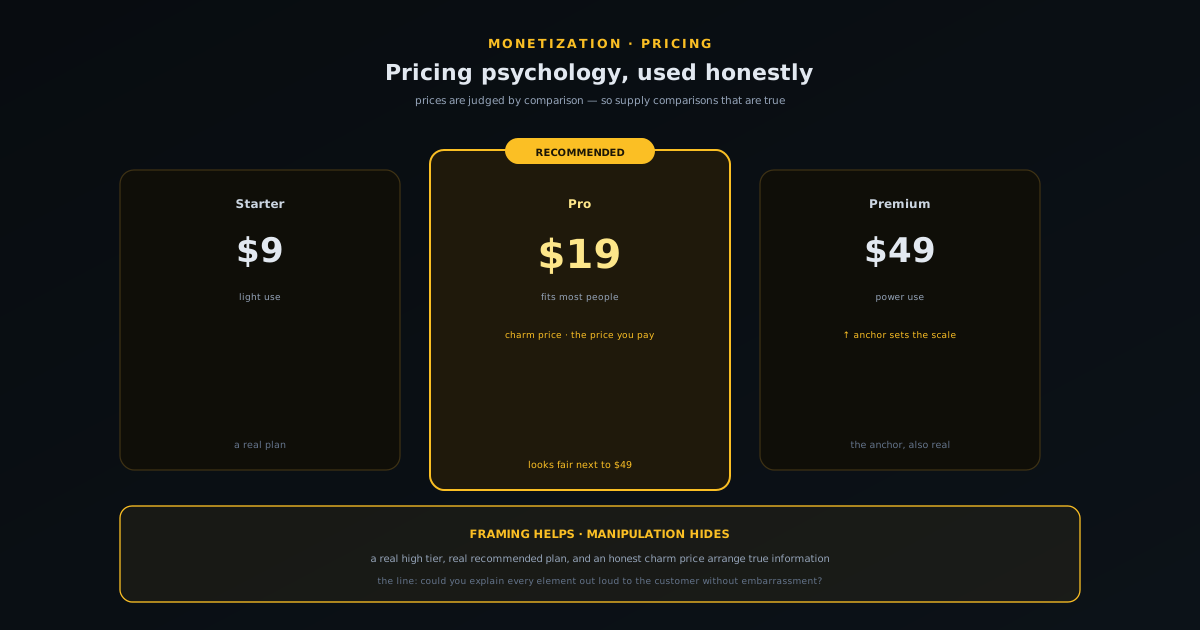
Anchoring is the effect where the first number a person sees becomes the reference point against which they judge everything after it. Show a premium plan at a high price first, and the mid-tier plan that follows looks reasonable by comparison; show the mid-tier first and the same plan can look expensive. The anchor does not have to be the option you expect most people to buy; often it exists precisely to set the scale, so that the plan you do expect them to buy is read against it and feels like sensible value. This is why "good, better, best" layouts so often lead with the "best": the top option is anchoring the whole page.
Used honestly, anchoring is just leading with a real, available option and letting the customer calibrate. The premium plan genuinely exists, genuinely delivers more, and is genuinely bought by the customers it suits; placing it first helps everyone else understand the value of the cheaper plans by reference to it. Used dishonestly, anchoring becomes the fake "was £200, now £80" where the £200 was never a real selling price, an invented anchor whose only job is to make £80 feel like a saving it is not. The test is whether the anchor is a true option or a fiction: a real premium plan informs the comparison, a phantom original price corrupts it.
Tiers: helping people self-select, or hiding the ball
Offering several tiers rather than a single price works with another reality of how people decide: most buyers do not want to be told the price, they want to find the version that fits them, and a small set of well-drawn tiers lets them self-select. Three is the number you see everywhere because it gives a clear low, middle, and high without overwhelming, and highlighting one as "recommended" or "most popular" reduces the paralysis of an open choice by offering a sensible default. When the tiers map honestly onto real differences in what people need (a light user, a regular user, a power user), tiering is a genuine service that gets each customer to the plan that suits them with less effort.
Tiering turns manipulative when the tiers are designed to obscure rather than clarify. The familiar abuses are making the cheap tier deliberately, frustratingly inadequate so people are pushed up not by their needs but by artificial pain; burying the real limitations of a plan so the customer discovers them only after buying; and labelling a tier "most popular" when it is simply the most profitable for you. The honest version draws each tier around a real use case, states its limits plainly on the page, and recommends the plan you would actually recommend to a friend in that situation. The question to ask of your own pricing table is whether a customer who read it carefully would feel, after a month, that they had chosen well, or that the table had steered them.
Charm pricing and the psychology of the nine
Charm pricing (ending a price in nine, so £20 becomes £19.99 or £19) is the most recognisable tactic and the most harmless when used plainly. It works partly because we read left to right and the leading digit anchors our impression, so £19 lands closer to "nineteen-ish" than to "basically twenty," and partly because prices ending in nine have become a cultural signal for value and good deals. The effect is small per purchase but real in aggregate, which is why it is nearly universal. On its own, pricing something at £19 instead of £20 is not deceptive; the customer can see exactly what they will pay and pays it, and nobody is materially misled about the cost.
Charm pricing only becomes a problem when it is used to disguise rather than to round, and the disguise is usually elsewhere on the page, not in the nine itself. A headline price ending in nine that quietly omits mandatory fees revealed only at checkout, or a "£19" that is actually £19 per month dressed up to look like a one-time cost, is using the friendly nine as cover for a number that is not the real number. The honest use is straightforward: end your prices wherever you like, including in nine, but make sure the price shown is the price paid, with any unavoidable additions visible up front. The deception, when it exists, is in the hidden total, not in the choice of final digit.
The decoy effect: the option that exists to be rejected
The decoy effect is the most cunning of the common tactics and the one that most rewards an honest hand. It works by adding a third option that is clearly worse than one of the existing two, so that the targeted option suddenly looks like an obvious winner by comparison. The classic shape is a "medium" priced almost as high as the "large," so the large looks like far better value and sales shift toward it. The decoy is not really meant to be bought; its job is to change how the other options are perceived by giving the customer an easy, flattering comparison to make. It is anchoring’s sneakier cousin, working through a deliberately unattractive neighbour rather than a high first number.
Here the honesty line is bright and worth stating plainly: a decoy whose only purpose is to distort the customer’s judgement of the real options is manipulation, full stop, because it adds nothing of value and exists solely to engineer a choice. But the same structure can be entirely legitimate when the "decoy" is a real option that genuinely suits some customers, even if it suits few. If your three plans each make honest sense for a real segment, the fact that the comparison naturally flatters one of them is a feature of a fair menu, not a trick. The difference is whether the third option is a real thing some people should buy or a prop that exists only to push everyone toward a different one. Build real options; do not build props.
The line between framing and manipulation
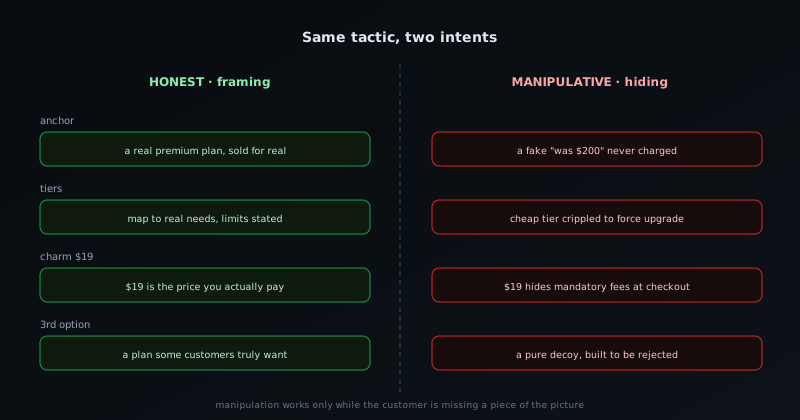
Across all four tactics, the same test keeps reappearing, and it is worth stating as a single principle. Framing helps a customer understand a real choice; manipulation manufactures a false impression to extract a decision they would not make with full information. A high anchor that is a real plan, tiers that map onto real needs, a charm price that is the actual price, a third option that genuinely suits some people: all of these arrange true information so it is easier to judge, and a customer who later saw exactly what you did would feel informed, not played. That feeling ("I understood my options and chose well") is the signature of honest pricing, and it is the thing you are protecting.
Manipulation fails that test in a specific way: it depends on the customer not knowing what you know. The fake original price, the cripple-ware cheap tier, the hidden mandatory fee, the pure decoy: each one works only as long as the customer is missing a piece of the picture, and each one curdles into resentment the moment the picture is complete. A useful gut check before you ship a pricing page is to imagine explaining every element of it, out loud, to the customer it is aimed at. If you could say "I put the premium plan first so you could see what the cheaper ones are worth relative to it" without embarrassment, you are framing. If the honest explanation would be "I did that so you would not notice X," you have crossed the line, and no amount of conversion lift is worth what is on the other side of it.
Why honest pricing is the better long game
It would be naive to pretend manipulation never works in the short term (it plainly does, which is why it is everywhere), so the case for honesty has to be made on the long game, and there it is strong. A manipulated sale and an informed sale look identical at the moment of purchase and diverge sharply afterwards. The customer who was nudged past their better judgement discovers the mismatch when the bill is bigger than they thought, or the cheap tier is useless, or the "saving" was imaginary, and what they feel is not buyer’s remorse aimed at themselves but resentment aimed at you. That resentment shows up as refunds, chargebacks, bad reviews, cancelled subscriptions, and a customer who will never return and will warn others off, the precise opposite of the repeat business and word of mouth a small operation lives on.
The informed sale ages the other way. A customer who understood their options and chose the plan that genuinely fit is far more likely to stay, to upgrade when their real needs grow, and to recommend you, because the product matched the promise and the price matched the value. For a business that intends to be around in a few years and to grow on reputation rather than churn, that compounding trust is worth more than any one optimised checkout. So the honest use of pricing psychology is not a moral luxury you can afford only once you are successful; it is the strategy most likely to get you there. Use the tactics (they are how clear pricing is communicated) but use them to make a fair choice obvious, not to make an unfair one invisible.
Frequently asked questions
Quick answers to common questions about this topic.
Is pricing psychology manipulative?
It can be, but it does not have to be. Tactics like anchoring, tiers, charm pricing, and the decoy effect work by shaping the comparisons a customer uses to judge value. Used to arrange true information so a fair choice is easy to understand, they are framing; used to manufacture a false impression that depends on the customer not knowing something, they are manipulation. The mechanism is neutral; the honesty is in how you use it.
What is price anchoring?
Anchoring is when the first price a customer sees becomes the reference point for judging the others. Leading with a real premium plan helps people calibrate what the cheaper plans are worth, which is honest. Inventing a fake "original" price to make a discount look bigger than it is uses the same effect dishonestly; the test is whether the anchor is a true, available option or a fiction.
Why do so many prices end in nine?
Because of charm pricing: we read left to right, so £19 reads as closer to "nineteen-ish" than to "basically twenty," and prices ending in nine have become a cultural signal for value. The effect is small but real in aggregate. It is harmless when the price shown is the price paid, and only deceptive if a friendly nine is used to disguise hidden fees or a recurring charge dressed up as one-time.
What is the decoy effect in pricing?
The decoy effect adds a third option that is clearly worse than one of the existing two, making the targeted option look like an obvious winner, for example a "medium" priced almost as high as the "large." It is manipulation when the third option exists only to distort the comparison, and legitimate when it is a real plan that genuinely suits some customers even if few choose it.
Does honest pricing actually convert as well as manipulation?
Manipulation can win the single sale, but it loses the relationship: nudged customers discover the mismatch and respond with refunds, chargebacks, bad reviews, and lost word of mouth. Informed customers who chose a plan that genuinely fit are more likely to stay, upgrade, and recommend you. For a business growing on reputation rather than churn, honest pricing is the stronger long-term strategy.
Related troubleshooting
Was this page helpful?
Your answer stays in this browser, it is not sent anywhere and no account or cookie is involved.