2026 · Novus Stream Solutions (hub)About 11 min readNovus Stream Solutions
Owning your distribution: RSS, email, and the feeds nobody can take away
Every follower you have on a platform is a loan the platform can call in. This is the case for owned distribution: why RSS still quietly matters, why an email list is insurance you buy before the fire, how POSSE works in practice, and what realistic growth of owned channels looks like.
Contents
- 1.Overview
- 2.What the platforms actually sell you
- 3.RSS: unfashionable, unkillable, still working
- 4.The email list is insurance, so buy it before the fire
- 5.POSSE: publish on your own site, syndicate elsewhere
- 6.What realistic growth of owned channels looks like
- 7.A minimal owned-distribution stack
- 8.The migration test
Overview
Twice in my operating life I have watched a traffic source I depended on get cut roughly in half by a decision made in a building I will never enter. One was a social algorithm shift that de-prioritized outbound links; the other was a search update that reshuffled a category overnight. Neither was aimed at me. Nobody at either company knew my site existed. That is the defining property of rented reach: the landlord renovates whenever it suits them, and your lease was never in writing.
The lesson I drew was not “abandon platforms”: they remain the cheapest discovery engines ever built, and a small business refusing them is refusing free prospecting. The lesson was to stop confusing discovery with distribution. Discovery is meeting strangers; distribution is being able to reach the people who already chose you, tomorrow, without asking anyone’s permission. Platforms are genuinely good at the first and structurally incapable of guaranteeing the second, because their business depends on standing between you and your own audience.
What follows is the owned-distribution argument in full: why a follower count is a loan rather than an asset, why RSS (the least fashionable technology on this list) still earns its place, why an email list is best understood as insurance, how the POSSE pattern lets you keep the platforms without depending on them, and what growth honestly looks like when you build on channels nobody can throttle. The narrower email-versus-social comparison lives at Email vs social media for owning your audience; this piece is about the whole stack.
What the platforms actually sell you
It helps to be precise about the deal. When someone follows your account on a social platform, no connection between you and that person is created. What is created is an entry in the platform’s database that slightly raises the probability its ranking system shows your next post to them. You cannot see the list in full, export it meaningfully, or message it reliably. Organic reach (the fraction of followers who see a given post) has trended down on every mature platform for a decade, and it trends down for a structural reason: the space your posts used to occupy is the inventory the platform sells.
This is not a moral complaint. Platforms carry the costs of hosting, moderation, and discovery, and showing your content to people is the resource they monetize; of course they ration it. The mistake is on our side of the table, when operators book followers as an asset on the mental balance sheet. An asset is something you control that produces future value. A follower count is closer to a lottery position in someone else’s ranking system, real, occasionally lucrative, and repriceable to near zero without notice or appeal.
The test I apply to any channel now: if this company changed its rules tomorrow, would my ability to reach these people survive? For a subscriber list, yes: I hold the addresses and can move them between providers in an afternoon. For an RSS feed, yes: subscribers pull from my domain directly. For every platform following I have, the honest answer is no. That test, not sentiment about any particular company, is what separates owned from rented.
RSS: unfashionable, unkillable, still working
RSS is the technology everyone declared dead that never stopped running the internet’s plumbing. Every podcast you have ever subscribed to is distributed over RSS; the entire industry rides on it. Feed readers survived the death of the famous one and quietly serve a smaller but remarkably valuable audience: developers, writers, researchers, operators, disproportionately the kind of people who cite, link, and share for a living. When a post of mine travels further than its traffic numbers explain, the first hop was usually somebody’s feed reader.
The mechanics are the whole appeal. A feed is a file your site serves; a subscriber’s reader fetches it on their schedule. There is no ranking layer, no engagement scoring, no interstitial asking them to log in. One hundred percent of subscribers receive one hundred percent of posts, in order, forever, until they choose to leave. No other channel (including email, with its spam filters and clipped messages) delivers that guarantee. And serving a feed costs effectively nothing: every serious site generator and CMS emits one, and a run through the W3C feed validator confirms yours is well-formed.
Beyond human readers, the feed is your machine-readable front door, and machines are underrated subscribers. Newsletter services can ingest it, automation tools can watch it, syndication partners can pull from it, and aggregators can list you off it. Several of the recurring traffic sources to this site connect through the feed with zero marginal effort on my side. For one URL and no ongoing cost, RSS is the highest-leverage neglected asset in small publishing.
- Podcast distribution: the entire ecosystem is RSS underneath.
- Feed readers: a small, high-intent audience heavy on people who link and share.
- Newsletter tooling: many email services can send automatically from your feed.
- Automations: watchers that repost, archive, or notify when the feed updates.
- Aggregators and directories: many list and rank sites by consuming their feeds.
The email list is insurance, so buy it before the fire
If RSS is the quiet channel, email is the durable one, and the right frame for it is insurance. Insurance has two awkward properties: it feels unnecessary right up until the moment it is priceless, and you cannot buy it once the fire has started. An operator who begins collecting addresses the week a platform account gets suspended is buying flood coverage in the rain. The list only functions as insurance if it was growing during the years everything was fine, which is why “start before you feel ready” is not a platitude here but the actual mechanism.
What makes email ownership real rather than rhetorical is portability. The list is a file of addresses given to you, with consent, by people who wanted to hear from you. Your relationship with any particular sending provider is a vendor contract, not a dependency: if the provider raises prices or degrades, you export the file and re-import it elsewhere, and the audience never notices. Contrast every platform, where the audience is precisely the thing you cannot pack up. Deliverability is a genuine ongoing discipline (permission-based collection, easy unsubscribes, consistent volume), but it is a craft you can learn, not a landlord you must appease.
The practical playbook (incentives, placement, welcome sequences) is covered properly in Building an email list from day one for a small store, so I will make only the strategic point here: treat the list as the business’s second-most-durable asset after the domain itself. Revenue attached to email tends to be the most defensible revenue a content business has, because it survives every external repricing event that batters the rest of the traffic mix.
POSSE: publish on your own site, syndicate elsewhere
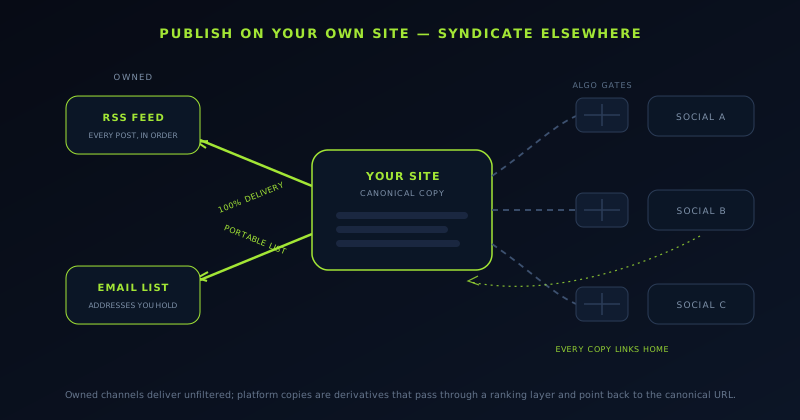
The pattern that reconciles owning your distribution with using the platforms is POSSE (Publish on your Own Site, Syndicate Elsewhere), an idea formalized by the IndieWeb community. The rule is a publishing order: the canonical version of everything you make lives at a URL on your domain first, and the platform versions are derivatives that point home. You still show up everywhere your audience gathers; you just stop letting any of those places be the master copy.
The order matters more than it looks. When the canonical copy is on your domain, every external share compounds into your asset: links accrue to URLs you control, search engines index the original, and a reader who arrives can be offered your feed and your list, conversions from rented reach into owned reach. Invert the order, as platform-native publishing does, and each piece strengthens the walled garden instead; when the garden closes or your account stumbles, the archive, inbound links, and audience path all vanish together.
In practice POSSE is lighter than it sounds. The syndicated copy does not need to be the whole piece: a platform-native excerpt, a thread of the key points, or a chart with a pointer home each work, and matching the format to the platform usually outperforms pasting the full text anyway. The mechanics of slicing one canonical piece into many platform-shaped fragments are exactly the workflow described in Repurposing one piece of content into ten; POSSE just adds the rule about where the original lives. My own pipeline runs on a small routine: publish to the site, let the feed and newsletter pick it up, then hand-craft two or three platform versions in the same sitting.
What realistic growth of owned channels looks like
Here is the part the pitch decks omit: owned channels grow slowly, and anyone selling you a shortcut is selling churn. A platform post can reach ten thousand strangers by lunch because a recommendation engine exists to make that happen; nothing performs that service for your RSS feed or your signup form. Owned subscribers arrive roughly linearly with the useful work you publish: single digits per good post at modest traffic is a normal early rate, and the operators I trust all describe first years that looked like that.
The compounding hides in the retention arithmetic. A platform post is mortal: its reach window closes in hours and every new post starts at zero against the algorithm. A subscriber persists. If you add forty subscribers a month and lose two percent monthly to churn, the arithmetic quietly carries you past a thousand people inside two years, a thousand people you can reach on demand at near-total delivery, which routinely outperforms a rented following ten times its size on any metric that pays. Slow-but-cumulative beats fast-but-mortal on a long enough ledger, and a business is a long ledger.
The discipline this requires is mostly about measurement mood. Owned-channel dashboards are boring; there are no viral spikes to screenshot. I track three numbers monthly (net new email subscribers, feed requests, and the share of site sessions arriving from owned channels), and I let them be small without concluding they are failing. The failure mode to actually watch for is not slowness, it is neglect: feeds that break silently, welcome emails that go stale, signup forms buried below three scrolls. Owned channels rarely die of competition. They die of inattention.
A minimal owned-distribution stack
None of this requires infrastructure heroics; the whole stack is five pieces, most of which you already have. The domain is the root of it: every other asset hangs off DNS you control, which is why the domain should be registered to you personally or your company, never to an agency, a platform, or a defunct partner. The site under it holds the canonical copies. The feed comes free with any competent site setup. The email service is the only recurring bill, and entry tiers are cheap or free at small list sizes. The last piece is a habit, not a technology: the publishing routine that feeds the stack, which is a scheduling problem solved the same way as any other content cadence; see A content calendar that survives a busy week for the version of that system that survives real weeks.
Two configuration details punch above their weight. First, expose the channels: a visible subscribe path for email and a discoverable feed link in the site head, because an owned channel nobody can find grows at exactly zero. Second, keep the export paths warm: know how to download your subscriber list, and keep your content in a format you can regenerate the site from. Ownership you have never exercised is a rumor.
What I deliberately left off the list: a community server, a second newsletter, a members area, and every other owned-ish surface that multiplies maintenance before the basics compound. The stack above is maybe an hour of setup beyond the site you already run and close to zero marginal hours per week. Additions earn their place only after the boring five are humming.
The migration test
I will end with the drill that makes all of this concrete. Once a year, I run a tabletop exercise on the business: pick a dependency and pretend it disappeared this morning. The search traffic is gone. The biggest social account is suspended, appeal denied. The email provider doubled its prices overnight. For each scenario, write down (actually write down) what survives and what it would take to reach the audience by Friday. The first time I ran this exercise it was embarrassing, which is precisely the information I needed. The exercise belongs in the same drawer as the continuity planning in A one-person business continuity plan (the bus-factor problem): cheap paranoia, exercised annually, against expensive surprises.
The comforting version of the result, once the stack is in place: the domain survives everything except non-payment. The archive survives because the canonical copies are yours. The list survives any single provider. The feed survives any reader shutting down. What does not survive is whatever lived platform-first, and after the drill, you will find you instinctively stop building anything important that way.
Owning your distribution is not a rebellion against the platforms, and it does not require quitting them; I still use them daily, gratefully, as the top of the funnel they are good at being. It is simply the refusal to let the top of the funnel be the whole funnel. Meet strangers wherever strangers gather, then bring the relationship home to an address you own, a feed you serve, and a list you hold. The landlord can keep renovating. You will no longer be living there.
Frequently asked questions
Quick answers to common questions about this topic.
Is RSS still worth supporting in 2026?
Yes, and it costs almost nothing to find out. Every serious site generator and CMS emits a feed automatically, so support is usually one link tag away. The direct audience is small but unusually high-intent (feed-reader users skew toward people who write, link, and share professionally), and the indirect value is larger: podcasts, newsletter tooling, automations, and aggregators all consume RSS. Unlike any social channel, a feed delivers every post to every subscriber with no ranking layer in between.
What does POSSE mean?
POSSE stands for Publish (on your) Own Site, Syndicate Elsewhere, a pattern popularized by the IndieWeb community. The canonical version of everything you publish lives at a URL on your domain first; the versions you post to social platforms are derivatives that link back to the original. You keep the discovery benefits of the platforms, while links, search equity, and the archive accrue to the domain you own. If a platform closes or suspends you, you lose pointers, not the work.
How fast does an email list realistically grow for a small site?
Slowly and roughly linearly with the useful work you publish. At modest traffic, single-digit signups per good post is a normal early rate, and a first year that ends in the low hundreds of subscribers is a success, not a failure. The compounding comes from retention: subscribers persist while platform posts expire, so steady adds minus low churn quietly crosses a thousand people within a couple of years, an audience you can reach on demand, which typically out-converts a rented following many times its size.
Should I stop posting on social media and only build owned channels?
No. That misreads the argument. Platforms are the cheapest discovery engines available, and a small business refusing them gives up free prospecting. The correction is about roles: use platforms to meet strangers, and use your site, feed, and email list to keep the relationship. Publish the canonical version on your domain, syndicate platform-shaped versions outward, and always offer arriving readers an owned path to subscribe. You are converting rented reach into owned reach instead of choosing between them.
What is the minimum owned-distribution setup for a small business?
Five pieces: a domain registered in your own name, a site on it holding the canonical copies of your work, an RSS or Atom feed (free with any competent setup; run it through the W3C validator once), an email service with a visible signup path, and a publishing routine that feeds them. Total cost beyond the site you already run is roughly an hour of setup and one small recurring bill. Keep export paths tested: a list you have never downloaded is ownership in theory only.
Related troubleshooting
Was this page helpful?
Your answer stays in this browser, it is not sent anywhere and no account or cookie is involved.