2026 · Novus Stream Solutions (hub)About 12 min readNovus Stream Solutions
Meta titles and descriptions that earn the click
A page can rank and still lose the click. The title tag and meta description are the two lines that decide whether a searcher chooses your result over the nine others on the page. How to write them to match intent and earn the click: length and pixel limits, front-loading the words that matter, avoiding the clickbait that backfires, and why Google sometimes rewrites them anyway.
Contents
- 1.Overview
- 2.Match the intent before you optimize anything else
- 3.Length and the pixel budget
- 4.Front-load the words that matter
- 5.Anatomy of a snippet
- 6.Avoid clickbait: it backfires twice
- 7.Why Google sometimes rewrites your snippet
- 8.Every page deserves its own title and description
- 9.A worked example of the difference
- 10.The highest-leverage copy on the site
Overview
There is a quiet failure mode in search that does not show up as a missing ranking: the page that ranks well and still gets passed over. A result can sit in a perfectly good position and lose the click to the result above or below it, because the two lines that represent it in the search listing (the title and the description) did not give the searcher a reason to choose it. Ranking gets you onto the page of results; the title and description are what convert that placement into an actual visit. They are, for most pages, the only marketing copy a searcher ever sees before deciding, and they get a second or two to do their job.
The mistake is to treat these two fields as an afterthought, autogenerated or copied across pages, when they are arguably the highest-leverage copy on the site. A small improvement in how compelling and well-matched a snippet is can lift the share of searchers who click it without changing the ranking at all, and on a page that already ranks, that is close to free traffic. This guide is about writing the title tag and meta description so they match what the searcher wanted and earn the click: getting the length right, putting the important words where they count, staying honest enough to keep the click once it is made, and understanding why the search engine sometimes overrides your copy entirely.
Match the intent before you optimize anything else
Before any consideration of length, keywords, or phrasing, a title and description have to do one thing: confirm to the searcher that this page answers the question they just asked. A searcher scans the results with a specific intent in mind, and they are looking for the result that most clearly matches it. The most beautifully written title in the world loses to a plainer one that more obviously fits the query, because the click goes to relevance first and polish second. Matching intent is therefore not one tactic among many; it is the foundation the rest of the tactics decorate.
This is why the same instinct that produces a good page produces a good snippet: both start from understanding what the searcher actually wanted. A query phrased as a question wants an answer; a query phrased as a task wants a tool or a how-to; a query phrased as a comparison wants options weighed. The title and description should signal, in the searcher's own terms, that this page delivers exactly that, not by stuffing the query in verbatim, but by making the match unmistakable. Get the intent match right and a serviceable snippet will earn clicks; get it wrong and a brilliant snippet will be ignored, because it is answering a question nobody on that results page asked.
Length and the pixel budget
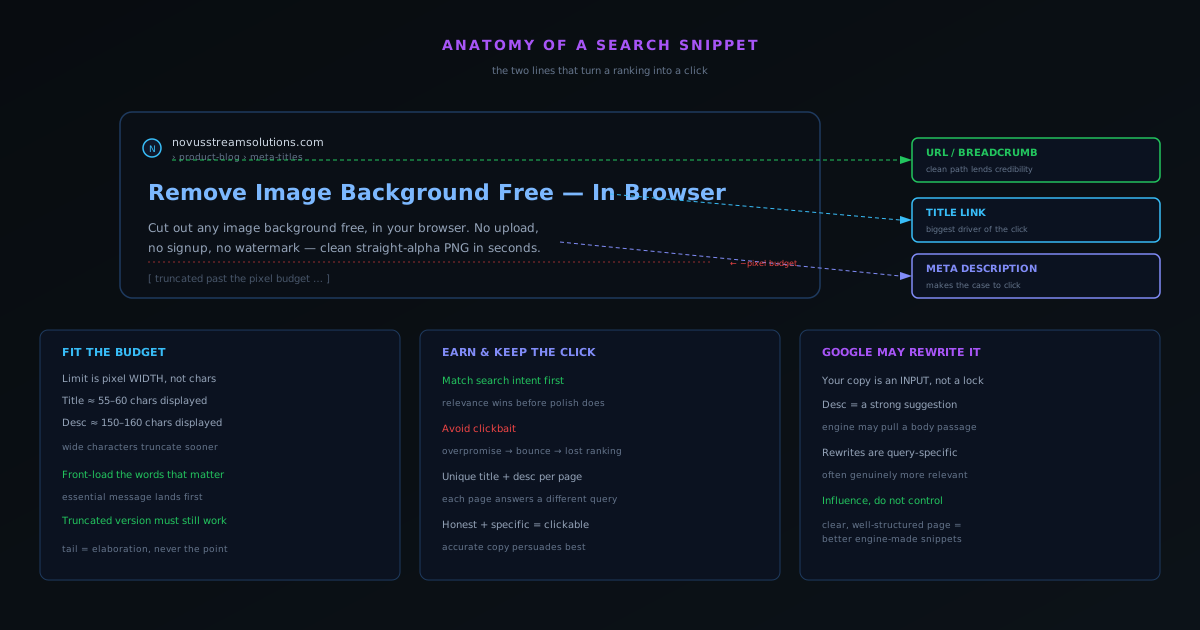
Titles and descriptions live in a constrained space, and the constraint is measured in pixels, not characters. That subtlety trips up advice given purely in character counts. Search engines display the title and description up to a width, and anything past that width is cut off with an ellipsis, so a title full of wide characters truncates sooner than one full of narrow ones at the same character count. As a working guide, titles tend to display fully somewhere around 55 to 60 characters and descriptions around 150 to 160, but the honest rule is that the budget is a width, and the practical defense is to keep the essential message comfortably inside it rather than gambling on the exact cutoff.
The implication for how you write is concrete: the part of the title or description that has to be read should never be the part at risk of truncation. A title whose meaning depends on its last few words is a title that breaks when it gets cut; a description whose call to action sits past the fold of the snippet is a call to action nobody sees. Write so that a truncated version still works: the key message landing early, the tail being elaboration rather than the point. Treating the snippet as a fixed-width space you fit a complete thought into, rather than a sentence you hope displays in full, is what keeps it effective regardless of exactly where the engine draws the line.
- Treat the limit as a pixel width, not a character count; wide characters truncate sooner.
- As a rough guide, keep titles near 55 to 60 characters and descriptions near 150 to 160.
- Put the essential message early so a truncated snippet still communicates the point.
- Avoid relying on the tail end of either field; assume it may be cut off.
Front-load the words that matter
Because the snippet is scanned, not read, and because the end may be truncated, the words that carry the meaning belong near the front. A title that opens with the topic (the thing the searcher is looking for) declares its relevance instantly, where a title that buries the topic behind a brand name or a generic phrase makes the searcher work to find the match, and on a results page nobody works. Front-loading is not keyword stuffing; it is ordering the words so the most relevant one is the first thing the eye lands on.
The same applies to the description. The first phrase should make the value of the page clear, because that is the part guaranteed to display and the part that earns the scan. Branding, qualifiers, and supporting detail can follow, but the lead has to carry the relevance and the reason to click. This ordering discipline pays off twice: it helps the searcher confirm the match faster, and it protects the message against truncation, since the part most likely to be cut is the part you deliberately made least essential. Putting the important words first is the simplest high-leverage edit most titles and descriptions need.
Anatomy of a snippet
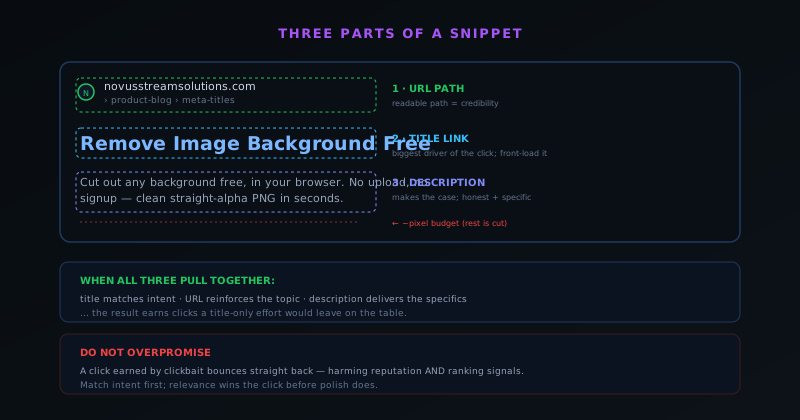
It helps to look at the snippet as the searcher does: a small, three-part unit that has to sell the page in a glance. At the top sits the title link: the largest, most prominent line, and the single biggest influence on whether the result is clicked. Below it runs the URL or breadcrumb path, which quietly signals what the page is and where it sits, lending or undermining credibility before the description is even read. Then comes the description, the supporting line that elaborates on the title and makes the case for this result over its neighbors.
Each part does a distinct job, and a strong snippet uses all three deliberately rather than treating the title as everything and the rest as filler. The title makes the claim of relevance; the URL substantiates it with a clean, readable path rather than a string of parameters; the description closes by spelling out what the searcher gets if they click. The diagram here labels these three elements so the structure is concrete. When all three pull in the same direction (title matching intent, URL reinforcing the topic, description delivering the specifics), the result earns clicks that a title-only effort would leave on the table.
Avoid clickbait: it backfires twice
The temptation to overpromise in a title is strong, because a sensational line can lift the click rate in the short term. The problem is that a click earned by a promise the page does not keep is a click that bounces straight back to the results, and that backfires twice. First, the searcher who feels misled forms a negative impression of the source, which costs more than the single visit. Second, search engines pay attention to whether searchers stay or return to the results, and a pattern of clicks followed by quick returns is a signal that the result did not satisfy the query, which can hurt the very ranking the clickbait was meant to exploit.
The durable approach is to write a title and description that are compelling because they are accurate, not in spite of it. The most clickable honest snippet is one that clearly and specifically promises exactly what the page delivers, so the searcher who clicks finds what they expected and stays. This is the same humans-first principle that governs good content: respect the searcher's intent, tell them truthfully what they will get, and let the genuine match do the persuading. Clickbait optimizes a single moment at the expense of trust and ranking; an honest, specific snippet optimizes for the click and the satisfaction that follows it, which is what actually compounds.
Why Google sometimes rewrites your snippet
A fact that surprises people new to this is that the title and description you write are inputs, not guarantees. Search engines reserve the right to generate their own title link or pull a different description from the page when they judge their version better matches the query, and they do this routinely. A meta description in particular is best understood as a suggestion: the engine may use it, or it may surface a passage from the page body that more directly answers the specific search. This is not a malfunction; it is the engine trying to serve the searcher, and sometimes its query-specific snippet genuinely is more relevant than your one-size-fits-all line.
The right response is neither to ignore these fields nor to obsess over forcing them through. Write a strong, accurate title and description as your best general-purpose representation of the page, and accept that the engine may adapt them for specific queries. The way to make a helpful rewrite more likely and an unhelpful one less likely is to ensure the page content itself is clear and well-structured, because that is the raw material the engine draws on when it composes its own snippet. Influence, not control, is the realistic goal: you supply the best default and a clean page, and you let the engine handle the long tail of queries you could never have written a bespoke snippet for. Google's own guidance on controlling snippets and title links is the authoritative reference for exactly how much influence you have and how to exercise it.
- Treat your meta description as a strong suggestion, not a guarantee of what displays.
- Expect query-specific rewrites; they are often genuinely more relevant than a generic line.
- Make the page content clear and well-structured so engine-generated snippets are good.
- Aim to influence the snippet, not to control it: supply the best default and a clean page.
Every page deserves its own title and description
One of the most common and costly mistakes is reusing the same title and description across many pages, or leaving them to be autogenerated into near-duplicates. Each page exists to answer a different query, and a snippet that does not reflect that page's specific value cannot earn the click for that page's specific search. Duplicate titles also confuse the search engine about which page to show for a query and dilute the distinctiveness that helps a result stand out. Uniqueness is not a nicety here; it is the baseline requirement for a snippet to do its job.
For a site with many pages this is real work, but it is the kind of work that compounds, because every page that gets a tailored title and description becomes a page that can earn its own clicks rather than borrowing a generic line that fits none of them well. The discipline is to write the title and description as deliberately as the page content: one per page, matched to that page's intent, distinct from its neighbors. A template can help structure them, but a template that produces identical or near-identical snippets across pages defeats the purpose. The goal is that anyone scanning the results for any of your pages sees a line written specifically to win that particular search.
A worked example of the difference
Consider a page that lets someone remove the background from an image in their browser. A weak title might read like the brand name followed by a generic word ("Novus Tools: Image Editing"), which buries the topic, wastes the front of the line, and matches no specific intent. A strong title leads with what the searcher wants and what makes this page worth choosing: something like "Remove Image Background Free: No Upload, In Your Browser." It front-loads the task, fits inside the pixel budget, and signals the specific value in the same breath, all without a word of exaggeration.
The description does the supporting work. A weak one repeats the title or describes the company; a strong one spells out the concrete promise the searcher cares about (that the tool is free, runs entirely in the browser, requires no account, and produces a clean cutout) in a lead phrase that survives truncation. None of this is clickbait, because every claim is true and specific; it is simply the page's real value, ordered and worded to be obvious in a glance. That is the whole craft: take what is genuinely good about the page, match it to what the searcher wanted, and put it where a scanning eye will catch it before the snippet runs out of room.
The highest-leverage copy on the site
It is worth ending on why this small, fiddly work deserves attention out of proportion to its size. The title and description are, for most pages, the only copy a potential visitor reads before deciding whether to come at all, a tiny surface that gates everything downstream. Improving them lifts the share of searchers who click without requiring a better ranking, which makes them one of the few levers that turns existing visibility into more traffic almost for free. Two well-chosen lines can outperform a great deal of effort spent elsewhere, simply because they sit at the exact decision point where a ranking becomes a visit.
Pulling the threads together: match the searcher's intent first, because relevance wins the click before polish does; respect the pixel budget and front-load the words that matter, so the message lands inside the space and survives truncation; stay honest, because clickbait costs trust and ranking both; write a unique title and description for every page, because each answers a different query; and treat your snippet as a strong suggestion the engine may adapt, supplying the best default and a clean page so its rewrites are good. Done across a site, this is some of the highest-return work available: quiet, unglamorous, and directly responsible for whether the rankings you earned ever turn into visits.
Frequently asked questions
Quick answers to common questions about this topic.
How long should a meta title and description be?
The real limit is a pixel width, not a character count, so wide characters truncate sooner. As a working guide, titles display fully around 55 to 60 characters and descriptions around 150 to 160. The safest approach is to put the essential message early so a truncated snippet still communicates the point.
Does the meta description affect rankings?
Not directly, but it strongly affects click-through rate, and a result that earns clicks and satisfies searchers tends to do better over time. Think of the description as your pitch for the click rather than a ranking factor in itself.
Why does Google change my title or description?
Search engines treat your title and description as inputs, not guarantees, and will generate their own when they judge it better matches a specific query. This is usually an attempt to serve the searcher. You influence rather than control the snippet by writing a strong default and keeping the page content clear and well-structured.
Is clickbait in titles a good idea for more clicks?
No. A click earned by an overpromise bounces straight back when the page disappoints, which harms your reputation and signals to search engines that the result did not satisfy the query. An honest, specific snippet earns the click and the satisfaction that follows, which is what compounds.
Should every page have a unique title and description?
Yes. Each page answers a different query, and a reused or autogenerated snippet cannot earn the click for that page's specific search. Duplicate titles also confuse search engines about which page to show. Write one tailored title and description per page, matched to that page's intent.
What is the single most important thing in a snippet?
Matching the searcher's intent. A title and description that obviously fit the query will earn the click even if they are plain, while a polished snippet that does not match the intent will be passed over. Confirm relevance first, then optimize length, ordering, and phrasing.
Related troubleshooting
Was this page helpful?
Your answer stays in this browser, it is not sent anywhere and no account or cookie is involved.