2026 · Novus SupplyAbout 13 min readNovus Stream Solutions
Managing suppliers and lead times as a small buyer
When your orders are small, you have little leverage with suppliers — so you compete on being a reliable, easy, well-organised customer instead of a big one. This is how to manage suppliers and lead times as a small buyer: understanding real lead times, handling minimums, building genuine relationships, and never depending on a single source.
Contents
- 1.Overview
- 2.Lead time is the number that runs your inventory
- 3.Learn the real lead time, not the quoted one
- 4.Minimums and the cash they tie up
- 5.Offset the small-buyer disadvantage with discipline
- 6.Build a relationship, not just a transaction
- 7.Share forecasts, not just orders
- 8.Have a backup before you need one
- 9.Control quality at a distance
- 10.Keep a simple supplier record
- 11.Reliability beats price for a small buyer
Overview
A large retailer walks into a supplier relationship holding most of the cards: huge orders, the leverage to demand favourable terms, and the volume to make a supplier bend over backwards. A small buyer has almost none of that. Your orders are modest, your leverage is slight, and you are one of many small accounts a supplier could take or leave. Pretending otherwise — trying to negotiate like a big player you are not — wastes everyone’s time and tends to sour the relationship before it starts. The first step in managing suppliers as a small buyer is accepting the position honestly, because the strategies that work for you are entirely different from the ones that work for a giant.
What a small buyer can offer instead of volume is reliability, organisation, and ease — being the customer a supplier never has to chase, whose orders are clean, whose payments are prompt, and whose communication is clear. Combined with operational discipline about lead times and stock, those things let a small store run a dependable supply chain without the leverage of size. This article is about that playbook: understanding the lead times that actually govern your inventory, handling the minimums that lock up your cash, building relationships that earn you flexibility you could never demand, and never letting yourself depend on a single source. None of it requires being big; all of it requires being deliberate.
Lead time is the number that runs your inventory
New buyers fixate on unit price, but the number that actually governs whether your shelves are stocked is lead time: how long it takes from placing an order to having sellable stock in hand. Price determines your margin; lead time determines whether you have anything to sell at all, and a stockout costs you the sale, the customer, and often the search ranking or the habit that brought them. A slightly cheaper supplier with an unpredictable, lengthy lead time can easily cost you more in lost sales and emergency reorders than a slightly pricier one who delivers reliably on a known schedule. For a small buyer especially, dependability of timing usually beats a small saving on price.
Lead time also drives the math of when to reorder, which is the practical core of inventory management. You have to place an order far enough ahead that the new stock arrives before the old runs out, and the length and the variability of the lead time are exactly the inputs that determine how far ahead "far enough" is. Longer or less predictable lead times force you to order earlier and hold more buffer, which ties up more cash in stock. This is why lead time is not a logistics detail but a central business variable, feeding directly into the reorder-point and safety-stock calculations covered in /product-blog/safety-stock-and-reorder-points. Get the lead time wrong and every downstream timing decision is wrong with it.
Learn the real lead time, not the quoted one
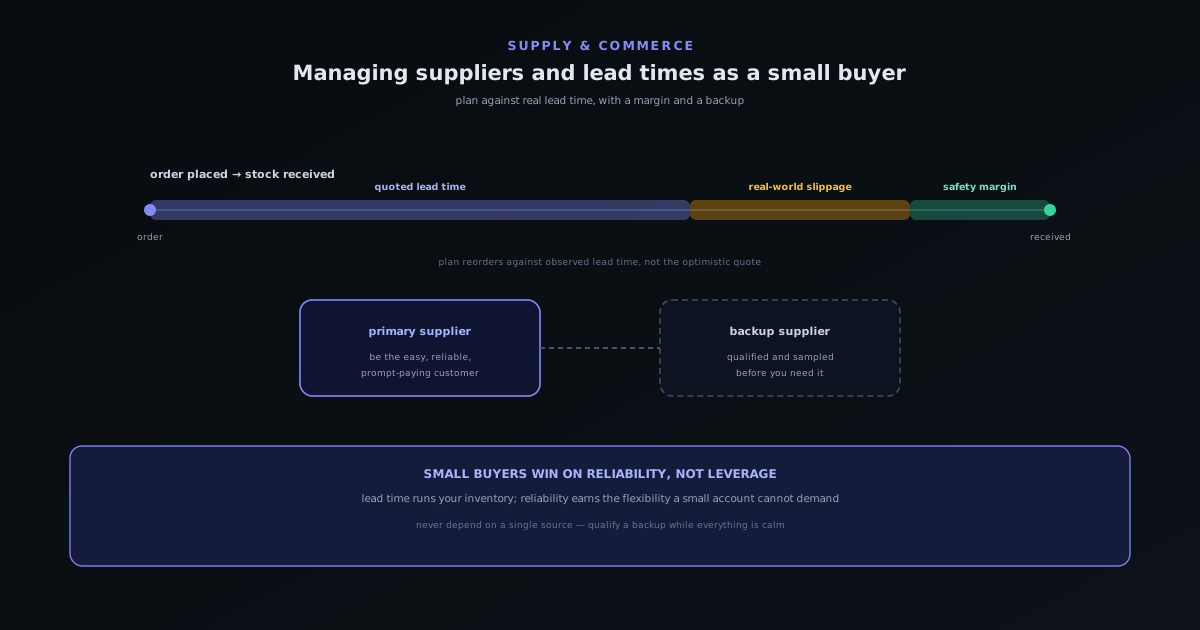
Every supplier quotes a lead time, and that quoted figure is best understood as an optimistic estimate rather than a promise. The real lead time — the one you should plan against — is what you actually observe across multiple orders, including the delays, the partial shipments, the customs holdups, and the busy seasons when the supplier is slower than usual. The gap between the quoted and the actual can be substantial, and planning your reorders against the quoted figure is a reliable way to run out of stock while technically having "ordered in time." The number that protects you is the one you measured, not the one you were told.
This means the most valuable thing you can do early in a supplier relationship is simply to record what actually happens: when you ordered, when it shipped, when it arrived, and whether the quantity and quality were right. After a handful of orders you have a real distribution of lead times rather than a single hopeful number, and you can plan against the realistic upper end of it rather than the average, building in a margin for the variability you have observed. Suppliers are rarely being dishonest with their quotes; they are quoting their best case, and your job as the buyer is to know their typical and worst cases too. The discipline of measuring turns lead time from a promise you hope holds into a fact you can plan around.
Minimums and the cash they tie up
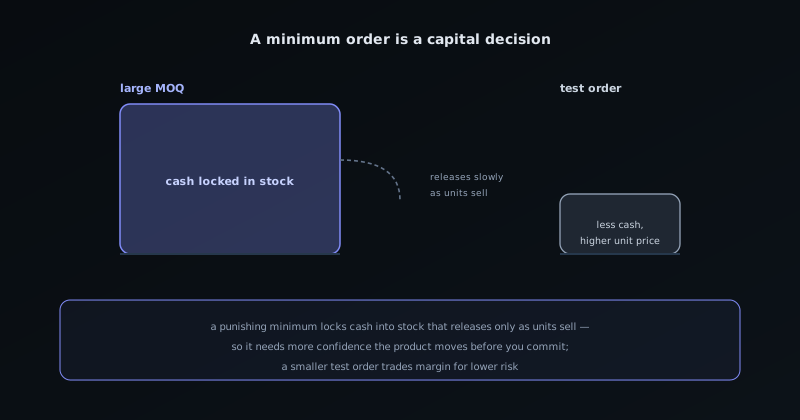
Suppliers, especially manufacturers, often impose minimum order quantities — the smallest amount they will sell in one order — and for a small buyer the MOQ is frequently the binding constraint, not the price. A minimum that is large relative to your sales rate forces you to buy more than you would like at once, which locks up cash in inventory that sells through slowly and creates the risk of overstock if demand disappoints. The MOQ turns a simple "buy what I need" into a real capital and risk decision, and underestimating its impact is how small buyers end up with a storeroom full of money they cannot get back quickly.
There are honest ways to manage this without leverage you do not have. You can ask whether a smaller first order is possible to test the relationship, accepting a higher unit price as the cost of lower risk; you can look for distributors who break manufacturer minimums into smaller quantities, trading some margin for flexibility; and you can be disciplined about only committing to a large minimum once the product has proven it sells. The key is to treat the MOQ as part of the true cost and risk of a product, not an afterthought — a product with a punishing minimum needs a correspondingly higher confidence that it will sell before you commit, because the downside of being wrong is parked on your shelf for months.
Offset the small-buyer disadvantage with discipline
You cannot offset a lack of volume with more volume, so you offset it by being the kind of customer a supplier wants to keep even though you are small. That means orders that are clean and unambiguous, communication that is prompt and clear, payments that arrive on time without chasing, and a complete absence of the chaos and last-minute panic that makes small accounts a headache to serve. Suppliers have a finite amount of goodwill and flexibility to distribute, and they distribute it toward the customers who are easy and reliable, not necessarily the largest. Being conspicuously easy to deal with is leverage of a different kind, and it is the kind a small buyer can actually build.
This discipline compounds into real, practical advantages over time. The supplier who has learned that your orders are accurate and your payments are dependable is the one who will squeeze your order in when capacity is tight, give you honest warning when a lead time is slipping, and extend you a little flexibility on a minimum or a payment term when you need it. None of that can be demanded by a small account, but all of it can be earned, and it is earned precisely through the unglamorous reliability that costs you nothing but attention. The smallest buyer who is the easiest customer often gets better real-world service than a larger one who is a constant hassle.
Build a relationship, not just a transaction
It is easy to treat a supplier as a faceless source of stock, but the relationship is a genuine business asset, and small buyers benefit from investing in it more than large ones do, precisely because they cannot fall back on volume. A supplier who knows you, understands your business, and has a reason to care about your success is worth far more than the marginally cheaper anonymous source, because that relationship is what you draw on when something goes wrong — a rush order, a quality issue, a sudden demand spike. Relationships are built in the ordinary times so they are there in the extraordinary ones, which is the opposite of how panicked buyers treat them.
Practically, this means treating the people on the other end as long-term partners rather than interchangeable vendors: communicating beyond just placing orders, being honest about your plans and your constraints, paying attention to their constraints in return, and behaving like someone they would want to keep working with for years. A supplier relationship built only on price is fragile and switches the moment someone undercuts it; one built on mutual reliability and a bit of genuine rapport is resilient and tends to improve over time, with better terms and more flexibility accruing as trust deepens. For a small buyer with no leverage to spend, the relationship is the leverage.
Have a backup before you need one
Depending on a single supplier for anything important is one of the most common and most dangerous mistakes a small store makes, because it makes your business hostage to that supplier’s problems. If your sole source has a disruption — a factory issue, a shipping crisis, a price hike, or simply going out of business — you have no stock and no alternative, and you discover the fragility at the worst possible moment. The time to find a backup is when everything is fine and you can evaluate alternatives calmly, not when your primary source has just failed and you are panic-searching while your shelves empty.
A backup supplier does not have to be a fully active second source carrying half your orders; it can be a qualified alternative you have identified, sampled, and perhaps placed a small order with, so that switching is a known, tested path rather than a frantic improvisation. The modest cost of maintaining that option — a little more complexity, perhaps a slightly higher price on the backup’s smaller orders — is cheap insurance against the existential risk of a single point of failure. For a small buyer who cannot absorb a long stockout, supplier redundancy is not over-engineering; it is the difference between a supplier’s bad week being an inconvenience and being a crisis that takes your store down with it.
Control quality at a distance
When you are buying from a supplier you may never meet, often in another country, quality control becomes something you have to engineer rather than assume, because a defective batch discovered only after it reaches your customers damages your brand far more than it damages the distant supplier. The first defence is samples: never commit to a significant order of a new product without inspecting a physical sample first, because photographs and descriptions hide exactly the quality problems that will generate returns and complaints. A sample is cheap; a bad bulk order is expensive in both money and reputation.
Beyond the initial sample, quality control at a distance is about clear specifications and consistent checking. Spelling out exactly what you expect — materials, dimensions, tolerances, finish — removes the ambiguity that lets a supplier ship something technically-defensible but wrong, and checking incoming stock rather than blindly trusting it catches problems before your customers do. For a small buyer the realistic approach is risk-based: inspect new products and new suppliers carefully, and spot-check established ones, rather than trying to inspect everything exhaustively. The goal is to catch the quality problems that would reach customers, because at a distance the supplier will not catch them for you, and your brand, not theirs, pays for the ones that slip through.
Keep a simple supplier record
All of this discipline depends on memory you should not trust to your head, so the small but high-leverage habit is to keep a simple record for each supplier. It does not need software; a sheet per supplier is plenty. The value is that it turns scattered experience into a basis for decisions — which supplier is actually reliable, which lead time to plan against, which minimums and terms apply — so you are managing your supply chain on evidence rather than impression. A few fields, kept current, are enough to make every reorder and every sourcing decision better-informed:
Kept up to date as orders happen, that record is what lets a small buyer run a professional supply operation without a procurement department — it is the institutional memory that organisation, rather than size, provides.
- Contact details and the specific person you deal with.
- Quoted lead time and the actual lead times you have observed, order by order.
- Minimum order quantity, unit prices at relevant volumes, and payment terms.
- Quality notes: defects, consistency, and any specifications agreed.
- Reliability notes: missed dates, partial shipments, how they handled problems.
Reliability beats price for a small buyer
If there is a single theme to managing suppliers as a small buyer, it is that reliability — theirs and yours — matters more than price. A dependable supplier with a predictable lead time who serves you well because you are an easy, organised, trustworthy customer is worth more than a marginally cheaper one who is unpredictable, hard to reach, or indifferent to a small account. The savings on price are real but bounded; the cost of a stockout, a quality failure, or a supplier disruption can be unbounded, and it is reliability that protects against those. Optimising hard for the lowest unit cost while ignoring dependability is how small stores end up cheap on paper and chaotic in practice.
So the playbook, in sum, is to compete where a small buyer can win: be the easy, reliable, well-organised customer; plan against real lead times rather than quoted ones; treat minimums as the capital decisions they are; invest in supplier relationships as genuine assets; share your forecasts so the chain can serve you; keep a backup before you need it; control quality at a distance; and write down what you learn. None of this requires the leverage of size, and all of it adds up to a supply operation a small store can actually depend on. The boundary worth holding, as ever, is between a relationship built only on price — fragile and disposable — and one built on mutual reliability, which is the kind that quietly gets better every year.
Frequently asked questions
Quick answers to common questions about this topic.
What matters more for a small buyer, price or lead time?
Usually lead time and reliability. Price sets your margin, but lead time determines whether you have anything to sell — and a stockout costs the sale, the customer, and often the habit or ranking that brought them. A slightly cheaper supplier with an unpredictable, lengthy lead time can cost far more in lost sales and emergency reorders than a pricier, dependable one.
How do I know a supplier’s real lead time?
Measure it rather than trust the quote. The quoted lead time is an optimistic estimate; the real one is what you observe across several orders, including delays, partial shipments, and busy seasons. Record when you ordered, shipped, and received each time, and after a handful of orders plan against the realistic upper end of what you actually saw, not the hopeful number you were given.
How should a small buyer handle minimum order quantities?
Treat the MOQ as part of a product’s true cost and risk, because it locks cash into stock that sells through slowly. Ask about a smaller first order to test the relationship, consider distributors who break manufacturer minimums into smaller lots, and only commit to a large minimum once the product has proven it sells — a punishing MOQ needs more confidence before you tie up the capital.
How can a small buyer get good service without big orders?
By being the customer a supplier wants to keep: clean, unambiguous orders, prompt clear communication, on-time payment, and none of the last-minute chaos that makes small accounts a headache. Suppliers steer their finite flexibility toward easy, reliable customers, not just large ones, so conspicuous reliability earns you the rush slots, honest warnings, and small flexibilities a small account could never demand.
Do I really need a backup supplier?
For anything important, yes. A single source makes your business hostage to that supplier’s disruptions, and you discover the fragility at the worst moment. A backup need not be fully active — a qualified, sampled alternative you could switch to is enough — and the modest cost of maintaining the option is cheap insurance against a stockout that a small store cannot absorb.