2026 · Novus Stream Solutions (hub)About 13 min readNovus Stream Solutions
Safety stock and reorder points: the simple math that prevents stockouts
Running out of stock costs you sales, momentum, and marketplace rankings; carrying too much ties up the cash a small business cannot spare. Between those two failures sits a small amount of arithmetic almost no small seller actually does. This is a plain-language guide to safety stock and reorder points — the few inputs and simple formulas that keep you in stock without drowning in inventory.
Overview
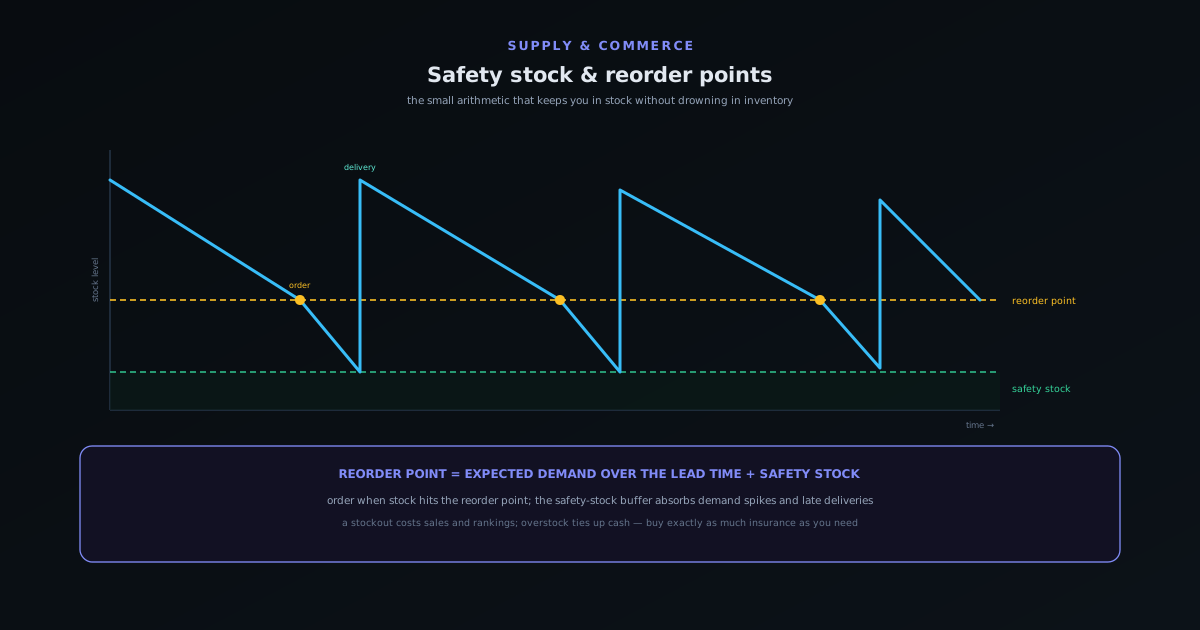
There are two ways to get inventory wrong, and a small seller usually oscillates between both. Run out of a product and you lose the sale you would have made, but the damage does not stop there: a stockout costs you the momentum of a listing, often a chunk of its marketplace ranking, sometimes the customer permanently to a competitor, and always the goodwill of someone who wanted to give you money and could not. Overcorrect by ordering huge quantities so you never run out, and you tie up cash a small business cannot spare in boxes sitting in storage, exposed to obsolescence, damage, and the simple opportunity cost of money you could have used for anything else. Both failures are expensive, and most small sellers manage the tension by gut feel, lurching from panic-reorder to overstock and back.
Sitting between those two failures is a small amount of arithmetic that almost no small seller actually does, even though it is genuinely simple and would resolve most of the oscillation. The concepts are safety stock and the reorder point, and together they answer the only two questions inventory really poses: when should I place an order, and how much buffer should I hold against things going wrong? You do not need software, a consultant, or an operations degree to use them — a spreadsheet and a handful of numbers you already roughly know will do. This guide explains the inputs, the formulas in plain terms, how to set your tolerance for stockouts honestly, and how to run the whole thing without it becoming a second job.
The two failures and why both are costly
It is worth being precise about the costs, because the whole point of the math is to balance two things that feel very different but are both money. The cost of a stockout is partly the obvious lost sale, but the larger, sneakier costs are downstream: on a marketplace, going out of stock can tank a listing hard-won ranking, so even after you restock you sell less than before until you claw the ranking back. A customer who hits your out-of-stock once may simply buy from a competitor and never return. And stockouts tend to cluster at exactly the worst time — during a demand spike — so the sales you lose are the most valuable ones. The true cost of running out is almost always higher than the sticker price of the missed orders.
The cost of overstock is quieter but just as real, and it is mostly about cash. Every unit sitting in storage is money you spent that you cannot use for anything else until it sells — a particularly painful constraint for a small business where cash is the binding limit on everything. On top of the tied-up cash sit storage fees, the risk of damage or obsolescence, and for seasonal or trend-driven products the real possibility of being stuck with stock you have to discount heavily or write off. The reason the cash cost of inventory deserves this much respect is laid out in /product-blog/the-true-cost-of-a-physical-product. Holding inventory is not free safety; it is a cost you are paying for insurance, and the goal is to buy exactly as much insurance as you need and no more.
The few numbers you actually need
The math runs on a surprisingly small set of inputs, all of which you either already know or can estimate well enough. The first is your demand rate: how many units you sell in a given period, say per day or per week, on average. The second is your lead time: how long it takes, from the moment you place an order with your supplier, for the stock to actually arrive and be sellable — and this is the number small sellers most often underestimate, because it includes not just shipping but processing, customs, and the time to get goods checked in. The third and fourth are the variability of each: how much your daily demand swings around its average, and how much your lead time swings around its average.
That variability is the part most people skip, and it is precisely the part that safety stock exists to handle. If your demand were perfectly steady and your supplier perfectly punctual, you would need no buffer at all — you would simply reorder exactly enough to arrive exactly as you ran out. Safety stock is the answer to the fact that reality is not steady: some weeks you sell double, sometimes the shipment is a week late, and occasionally both happen at once. The bigger and less predictable those swings, the more buffer you need; the steadier your business, the less. You do not need precise statistics — a rough sense of "a normal week versus a busy week" and "the usual lead time versus a bad one" is enough to start, and you refine it as you watch.
The reorder point and safety stock in plain terms
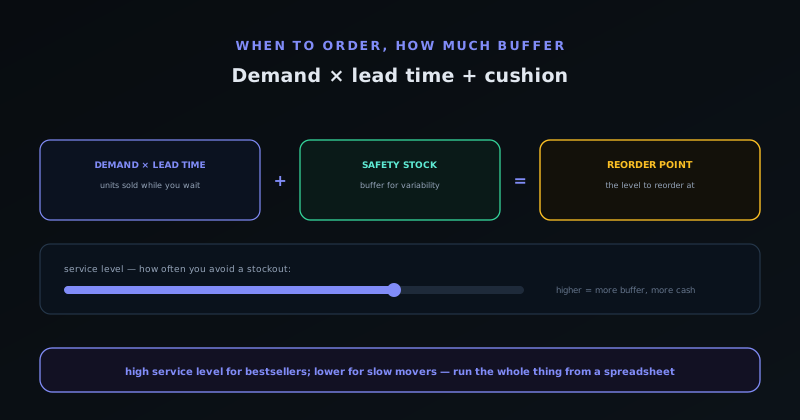
The reorder point is the inventory level at which you place a new order, and its logic is intuitive once stated: you reorder when you have just enough left to last through the lead time, plus your safety buffer. In plain terms, the reorder point equals your expected demand during the lead time, plus your safety stock. The first part is straightforward — if you sell ten a day and the lead time is fourteen days, you will get through about a hundred and forty units while waiting for the new order, so you need at least that many on hand when you place it. Reorder when stock drops to that level and, in the average case, the new shipment arrives just as you would have run out.
Safety stock is the extra cushion on top, sized to the variability, and you can think of it as the answer to "how bad a combination of high demand and late delivery am I willing to survive?" A small buffer covers ordinary fluctuation; a larger one covers rarer, nastier combinations. There are precise formulas that turn your variability numbers and a chosen service level into an exact safety-stock figure, and they are worth using once you are comfortable — but even a rough version works: estimate your worst realistic demand over the lead time, compare it to your average, and hold roughly that difference as buffer. The reorder point then becomes average-demand-over-lead-time plus that buffer, and you have converted "do I have enough?" from a nightly worry into a single number you watch.
Lead time is the number people underestimate
Of the inputs, lead time is the one small sellers most consistently get wrong, almost always underestimating it, and since the reorder point depends directly on it, that error translates straight into stockouts. The mistake is treating lead time as just shipping time, when in reality it spans the whole gap from deciding to reorder to having sellable stock on the shelf. That includes the time to actually place the order, the supplier production or pick time, transit, any customs or inspection, and your own receiving — unpacking, checking, and logging the stock in before it can be sold.
Each of those sub-steps has its own variability, and they compound, which is why the realistic lead time is usually longer and lumpier than the optimistic one in your head. The practical move is to measure it from real orders rather than estimate it: note when you placed each order and when the stock actually became sellable, and use the honest average — and the honest worst case — rather than the supplier quoted figure, which is typically best-case. Getting lead time right is the single biggest improvement most sellers can make to their reorder math, because everything downstream is built on it.
Variability: where safety stock actually comes from
Safety stock exists to cover variability, so it helps to be concrete about the two kinds it protects against, because they combine in the worst cases. The first is demand variability: some weeks you simply sell more than average, and a promotion, a mention, or a seasonal bump can spike it well beyond the norm. The second is lead-time variability: sometimes the shipment is late, the supplier is slow, or customs holds it. Each on its own is manageable; the danger is when they coincide — a demand spike during a late delivery — which is exactly the scenario safety stock is sized to survive.
You do not need formal statistics to handle this, though precise formulas exist for when you want them. A workable approximation is to estimate your realistic worst case over the lead time — the most you might plausibly sell while waiting, against your average — and hold roughly that gap as buffer. The more erratic your demand and the less reliable your supplier, the bigger that gap and the more safety stock you need; the steadier both are, the less. The buffer is, in a real sense, the price of your uncertainty: reduce the uncertainty with a more reliable supplier or steadier demand, and you can safely carry less.
Not every product deserves the same attention
A trap that wastes both cash and attention is treating every product in the catalog identically, when in reality a small fraction of products usually drives most of the sales and deserves most of the care. A simple discipline is to sort products by how much they matter — by revenue or volume — and concentrate your forecasting effort and your highest service levels on the vital few, while managing the long tail of slow movers more loosely. The top sellers are where a stockout is most costly and where the math repays precision; the slow movers are where carrying a large buffer ties up cash for little benefit.
This tiering changes the buffers directly: the bestsellers earn a high service level and a generous safety stock because running out of them is expensive in lost sales and lost ranking, while the slow movers can run a lower service level where the occasional gap is cheaper than the cash to prevent it. Applying one rule to everything guarantees the worst of both — overstocked on the items that barely sell and under-stocked on the ones that carry the business. Spending your inventory cash where it earns the most is the same prioritisation logic that runs through every part of a lean operation.
Seasonality and predictable spikes
The reorder math as described assumes demand wobbles around a stable average, but real demand often has predictable structure — seasons, launches, recurring promotions — and ignoring that structure causes both stockouts at the peaks and overstock in the troughs. The fix is not to abandon the model but to feed it the right average for the period: raise the expected demand going into a known busy season and lower it afterward, so the reorder point rises and falls with the real pattern rather than lagging it. A static reorder point is always fighting the last period battle.
The hard part of seasonal demand is that the spikes are exactly when a stockout is most expensive and when lead times are often longest, because everyone is ordering at once. That means ordering earlier and holding more buffer ahead of a known peak than the steady-state math alone would suggest, accepting a little extra carrying cost as cheap insurance against missing the season entirely. The deeper treatment of forecasting spiky, seasonal demand without running out is in /product-blog/supply-seasonal-drop-forecasting-without-stockouts; the reorder point is the tool that executes whatever the forecast says.
The traps that cause stockouts anyway
Even with the math right, a few practical traps cause stockouts, and they are worth guarding against directly. Minimum order quantities and supplier batch sizes can force you to order more or less than the math wants, so the reorder point has to be reconciled with how the supplier actually sells — sometimes meaning you order earlier to align with a batch. Supplier reliability is another: a supplier who is frequently late effectively lengthens your lead time and widens its variability, which should push your safety stock up until they prove dependable or you find an alternative.
The other quiet trap is stale inputs: demand changes, lead times drift, suppliers change, and a reorder point set six months ago and never revisited slowly stops matching reality. The cure is simply to revisit the numbers on a regular cadence rather than setting them once, treating the reorder points as living figures that you refresh as real sales and delivery history accumulate. None of this is complicated, but it is the difference between a system that quietly keeps you in stock and a spreadsheet that was right once and has been drifting wrong ever since.
Start simple and let it earn complexity
For anyone intimidated by the math, the encouraging reality is that a rough version applied consistently beats a perfect version never built. You can start with the simplest possible reorder point — average demand over an honest lead time, plus a modest buffer for your bestsellers — and run that for a while before adding any sophistication. Even this crude version catches the most damaging cases, because most stockouts come from having no reorder discipline at all rather than from an imprecise one.
From that simple base, let the system earn complexity only where reality demands it: tighten the buffers as you accumulate real history, raise service levels on the products that hurt most when they run out, and add seasonal adjustments where demand clearly has a pattern. The goal is not a sophisticated model for its own sake but a reliable one that matches your actual business, grown from a simple start. A small seller who reorders on a rough but consistent rule is in far better shape than one waiting to build the perfect system before reordering on instinct.
Setting a service level and running it simply
The one genuine judgment call in all this is your service level — the percentage of the time you want to avoid a stockout — because aiming for never running out is a trap. Each additional nine of reliability costs disproportionately more safety stock, so chasing a hundred percent means carrying enormous, cash-draining buffers to cover the rarest spikes. The honest move is to pick a service level that fits the product: high for your bestsellers and anything where a stockout damages a ranking or a key customer, lower for slow movers where an occasional gap is cheaper than the cash to prevent it. Different products deserve different buffers, and treating them all the same is how you end up both overstocked on the slow ones and out of the fast ones.
None of this needs special software. A spreadsheet with a row per product — average demand, lead time, a variability estimate, a chosen service level, and the resulting reorder point — is enough to run the whole system, and reviewing it on a regular cadence so you catch the products approaching their reorder point turns inventory from a series of panics into a routine. As you accumulate real sales and lead-time history, your estimates sharpen and the buffers tighten, freeing cash without raising stockout risk. The same disciplined, unglamorous attention applied to demand that spikes seasonally is covered in /product-blog/supply-seasonal-drop-forecasting-without-stockouts, and the fulfillment operations the reorder point keeps supplied are in /product-blog/shipping-and-fulfillment-for-a-small-store. The whole point is modest: a little arithmetic, done regularly, replaces a lot of expensive guessing.
Frequently asked questions
Quick answers to common questions about this topic.
What is a reorder point?
The reorder point is the inventory level at which you place a new order. In plain terms it equals your expected demand during the lead time plus your safety stock — so you reorder when you have just enough left to last until the new shipment arrives, plus a buffer. If you sell ten a day with a fourteen-day lead time, you need about 140 units plus safety stock on hand when you order.
What is safety stock?
Safety stock is the extra inventory buffer you hold to absorb variability — weeks when demand spikes, shipments that arrive late, or both at once. If demand and lead time were perfectly steady you would need none; the bigger and less predictable the swings, the more buffer you need. It is the insurance portion of your inventory.
What numbers do I need to calculate this?
Four: your demand rate (units sold per day or week), your lead time (from placing an order to stock being sellable, including processing and check-in), and the variability of each. You do not need precise statistics to start — a rough sense of a normal versus busy week, and a usual versus bad lead time, is enough, and you refine it over time.
Why not just hold lots of stock so I never run out?
Because overstock is also expensive: it ties up cash a small business cannot spare, adds storage costs, and risks damage or obsolescence — especially for seasonal or trend products. Aiming to never run out also costs disproportionately more buffer for each additional bit of reliability. The goal is to buy exactly as much insurance as you need, not more.
What service level should I aim for?
It depends on the product. Use a high service level for bestsellers and anything where a stockout damages a marketplace ranking or a key customer, and a lower one for slow movers where an occasional gap is cheaper than the cash to prevent it. Treating every product the same leaves you overstocked on slow items and out of fast ones.
Do I need special software for this?
No. A spreadsheet with a row per product — average demand, lead time, a variability estimate, a chosen service level, and the resulting reorder point — runs the whole system. Review it on a regular cadence to catch products approaching their reorder point, and your estimates sharpen as you accumulate real history.