2026 · Novus Stream Solutions (hub)About 8 min readNovus Stream Solutions
Shipping and fulfillment for a small store: the options explained
Shipping is not the boring last step of a sale — it is where margins leak, reviews are won or lost, and repeat customers are made. Here are the fulfillment options for a small store, how to price shipping honestly, and how to turn it into a strength.
Overview
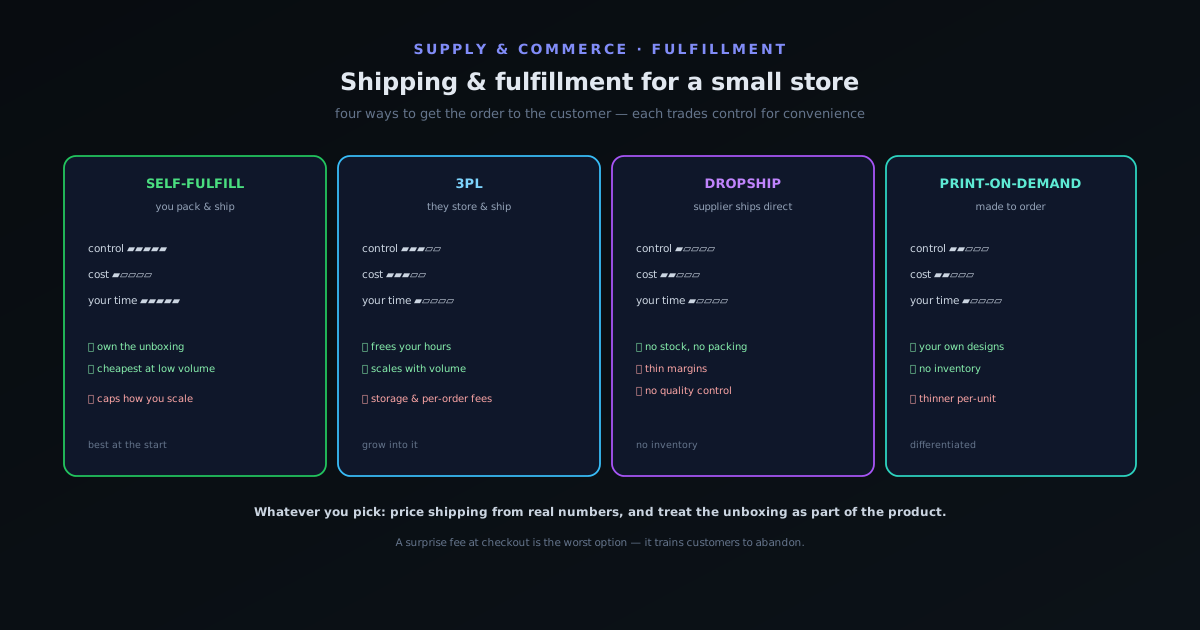
New store owners obsess over the product, the brand, and the marketing, and treat shipping as an afterthought — the boring logistics that happen after the interesting part, the sale, is done. This gets the importance exactly backwards. Shipping and fulfillment are where a surprising amount of a store's economics and reputation actually live: shipping costs quietly eat margins, slow or unreliable delivery generates the bad reviews and refund requests that sink a young store, and the unboxing experience is one of the few physical touchpoints you have to turn a one-time buyer into a repeat one. Treated as an afterthought, fulfillment becomes the thing that undermines everything the product and marketing built. Treated deliberately, it becomes a source of margin, good reviews, and loyalty. This guide explains the options, the pricing, and how to make shipping a strength.
The reason fulfillment is worth real thought up front is that the choices compound. How you fulfill orders determines your costs, your control over quality and speed, how much of your time the work consumes, and how well you can scale when volume grows — and changing fulfillment models later, once you have customers and commitments, is far harder than choosing well at the start. The good news is that the landscape of options is not complicated once laid out: there are a handful of distinct fulfillment models, each with a clear set of trade-offs, and the right one for a given store depends on knowable factors — your volume, your product, your margins, and how much of the work you want to do yourself. The sections below walk the options, then turn to the two things every store must get right regardless of model: pricing shipping, and making delivery part of the product.
Self-fulfillment: you pack and ship
The default starting point for most small stores is self-fulfillment: you hold your own inventory and personally pick, pack, and ship each order. Its advantages are control and cost at low volume. You control everything the customer touches — the product, the packaging, the speed, the little inserts and notes that make an unboxing feel considered — and at low volume you avoid paying a third party's fees, so more of the sale stays as margin. For a store finding its feet, self-fulfillment is often the right choice precisely because it is cheap to start and because doing the packing yourself teaches you exactly what the fulfillment side of your business actually involves before you hand it off.
The cost of self-fulfillment is your time and its ceiling on scale. Packing orders is real, repetitive labor, and as volume grows it consumes more and more of the hours you could spend on product and marketing, until at some point it becomes the bottleneck that caps how much the store can grow without breaking you. It also ties you down — orders have to be packed and shipped on a schedule, which is hard to maintain through travel, illness, or a sudden spike. Self-fulfillment is excellent at the start and at low volume, and it becomes a constraint as you grow, which is exactly why the next option exists: at some point, the time cost of packing every order yourself exceeds the fee to have someone else do it.
Third-party logistics: someone else packs and ships
A third-party logistics provider (3PL) is a company you pay to store your inventory and fulfill your orders: you send them your stock, and when an order comes in, they pick, pack, and ship it for you. The advantage is that fulfillment stops consuming your time and stops being a ceiling on scale — a 3PL can handle volume that would overwhelm you packing by hand, often ships faster and from locations closer to customers, and frees you to spend your hours on the parts of the business only you can do. For a store that has grown past the point where self-fulfillment is sustainable, a 3PL is how you keep growing without drowning in packing.
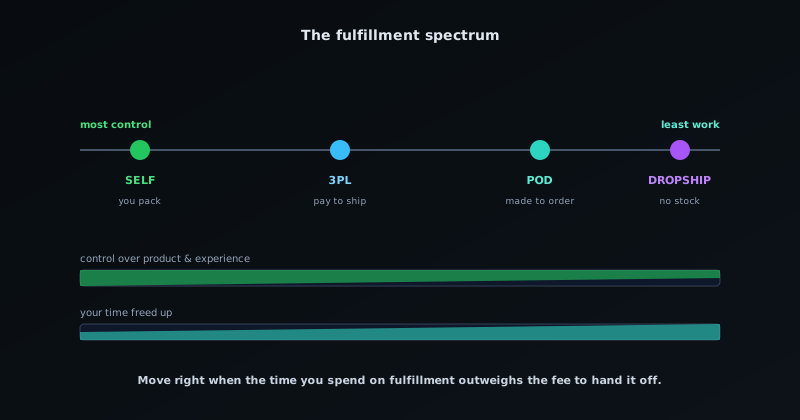
The trade-offs are cost and control. A 3PL charges for storage and for each order it fulfills, so it only makes economic sense once your volume and margins can absorb those fees — which is why it is usually a step you grow into rather than start with. And you hand over direct control of the packing and the unboxing experience, relying on the provider to represent your brand in the box, so a 3PL that packs carelessly or ships slowly becomes a problem you manage at a distance. The decision to move to a 3PL is essentially a calculation: when the time you spend on fulfillment, valued honestly, exceeds what a provider would charge to take it off your hands, and your margins can bear the fee, the switch frees you to grow. Below that point, self-fulfillment usually wins.
No-inventory models: dropshipping and print-on-demand
Two models skip the inventory question entirely by never having you hold stock. In dropshipping, a supplier ships products directly to your customers when they order, so you never touch inventory at all; in print-on-demand, products are made to order when sold, then shipped — your own designs on blank goods, produced one at a time. Both share the appeal of no upfront inventory cost and no packing labor, since the supplier or producer handles the physical side, which makes them attractive ways to start without capital tied up in stock. For some stores they are the whole fulfillment strategy; for others they are a way to test products before committing to inventory.
The cost of the no-inventory models is the same cost in both: you give up control and margin in exchange for not holding stock. You do not control the product quality, the packaging, or the shipping speed, all of which sit with the supplier or producer, and the per-unit economics are thinner because the producer takes their share. These are real trade-offs rather than free lunches, and they are covered honestly for each model in /product-blog/dropshipping-honestly-how-it-works and /product-blog/print-on-demand-as-a-business-model. The point for fulfillment planning is that no-inventory models are a legitimate option with a clear shape — no stock and no packing, paid for with less control and thinner margins — and choosing one is choosing where on the control-versus-convenience spectrum your store sits.
How to price shipping without losing on it
Whatever model you use, you have to decide how the customer pays for shipping, and this is where small stores most often quietly lose money or sales. The core tension is that shipping costs real money, and you can either charge it separately or build it into the product price — and the choice affects both your margin and your conversion. Charging shipping separately keeps the product price low but adds a cost at checkout, where surprise shipping fees are one of the leading causes of abandoned carts; building shipping into the price and offering "free shipping" tends to convert better because customers strongly prefer it, but it means your product price must be high enough to absorb the shipping cost without erasing your margin.
The practical approach most small stores land on is to build shipping into pricing where they can — setting product prices that quietly include the cost so you can offer free shipping — while knowing their true shipping costs precisely enough that the absorbed cost does not eat the margin. That requires actually measuring what it costs you to ship: the postage, the packaging, the handling, by weight and destination, which is part of the real landed cost covered in /product-blog/the-true-cost-of-a-physical-product. The fatal mistake is guessing — offering free shipping without knowing it costs more than your margin, or charging a flat rate that loses money on heavy or distant orders. Price shipping deliberately, from real numbers, and it stops being the leak that turns profitable-looking sales into losses. Whatever you choose, avoid the worst option: a surprise fee revealed at the final step, which trains customers to abandon.
Delivery and unboxing are part of the product
The last shift in thinking is to stop seeing fulfillment as logistics that happen after the sale and start seeing it as part of the product the customer bought. From the customer's side, the experience of buying from you is not over at checkout; it continues through the wait, the arrival, and the opening of the package, and those moments shape their impression as much as the product itself. Slow, untracked, or unreliable delivery sours an otherwise good purchase; fast, communicative delivery — an order confirmation, a shipping notification, tracking, an arrival in a reasonable time — reassures and delights, and reliability here is what generates good reviews and prevents the "where is my order?" messages that consume a small store's time.
The unboxing is the one physical, branded moment you fully own in many sales, and it is disproportionately powerful for a small store competing on experience rather than scale. Thoughtful, sturdy packaging that protects the product and feels considered, perhaps a handwritten note or a small extra, turns the arrival into a moment a customer remembers and shares — the kind of detail that converts a buyer into a repeat customer and an advocate, which is worth far more than its small cost. This is precisely the advantage self-fulfillment preserves and the no-inventory models give up, and it is why control over the box matters. Treating delivery and unboxing as part of the product — as the final, tangible chapter of the experience rather than an afterthought — is what turns fulfillment from a cost center into a reason people come back, which is the whole argument for taking it seriously from the start rather than bolting it on at the end.
Frequently asked questions
Quick answers to common questions about this topic.
What are the main order-fulfillment options for a small store?
Self-fulfillment (you hold stock and pack orders yourself — most control, most time), third-party logistics or 3PL (a company stores your inventory and ships for you — frees time, costs fees), and no-inventory models like dropshipping and print-on-demand (a supplier ships directly — no stock or packing, but less control and thinner margins).
When should I move from packing orders myself to a 3PL?
Roughly when the time you spend on fulfillment, valued honestly, exceeds what a 3PL would charge to do it — and your volume and margins can absorb the storage and per-order fees. Below that point self-fulfillment is cheaper and keeps you in control; above it, a 3PL lets you keep growing without drowning in packing.
Should I charge for shipping or offer free shipping?
Free shipping usually converts better because customers prefer it and surprise fees at checkout cause abandoned carts — but it only works if your product price quietly absorbs the real shipping cost without erasing your margin. Measure your true shipping costs by weight and destination first; the worst option is a surprise fee revealed at the final step.
Does packaging really matter for a small store?
Yes. Delivery and unboxing are part of the product from the customer's side — reliable, communicative shipping prevents bad reviews and "where is my order?" messages, and a considered unboxing is one of the few branded physical moments you own. It is a high-leverage way a small store turns one-time buyers into repeat customers.