2026 · Novus SupplyAbout 12 min readNovus Stream Solutions
Omni-channel retail operations for a solo seller
Selling across more than one channel multiplies the operational surface — listings, inventory, fulfillment, and expectations all have to stay consistent. Here is how a solo seller can run omni-channel retail without it becoming chaos, from the commerce side of the ecosystem.
Overview
Selling on one channel is a manageable job. Selling on several at once is a different animal, because every channel you add multiplies the operational surface — another set of listings to keep accurate, another view of inventory to keep in sync, another set of customer expectations to meet, another place a mistake can surface. For a solo seller, where there is no operations team to absorb that multiplication, omni-channel retail can tip from opportunity into chaos fast. This note is about keeping it coherent when you are the whole team.
The goal is not to avoid multiple channels — meeting buyers where they already are is genuinely valuable — but to run them in a way that scales down to one person. That requires deliberately fighting the natural tendency of each channel to drift into its own little silo with its own slightly-wrong version of the truth.
The real cost of every extra channel
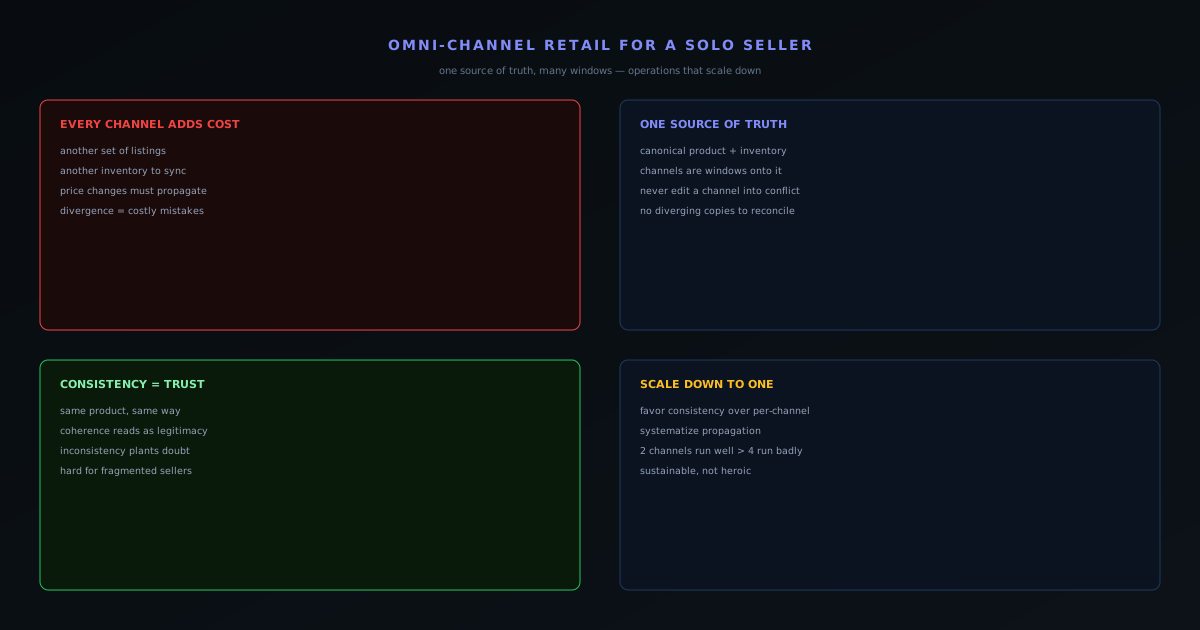
Each channel does not just add sales; it adds maintenance. A price change has to propagate everywhere. A product that sells out on one channel has to stop being sold on the others before you oversell stock you do not have. A description fixed in one place is still wrong everywhere you did not update. Left unmanaged, the channels diverge, and divergence is where the costly mistakes live — overselling, mispricing, and contradictory information that erodes the trust you are trying to build.
Recognizing this upfront is what separates sane omni-channel operations from a slow-motion mess. The channels are not free to add; each one is a standing commitment to keep something consistent. Budget for that maintenance honestly, or the channel you added to grow sales becomes the channel that generates errors.
One source of truth, many windows
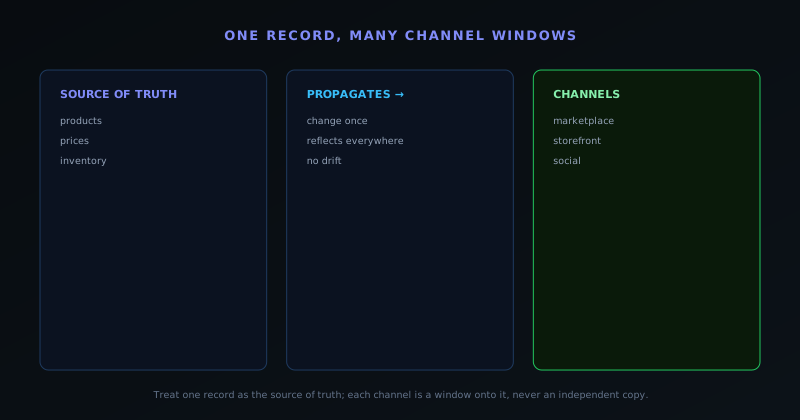
The single most stabilizing practice is to treat one place as the source of truth for products, prices, and inventory, and to regard each channel as a window onto that truth rather than an independent system. When something changes, it changes in the source of truth and propagates outward, so the channels cannot drift into mutually contradictory states. The discipline is to never edit a channel directly in a way that makes it disagree with the source — every change starts from the canonical record.
This is the same instinct that good engineering applies to data: avoid multiple diverging copies of the thing that has to be correct. A solo seller cannot afford to reconcile four slightly-different inventory counts by hand. One authoritative count, reflected everywhere, removes an entire category of errors before it can happen.
Consistency is a trust signal
Beyond preventing errors, consistency across channels is something customers feel. A buyer who sees the same product presented the same way, with the same information and the same quality of imagery, whether they find you on a marketplace or your own storefront, experiences a coherent brand — and coherence reads as legitimacy. Inconsistency does the opposite: a product that looks one way here and another way there, or whose details disagree between channels, plants a small seed of doubt about whether the seller has it together.
For a solo operation, that coherence is a competitive edge precisely because it is hard for fragmented sellers to maintain. The same clean, consistent imagery and accurate listings that lift conversion on one channel compound across all of them when they are kept in sync. Presenting one consistent face everywhere is brand-building that costs only discipline.
Why "meet buyers where they are" is still right
Before cataloguing the costs of multiple channels, it is worth affirming why a solo seller takes them on at all, because the difficulty is a reason to manage omni-channel well, not to avoid it. Buyers have their own habits and preferred places to shop — a marketplace they trust, a social platform they browse, a storefront they found through search — and meeting them where they already are removes friction from the sale. Forcing every customer to your single channel of choice means losing the ones who would have bought on a channel you do not serve. Multiple channels expand the surface where a sale can happen, which is genuinely valuable for a small operation trying to grow.
So the goal is not to retreat to one channel for simplicity's sake but to run several in a way that scales down to one person. The value of being present on more channels is real; the challenge is doing it without the operational surface multiplying into chaos. That tension — more reach versus more maintenance — is the actual problem omni-channel operations have to solve, and solving it well is what lets a small seller capture the reach benefit without drowning in the coordination cost. The rest of the discipline is about making multi-channel presence sustainable for a team of one rather than about deciding whether to attempt it.
Drift is the specific enemy
It helps to name the precise failure mode that turns multi-channel selling from opportunity into liability: drift. Each channel, left to itself, accumulates its own slightly-different version of the truth — a price updated here but not there, a description fixed on one channel and stale on another, an inventory count that no longer matches reality across listings. Drift is gradual and quiet, which is what makes it dangerous; no single moment feels like a mistake, but the cumulative divergence produces the costly errors of overselling stock you do not have, contradicting yourself across channels, and presenting customers with inconsistent information that erodes trust.
Understanding that drift is the enemy clarifies what the operational discipline has to prevent. The goal is not to do more work per channel but to stop the channels from diverging in the first place, because it is the divergence, not the multiplicity, that generates the expensive mistakes. A seller who keeps their channels in sync can run several with relatively little pain; a seller who lets them drift will spend increasing time firefighting contradictions and reconciling mismatched states. The whole point of a source-of-truth approach is to attack drift at its root rather than to keep patching its symptoms channel by channel, which is a losing game at any scale and an impossible one solo.
The source of truth, in practice
The single most stabilizing practice is to designate one place as the authoritative record of products, prices, and inventory, and to treat every channel as a window onto that record rather than as an independent system with its own editable state. When something changes, it changes in the source of truth and propagates outward, so the channels cannot drift into mutually contradictory states because none of them is the original — they are all reflections of one canonical record. The discipline is to never edit a channel directly in a way that makes it disagree with the source; every change starts from the authoritative record and flows out.
In practice this is a habit as much as a system: resist the temptation to make a quick fix directly on a marketplace listing, and instead make the change in your source of truth and let it propagate. The habit is what prevents the slow accumulation of channel-specific edits that, individually reasonable, collectively produce drift. For a solo seller especially, where there is no one else to catch a divergence, the rule "one place is authoritative, everything else reflects it" is the difference between channels that stay coherent on their own and channels that require constant manual reconciliation. The source of truth is not just a data structure; it is a working discipline about where changes are allowed to originate.
Borrowing a principle from engineering
The source-of-truth approach is the same instinct that good software engineering applies to data, and the parallel is instructive: avoid keeping multiple diverging copies of the thing that has to be correct, because reconciling copies by hand is error-prone and does not scale. In code, you keep one authoritative representation and derive views from it rather than maintaining several independent copies that can disagree; in retail operations, you keep one authoritative record of inventory and price and let each channel be a derived view. The problem is identical — multiple mutable copies of critical state drift apart — and so is the solution.
Borrowing the principle is natural here because the ecosystem's software side runs on exactly this discipline, and the commerce side benefits from the same thinking. A solo seller cannot afford to reconcile four slightly-different inventory counts by hand any more than a developer can afford to manually sync four copies of a critical value; in both cases, one authoritative source reflected everywhere removes an entire class of errors before it can occur. Treating retail data with the same rigor a developer treats application state — one canonical record, many derived views — is what lets a small operation run multiple channels without the coordination overhead growing faster than the seller can handle.
Consistency as a customer-facing trust signal
Keeping channels in sync is not only an internal error-prevention measure; the resulting consistency is something customers perceive and respond to. A buyer who encounters the same product, presented the same way, with the same information and the same quality of imagery whether they find you on a marketplace or your own storefront, experiences a coherent brand — and coherence reads as legitimacy. The seller who has it together across channels looks more trustworthy than one whose presence is fragmented and contradictory, and that perceived trustworthiness directly affects whether a hesitant buyer commits.
For a small operation, this coherence is a competitive edge precisely because it is hard for fragmented sellers to maintain and therefore relatively rare. The same clean, consistent imagery and accurate listings that lift conversion on one channel compound across all of them when kept in sync, so the discipline of synchronization pays off twice: once in fewer internal errors, and once in a more credible customer-facing presence. Presenting one consistent face everywhere is brand-building that costs only the discipline of keeping the channels aligned, which is exactly the kind of low-cost, high-return work a small operation should prioritize. Consistency is simultaneously an operations practice and a marketing one.
Be honest about how many channels you can run
A piece of discipline that is easy to skip is being honest about capacity: it is better to run two channels well than four channels badly, and a solo seller has to make that call realistically rather than aspirationally. Each channel added is a standing commitment to keep something consistent, and there is a real limit to how many such commitments one person can honor before the channels start to drift despite their best intentions. Adding a channel you cannot actually keep in sync does not expand your reach so much as it expands your error surface, which can cost more in mistakes and damaged trust than the additional channel earns.
The honest approach is to add channels deliberately, confirming you can keep each one coherent before taking on the next, rather than spreading across every available platform because more seems better. Sometimes the right answer is fewer channels run impeccably, presenting a consistent, reliable face on each, rather than a sprawling presence that is contradictory and error-prone. This is the same keep-it-sustainable judgment the software side applies when deciding what to build and maintain — capacity is finite, and pretending otherwise produces a mess. Matching the number of channels to the reality of a one-person operation is not a limitation to apologize for; it is what keeps the multi-channel presence an asset rather than a liability.
Forecasting demand across several channels
Running multiple channels complicates not just listings but forecasting, because demand now arrives from several places at once and has to be anticipated in aggregate to avoid stockouts or overstock. A product that is steady on one channel might spike on another due to a different audience or a platform-specific moment, and a seller looking at only one channel's signal will be repeatedly surprised. Treating inventory as a single pool drawn down by all channels together — which the source-of-truth approach already encourages — is what lets a seller forecast against total demand rather than being blindsided by the sum of several partial views.
This is where the operations discipline connects to the seasonal-forecasting side of running a small commerce operation. Anticipating demand without overcommitting capital to inventory is hard enough with one channel; across several, it requires seeing the combined signal clearly, which again comes back to having one authoritative view of stock and movement rather than reconciling fragmented per-channel numbers. The payoff of synchronization is not only fewer listing errors but better forecasting, because a unified picture of demand is far easier to project from than a scatter of channel-specific snapshots. Keeping the data coherent is what makes the harder analytical work of forecasting tractable for a solo operator.
Where automation earns its place
A solo seller's time is the binding constraint, so the operational goal is to automate or systematize the propagation of changes wherever possible, reserving human attention for the decisions that actually require judgment. Pushing a price change or an inventory update out to every channel is mechanical work that should not consume a person's day; deciding what to sell, how to price it, and how to present it is judgment work that should. The more the mechanical propagation can be systematized — so a change made once in the source of truth flows to the channels with minimal manual effort — the more of the seller's finite time is freed for the work that genuinely needs them.
This mirrors the same instinct the software side of the ecosystem applies to its own operations: automate the repetitive, reserve human effort for the non-obvious, and keep the system lean enough for a small team to run sustainably. On the commerce side it means favoring approaches and tools that reduce per-channel manual maintenance, even at some upfront setup cost, because the recurring time savings compound. An operation that has automated its propagation can add a channel with far less marginal overhead than one doing everything by hand, which directly raises the ceiling on how many channels one person can coherently run. Automation is not a luxury here; it is what makes the multi-channel ambition survivable for a team of one.
Operations that scale down to one person
The throughline is building operations that fit the actual team, which is you. That means favoring consistency over per-channel optimization, automating or systematizing the propagation of changes wherever possible, and being honest about how many channels you can genuinely keep coherent — sometimes two channels run well beat four run badly. The aim is an operation that one attentive person can keep correct, not one that requires heroics to stop from drifting into error.
This mirrors the software side of the ecosystem, where the discipline is to keep systems lean enough for a small team to run sustainably. On the commerce side it is the same logic: omni-channel done right is not about maximum reach at any cost, but about coherent reach you can actually sustain. The conversion post covers turning that consistent presentation into sales, and the forecasting post covers keeping the channels stocked without overcommitting.