Novus Supply
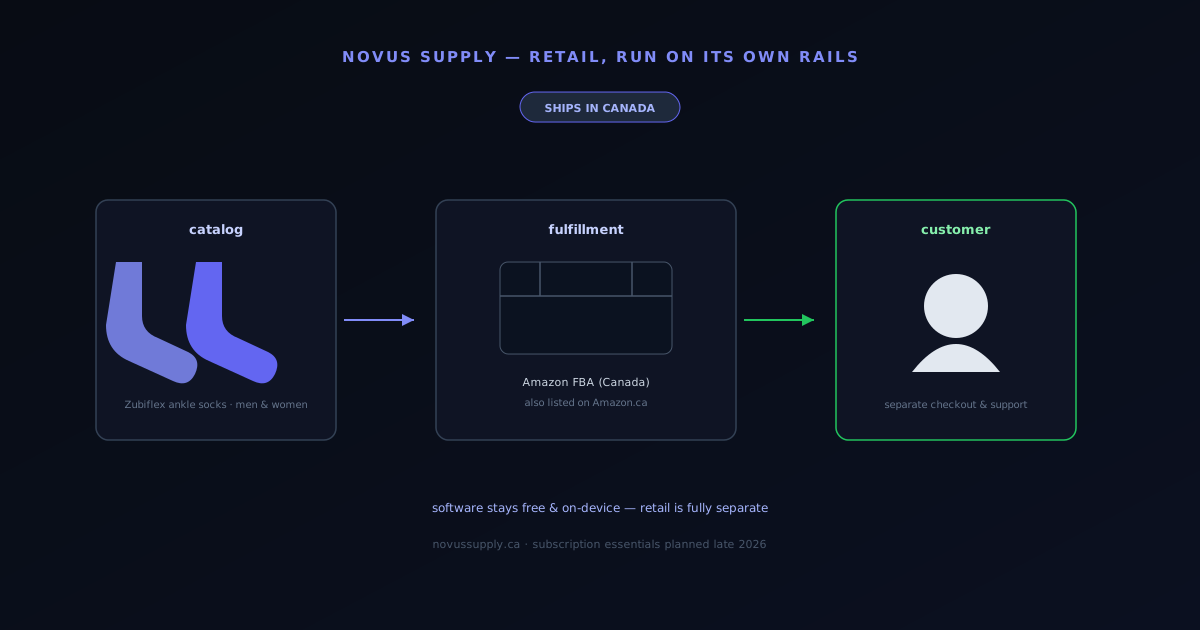
Novus Supply is the physical retail division of Novus Stream Solutions—focused on practical goods, dependable fulfillment, and storefront experiences that stand apart from our software products. The primary storefront is novussupply.ca, with marketplace distribution including Amazon FBA where that channel strengthens discovery and logistics. A flagship consumer line is Zubiflex ankle socks, live and selling into the Canadian market with product positioning around everyday comfort and durability. This documentation page explains how Supply relates to novusstreamsolutions.com, why checkout and support are intentionally separate from software billing, and how operators should think about omni-channel inventory, brand promises, and customer trust. Read it end-to-end once for orientation, then keep it as a reference when you change channels, suppliers, or policies so the whole team shares the same operational vocabulary.
Contents
- 1.Positioning: retail versus digital products
- 2.novussupply.ca as the owned storefront
- 3.Amazon FBA and marketplace distribution
- 4.Zubiflex ankle socks and the Canadian market
- 5.Omni-channel inventory and demand planning
- 6.Customer support, returns, and reputation
- 7.Brand, packaging, and unboxing experience
- 8.Pricing, promotions, and margin discipline
- 9.Compliance, labeling, and product safety
- 10.Logistics partners and business continuity
- 11.Retail analytics that tie to decisions
- 12.Marketing and cross-channel operations
- 13.Sustainability narratives and proof points
- 14.Wholesale, corporate gifts, and B2B experiments
- 15.Crisis communications for product issues
- 16.Roadmap hygiene for retail SKUs
- 17.Product photography, sizing charts, and PDP completeness
- 18.SEO, structured data, and organic discovery on novussupply.ca
- 19.Reviews, social proof, and authentic user stories
- 20.Payments, fraud signals, and chargebacks
- 21.Inventory accounting and COGS discipline
- 22.Carrier selection, shipping promises, and Canadian geography
- 23.Product development: materials, wear-testing, and supplier QA
- 24.Retail partnerships, pop-ups, and local experiments
- 25.Email list building at retail checkout
- 26.Competitive positioning without trash-talk
- 27.Warehousing, 3PL handoffs, and unit economics
- 28.Insurance, loss, and shrinkage planning
- 29.Paid acquisition, retail media, and incrementality tests
- 30.Customer lifetime value and repeat purchase programs
- 31.Knit construction, fiber blends, and technical claims
- 32.International expansion beyond Canada
- 33.Packaging engineering, cube utilization, and freight
- 34.Post-purchase education, care, and loyalty loops
- 35.Where to go next
Positioning: retail versus digital products
Novus Stream Solutions operates as an app testing lab with multiple surfaces: software such as Novus Visualizers, content on novusstreamsolutions.com, and retail through Novus Supply. Customers benefit when boundaries are obvious—retail receipts, return windows, and carrier tracking should not be confused with software invoices or app subscription renewals.
The FAQ on the hub states the rule plainly: Novus Supply checkout is not the same as software checkout. That is a feature, not a limitation. It keeps tax treatment, chargeback handling, and customer support routing cleaner for both sides of the house.
novussupply.ca as the owned storefront
An owned domain lets Novus Supply tell a coherent product story without the layout constraints and policy overlays of marketplaces alone. You can publish fit guidance, care instructions, bundles, and editorial content that would be awkward inside a marketplace tile. Owned sites also capture first-party relationships when you invite email signups—without forcing every purchase intent through a third-party inbox.
Storefront operations still require rigor: performance budgets for mobile shoppers, accessible color and typography, honest shipping estimates, and clear contact paths when something goes wrong. Treat the site as a product with releases, not a brochure that ships once.
Amazon FBA and marketplace distribution
Fulfillment by Amazon can expand reach dramatically because many shoppers begin product discovery on marketplaces. FBA also shifts parts of logistics and returns processing into standardized rails, which can be advantageous for small teams if margins and fee structures are modeled honestly.
Marketplace success is not only listing quality—it is review integrity, inventory depth, advertising discipline, and staying responsive to policy changes. Maintain parity between marketplace copy and owned-site copy so promises about materials, sizing, and packaging do not drift.
- Monitor inventory across FBA and owned warehouse stock to avoid split shipments that confuse customers.
- Keep SKU naming legible for humans who pick and pack during promotions.
- Document how you handle commingled inventory risks if applicable to your account setup.
Zubiflex ankle socks and the Canadian market
Zubiflex ankle socks represent a concrete consumer bet: everyday essentials with clear utility, sized and marketed for real wear patterns rather than novelty. Selling into Canada implies thoughtful attention to bilingual labeling where required, duties transparency for cross-border shoppers if applicable, cold-weather footwear pairings in marketing, and realistic delivery timelines across provinces.
Product pages should answer boring questions well: fiber content, care instructions, fit notes for common shoe sizes, and what pain points the sock addresses—slipping, overheating, or abrasion. Boring answers reduce returns and support tickets.
Community proof matters for apparel: user-generated photos, honest reviews, and guidance on how socks perform after multiple washes. Authenticity beats superlatives.
Omni-channel inventory and demand planning
Omni-channel means customers may discover on Amazon, research on novussupply.ca, and ask questions via email or support chat. Inventory signals must reconcile so you do not advertise stock you cannot fulfill. Start with a single source of truth for available units and propagate cautiously to channels with different sync cadences.
Seasonal demand for socks and basics still spikes around holidays and back-to-school windows even if the category is evergreen. Build modest forecasts with explicit uncertainty bands rather than single-point optimism.
Customer support, returns, and reputation
Retail trust is won in support moments: a lost package, a mismatched size, or a manufacturing defect. Publish clear return windows and who pays return shipping under which conditions. Train support staff with scripts that acknowledge frustration first, then explain facts.
Track recurring complaints as product signals, not noise. If a seam fails disproportionately on one batch, escalate to supplier quality review.
Brand, packaging, and unboxing experience
Packaging is a silent marketing channel. Minimal, recyclable packaging can reinforce a quality brand if executed cleanly; flimsy packaging signals indifference. Document pack-out SOPs so contract fulfillment matches in-house quality.
Include a simple card linking to care instructions and novussupply.ca so repurchase paths are obvious.
Pricing, promotions, and margin discipline
Promotions drive volume but erode margin if run reflexively. Model fully loaded costs—COGS, marketplace fees, advertising, returns, and payment processing—before approving discounts. Prefer targeted promos to loyal subscribers rather than site-wide race-to-the-bottom sales unless inventory strategy demands liquidation.
Compliance, labeling, and product safety
Textile labeling rules vary by jurisdiction. Maintain a compliance matrix keyed by ship-to country: fiber percentages, country of origin, and care symbols. When in doubt, engage counsel before launch rather than after a regulator or marketplace flags a listing.
Logistics partners and business continuity
Single-supplier dependence is risky. Evaluate backup manufacturers with documented qualification steps, not verbal assurances. For logistics, map what happens if a carrier strikes, a port delays, or a fulfillment center has an outage. Business continuity does not need to be a hundred-page binder; it needs actionable triggers and owners.
Retail analytics that tie to decisions
Track contribution margin after ads, not only top-line revenue. Segment performance by channel, cohort, and SKU so you can retire weak variants without drama. Pair quantitative metrics with qualitative signals: reviews, support themes, and fit feedback from community channels.
Marketing and cross-channel operations
Marketing orchestration crosses channels: announce a restock via email or social, link to novussupply.ca for purchase. Keep responsibilities aligned—retail support answers sizing and shipping questions, software support answers product and billing questions. Cross-training is helpful for small teams, but tickets should still route to the correct domain to preserve SLA clarity.
Sustainability narratives and proof points
If you claim sustainability benefits—material sourcing, reduced packaging, or carbon offsets—keep evidence contemporaneous. Greenwashing backlash is expensive. Prefer specific, verifiable statements over vague superlatives.
Wholesale, corporate gifts, and B2B experiments
Basics like socks can suit corporate gifting or small wholesale accounts. If you explore B2B, separate invoicing, tax handling, and fulfillment SLAs from consumer defaults. Document MOQs and lead times transparently.
Crisis communications for product issues
If a batch defect reaches customers, prepare a holding statement, a factual root-cause summary, and remediation steps including refunds or replacements. Speed plus honesty beats silence. Coordinate retail messaging with hub communications if the issue is large enough to affect brand-wide trust.
Roadmap hygiene for retail SKUs
Maintain a lightweight SKU roadmap: core evergreen lines, seasonal experiments, and end-of-life plans. Retire SKUs cleanly—clearance strategy, leftover inventory disposition, and URL redirects so bookmarks do not 404 without guidance.
Product photography, sizing charts, and PDP completeness
Apparel conversion lives in the product detail page. Invest in consistent lighting, true color representation, and on-foot or in-use shots that answer obvious questions without prose. Sizing charts should state how measurements were taken, whether socks are unisex, and how shrinkage behaves after washing.
Update PDPs when suppliers change yarn or construction—even small material swaps can change stretch and fit enough to alter reviews.
SEO, structured data, and organic discovery on novussupply.ca
Organic traffic rewards clarity: descriptive titles, human-readable URLs, and structured data where appropriate for products. Avoid keyword stuffing; search engines and humans both punish it. Write meta descriptions as ad copy that matches the page so bounce rates stay healthy.
Internal linking should connect related basics—liner socks versus crew, athletic versus dress use cases—so crawlers understand topical clusters.
Payments, fraud signals, and chargebacks
Monitor for fraud patterns—velocity limits on high-risk regions if your processor recommends them, AVS mismatches, and reshipping scams. Chargebacks hurt more than the single order; they can threaten processor relationships. Maintain evidence packets: tracking IDs, delivery confirmations, and customer communications.
Inventory accounting and COGS discipline
Tie inventory movements to accounting periods. Shrinkage, promotional giveaways, and sample units should be categorized explicitly so margins reflect reality. Periodic cycle counts catch drift before it becomes a year-end surprise.
Carrier selection, shipping promises, and Canadian geography
Canada spans vast distances with uneven carrier performance by region. Set delivery expectations conservatively and explain when remote surcharges apply. During winter storms, proactive banners about delays reduce angry tickets.
Offer tracking links that work on mobile and consider SMS notifications if your stack supports them responsibly.
Product development: materials, wear-testing, and supplier QA
Before scaling a new sock construction, run structured wear tests across shoe types and activities. Log pilling, elastic degradation, and odor control after repeated washes. Supplier QA should include inline inspections for critical batches, not only final audits.
Retail partnerships, pop-ups, and local experiments
Physical pop-ups or local retail partnerships can validate merchandising hypotheses. Keep agreements explicit about who handles tax, who staffs the booth, and how inventory transfers are recorded. Even short experiments deserve a retro: revenue per hour, sell-through, and qualitative shopper questions.
Email list building at retail checkout
If you invite email capture at checkout, use clear consent language so subscribers know what they receive. Avoid pre-checked boxes where law forbids them. Treat retail subscribers as a distinct segment until they engage broadly with software content.
Competitive positioning without trash-talk
Explain differentiation with facts—construction, materials, warranty—rather than attacking named competitors. Comparative charts help when truthful; vague superiority claims hurt credibility.
Warehousing, 3PL handoffs, and unit economics
If you blend in-house fulfillment with third-party logistics, define cutoffs for which SKUs live where and how transfers are recorded. Ambiguous ownership of inventory leads to oversells and angry customers. Model pick-and-pack fees as part of unit economics so apparently healthy gross margins do not collapse after operational true-up.
Barcode discipline matters at scale: scan-in and scan-out events should reconcile nightly. Small scanning errors multiply into large trust failures when wrong socks ship repeatedly.
Insurance, loss, and shrinkage planning
Evaluate cargo and inventory insurance relative to stock concentration and carrier routes. Document claims processes before you need them. Shrinkage includes theft, damage, and administrative mistakes—budget for all three rather than pretending only theft exists.
Paid acquisition, retail media, and incrementality tests
Marketplace ads can drive volume but may cannibalize organic sales if not measured. Run disciplined incrementality tests where budget and targeting shifts are time-boxed and read against holdout regions or SKUs when feasible.
On novussupply.ca, pair paid traffic with strong landing pages—fast mobile load, clear value prop above the fold, and visible trust signals like return policy and contact options.
Customer lifetime value and repeat purchase programs
Basics reward repeat purchase programs when quality holds: bundle offers, subscribe-and-save where operationally viable, and gentle reminders when replenishment timing aligns with observed purchase cadence. Avoid creepy precision; approximate windows respect privacy while still helping customers restock.
Knit construction, fiber blends, and technical claims
If you publish technical claims—moisture wicking, compression zones, antimicrobial treatments—tie each claim to test methods or supplier specifications you can produce on request. Regulators and savvy customers increasingly ask for receipts, not vibes.
Educate customer support on fiber behavior so they can explain why a wool blend feels different from all-synthetic athletic blends without dismissive tone.
International expansion beyond Canada
When you expand shipping regions, revisit duties, harmonized tariff codes, return logistics cost, and customer service hours. Pilot with a small SKU set before opening the entire catalog to avoid operational whiplash.
Packaging engineering, cube utilization, and freight
Carton sizes influence both freight cost and damage rates. Oversized boxes invite product movement; undersized boxes crush delicate knits. Run drop tests when you change suppliers or carton specs, and photograph failures for supplier corrective action.
Cube utilization in outbound pallets affects LTL and FTL economics. Operations and finance should review dimensional weight charges together so pricing strategy reflects reality, not spreadsheet hope.
Post-purchase education, care, and loyalty loops
The sale is not the finish line—it is the start of a relationship that can generate referrals and repeat orders if the product performs. Follow-up emails or inserts can explain wash care, rotation between pairs to extend life, and when to expect subtle pilling as fibers settle.
Loyalty does not require a points program; clarity, consistency, and fast resolution of the occasional defect often matter more. Track repeat purchase intervals for basics and time replenishment nudges accordingly.
When customers ask nuanced fit questions in email or social threads, capture anonymized FAQs back into PDP copy so the next shopper gets the answer without waiting for a human reply.
Where to go next
Shop the current catalog at https://novussupply.ca. For how retail sits next to software in the broader portfolio, read Portfolio and Ventures. For the software side of the portfolio, see Novus Visualizers for product-specific documentation.
Frequently asked questions
Quick answers to common questions about this topic.
Is Novus Supply the same checkout as the Novus software products?
No. Novus Supply is a separate retail storefront at https://novussupply.ca on retail rails. The software tools are free and are not fulfilled through the retail site, and Supply orders are not processed by the software side — checkout, shipping, and returns for physical goods are handled entirely on the storefront or the relevant marketplace.
What does Novus Supply sell?
Everyday essentials, with a flagship line of Zubiflex ankle socks sold into the Canadian market. Select items are also listed on Amazon via FBA where that channel improves discovery and logistics.
Where do I get help with a Supply order?
Order, shipping, and return questions are handled on the storefront where you purchased (novussupply.ca or the marketplace listing). Software support cannot look up a retail order, so contacting the retail channel first is the fastest route to resolution.
Does Novus Supply ship outside Canada?
The primary market is Canada. International shipping is expanded cautiously — duties, tariff codes, and return logistics are revisited before opening new regions — so check the current shipping options at https://novussupply.ca for where the catalog ships today.