2026 · Novus Stream Solutions (hub)About 15 min readNovus Stream Solutions
Local SEO and your Google Business Profile, explained
Local search runs on its own logic: a map block, a three-result pack, and ranking signals that have little to do with classic on-page SEO. This guide explains proximity, relevance, and prominence, then walks through a concrete Google Business Profile playbook for a small operator.
Contents
- 1.Overview
- 2.The local pack is a separate result, not a better ranking
- 3.Proximity, relevance, prominence: the three ingredients
- 4.Claim and fully complete the profile, then keep completing it
- 5.Why your primary category is one of the biggest levers
- 6.Reviews: the engine of local prominence
- 7.NAP consistency and citations across the web
- 8.Honest local landing pages, not doorway-page spam
- 9.Online and service-area businesses without a storefront
- 10.When local SEO is not worth it
- 11.Tying local into your wider content and links
Overview
Most advice about ranking on Google quietly assumes you want to win a global query. Write the better page, earn the better links, match the search intent, and over time you climb. That model is mostly true for ordinary organic results, and it is the model almost every SEO article teaches. The trouble is that a large share of commercial searches never resolve in that arena at all. When someone types a service plus a place, or just a service while carrying a phone that knows where they are standing, Google quietly switches games. It stops asking which page on the open web is best and starts asking which nearby business is the right one to put in front of this person, right now. That second game has its own board, its own pieces, and its own scoring, and a small operator who treats it like regular SEO will spend months optimizing for a contest that is not being held.
This post is about that second game. We will look at what the local pack actually is, the three ingredients Google leans on to fill it, and then a concrete playbook centered on your Google Business Profile, the single most important asset in local search and one that has almost nothing to do with your website. We will also be honest about the cases where none of this matters to you, because a purely national online brand can pour effort into local signals and get nothing back. The goal is not to make you obsessed with maps. It is to help you decide, calmly, whether local intent is part of your demand, and if it is, to give you a sequence of moves that compounds rather than a checklist you do once and forget.
The local pack is a separate result, not a better ranking
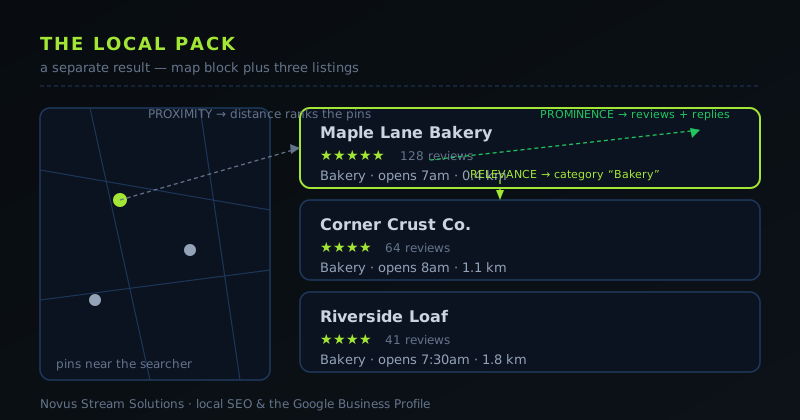
When a search carries local intent, Google often inserts a distinct block near the top of the page: a small map with pins and, beneath it, usually three business listings showing a name, a star rating, a category, and a few details like hours or a phone number. This is the local pack, sometimes called the map pack or the three-pack. It sits above most of the blue links, and for a lot of queries it is where the clicks actually go. The crucial thing to understand is that the pack is not your normal organic listing climbing higher. It is a separate surface, fed by a separate index of business profiles, ranked by a separate set of signals. Your beautifully optimized homepage can be invisible in the pack while a competitor with a thin website but a complete, well-reviewed profile owns all three slots.
This separation is why a small business owner can feel like their SEO work is failing when it is simply pointed at the wrong target. You can rank tenth on the regular results and still appear first in the pack, or rank first organically and never enter the pack at all. The two systems overlap a little, since a strong website lends prominence to a profile, but they are distinct enough that you have to work them as two jobs. The local pack is fed primarily by your Google Business Profile and the reputation signals attached to it. So before you touch a single page on your site, the first question is whether your profile exists, is verified, and is genuinely complete, because that profile is your entry ticket to a result your website cannot reach on its own.
Proximity, relevance, prominence: the three ingredients
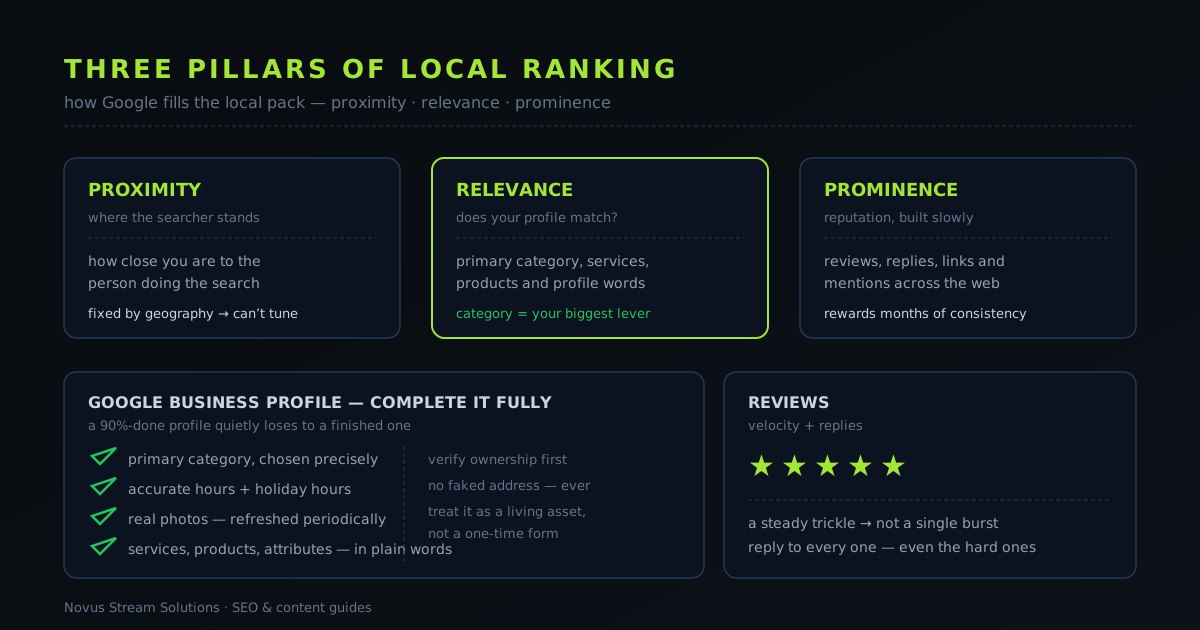
Google has been unusually plain about what feeds local ranking. It names three factors, and almost everything tactical sits underneath one of them. The first is proximity: how close the business is to the searcher, or to the location implied by the query. This is the factor you cannot optimize directly, and it is the one that humbles a lot of strategies. If someone is searching from across town, a closer competitor may simply win the pack for that person no matter how good your profile is. Proximity means there is no single ranking; there is a different pack for every point on the map. The second is relevance: how well your profile matches what the person actually asked for. This is driven heavily by your primary category, the services and products you list, and the words in your profile, which is why category choice turns out to be one of the largest levers you control.
The third is prominence: how well known and well regarded the business is, both offline and online. This is where reviews, their recency, your responses to them, links to your site, mentions across the web, and your broader web presence all feed in. Prominence is the slow-cooking ingredient, the one that rewards consistency over months, and it is the closest thing local search has to traditional authority. The practical takeaway is that you spend your energy on relevance and prominence, because proximity is mostly fixed by geography and the searcher's position. A complete, accurately categorized profile handles relevance. A steady stream of genuine reviews, thoughtful replies, and a credible web presence handles prominence. Get those two right and you will rank as high as your location physically allows, which is all any local business can ask for.
Claim and fully complete the profile, then keep completing it
The work begins at the official Google Business Profile front door, where you search for your business, claim it if it already exists, or create it, and then verify ownership. Verification can take a few days and sometimes asks for a postcard, a video, or a phone call, and there is no shortcut worth the risk; a profile that gets suspended for a faked address is far worse than no profile. Once verified, the temptation is to fill in the obvious fields and stop. Resist it. Completeness is itself a ranking and conversion signal, and a profile that is ninety percent done quietly loses to one that is fully done. Google rewards the platform with engagement, and a thin profile gives searchers fewer reasons to tap through, so the gaps cost you twice.
Treat the profile as a living asset rather than a one-time form. The pieces that matter most are concrete, and it is worth listing them so nothing slips.
- Primary category, chosen precisely, plus any honest secondary categories that genuinely describe what you do.
- Accurate hours, including special hours for holidays, so you never show as open when you are closed.
- A real service area or address, depending on whether customers come to you or you go to them.
- A genuine set of photos: exterior, interior, team, and the actual work or products, refreshed periodically.
- The services and products you offer, written in the plain language people search with, not internal jargon.
- Relevant attributes, such as accessibility, payment options, or whether you offer free quotes, filled in honestly.
Why your primary category is one of the biggest levers
Of every field on the profile, the primary category does the most quiet heavy lifting. It tells Google, in the platform's own taxonomy, what kind of business you fundamentally are, and it shapes which searches you are even eligible to appear for. A bakery that lists its primary category as bakery competes for bakery searches; the same shop listed as restaurant competes in a different, often more crowded race and may miss the very queries that fit it best. The category is not a keyword you stuff; it is a single, decisive declaration, and choosing the most specific accurate option usually beats a broader one. If you can be a wedding photographer rather than just a photographer, and that is truly your core, the more specific category aligns you with higher-intent searches and fewer mismatched ones.
The honest caveat is that you should never pick a category because it looks more lucrative. Listing services you do not actually provide, or a category that overstates what you do, invites mismatched visitors who bounce, poor reviews, and the kind of profile churn that erodes trust over time. Secondary categories give you room to reflect a genuinely multi-faceted business without distorting the primary signal, so use them for the real edges of what you do rather than aspirations. Spend real time here once, test it against the exact phrases your customers use, and revisit it only when your business genuinely changes. A precise category quietly improves relevance for every query you should win, and no amount of clever description text makes up for getting it wrong.
Reviews: the engine of local prominence
If proximity is fixed and relevance is mostly set once you finish the profile, reviews are where ongoing prominence is won or lost. They influence ranking, but more importantly they decide whether someone who sees you in the pack actually chooses you. The number matters, the average rating matters, and so does something many owners overlook: velocity, the steady arrival of fresh reviews over time. A business with two hundred reviews none of which arrived in the last year looks neglected next to one gaining a handful every month. The goal is a calm, continuous trickle, not a single burst, and certainly not a paid pile of fakes that Google is increasingly good at detecting and that can get a profile penalized. Earning reviews ethically simply means asking happy customers, at the natural moment, in a way that is easy to act on.
The mechanics are unglamorous and they work. Finish a job, deliver an order, resolve a question well, and then ask, in person or with a short follow-up message that links straight to the review form. Never gate the request on a positive experience, never offer payment or discounts in exchange for a review, and never review yourself or lean on staff to, because all of those violate the rules and the eventual cleanup hurts. Just as important is the reply: respond to every review, the warm ones and the critical ones, briefly and like a human. A thoughtful reply to a hard review reassures the next reader far more than a wall of perfect fives, and it signals to Google that the profile is actively tended. Over months, this loop of genuine reviews and genuine replies is the single most durable prominence signal a small operator can build.
NAP consistency and citations across the web
NAP stands for Name, Address, and Phone number, and the rule is almost boringly simple: those three details should be identical everywhere they appear. Your profile, your website, your social pages, and any directory that lists you should agree, character for character, on the spelling of your name, the format of your address, and the digits of your phone. When they disagree, Google has to guess whether two slightly different listings are the same business, and that uncertainty quietly drags on prominence. The classic failures are mundane: a suite number on one listing and not another, an old phone line that still lives in a directory, a name with and without a trailing legal suffix. None of them feel important in isolation, which is exactly why they accumulate.
Citations are simply mentions of your NAP on other sites, especially business directories and industry listings, and they reinforce that your business is a real, locatable entity. You do not need hundreds of them, and chasing low-quality directory spam is a waste; a focused set of reputable, relevant listings does more than a scattershot blast. Pick the handful that matter in your industry and region, claim them, make them match, and then leave them alone except to update when something genuinely changes. The work here is less about acquisition and more about hygiene: doing an honest audit of where your business already appears, fixing the inconsistencies you find, and resisting the urge to spray your details across every directory that will take them. Clean, consistent, sparing citations beat a sprawling, contradictory footprint every time.
Honest local landing pages, not doorway-page spam
Your website still plays a role, mostly by lending relevance and prominence back to the profile, and the place that shows up is your local landing pages. The honest version of this is one real page per genuine location or distinct service area, with content that a human in that area would actually find useful: the specific services offered there, real details, real photos, real contact information, and any local specifics that matter. If you serve three real towns from one base, three honest pages can make sense. The page exists because the place exists, and it earns its spot by being genuinely informative about that place rather than by repeating your service name with a different town pasted in.
The temptation, and it is a well-worn trap, is the doorway page: dozens or hundreds of near-identical pages, one per town you have never set foot in, generated from a template with only the place name swapped. Google explicitly treats these as spam, and the modern penalty is simply that they do nothing, or worse, drag down the credible parts of your site. A page for a town you do not serve helps no one and signals manipulation. The discipline is to build a local page only when you can fill it with something true and specific, and to stop the moment you would have to invent the content. This is also where local SEO ties back into the rest of your site: those honest pages should sit inside a sensible structure, linked to and from related service pages so they form a small cluster rather than orphaned islands.
Online and service-area businesses without a storefront
A lot of small operators do not have a shop someone can walk into, and the rules bend to fit them. If you travel to customers, a plumber, a mobile detailer, a home tutor, you set up your profile as a service-area business, hide the street address, and define the regions you actually cover. The same three ingredients apply, with proximity now measured against the searcher inside your declared area rather than a fixed pin. The discipline about honesty matters even more here: claim only the regions you genuinely serve, because overstating your area to appear in more packs creates the same mismatch problem as a wrong category, just at the level of geography. A tightly drawn, truthful service area outperforms a greedy one that brings in leads you cannot fulfill.
A purely online business with a regional angle is a subtler case. Maybe you sell nationwide but ship from one city, or you are a remote consultancy that still meets local clients. Here you can run a profile tied to your real location while your main growth comes from ordinary organic and content work, treating local as a modest supplementary channel rather than the centerpiece. Our own storefront sits in this middle ground, reaching customers broadly while keeping an honest regional footprint, and the lesson we keep relearning is to match effort to genuine intent. If a meaningful slice of your demand is people looking for someone near them, invest in the profile and the reviews. If it is not, a thin local presence is fine and your energy belongs elsewhere.
When local SEO is not worth it
The most useful thing this post can do is give you permission to skip all of it. If you are a purely national or global online brand with no local intent in your demand, a digital product, a content site, a store that ships everywhere and competes on the open web, then the local pack is simply not a stage you perform on. You can build a flawless Google Business Profile and watch it return almost nothing, because no meaningful share of your buyers is searching for someone nearby. The signals that win local search, proximity above all, have no purchase when the customer does not care where you are. Time spent chasing citations and review velocity is time stolen from the channels that actually move a national business: strong content, topical authority, and the internal structure that ties it together.
The way to decide is to look honestly at how people find you. Sample the actual searches that bring in customers and ask whether any of them imply a place or a near-me intent. If the answer is essentially no, set up a basic profile for branded searches and the occasional person checking you are real, then leave it and spend your effort on the broader SEO that matches your demand. If the answer is yes, even partly, then the playbook above earns its keep. Local SEO is not a virtue you owe Google; it is a response to a specific kind of demand. Match the work to the demand you actually have, and you will neither neglect a real local opportunity nor waste months optimizing for a contest your customers are not entering.
Tying local into your wider content and links
However you land on the local question, the work does not live in a silo. The honest local pages we described belong inside the same structure as the rest of your site, and the way you connect them decides whether they pull their weight. A location or service-area page should link up to the broader service it represents and across to genuinely related content, so a reader and a crawler can both move naturally between the specific and the general. That is the same discipline good internal linking asks of every page, and it is why local pages do best when they are treated as members of a topic cluster rather than standalone landing spots bolted onto the navigation. The prominence that helps your profile is partly built by a website that hangs together.
So the close is less a checklist than a posture. Decide whether local intent is real for you; if it is, claim and fully complete your Google Business Profile, choose the primary category with care, earn reviews ethically and reply to every one, keep your NAP consistent and your citations clean, and build only the honest local pages you can genuinely fill, then wire them into your site like any other content. If local intent is not real for you, give yourself the freedom to invest elsewhere with a clear conscience. Either way, the underlying habit is the same one that serves every part of a small operator's search work: do the true thing thoroughly, connect it sensibly to everything around it, and let consistency rather than tricks do the slow work of building prominence.
Frequently asked questions
Quick answers to common questions about this topic.
What is the local pack and why does it matter so much?
The local pack is the map plus the cluster of usually three business listings Google shows for searches with local intent. It sits above most regular results and captures a large share of clicks, and it is fed by a separate index of Google Business Profiles rather than by ordinary organic ranking, which is why your website can rank well organically yet never appear in the pack.
How do proximity, relevance, and prominence actually differ?
Proximity is how close you are to the searcher and is mostly fixed by geography, so you cannot optimize it directly. Relevance is how well your profile matches the query, driven largely by your primary category and listed services. Prominence is your reputation, built from reviews, replies, links, and mentions over time. You spend your effort on relevance and prominence because proximity is set by where the searcher stands.
Why is the primary category such a big deal?
Your primary category tells Google, in its own taxonomy, what kind of business you fundamentally are, and it controls which searches you are even eligible to rank for. Choosing the most specific accurate option aligns you with higher-intent queries and fewer mismatched ones. Never pick a category because it looks more profitable, since overstating what you do invites bouncing visitors and poor reviews that erode trust.
How do I get reviews ethically without breaking Google's rules?
Ask happy customers at the natural moment, in person or with a short follow-up that links straight to the review form. Never gate the request on a positive experience, never offer payment or discounts for reviews, and never post fake ones. Aim for a steady trickle rather than a single burst, and reply to every review, including critical ones, because consistent genuine reviews and human replies are the most durable prominence signal you can build.
What exactly is NAP consistency and why does it matter?
NAP stands for Name, Address, and Phone number, and the rule is that those details should be identical everywhere they appear: your profile, website, social pages, and any directory. When they disagree, even over a suite number or an old phone line, Google has to guess whether the listings are the same business, and that uncertainty quietly drags on your prominence. Clean, consistent details beat a sprawling, contradictory footprint.
When should a business skip local SEO entirely?
If you are a purely national or online brand with no local or near-me intent in your demand, the local pack is not a stage you perform on, and a perfect profile will return almost nothing. Sample the searches that actually bring in customers; if essentially none imply a place, set up a basic profile for branded searches and invest your effort in broader content and internal linking instead. Match the work to the demand you genuinely have.
Related troubleshooting
Was this page helpful?
Your answer stays in this browser, it is not sent anywhere and no account or cookie is involved.