2026 · Novus Stream Solutions (hub)About 14 min readNovus Stream Solutions
Your first paid ads on a tiny budget (and when to skip them)
Paid ads are not a growth hack you flip on to make sales appear. They are a measured experiment that only pays off after your offer already converts. This is the small-budget method, the math that decides whether to spend, and the honest case for skipping ads entirely for now.
Contents
- 1.Overview
- 2.Ads are a magnifying glass, not a faucet
- 3.The three things that must be true before you spend a dollar
- 4.The only math that decides whether ads can work
- 5.Search versus social: capture demand or create it
- 6.The tiny-budget method: one of everything
- 7.Why early swings are noise, not news
- 8.The kill switch you set before you launch
- 9.The five ways beginners burn money
- 10.When to skip ads entirely (for now)
Overview
There is a particular fantasy that takes hold the first time a small online business has a slow week. You picture a switch somewhere in an ad dashboard, and you imagine that flipping it on will make customers appear in proportion to the money you feed it. Spend ten dollars, get a sale. Spend a hundred, get ten. It feels mechanical and fair, the way a vending machine feels fair. The trouble is that paid advertising does not work like a vending machine. It works like a magnifying glass. Point it at an offer that already converts and a margin that already holds, and it makes a real thing bigger. Point it at a page nobody buys from, or a product whose numbers do not add up, and it magnifies the loss instead, faster and more expensively than you would have managed on your own.
So this guide treats paid ads the way a careful operator does, as a measured experiment with a clear hypothesis and a predetermined stopping point, rather than a growth hack you reach for when sales are slow. I am going to spend the first part of this convincing you not to spend a dollar yet, because the prerequisites matter more than the platform. Then I will give you the math that decides whether ads can ever work for your numbers, and a tiny-budget method built around a hard kill switch you set in advance. Along the way I will be blunt about the fact that most early-stage stores get a better return from organic and owned channels first. None of this is financial advice. It is operating experience, and the goal is to spend less while learning more.
Ads are a magnifying glass, not a faucet
The single most useful reframe I can give you is this. An ad does not create a customer. It rents you a moment of a stranger's attention and points them at your page. Everything that happens after the click is your funnel doing its job or failing to. If your page converts one visitor in fifty into a buyer, then paid traffic buys you sales in a predictable, if expensive, way. If it converts nobody, paid traffic buys you nothing but a bill and a graph that trends downward. The platform cannot fix a weak offer. It can only deliver more people to the same outcome you are already getting from your free traffic, which means the honest first question is never which platform should I use. It is does my page already turn visitors into buyers at a rate I have actually measured.
This is why pouring money into ads early so often feels like being scammed. Nothing was technically broken. The clicks were real, the impressions were delivered, the targeting did what it said. What was missing was the part nobody sells you, which is a destination worth arriving at. Before you ever open an ad account, watch your existing visitors. If you have organic traffic from search, social, or word of mouth and almost none of it converts, ads will not rescue you. They will just let you lose money in higher resolution. Fix the destination first, then consider buying the trip.
The three things that must be true before you spend a dollar
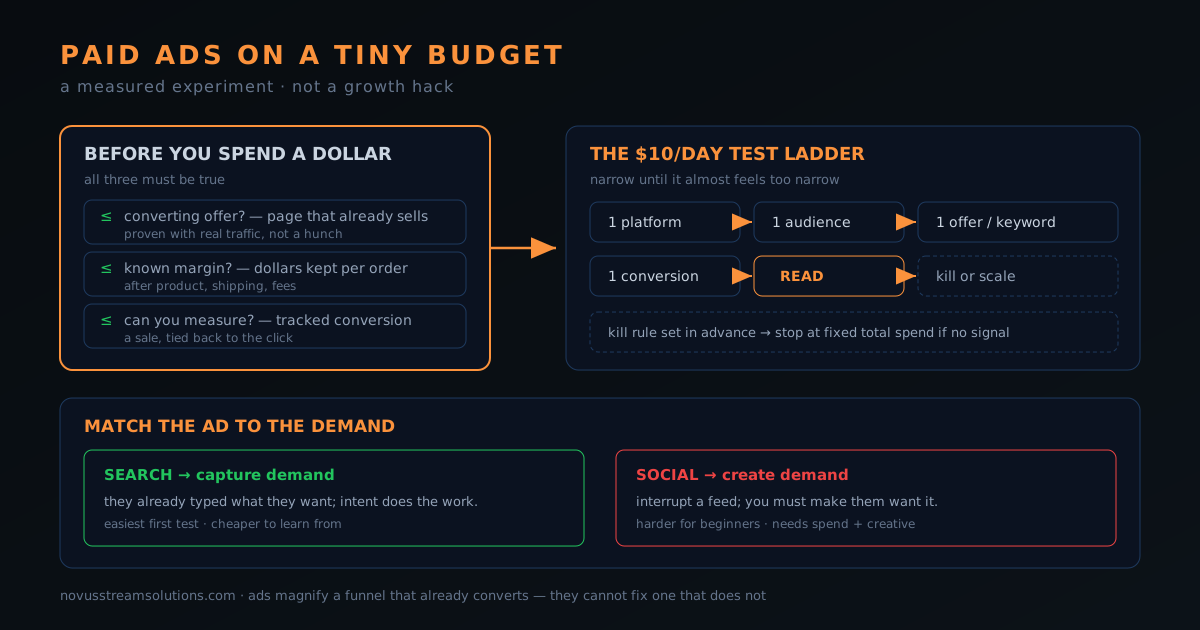
Before any budget goes live, three conditions have to hold, and if even one of them is missing you should close the tab and go work on that instead. The first is a converting offer and landing page, meaning you have evidence, not a hunch, that traffic arriving at a specific page turns into orders at some real rate. The second is known margins, meaning you can say in plain numbers what you actually keep from a single sale after the cost of the product, the shipping, the payment processing, and any per-order fees. The third is a way to measure a conversion, meaning when someone buys, your ad platform can know that the sale happened and tie it back to the click that caused it. Without that last piece you are flying blind, optimizing toward applause instead of revenue.
These are not nice-to-haves you can bolt on later. They are the instrument panel. A pilot does not take off and then go looking for an altimeter. If you cannot yet state your margin per order to the dollar, you are not ready to decide how much a customer is worth, which means you cannot tell a winning campaign from a losing one even while it runs. Spend the week getting these three right and you will have done more for your eventual ad performance than any amount of clever targeting could.
- The pre-flight checklist, all three of which must be true:
- A landing page that already converts a known share of visitors into buyers, proven with real traffic, not assumed.
- A gross margin per order you can state in dollars after product cost, shipping, processing fees, and any per-order overhead.
- Working conversion tracking, so the platform records a real purchase and attributes it to the click that drove it.
- A specific page the ad points to, not your homepage, matching exactly what the ad promised.
- A predetermined budget you can lose entirely without it hurting the business or your sleep.
The only math that decides whether ads can work
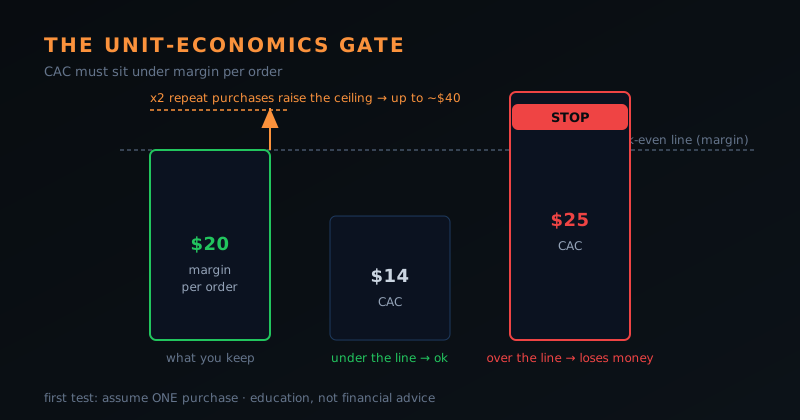
Here is the core of the whole thing, and it fits on an index card. Your customer acquisition cost, the total ad spend divided by the number of customers it produced, must be less than your gross margin per order. If you make twenty dollars of margin on an order and it costs you twenty-five dollars in ads to win that order, you are paying five dollars for the privilege of shipping a box. Do that at scale and you go broke faster the more you spend, which is the cruel inversion that catches new advertisers. The break-even line is simple. CAC must sit below margin, ideally well below, because you also want something left over to actually pay yourself.
There is one honest adjustment that raises the ceiling, and it is repeat-purchase value. If a customer typically buys from you about twice over their life with you, then the true value of acquiring them is closer to two orders of margin, not one. With that same twenty dollars of margin and roughly two purchases, you could in principle afford to spend up to around forty dollars to acquire a customer and still come out ahead over time. That is real, and it is how mature stores justify aggressive spend. But on your very first test you should assume one purchase and one purchase only, because you do not yet have proof that your customers come back, and betting your budget on loyalty you have not earned is how the math quietly turns against you. (This is education, not financial advice. Run your own numbers before you spend.)
The tiny-budget method: one of everything
When you are ready to actually spend, the method that protects you is radical narrowing. Pick one platform, the one that matches your demand type, and ignore the others completely for now. Pick one audience or one tight theme of keywords, not a sprawling list that tries to catch everyone. Point everything at one clear conversion, an actual purchase, not a click or a page view or a vague sense of engagement. Set a small daily cap you can comfortably lose, something in the range of ten to twenty dollars a day, and leave it there. The instinct to spread a budget across two platforms and five audiences to see what sticks feels thorough, but on a small budget it just guarantees that no single test ever gathers enough data to tell you anything.
The reason for this discipline is not minimalism for its own sake. It is that every variable you add splits your already-thin budget into pieces too small to read. With ten dollars a day across one tightly defined campaign, you give that one experiment a fighting chance to accumulate enough conversions that you can trust the result. With ten dollars a day split six ways, you get six puddles of noise and no signal anywhere. Narrow until it almost feels too narrow, run it long enough to gather real data, and only then consider adding a second thing. One platform, one audience, one offer, one conversion, one cap. That is the whole recipe, and its restraint is the point.
- Set these five before the first dollar goes live, and change nothing for the duration of the test:
- One platform, matched to whether you are capturing or creating demand.
- One audience or one tight keyword theme, narrow enough to read.
- One conversion that equals a real purchase, never a click or a view.
- One small daily cap, in the rough range of ten to twenty dollars.
- One kill rule, written down before launch: stop at a fixed total spend if no conversions appear.
Why early swings are noise, not news
On a tiny budget, the most dangerous thing you can do is react to your first few results, because at low volume the early numbers are almost pure noise. Imagine your true, long-run cost per conversion is going to settle around twenty-five dollars. On day one you might get a lucky sale on the third click and feel like a genius, with a cost per conversion that looks like fifteen dollars. On day two you might spend forty dollars and get nothing, and feel like a fool. Neither day is telling you the truth. They are both just small samples bouncing around an average you cannot see yet. If you scale up after the good day or panic and kill it after the bad one, you are letting random chance run your business.
The discipline that fixes this is judging on cost per conversion measured over enough conversions to be meaningful, not over enough days to be impatient. A rough rule that keeps people out of trouble is to wait for something like fifteen to thirty actual conversions before you draw any conclusion about whether a campaign works. On a tiny budget that can take a couple of weeks, and that slowness is genuinely frustrating, but it is also the price of an honest read. The owners who succeed with small ad budgets are almost always the ones who were boring about this, who let the experiment run, ignored the daily wiggles, and only acted once the average had something real to say.
The kill switch you set before you launch
The most important number in your entire first campaign is the one you decide before any money moves, and it is the kill switch. Pick a total amount you are willing to spend in pursuit of evidence, and a condition under which you stop no matter how you feel in the moment. A reasonable version sounds like this: I will spend up to one hundred and fifty dollars total, and if I have not seen a single conversion by the time I have spent it, I shut it off and walk away. Writing this down beforehand matters more than the exact figure, because the failure mode is not setting too high a number. It is having no number at all, and then talking yourself into one more day, and one more after that, while the meter runs.
The reason a predetermined kill rule works is that it takes the decision out of the hands of the version of you that is emotionally invested and tired and hopeful at eleven at night. You are not trying to predict the future. You are buying a fixed amount of information for a fixed price, and the kill rule is simply your agreement to stop buying once you have either learned that it works or learned that it does not. Both outcomes are useful. A campaign that cleanly fails for a hundred and fifty dollars has told you something true about your offer or your channel, and that is worth far more than a campaign that bleeds slowly for months while you avoid looking at it.
The five ways beginners burn money
Almost every wasted ad dollar I have watched a small operator spend traces back to a short list of avoidable mistakes, and naming them is half the cure. Broad targeting is the first, where the audience is so wide that the platform shows your ad to everyone and converts nobody, and your budget evaporates into impressions that never had a chance. The absence of conversion tracking is the second and most insidious, because without it you are optimizing toward a goal the platform cannot see, which means it cannot help you even if it wanted to. Boosting posts is the third, that tempting button that promises reach and almost always delivers cheap clicks from people who will never buy, optimized for engagement rather than sales.
The fourth is optimizing for clicks instead of purchases, telling the platform you want traffic and then being surprised when it sends you the cheapest possible traffic, which is rarely the kind that buys. The fifth is impatience, scaling a campaign up after one good day or killing it before it has gathered enough conversions to mean anything, which we covered, but it bears repeating because it is the one even experienced people relapse into. If you simply avoid these five, narrow your targeting, install tracking, ignore the boost button, optimize for the actual sale, and let the data accumulate, you will already be spending more wisely than most people who outspend you ten to one.
When to skip ads entirely (for now)
Here is the part the people selling you ad courses will not say plainly. For most early-stage stores, the right amount to spend on paid ads is zero, at least for now. Before you have a funnel that converts on its own, your money and your hours buy you far more when they go into organic and owned channels, the ones you keep rather than rent. Content that ranks in search and keeps working after you publish it. An email list of people who already raised their hand, which costs almost nothing to reach again. Referrals from happy customers, which arrive pre-trusted in a way no ad ever will. These compound. Ads do not. The moment you stop paying, paid traffic stops the same day, while a good piece of content or a healthy email list keeps earning quietly in the background.
So the honest sequence is to build the converting funnel first, prove it with free or cheap traffic, exhaust the owned channels that cost time rather than money, and only then layer in paid ads as a way to pour a little fuel on a fire that is already burning. Ads are an accelerant, not an ignition source. If there is no fire yet, the accelerant just makes a mess. When you have a page that converts, a margin that holds, and a real way to measure a sale, a small, disciplined, kill-switched test on the right platform can teach you whether buying customers profitably is even possible for your numbers. Until then, the cheapest and smartest ad budget is the one you have not spent.
Frequently asked questions
Quick answers to common questions about this topic.
How much should I budget for my first paid ad test?
Think in terms of a total you can lose entirely without hurting the business, not a daily number you hope to recoup. A common starting shape is ten to twenty dollars a day with a hard cap of around one to two hundred dollars total for the whole experiment, set before you launch. The point of that money is not to make sales. It is to buy a clear answer to one question: can you acquire a customer for less than your margin. Decide the total and the stopping condition first, then treat anything you learn as the return. This is education, not financial advice, so run your own numbers against your own margins.
Should I start with Google search ads or Facebook and Instagram ads?
For most beginners on a small budget, search ads are the gentler classroom because they capture demand that already exists. Someone typed in what they want, and you simply paid to be there at the moment of intent, so the sale is much easier to convert. Social ads on Meta create demand instead, interrupting people who were not looking for you, which usually requires more spend, more testing, and far stronger creative before the math works. If real people are already searching for what you sell, start with search. If nobody is searching for it at all, that is a signal to revisit whether there is demand to capture before you pay to create it.
What is a good customer acquisition cost?
There is no universal number, because a good CAC is defined entirely by your own margins. The only rule that matters is that your customer acquisition cost must come in below your gross margin per order, ideally well below so there is profit left over after you have paid for the customer. If you keep twenty dollars per order, a CAC of twenty-five dollars loses money on every sale no matter how the dashboard looks. Repeat purchases can raise that ceiling over time, but on a first test you should assume a single purchase and judge the campaign against one order of margin. Compare CAC to your margin, not to someone else's benchmark.
Why are my early ad results so inconsistent?
Because at low volume your results are mostly noise, not news. A few clicks and a lucky sale on a good day, or a dry stretch on a bad one, are just small samples bouncing around an average you cannot see yet. The fix is to judge on cost per conversion measured across enough conversions to be meaningful, often something like fifteen to thirty, rather than reacting to daily swings. This is genuinely slow on a tiny budget and can take a couple of weeks, but reacting to early luck or early misfortune is how people scale losers and kill winners. Let the experiment run long enough to give you an honest average before you decide anything.
Is boosting a post the same as running an ad?
Technically yes, practically no, and the difference costs people a lot of money. The boost button is the simplest possible version of advertising, and it is optimized by default for cheap engagement rather than actual sales. It tends to deliver clicks and reactions from people who will never buy, which feels like momentum and produces almost no revenue. A proper campaign built in the ads manager lets you optimize for a real purchase conversion, target far more precisely, and measure what actually happened. If your goal is sales rather than applause, skip the boost button and build the campaign properly, even though the boost button is the one the platform pushes hardest because it is the easiest to spend on.
When should a small store skip paid ads completely?
Whenever your funnel does not yet convert on its own, which describes most early-stage stores. If your existing organic traffic rarely buys, ads will only let you lose money faster and in higher resolution, because they cannot fix a weak offer or a page nobody purchases from. Until you have a converting page, a margin you can state in dollars, and working conversion tracking, your time and money buy more in owned channels like content, an email list, and referrals, which keep working after you stop paying. Build and prove the funnel first, exhaust the channels that cost time rather than money, and only then test ads as fuel on a fire that is already lit.
Related troubleshooting
Was this page helpful?
Your answer stays in this browser, it is not sent anywhere and no account or cookie is involved.