2026 · Novus Stream Solutions (hub)About 15 min readNovus Stream Solutions
Building a referral engine that isn't sleazy
A referral program does not create love for your product, it multiplies love that already exists. This is a calm, honest guide to encouraging word of mouth without bribery, fake scarcity, or guilt mechanics, including when you should not run a program at all.
Contents
- 1.Overview
- 2.The prerequisite nobody wants to hear
- 3.Organic word of mouth versus a structured program
- 4.Two-sided incentives, done honestly
- 5.The psychology of timing the ask
- 6.Make sharing genuinely effortless
- 7.The lines you must never cross
- 8.A loop that feeds itself
- 9.What to actually measure
- 10.When not to run a referral program
- 11.Putting it together without the ick
Overview
A referral program is one of the most misunderstood growth tools a small business has. People reach for it the way they reach for a discount code, as if the mechanism itself produces customers. It does not. A referral program is a multiplier, and a multiplier only does something when there is a number in front of it. If you have built a product people quietly love, and you have created moments that genuinely delight them, a referral program can take that goodwill and turn it into a steady, compounding flow of new customers who arrive already trusting you. If you have not built that, no amount of clever incentive design will save you, and a generous reward will actually make things worse by attracting people who care about the reward and nothing else.
This post is about the version of referrals that does not make you feel like you need a shower afterward. The kind you can run for years and feel proud of, where your customers are giving their friends a genuine gift rather than being conscripted as unpaid salespeople. We will start with the uncomfortable prerequisite that most guides skip, then work through the difference between organic word of mouth and a structured program, how to design a two-sided reward honestly, when and how to ask, the lines you must never cross, what to actually measure, and the situations where the right answer is to not run a program at all. None of this is theory. It is the same approach we use in our own stores.
The prerequisite nobody wants to hear
Before you design anything, sit with this: referrals are a tax on remarkability. A customer will only put their own reputation on the line for you if recommending you makes them look good to their friend. That happens when the product solved a real problem, when the experience exceeded what they expected, or when the moment of using your thing was quietly delightful. If none of those are true, asking for a referral is asking someone to spend their social capital on your behalf for free, and most people will politely decline by simply doing nothing. The honest test is to ask yourself whether your last twenty customers would describe you to a friend without being prompted. If the answer is no, your problem is not the referral mechanism. It is upstream, in the product or the experience.
This is why a big bribe on a weak product is so corrosive. Money will, in fact, move people to share things they do not believe in, which sounds like a feature until you trace what happens next. The friend arrives skeptical, having been pitched by someone who was clearly paid to pitch. They convert at a low rate, and the ones who do convert churn quickly because the underlying product still is not good. You have spent real money to acquire customers who cost you more in support and refunds than they ever pay you, and you have taught your existing customers that their recommendation is a transaction rather than a kindness. The reward did not fix the product. It just put a price tag on a problem you still have.
Organic word of mouth versus a structured program
Organic word of mouth is what happens when a customer mentions you without any prompting or reward, because the experience was worth talking about. It is the strongest form of growth there is, it costs you nothing, and you cannot directly control it. What you can do is remove friction from it and notice when it is happening. A structured referral program is a deliberate system layered on top: you explicitly invite customers to refer others, you give them an easy way to do it, and you often attach a reward. The mistake is treating the program as a replacement for the organic version rather than an amplifier of it. If organic word of mouth is already trickling in, a program turns the trickle into something you can count on. If it is completely absent, the program is shouting into a room where nobody is listening.
The practical signal that you are ready to formalize a program is that referrals are already happening on their own and you have evidence of it. New customers tell you a friend sent them. People tag you, forward your emails, or paste your link into a group chat without being asked. When you see that pattern even at a small scale, you have found your multiplier candidate. Formalizing it then means making the path official and frictionless rather than inventing demand from nothing. If you are not seeing any of this yet, the better investment is in the product and in creating the kind of moments people want to talk about, which is slower but is the only thing that makes a program work later.
Two-sided incentives, done honestly
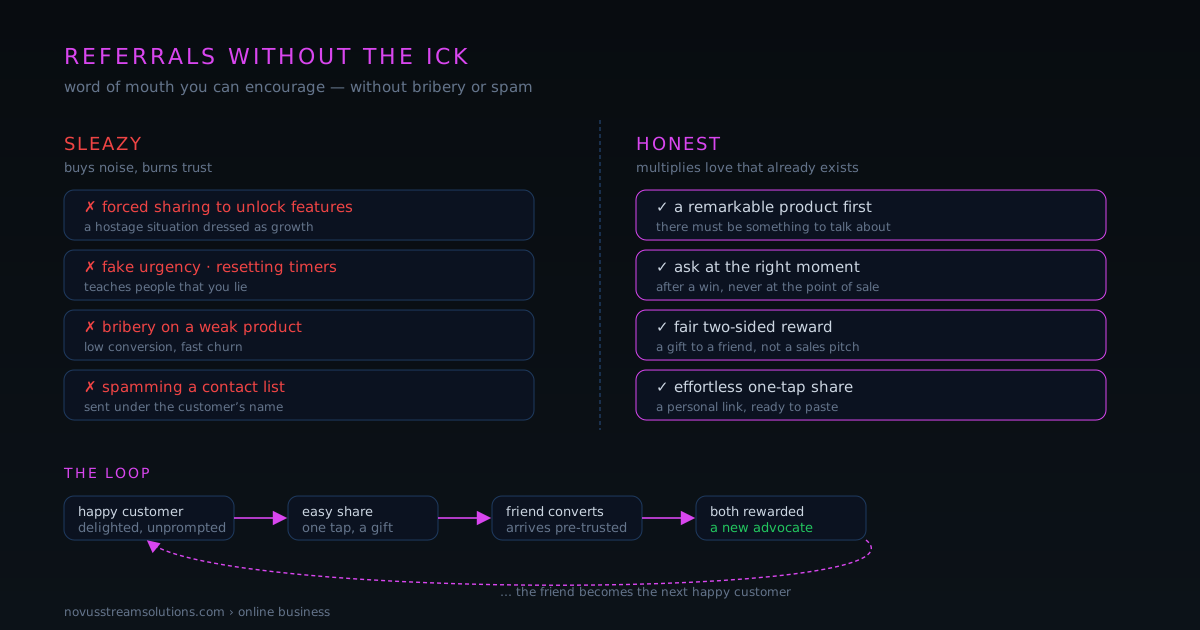
The single most important design decision is to reward both the person referring and the friend who receives the referral. A one-sided reward, where only the referrer gets something, quietly turns your customer into a commissioned salesperson. They are now pitching their friend in order to get a payout for themselves, and the friend can feel that. A two-sided reward flips the emotional frame entirely. The referrer is no longer selling, they are giving a gift, because the friend gets something too. When someone sends a link that says here is twenty dollars off your first order, the message they are really sending is I found something good and I want you to have a deal on it. That is a kind thing to do, and people are far more comfortable doing kind things than selling.
Keep the rewards proportional and honest. The friend's side should be a real welcome, a meaningful discount or a bonus on a first purchase, not a token gesture. The referrer's side should be worth their effort but not so large that it dominates their motivation, because once the reward becomes the point, the recommendation loses the authenticity that made it valuable. Account credit, a future discount, or a small thank-you toward their next order tends to work better than cash, because it keeps the relationship inside your world rather than turning it into a side hustle. Whatever you choose, be transparent about it. The friend should always know the referrer may receive something. Hidden incentives feel like a betrayal the moment they are discovered.
The psychology of timing the ask
When you ask matters more than how you ask. The single worst moment to request a referral is the point of sale, before the customer has received any value at all. At checkout they have given you money and received nothing yet, so asking them to also recruit their friends is asking for trust you have not earned. The right moment is after a clear win, when the customer has just experienced the thing that makes you worth recommending. That might be a delightful unboxing, the moment a problem they were stuck on gets solved, the second purchase that signals they have decided to stay, or a glowing reply to a support message. These are the peaks of the relationship, and a peak is when people are most willing to share, because the feeling is fresh and real.
Practically, this means wiring the ask to events rather than to a calendar. Instead of a blanket monthly email begging everyone to refer, you trigger a gentle, well-timed invitation right after a positive moment. A customer who just left a five-star review is an obvious candidate. So is someone who just placed their third order, or someone who replied to a shipment email saying how much they loved the product. The ask itself should be light and unembarrassing, framed around the gift to their friend rather than the reward to themselves. Something as simple as, glad you are loving it, here is a link to share twenty dollars off with a friend, lands completely differently than a generic plea blasted to your whole list on the first of the month.
Make sharing genuinely effortless
Every unit of effort you ask of someone is a place where the referral dies. The customer who would happily share if it took one tap will not bother if it takes five steps, a login, and a hunt for their unique code. Your job is to compress the entire act of referring into something a person can do in a few seconds from their phone while standing in line for coffee. That means a personal referral link that is already theirs, already loaded with both rewards, and ready to paste anywhere. It means a pre-written message they can send as is or edit to sound like themselves, because forcing people to compose a pitch from scratch is friction, and a canned message that sounds nothing like them is awkward. The sweet spot is a sensible default they can tweak in two words.
Think about the actual surfaces where sharing happens. People forward links in text messages and group chats far more than they post them publicly, so a one-tap copy or a native share sheet beats a wall of social buttons for most small businesses. The link should land the friend on a page that immediately reflects the offer, so there is no confusion about whether the reward is real. And the whole thing should work without an account until the moment of purchase, because demanding a signup before someone can even see the deal is exactly the kind of friction that kills the loop. Below is a short checklist of what frictionless actually looks like in practice.
- A personal link that already contains both rewards, with no code to copy separately.
- A pre-written message the customer can send unedited or change in a couple of words.
- One-tap sharing to the customer's own messages, not just a row of public social buttons.
- A landing page that clearly shows the friend their welcome offer the moment they arrive.
- No account or login required to see the offer, only at the point of purchase.
- A plain confirmation when a referral succeeds, so the referrer feels the loop close.
The lines you must never cross
There is a clear boundary between encouraging word of mouth and manipulating it, and crossing it does lasting damage to the trust your customers have placed in you. The fastest way to ruin a referral program is to make it coercive. Forced sharing, where a customer has to refer someone in order to unlock a feature they already paid for or to access content they were promised, is a hostage situation dressed up as growth. Fake scarcity, like a countdown timer on a referral reward that quietly resets, teaches people that you lie. Guilt mechanics, where declining to share triggers a sad face or a confirm-shaming button that says no, I do not want free money, treat your customers as marks rather than people. Every one of these tactics can produce a short-term bump, and every one of them poisons the well you drink from.
The most common and most damaging line crossing is spamming a contact list. The moment your program asks a customer to upload their entire address book, or quietly messages everyone they have ever emailed, you have turned your customer into the instrument of spam sent under their name. Their friends do not blame you, they blame the customer, who then resents you for it. A referral should always be a deliberate act by the person sharing, aimed at a specific friend they actually want to tell. If you would be embarrassed to explain a mechanic out loud to the customer's face, do not build it. The honest version of every one of these is simply slower, and slower is fine, because a referral program built on trust compounds while a manipulative one collapses.
A loop that feeds itself
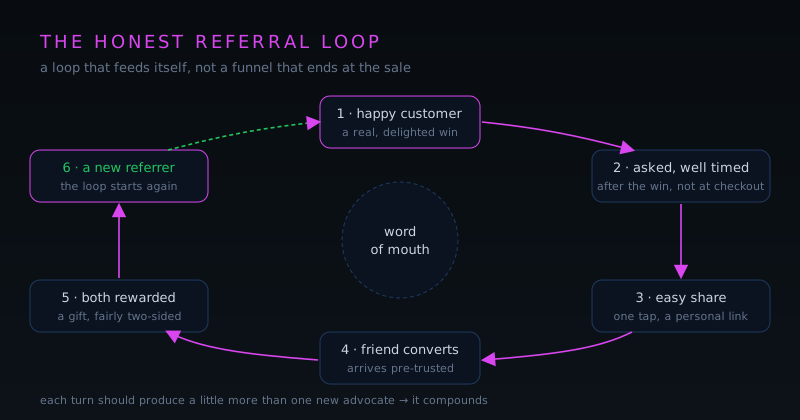
The reason an honest program compounds is that it is shaped like a loop rather than a funnel. A funnel ends when a customer buys. A loop turns that customer into the start of the next acquisition. A happy customer is asked at the right moment, they share with a specific friend because it is easy and feels like a gift, the friend converts and has the same good experience, both of them are rewarded, and now the friend is themselves a happy customer who can be asked at their own right moment. Each turn of the loop ideally produces slightly more than one new advocate, which is what separates a program that grows on its own from one that needs constant pushing. You do not get there with bigger rewards. You get there by making each step of the loop a little smoother and each underlying experience a little more remarkable.
It helps to map your own loop explicitly and find the leakiest step. Maybe customers are willing but the share is too clunky, so the loop breaks at sharing. Maybe they share enthusiastically but the friend lands on a confusing page and bounces, so it breaks at conversion. Maybe everything works but the reward never arrives reliably, so referrers stop bothering after the first time. Fixing the weakest link is almost always cheaper and more effective than increasing the incentive, and it does not erode trust the way a bigger bribe does. Treat the loop as a small system you tune over months, not a campaign you launch once and forget.
What to actually measure
A referral program is easy to fool yourself about, so measure it honestly. The headline number most people quote is the referral rate, the share of your customers who actually refer at least one person, and it is a useful pulse but it is not the whole story. Pair it with share-to-conversion, the rate at which the people who receive a referral actually become customers, because a high share rate with terrible conversion usually means your sharers are blasting links rather than telling specific friends, which is a warning sign that something in your design has tipped toward spam. Together these two numbers tell you whether the loop is turning and whether each turn is productive, and watching them over time will show you the effect of every change you make far more reliably than a single launch-week spike will.
The number that matters most, and the one almost everyone forgets, is the quality and retention of referred customers compared to the ones you pay to acquire. Referred customers typically stay longer, spend more over their lifetime, and refer others at higher rates than customers who arrived through paid ads, because they came in pre-trusted by someone they know. Track the retention curve of your referred cohort against your paid cohort, and you will usually find the referred customers are worth substantially more even when the upfront reward looks comparable to an ad cost. If you ever see referred customers churning faster than paid ones, treat it as an alarm, because it almost always means a reward has grown large enough to attract people who care about the payout rather than the product.
When not to run a referral program
Restraint is part of the discipline here, because a referral program launched at the wrong time does real harm. The first situation to avoid is being too early. If you do not yet have a base of genuinely happy customers, there is nothing to multiply, and standing up a program just creates an empty mechanism that signals desperation and produces a referral rate near zero. Spend that energy on the product and on serving the customers you have until word of mouth starts happening on its own. The second situation is thin margins. A two-sided reward has to be funded out of your unit economics, and if rewarding both the referrer and the friend pushes a sale into a loss, you are paying to acquire customers who may never become profitable. Do the arithmetic before you promise anything, because a reward you cannot afford is a reward you will eventually claw back, which is worse than never offering it.
The third situation is a product with no natural sharing moment. A genuinely one-time purchase that solves a problem and is then done, with no repeat use and no social context, gives the customer nothing to talk about after the fact. You can sometimes manufacture a moment, but if you have to manufacture it, the referral will feel manufactured too. In all three cases the honest answer is to wait or to skip the program entirely and lean on the things that earn organic word of mouth instead: a remarkable product, a delightful unboxing, and support that makes people feel looked after. A free tool that people love and pass around, like the kind we build, often does more for word of mouth than any incentive scheme, because it gives people something worth sharing for its own sake.
Putting it together without the ick
If you take one thing from this, let it be the order of operations. Build something worth recommending, create at least one moment that genuinely delights, watch for organic word of mouth, and only then formalize a program that makes the existing behavior easier rather than inventing it. Reward both sides so the referrer is giving a gift, ask only after a real win, compress the share to a single effortless tap, and refuse every coercive shortcut even when it would work in the short term. Measure the loop honestly, and above all watch whether your referred customers are happier and stick around longer than the ones you pay for, because that is the proof that you are multiplying love rather than buying noise.
Done this way, a referral program stops feeling like a growth hack and starts feeling like a natural extension of treating people well. Your best customers get to share something they are proud of, their friends get a genuine welcome, and you get a stream of new customers who arrive already trusting you. It is slower than a viral gimmick and far more durable, and it never requires you to do anything you would be embarrassed to explain. That is the whole point. The referral engine that lasts is the one you would be happy to describe, in full, to the very customers it depends on.
Frequently asked questions
Quick answers to common questions about this topic.
What makes a referral program feel sleazy?
Sleaziness comes from coercion and deception, not from rewards. Forced sharing to unlock features, fake countdown timers, guilt-tripping confirm buttons, hidden incentives the friend does not know about, and anything that spams a customer's contact list under their name all cross the line. A program feels honest when sharing is a deliberate act, both sides are rewarded transparently, and the customer is giving a friend a genuine gift rather than being turned into an unpaid salesperson.
Should the reward go to the referrer, the friend, or both?
Both. A one-sided reward that only pays the referrer quietly turns your customer into a commissioned salesperson, and their friend can feel the pitch. A two-sided reward reframes the whole act: the referrer is giving their friend a deal, which is a kind thing to do, rather than selling to them. Keep both sides proportional and honest, with a real welcome offer for the friend and a worthwhile but not dominating thank-you for the referrer.
When is the right time to ask a customer for a referral?
Ask after a clear win, never at the point of sale. The worst moment is checkout, when the customer has paid but received no value yet. The best moments are the peaks of the relationship: a delightful unboxing, a problem just solved, a second or third purchase, or a glowing support reply. Wire the ask to those events rather than to a calendar, and keep it light and framed around the gift to their friend.
How do I know if I am ready to launch a referral program?
You are ready when organic word of mouth is already happening and you can see it. New customers mention that a friend sent them, people forward your emails, or your link shows up in group chats without prompting. That existing behavior is the multiplier a program amplifies. If none of that is happening yet, a program will shout into an empty room, and the better investment is the product and the experience that earn word of mouth in the first place.
What should I measure to know if the program is working?
Track referral rate, the share of customers who refer someone, and share-to-conversion, the rate at which referred people actually buy. Most importantly, compare the retention and lifetime value of referred customers against customers you acquire through paid ads. Referred customers usually stay longer and are worth more because they arrive pre-trusted. If referred customers ever churn faster than paid ones, your reward is probably too large and is attracting people who care about the payout, not the product.
When should I not run a referral program at all?
Skip or delay a program in three situations: when you are too early and have no base of happy customers to multiply, when your margins are too thin to fund a two-sided reward without losing money on the sale, or when you sell a one-time purchase with no natural sharing moment. In all three cases, lean on the things that earn organic word of mouth instead, such as a remarkable product, a delightful unboxing, and support that makes people feel genuinely looked after.
Related troubleshooting
Was this page helpful?
Your answer stays in this browser, it is not sent anywhere and no account or cookie is involved.