2026 · Novus Stream Solutions (hub)About 12 min readNovus Stream Solutions
Digital products as a revenue line for a content site
A content site that already has an audience and authority is sitting on a revenue line beyond ads and affiliates: digital products. Templates, guides, and presets sell expertise at near-zero marginal cost. Here is how to add them well.
Contents
Overview
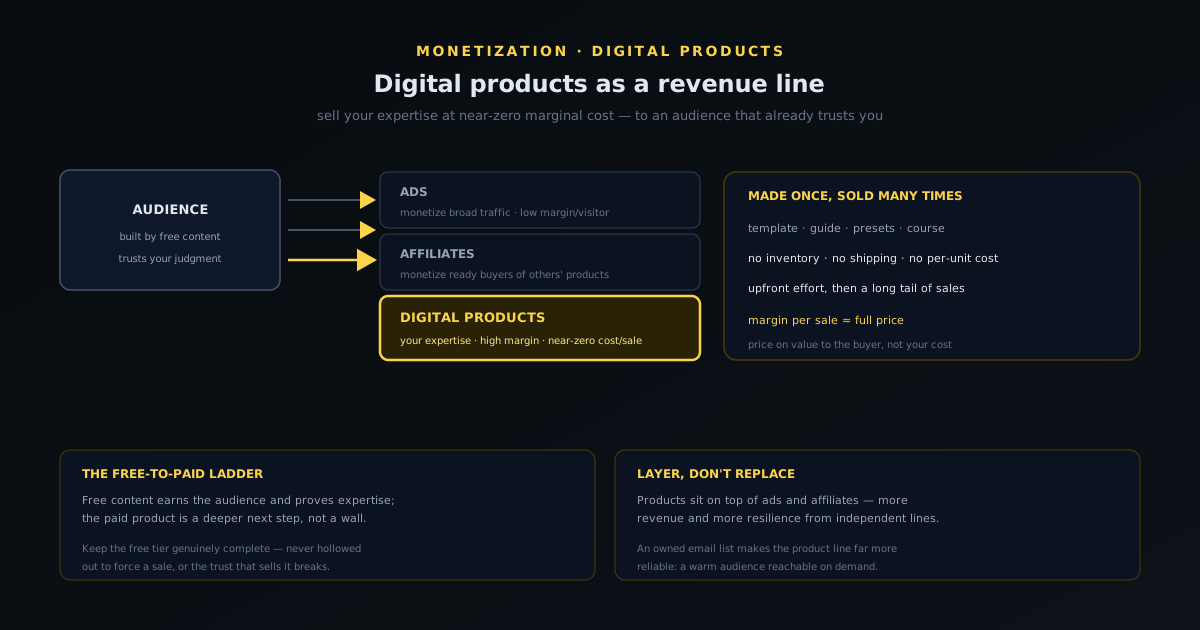
A content site that has built an audience and a measure of authority on a topic is sitting on a monetization line that many such sites never use: digital products. Most content sites monetize with ads and affiliate links (both legitimate, both covered elsewhere), but both share a ceiling, because they earn a small amount per visitor and scale only with traffic. Digital products are different: they sell your own expertise directly, at near-zero marginal cost per sale, to an audience that already trusts you because of the free content you have published. Adding a digital-product line does not replace ads and affiliates; it layers a higher-margin, higher-ceiling revenue source on top of the audience those channels are already serving.
The reason digital products fit a content site so naturally is that the hard part (building an audience that trusts your judgment on a topic) is exactly what publishing useful content accomplishes. By the time a site has readers who return for its guides and recommendations, it has the two ingredients a digital product needs: people who value your expertise and a relationship that makes them willing to buy from you. The product is simply that expertise, packaged into something they can purchase. This guide covers why digital products suit content sites, the formats that actually sell, how their economics work, how to price and sell them, and, most importantly for a content site, how to add the revenue line without breaking the trust that the free content built and that makes the whole thing possible.
Why digital products fit a content site
The defining economic property of a digital product is that it is made once and sold many times at almost no additional cost per sale. A template, a guide, a set of presets, or a course takes real effort to create, but once created, each additional copy sold costs essentially nothing to deliver: there is no inventory, no shipping, no per-unit manufacturing. This is the opposite of a physical product, where every sale consumes a unit that cost money to make and move, and it means the margin on a digital product, after the upfront creation effort is recovered, approaches the full price. For a content site already producing the audience, this near-zero marginal cost is what makes digital products such an efficient revenue line.
Digital products also align with the strengths a content site has already developed. The site has demonstrated expertise publicly, which is the credibility a product needs; it has an audience that has self-selected for interest in the topic, which is the market; and it has channels (the content itself, an email list, the site's traffic) to reach that market without paying for distribution. A content site launching a digital product is not starting from zero the way a standalone product would; it is monetizing an asset it already owns. This is why the digital-product line is so often the highest-return next step for a content site that has built an audience but is leaving money on the table by monetizing only with the low-ceiling channels of ads and affiliates.
Formats that actually sell
The right digital-product format depends on your topic and audience, but the formats that reliably sell share a property: they save the buyer time or effort, or they teach them something they want to learn, in a packaged form more convenient than piecing it together from free content. Templates and tools are among the most effective (spreadsheets, document templates, design files, presets, checklists), because they deliver an immediate, practical shortcut: the buyer gets a ready-made starting point instead of building one from scratch. A site that teaches a process can sell the template that executes it; a site about a craft can sell the presets or assets that craft uses. These products convert well because their value is obvious and instant.
Beyond templates, structured knowledge products sell when the audience wants to learn something deeply: guides, ebooks, and courses package expertise into a comprehensive, organized form that is worth paying for precisely because it is more complete and convenient than the scattered free articles. The key is that the paid product must offer something beyond the free content (more depth, better organization, a complete system, or a practical tool) rather than repackaging what is already free, because an audience that can read your free articles will not pay for the same thing in a PDF. The formats that sell are the ones where the packaging itself adds real value: the time saved by a template, the completeness of a course, the convenience of a system assembled in one place. Match the format to what your specific audience would genuinely pay to have done for them.
The free-content-to-paid-product ladder
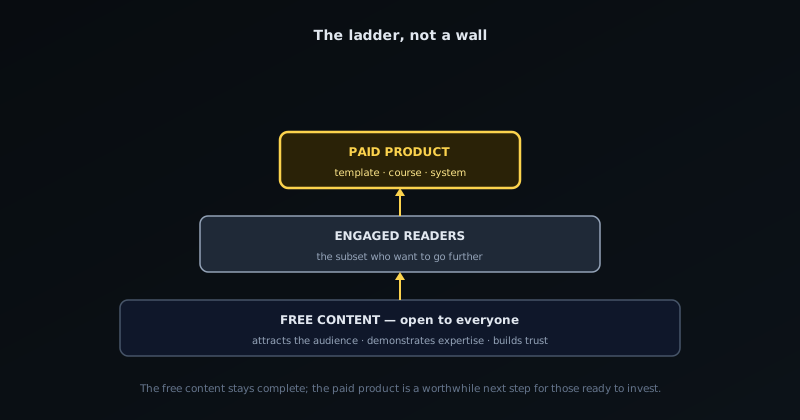
The relationship between your free content and your paid products is not competition but a ladder, and understanding it is what makes the model work rather than feel like a bait-and-switch. The free content does the job of attracting an audience, demonstrating expertise, and building trust; it is the top of the ladder, open to everyone, and it should remain genuinely valuable on its own. The paid product sits a rung up for the subset of that audience who want to go further: who want the template that executes the process the free article described, the course that teaches the whole system the articles touch on, or the tool that saves them the time the free content showed them how to spend. The free content earns the audience; the paid product monetizes the portion ready to invest in going deeper.
This ladder is why the free content must stay genuinely useful rather than being hollowed out to push the paid product. The temptation, once there is something to sell, is to make the free content a teaser that withholds the actual value to force a purchase, but this destroys the trust that built the audience and makes both the free content and the paid product less effective. The durable version keeps the free content complete and valuable, and positions the paid product as a worthwhile next step for those who want more, not as the missing piece deliberately removed from the free version. Done this way, the free content and the paid product reinforce each other: the free content proves the expertise is worth paying for, and the paid product gives the most engaged readers a way to get more of it. The economics of this free-to-paid relationship across a whole portfolio are explored in The economics of a free-tool portfolio.
Pricing a digital product
Pricing a digital product is harder than pricing a physical one because there is no per-unit cost to anchor to: the marginal cost is near zero, so price is set by value to the buyer rather than cost to you. The right frame is to price based on the value the product delivers: how much time it saves, how much it helps the buyer earn or accomplish, or how much the knowledge is worth to them. A template that saves a professional hours of work is worth a meaningful fraction of what those hours are worth to them, not a token amount reflecting the near-zero cost to copy the file. Underpricing is the more common mistake than overpricing, because creators anchor to their own (low) cost rather than to the buyer's (higher) value.
That said, pricing also interacts with your audience and your goals. A low price can drive volume and serve as an accessible entry product; a higher price positions the product as premium and can convert better with the right audience by signaling quality. Many successful digital-product lines use a ladder of products at different prices (an inexpensive entry product, a mid-tier, and a premium offering), so different segments of the audience can buy at the level that fits them. The practical approach is to price for the value delivered, test rather than agonize (since price is easy to change on a digital product), and consider a range of products rather than betting everything on one price point. The goal is to capture the value the product genuinely provides, which is almost always more than a creator's instinct to price cheaply suggests.
Selling without breaking trust
For a content site, the central risk in adding paid products is damaging the trust that the free content built, because that trust is the entire foundation: it is why people read, return, and would consider buying. The way to sell without breaking it is to keep the selling honest and proportionate: be transparent that the product is paid, represent accurately what it does and does not include, and never let the desire to sell distort the free content into a vehicle for pushing the product. An audience can tell the difference between a creator who offers a genuinely useful product as a natural extension of their helpful content and one who has turned every article into a sales funnel, and they reward the former with purchases and punish the latter with departure.
Concretely, this means the free content keeps serving the reader first, with the product mentioned where it is genuinely relevant rather than injected everywhere; the product's sales page is honest about its contents and value; and the relationship is treated as long-term rather than as something to extract maximum revenue from in a single transaction. The most durable digital-product businesses on content sites are built by creators who maintain their reputation for being helpful and honest, because that reputation is what makes people willing to buy in the first place and to buy again. Protecting trust is not in tension with selling; it is the precondition for selling sustainably, which is why the same honesty that governs good free content should govern the paid products and how they are sold. Break the trust and the products stop selling; protect it and the products become a reliable line built on the audience's genuine confidence in you.
The upfront effort and the long tail
A digital product front-loads its cost: the effort to create it well (to build the template thoroughly, write the guide comprehensively, or produce the course) happens before any revenue, and that upfront investment is real and should not be underestimated. A product that is rushed or thin will not sell well or will generate refunds and reputation damage, so the creation effort is where quality is determined. This front-loading is the main reason digital products feel risky: you do the work without knowing whether it will sell, unlike content that earns ad and affiliate revenue gradually as it is published. The mitigation is to validate demand before building heavily (gauging interest from your audience, pre-selling, or starting with a smaller product), so the upfront effort goes toward something the audience has signaled it wants.
The payoff for that front-loaded effort is the long tail: once created, a digital product can sell for years with minimal ongoing work, generating revenue from the same upfront effort indefinitely. A good template or course keeps selling to new audience members as they discover the site, with the creator only occasionally updating it to keep it current. This is the inverse of the upfront-cost risk: the product that took weeks to build can return that investment many times over across its selling life, which is what makes the economics attractive despite the front-loading. The strategic implication is to invest properly in creating products worth selling for years, validate before building to reduce the risk, and then let the long tail compound, rather than either skipping products because of the upfront cost or churning out thin ones that never earn back even their modest effort.
Where the email list comes in
Digital products sell most reliably to an owned audience, which is why an email list is the natural companion to a digital-product line; it is the channel through which you can reach the people most likely to buy, directly and repeatedly, without depending on an algorithm or a search ranking to deliver the message. A content site that has built an email list (covered in Building an email list from day one for a small store) has a warm audience that has explicitly chosen to hear from it, which is exactly the audience a product launch needs: people who already trust the site, are interested in the topic, and can be reached on demand. Launching a product to an engaged list typically converts far better than relying on site traffic alone, because the list is the self-selected, reachable core of the audience.
The list also enables the practices that make a digital-product line sustainable: announcing new products to people primed to care, nurturing the relationship between launches so the audience stays warm, and re-engaging past buyers for new products. Without a list, each product launch depends on whatever traffic happens to arrive and whatever the algorithms decide to show, which is far less reliable. With a list, the digital-product line gains a dependable launch channel and a way to build a repeat-purchase relationship with buyers. This is why building the email list and building the digital-product line are complementary rather than separate efforts: the list is the audience asset, and the products are how that asset is monetized at high margin, with each making the other more valuable. A content site serious about digital products should be serious about its list, because the two together are far stronger than either alone.
Layering products onto ads and affiliates
Digital products work best not as a replacement for ads and affiliates but as a complementary layer, because each revenue line serves a different part of the audience and the combination is more resilient than any single source. Ads monetize the broad flow of traffic, including the many visitors who will never buy anything; affiliates monetize the readers ready to purchase tools or products you recommend; and digital products monetize the segment willing to pay you directly for your own expertise. Together they capture value from a wide range of audience intent (passive readers, ready buyers of others' products, and committed buyers of yours) rather than leaving any segment unmonetized, which is what makes a layered approach earn more than any one channel alone.
The resilience of layering matters as much as the additional revenue. A site dependent on a single monetization source is exposed to that source's risks (an ad-rate decline, an affiliate program closing, a product category saturating), whereas a site with ads, affiliates, and its own products has multiple independent lines, so a setback in one does not threaten the whole. This diversification is the same principle that applies to revenue concentration generally: multiple sources reduce fragility. For a content site, the mature monetization stack is usually all three layered together (ads for breadth, affiliates for ready buyers, and digital products for high-margin direct revenue from the most committed audience), each adding both income and resilience. The digital-product line is often the missing layer on sites that monetize only with ads and affiliates, and adding it both raises the revenue ceiling and strengthens the whole, which is why it is worth building well rather than leaving the audience's willingness to pay for your expertise entirely untapped.
Frequently asked questions
Quick answers to common questions about this topic.
What digital products sell best on a content site?
Formats that save the buyer time or teach them something they want to learn: templates, tools, presets, checklists, guides, and courses. They must offer something beyond the free content (more depth, better organization, a practical shortcut), not repackage what is already free.
How do I price a digital product?
Price on value to the buyer, not your near-zero cost to copy it: how much time it saves or value it delivers. Underpricing is the common mistake. Price is easy to change on a digital product, so test rather than agonize, and consider a range of products at different price points.
Will selling products hurt the trust my free content built?
Only if you let selling distort the free content. Keep the free content genuinely complete and reader-first, be transparent that the product is paid, represent it honestly, and position it as a deeper next step rather than the missing piece withheld from the free version.
Do digital products replace ads and affiliates?
No. They layer on top. Ads monetize broad traffic, affiliates monetize ready buyers, and digital products monetize the segment willing to pay for your expertise. Together they earn more and are more resilient than any single source. An email list makes the product line far more reliable.
Related troubleshooting
Was this page helpful?
Your answer stays in this browser, it is not sent anywhere and no account or cookie is involved.