2026 · Novus Stream SolutionsAbout 13 min readNovus Stream Solutions
Automating SVG hero art for a 150-post blog
Every post deserves original art, but hand-designing images for 150 posts is impossible for a small team. Here is how a house style expressed as code generates unique, on-brand SVG art per post at scale.
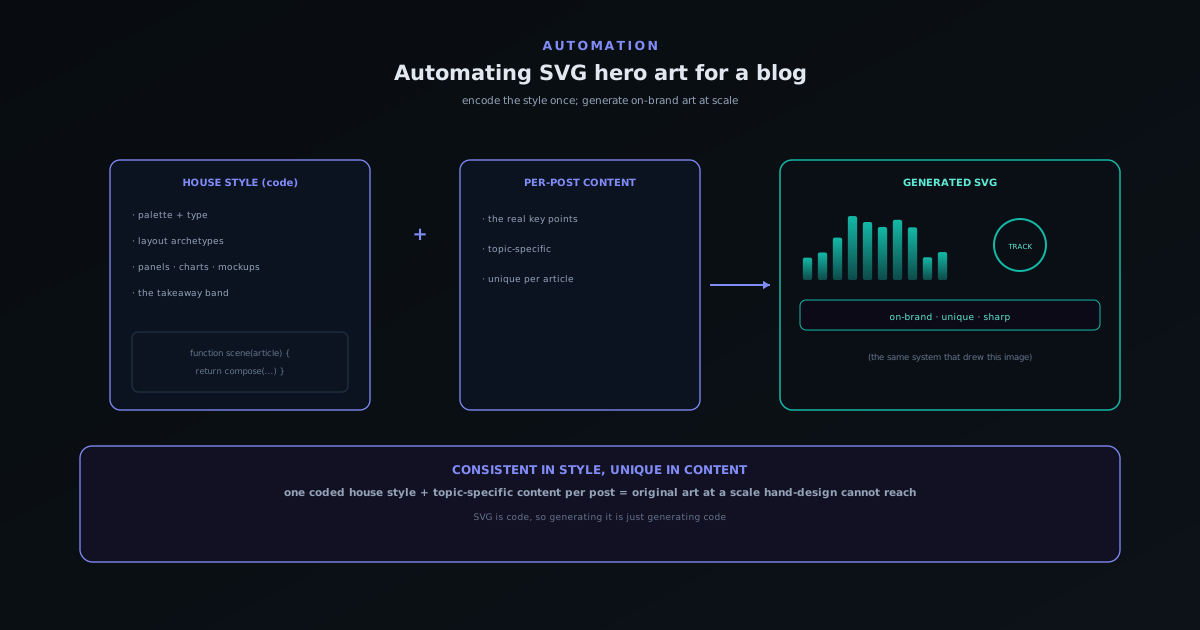
Contents
- 1.Overview
- 2.Why every post needs original art
- 3.The problem with stock and generic images
- 4.A house style expressed as code
- 5.Topic-specific content in a consistent frame
- 6.Why SVG instead of raster
- 7.Keeping art genuinely unique per post at scale
- 8.The script as a reusable system
- 9.The same idea applies beyond hero art
- 10.What this saves, and what it does not
Overview
Every blog post is better with original art: a hero image that gives it a face in listings and shares, and an inline diagram that breaks up the text and illustrates the idea. But hand-designing two custom images for every post is simply impossible for a small team running a blog of a hundred and fifty posts; the math does not work, and the alternative most sites fall back on (generic stock images or no images at all) makes the content look cheap and interchangeable. The way out of this bind is to express a house visual style as code and generate the art programmatically, so that every post gets unique, on-brand images without anyone hand-designing them. This is how that works, and why it is worth doing.
The key realization is that the problem is not "we need an artist for every post" but "we need a system that produces on-brand, topic-specific art at the scale of our content." Those are very different problems with very different solutions. The first is unsolvable for a small team; the second is a tractable engineering problem, solved by encoding the visual style as a reusable template and feeding it topic-specific content per post. The result is art that is consistent in style (because it shares a template) and unique in content (because each post supplies its own specifics), produced at a speed that keeps up with the content. Automating the art is what lets a large blog have original images on every post without an art department.
Why every post needs original art
Original art matters more than it might seem, for several concrete reasons. In listings, search results, and social shares, the image is often the first thing a potential reader sees, and an original, on-brand image signals quality and catches attention in a way a generic stock photo or a blank space does not. Within the post, an inline diagram breaks up long text, illustrates the idea, and gives the reader a visual anchor, which improves the reading experience and comprehension. And across the blog, consistent original art builds visual brand identity, so the posts feel like parts of a coherent publication rather than a random collection. The art is not decoration; it does real work for discovery, comprehension, and brand.
Generic or absent art, by contrast, quietly undermines all of that. Stock images that could appear on any site make the content feel interchangeable and cheap; missing images make posts look unfinished and perform worse in shares and listings; inconsistent images make the blog feel incoherent. For a content operation trying to build trust and stand out, the visual presentation is part of the quality signal, and neglecting it sends the wrong signal regardless of how good the writing is. This is why the art problem is worth solving rather than skipping: original, consistent art genuinely improves how the content is discovered, experienced, and perceived, which makes it worth the effort to produce even at scale.
The problem with stock and generic images
The default solution to the art problem (reaching for stock images) fails in ways worth naming, because understanding why stock falls short clarifies what the automated approach provides. Stock images are generic by nature: the same images appear across countless sites, so they signal "this could be any site" rather than building a distinct identity, and they rarely match the specific content closely because they were made for general use. A stock photo loosely related to your topic is better than nothing but does none of the brand-building or specific-illustration work that original art does, and at scale it makes your blog look like every other site relying on the same image library.
Generic AI-generated images solve the licensing and availability problem but often introduce their own: a sameness of style, a lack of genuine connection to the specific content, and a tendency to look like generic AI art that readers increasingly recognize and discount. The deeper issue with both stock and generic generated images is that they are not specific to your content or your brand: they are general images applied to specific posts, which is exactly backwards from what good art does. The automated approach this post describes produces the opposite: images that are specifically yours in style and specifically about each post in content, which is what stock and generic images structurally cannot be.
A house style expressed as code
The foundation of automated art is encoding your visual house style as code: a template that defines the consistent visual language all your art shares. This means defining, in code, the things that make your art recognizably yours: the color palette, the typography, the layout structure, the visual motifs, the overall aesthetic. Once the house style is expressed as a reusable template, any piece of art generated from it automatically shares that style, which is what gives the blog its consistent visual identity. The house style as code is the thing that makes all the generated art belong together, because it is the shared frame every image is built in.
Expressing the style as code rather than as a set of design files is what makes it generative. A design file is a single image; a coded template is a function that can produce many images, each sharing the style but differing in content. This is the crucial shift: instead of designing images, you design the system that produces images, encoding the style once so it can be applied automatically and infinitely. The house style as code is a one-time investment that pays off across every post, because once the template captures your visual language, generating on-brand art becomes a matter of feeding content into the template rather than designing from scratch. The style lives in the code, and the code produces the art.
Topic-specific content in a consistent frame
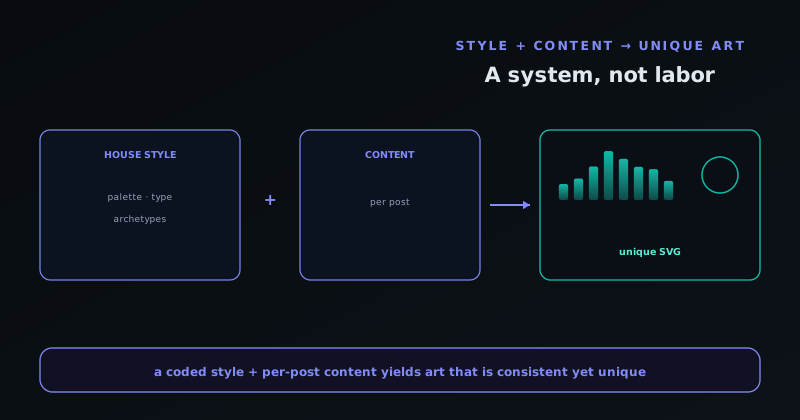
Consistency alone would produce identical images, which is not the goal: the goal is art that is consistent in style but unique to each post, and that uniqueness comes from feeding topic-specific content into the consistent frame. For each post, you supply the specifics: the title, the key points, the particular concepts or data the art should depict, the accent that distinguishes this post. The template applies the house style; the per-post content makes each image about its specific post. The result is art that shares a recognizable style across the blog while genuinely depicting the particular content of each post: consistent frame, unique content.
This combination is exactly what stock and generic images cannot provide and what makes the automated approach worthwhile. Because each image is built from the actual substance of its post (its real topic, its real key points), the art is genuinely specific and illustrative rather than loosely related, doing the real work of illustrating the idea. And because every image shares the house style, the blog stays visually coherent. The art is simultaneously unique (specific to each post) and consistent (sharing the style), which is the ideal combination that hand-design achieves slowly and stock images cannot achieve at all. The system gets both by separating the consistent part (the coded style) from the unique part (the per-post content) and combining them per image.
Why SVG instead of raster
The choice of SVG (a vector format defined as code) rather than raster images is deliberate and important for this approach. SVG is itself code: an SVG image is a text description of shapes, text, and colors, which means it can be generated programmatically by writing that description, exactly as you would generate any other code. This makes SVG the natural format for code-generated art, because producing an SVG is producing structured text, which a template and a script can do directly and precisely. Generating raster images programmatically is far more cumbersome; generating SVG is just generating code, which fits the whole code-as-everything approach.
SVG also has practical advantages for blog art beyond its generability. It is resolution-independent, so it looks crisp at any size on any screen; it is typically small in file size for the kind of clean, geometric, text-and-shape art a house style tends to use, which helps page performance; and it is precise, so the generated art is exactly what the code specifies. For a blog using a clean, diagrammatic house style (panels, text, shapes, a consistent palette), SVG is ideal, producing sharp, lightweight, precisely-controlled images that are generated as code. The format choice is part of what makes the automation clean: because SVG is code, generating it programmatically is straightforward, and the resulting art is sharp and light.
Keeping art genuinely unique per post at scale
A risk of templated art is that it becomes too uniform (recognizably the same template with minor variations), which would undercut the goal of unique art per post. Avoiding this requires the per-post content to genuinely vary the art, not just swap a title, so that each image really reflects its specific post. This means feeding in the actual key points, concepts, or data of each post so the art depicts something genuinely different each time, and using variation within the house style (different accents, different specific content arrangements) so that posts are visually distinguishable while still belonging to the same family. The aim is art that is clearly part of the blog's visual identity yet genuinely distinct per post.
Getting this balance right is the craft of the system, and it is achievable because the template can be designed to express the post's real substance rather than just frame a title. When the art genuinely depicts each post's specific content (the actual points it makes, the actual concepts it covers), the images are meaningfully different because the content is meaningfully different, even though they share a style. The uniqueness comes from the substance, not from cosmetic variation, which is what keeps the art from feeling repetitive at scale. A well-designed system produces a hundred and fifty images that are recognizably one blog's art and individually about their own posts, which is exactly the combination of consistency and uniqueness the whole approach exists to achieve.
The script as a reusable system
In practice, the automation takes the form of a script that holds the house-style template and accepts per-post content, producing the hero and inline SVGs for each post. This script is a reusable system: you write it once, encoding the style and the generation logic, and then run it whenever you need art for new posts, supplying the per-post specifics. Adding art for a new batch of posts becomes a matter of providing the content and running the script, rather than designing anything, which is what makes the art keep pace with the content. The script is the durable asset: the one-time investment that produces art indefinitely.
Treating the art generation as a reusable script rather than a one-off also means it improves over time. As you refine the house style, you update the template once and can regenerate art across posts; as you find better ways to express post content visually, you improve the generation logic for all future art. The script becomes a maintained system that gets better and produces increasingly good art as it evolves, rather than a fixed solution. This is the same code-as-everything philosophy applied to art: the visual production is a system in the codebase, versioned and improvable, which is exactly what makes it sustainable and consistent across a large, growing blog. The script is the art department, and it is a few hundred lines of code.
The same idea applies beyond hero art
The principle behind automated hero art (encode a consistent style as code, feed in per-item specifics, generate at scale) generalizes well beyond blog images, and recognizing that multiplies its value. The same approach works for any visual asset that needs to be produced repeatedly in a consistent style: social share cards, diagram templates, open-graph images, icon sets, category banners, and other recurring graphics that a content operation needs in volume. Wherever you find yourself needing many on-brand visual assets that share a style but differ in content, the house-style-as-code approach applies, turning what would be repetitive design work into a generation system. The hero-art script is one instance of a broadly useful pattern.
This generalization is part of why investing in the approach pays off beyond the immediate problem it solves. Once you have built the muscle of expressing a visual style as code and generating assets from it, that capability extends across your whole visual production, letting a small operation maintain consistent, original visuals everywhere they are needed rather than just on blog posts. The broader lesson is that visual production, like content production, can be turned into a system rather than a series of one-off design tasks, and doing so is what lets a small team maintain professional, consistent, original visuals at the scale a real content operation requires. The hero art is where it starts, but the underlying idea (encode the style, generate the assets) is a general tool for making visual production scale, which is exactly the kind of leverage a small operation needs to look polished across a large, growing site.
It is the same philosophy that runs through the whole approach to building and running the site: turn the things that need to happen repeatedly into systems rather than repeated manual effort, so that scale becomes a matter of running a system rather than multiplying labor. Content lives as code so it can be produced and validated systematically; art is generated from a coded style so it can be produced at scale; the changelog feeds a repeatable content engine. Each of these is the same move (replace repeated manual work with a reusable system), and together they are what let a small operation sustain a large, polished, original site. Automating the hero art is one expression of that philosophy, and the reason it matters is that the philosophy itself, applied across the operation, is what makes the scale achievable at all.
What this saves, and what it does not
It is worth being honest about what automated art does and does not provide. It saves the impossible labor of hand-designing original art for every post, which is its entire reason for existing: it makes original, on-brand, topic-specific art feasible at a scale where hand-design is not, freeing a small team to have good art on every post without an artist. It provides consistency and uniqueness together, which neither stock images nor hand-design-at-scale can. And it fits the code-as-everything architecture, making art production part of the same system as everything else. For a content operation at scale, these are large, real benefits.
What it does not provide is the bespoke, hand-crafted artistry of a designer making a unique illustration for a single important piece, for which there is still a place, and the automated system does not preclude doing custom art where it genuinely matters. The automated approach is the right solution for the scale problem: giving every post good, original, on-brand art when hand-designing every one is impossible. It is not a claim that algorithmic art beats a skilled designer on a flagship piece; it is a claim that a house style as code beats stock images and blank spaces for the everyday posts that make up the bulk of a large blog. Used for what it is good at (original art at scale), it solves a real problem that otherwise forces small teams into generic images or none, and it does so in a way that is consistent, unique per post, and entirely within the codebase.
Frequently asked questions
Quick answers to common questions about this topic.
How do you make unique hero art for hundreds of posts?
Define a programmatic house style (shared palette, layout, and motifs) and generate a tailored SVG per post from its topic. Each hero is distinct but consistent, without hand-designing every one.
Why use SVG for blog hero art?
SVGs are tiny, scale crisply at any size, and are easy to generate from code. For social previews they are rasterized to PNG, since crawlers ignore SVG og:images.
Does automated art look generic?
Not if the system varies meaningfully per topic. A shared style with per-post specifics reads as a cohesive brand, not a template, which is exactly what a large blog wants.
Related troubleshooting
Was this page helpful?
Your answer stays in this browser, it is not sent anywhere and no account or cookie is involved.