2026 · Novus SupplyAbout 10 min readNovus Stream Solutions
Amazon FBA for one product: the real unit economics of selling ZubiFlex socks
FBA hands you the warehouse, the shipping, and the customer base of the biggest store on earth — for a stack of fees that decide whether your product makes money. A first-person walk through the per-unit P&L of selling socks.
Overview
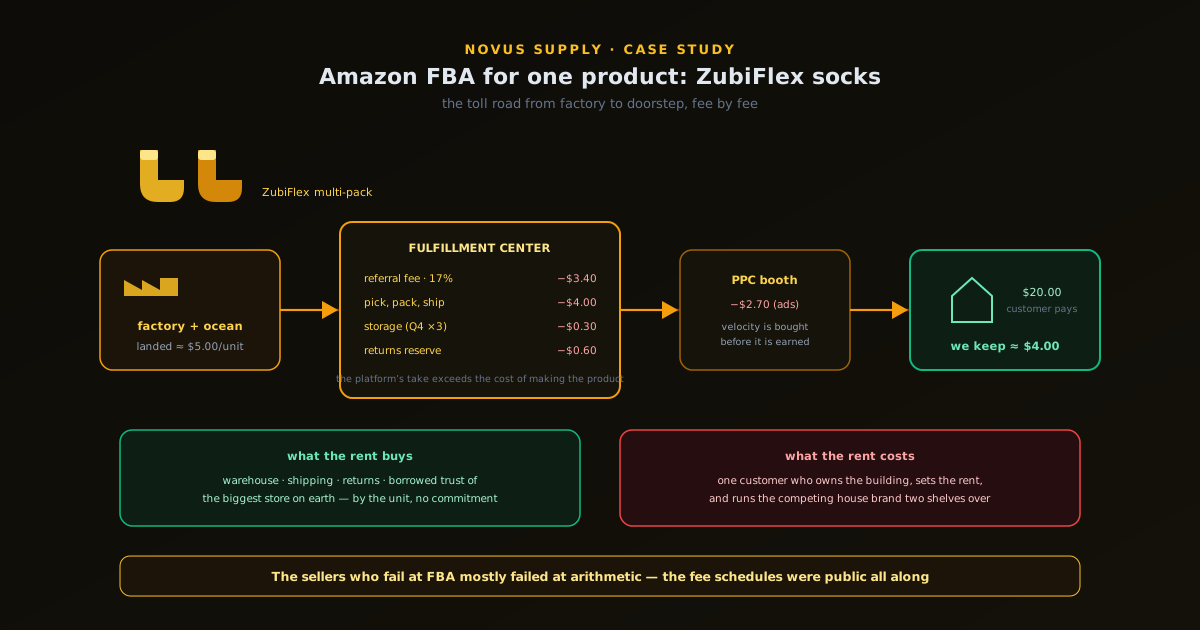
Novus Supply is the retail side of our ecosystem, and its flagship physical product is unglamorous on purpose: ZubiFlex socks — comfortable, durable, giftable, and small enough to ship cheaply. A meaningful share of their sales runs through Amazon FBA, which means we have lived the full fee stack this article describes, line by line, on our own settlement reports. What follows is the case study we wish we had read before sending the first carton to a fulfillment center: what FBA actually does, what it actually charges, and what survives of a twenty-dollar sock sale by the time the money reaches the business.
Numbers below are rounded and simplified for readability — fee schedules change yearly, vary by category and size tier, and nothing here is a substitute for running your own current-rate calculation. But the structure of the math is stable, and the structure is the lesson. FBA is neither the scam its critics describe nor the passive-income machine its course-sellers advertise. It is a logistics vendor with a toll road attached, and whether the toll is worth paying is a per-product arithmetic question that most new sellers never actually do.
What FBA actually buys you
Fulfillment by Amazon is, mechanically, an outsourcing contract: you manufacture and ship inventory in bulk to Amazon's warehouses, and from there they store it, pick it, pack it, ship it to customers — with the fast delivery badge that meaningfully lifts conversion — handle the customer service for delivery problems, and process the returns. For a one-person retail operation, that list is nearly the entire physical workload of e-commerce. The days a solo seller would otherwise spend taping boxes and standing in post office lines become hours available for product, sourcing, and marketing, and the operation scales from ten orders a week to a thousand without the seller's house filling with parcels.
The subtler half of the purchase is access. Listing through FBA puts a product inside the marketplace where an enormous share of product searches begin, in front of buyers who already have payment details saved and trust the platform completely even though they have never heard of you. That borrowed trust is the real product Amazon sells small brands: a stranger who would hesitate on an unknown website's checkout page buys a ZubiFlex three-pack without a second thought because the marketplace, not the brand, is the counterparty they are trusting. New sellers consistently underprice this in their mental accounting — and then, in the other direction, underprice what it costs, which is the subject of the rest of this article.
The fee stack, named and counted
Three fee families dominate. The referral fee is the marketplace's commission — for clothing categories including socks, roughly seventeen percent of the sale price at typical price points, taken off the top of every transaction. The fulfillment fee is the per-unit charge for pick, pack, and shipping, set by the product's size tier and weight: a multi-pack of socks lands in the small-and-light end of standard sizes, somewhere around four dollars per unit at current rates. This is where physical product design quietly becomes financial engineering — packaging that crosses a size-tier boundary can add a dollar per unit forever, which on socks is several points of margin. We learned to treat the dimensions of the retail packaging as a cost decision first and a branding decision second.
Storage is the third family, and the one that punishes inattention. Monthly inventory storage is billed per cubic foot, at rates that roughly triple in the fourth quarter, and long-term storage surcharges attach to units that sit unsold past their welcome. For a compact product like socks the monthly numbers look trivial — until a forecasting mistake parks a thousand units of a slow colorway through a holiday quarter, at which point storage stops being a rounding error. Around these three sit the minor levies that settlement reports reveal: inbound shipping to the fulfillment center (your cost, and you do not choose the destination), prep and labeling fees if anything arrives non-compliant, removal fees to retrieve unsold stock, and returns processing in apparel categories, where customers can return worn-once goods that come back unsellable.
The ZubiFlex waterfall: what survives of twenty dollars
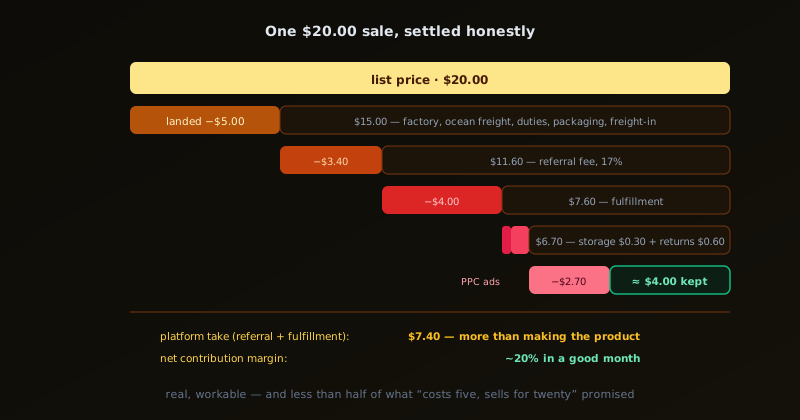
Here is the shape of the per-unit P&L on a representative ZubiFlex multi-pack at a twenty-dollar list price, with rounded figures. Landed cost — factory price, inbound ocean freight, duties, retail packaging, and the freight to Amazon's warehouse — comes to roughly five dollars. The referral fee takes about three forty at seventeen percent. Fulfillment takes about four dollars. Storage, averaged across normal sell-through including the expensive quarter, adds roughly thirty cents a unit. Returns in our category run mid single digits; reserved against every unit at full cost, call it sixty cents. That leaves roughly six dollars and seventy cents of pre-advertising contribution on a twenty-dollar sale — about a third of list price, and notice the sobering subtotal on the way there: the marketplace's combined take of referral plus fulfillment, at nearly eight dollars, exceeds the entire cost of manufacturing the product and moving it across an ocean.
Then advertising eats its share, because the toll road has a second booth. Organic placement on the marketplace is earned through sales velocity, and sales velocity for a new listing is bought through pay-per-click ads against your own product's search terms. Total advertising cost of sale for a competitive apparel niche commonly runs ten to twenty percent of revenue during growth phases — call it two to three dollars of our twenty — which brings the true bottom line to roughly four dollars per unit: a twenty percent net contribution margin in a good month, before the business's own overhead. That is a real, workable margin on a product that ships itself while we sleep. It is also less than half of what the naive "costs five, sells for twenty" math promised, and every dollar of the difference went to a fee that was published, knowable, and routinely unread.
What the spreadsheet cannot show you
A few FBA realities only surface in operation, and they belong in any honest case study. Cash flow runs colder than the P&L suggests: inventory is paid for months before it sells, the marketplace settles on a delay and holds reserves, and a growing FBA business can be profitable on paper while perpetually short of cash to fund the next, larger purchase order — the classic retail trap, with a marketplace's payment schedule layered on top. Forecasting is the actual job: the fee structure punishes both directions of error, with storage charges accruing on overstock and the sales-rank algorithm demoting listings that go out of stock, so the seller lives permanently between two fee regimes, steering with imperfect data. Our seasonal forecasting writeups elsewhere on this blog exist because socks, absurdly, are a deeply seasonal product, and the fourth quarter forgives nothing.
And the platform risk is not theoretical. Fee schedules revise upward most years, listing policies shift, and an account suspension — even a mistaken one, even briefly — turns the entire revenue line off while appeals crawl. This is the concentration problem this series keeps returning to, in its purest commercial form: an FBA-only business is a business with one customer, and that customer owns the building, sets the rent, and runs the competing house brand two shelves over. Our resolution is structural rather than clever: the marketplace is one channel for Novus Supply, beside the direct store at novussupply.ca — and the direct channel, which keeps the customer relationship and skips the referral fee, is where the marketplace's borrowed trust gets converted, slowly, into trust we own.
The flywheel above the fees: velocity, reviews, and rank
The per-unit waterfall describes the steady state; the launch phase runs on a different physics worth understanding before entering. Marketplace search rank is driven substantially by sales velocity and conversion rate, reviews drive conversion, and sales generate reviews — a flywheel that is brutal to start and powerful once spinning. A new listing has no reviews, therefore converts poorly, therefore ranks poorly, therefore sells slowly, therefore accumulates reviews slowly. This is why the advertising line in our waterfall is structural rather than optional during launch: PPC spend is how a new product buys the velocity that the flywheel will not yet give it organically, and the correct mental accounting treats early ad spend partly as a customer-acquisition cost and partly as a capital investment in rank. Our own experience with ZubiFlex matched the standard pattern — months of ad-heavy, margin-thin selling before organic placement began carrying a meaningful share of units, at which point the same revenue arrived with a visibly better bottom line.
Reviews deserve their own discipline because they are the flywheel's bottleneck and the platform polices them ferociously. The compliant playbook is unglamorous: a product that genuinely satisfies (the only sustainable review strategy ever devised), enrollment in the platform's early-review programs where available, and the platform's own request-a-review mechanisms used consistently — never incentivized reviews, never review swaps, never family accounts, all of which risk the listing itself. Two operational notes from the sock trade: review velocity matters more than review totals early on, because a listing gathering steady fresh reviews reads as alive to both algorithm and shopper; and negative reviews are product research that cost you a sale — ZubiFlex sizing copy improved measurably after two one-star reviews said the same thing our product page had failed to say. The flywheel, once turning, is also the moat: a competitor can copy the product in a quarter, but they start at zero reviews, zero velocity, and zero rank, paying the same launch toll we already paid.
Would we recommend it? A checklist instead of an answer
Whether FBA is right for a product is not a debate; it is a worksheet. For us, on this product, the answer is yes — the channel earns its fees, and the leverage of not running a warehouse is worth the rent. For a different product, the same worksheet says no. Run it before the first purchase order:
- Compute landed cost honestly first — the FBA fees stack on top of that number, not the factory quote.
- Pull current referral, fulfillment, and storage rates for your exact category and size tier; rates are published and specific.
- Check the size-tier boundaries against your packaging dimensions before finalizing packaging.
- Reserve for returns at your category's real rate, at full unit cost, in apparel especially.
- Budget advertising as a launch-phase line of ten to twenty percent of revenue, not as a contingency.
- Demand a contribution margin near a third of list price after everything above — thinner margins leave nothing for the business itself.
- Plan the second channel from day one: an owned store, an email list, anything that makes the marketplace a channel rather than the business.
The toll road, used deliberately
The framing that survives all the line items: FBA is infrastructure rental, and infrastructure rental is one of the genuinely great deals of modern small business when the math clears. We could not build a fulfillment network, a returns operation, and a hundred-million-customer storefront for any amount of money a small retail brand has — and we rent all three by the unit, with no fixed commitment beyond the inventory itself. The fees that look outrageous as percentages are, for a product with honest margins, cheaper than performing the same functions ourselves, which is the only comparison that matters. The sellers who fail on the platform mostly did not fail at selling; they failed at arithmetic, entering with products whose economics never cleared the toll.
The deeper lesson from the Novus Supply side of our ecosystem is about deliberateness across the boundary. The software side of this operation lives on margins where fees barely matter; the sock side lives on margins where a centimeter of packaging is a financial decision. Running both has made us better at each, because retail's discipline — count everything, forecast carefully, respect the waterfall — is exactly the discipline software businesses postpone until scale forces it. If you are considering FBA for your own product, take the lesson in its cheapest form: the worksheet above costs an evening, the fee schedules are public, and the difference between the sellers who thrive and the ones who quietly subsidize the marketplace is, almost always, whether that evening happened before or after the first carton shipped.
Frequently asked questions
Quick answers to common questions about this topic.
What are the real costs of selling a product on Amazon FBA?
Beyond the landed unit cost, FBA adds referral fees, fulfillment fees, storage, and usually advertising. Stacked together they often consume most of a naive gross margin, which is why the full unit economics matter.
Is Amazon FBA profitable for one product?
It can be, but only if the price supports landed cost plus all fees and ad spend with margin left over. This case study walks the actual numbers for one SKU so the math is concrete, not theoretical.
How do I calculate FBA profit per unit?
Start from price, subtract landed cost, referral and fulfillment fees, a returns allowance, and per-unit ad spend. See the general framework at /product-blog/the-true-cost-of-a-physical-product.