2026 · Novus SupplyAbout 13 min readNovus Stream Solutions
Why a software studio is also selling socks: the Novus Supply thesis
A studio that ships browser apps also runs a retail brand selling premium socks. It is not a side quest — it is the same operating model applied to physical goods, and a useful test of whether the model is real.
Overview
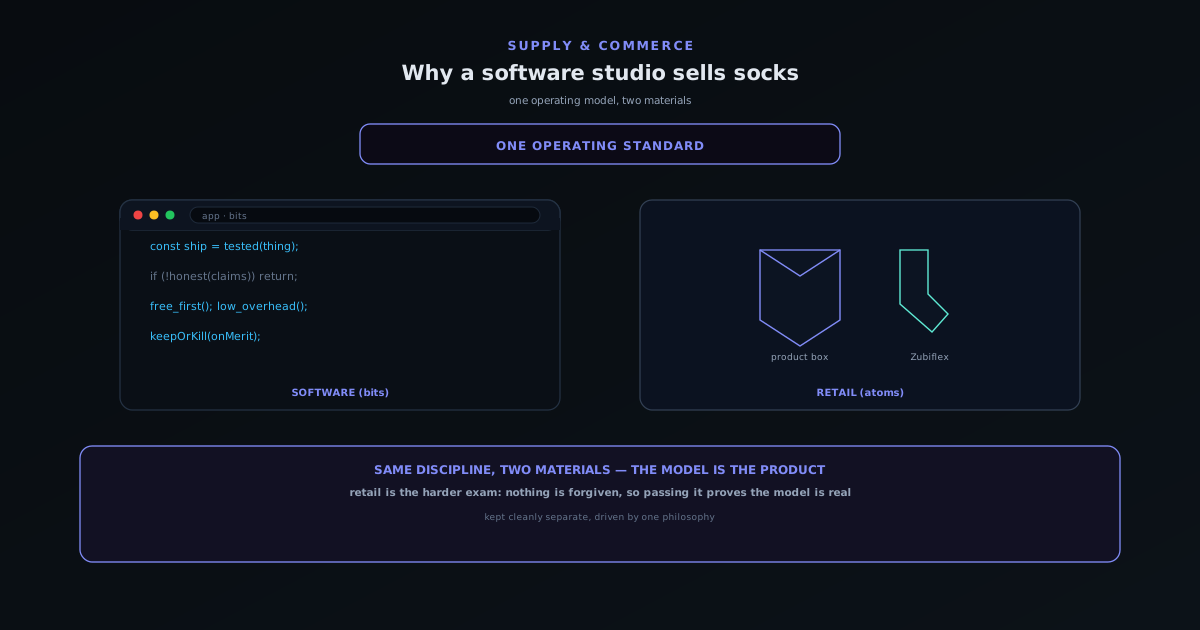
It is a fair thing to raise an eyebrow at: a studio that builds browser-based AI tools also runs a retail brand selling premium socks. On the surface those have nothing to do with each other — one is bits, the other is atoms — and it would be easy to read the retail side as an unrelated side hustle. It is not. Novus Supply exists because the operating model behind the software is not actually about software; it is about building small, honest, low-overhead businesses and keeping the ones that earn their place. Retail is that model applied to physical goods, and running it is partly a way to prove the model is real rather than a story that only works in the friendly conditions of free browser apps.
This is a field note on the thesis behind that choice: why a software studio deliberately took on a retail brand, what selling physical things teaches that shipping software cannot, how the Zubiflex line is meant to embody the same standards, and why the two sides are kept structurally separate even though they share an owner and a philosophy. The short version is that the discipline is the product, and Supply is one of the places that discipline gets tested under conditions software never imposes — real inventory, real fulfillment, real customers holding a physical thing to a daily standard.
The same operating model, applied to atoms instead of bits
The Novus operating model is consistent across everything it touches: build something small that solves a real problem, run it at low overhead, be honest about what it is, test before you commit, and keep or kill based on whether it earns its place. That model is usually described in the context of the software — free tools that push compute to the device so they cost almost nothing at idle — but nothing about it is software-specific. Applied to physical goods, it becomes: source products directly, test them to a real standard, price them honestly without the usual markups, and run the operation lean enough that one small team can actually sustain it.
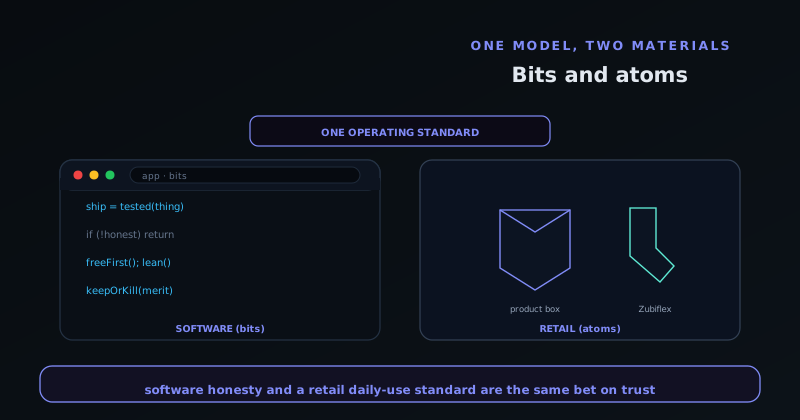
Novus Supply is exactly that translation. It positions itself as a new standard for daily essentials — premium white-label goods sourced directly and tested to a daily-use standard rather than marked up through layers of middlemen. The same instincts that decide which software gets built decide what Supply stocks: does it solve a real, everyday need, can it be offered honestly and at a fair price, and can the operation run without a large team behind it. Seeing the retail brand as the operating model applied to atoms instead of bits is what makes it coherent rather than random. The studio is not dabbling in two unrelated fields; it is running one philosophy in two materials.
Why retail at all: the lessons that transfer
A reasonable question is why bother with the harder medium — physical goods have inventory, shipping, returns, and none of the near-zero marginal cost that makes software so forgiving. Part of the answer is that the friction is the point. Software can hide a weak operating model behind generous economics; if a free app is cheap to run, you can get away with sloppiness that retail would punish immediately. Selling a physical product forces a discipline software does not: you cannot fake having tested it, you cannot ship and silently patch it, and a customer who is disappointed is holding the evidence in their hands. Retail is a harder exam for the same model, which makes passing it more meaningful.
The lessons also transfer in both directions. Retail teaches sharper thinking about conversion, honest expectation-setting, and the cost of every operational step, all of which sharpen how the software side is run. And the software instincts — systematize the repetitive parts, keep overhead low, be transparent — make a small retail operation viable in the first place. Running both means each side keeps the other honest: the software cannot get lazy about operations when the same team is feeling retail's harder constraints, and the retail cannot get disorganized when the same team is used to systematizing everything. The mix is a forcing function for the discipline that supposedly underlies all of it.
Zubiflex and the daily-use standard
The current expression of all this is Zubiflex, Novus Supply's line of premium textiles, starting with men's and women's ankle socks sold in ten-packs and fulfilled through Amazon FBA in Canada. Socks are a deliberately unglamorous starting point, and that is fitting: daily essentials are exactly where an honest, tested, fairly-priced standard is most useful and most often ignored. The promise is not novelty but reliability — goods sourced directly and held to a daily-use standard, the kind of thing you actually wear every day, sold without the markup that usually rides on a brand name. Starting with something humble and getting it genuinely right is more convincing than launching something flashy and hoping.
The phrase that anchors it is the daily-use standard: the idea that a thing is tested against how it will really be used, repeatedly, in ordinary life, rather than against a marketing photo. That standard is the retail version of the honesty that runs through the software — the audited model registry, the limitations stated plainly, the refusal to overpromise. In both cases the bet is that being honest about what a thing is, and making sure it actually holds up to that claim, builds more durable trust than hype does. A sock that quietly performs every day is the same kind of statement as a tool that does exactly what it says and nothing it cannot.
What retail teaches that software cannot
Some lessons only land when there is a physical product and a paying customer on the other end. Retail teaches the true cost of a return, the value of an accurate description, and the difference between traffic and conversion in a setting where every unit has a real cost of goods. It teaches that overselling is not a victory but a liability, because a product that does not match its listing comes back, costs money, and earns a bad review — a feedback loop far more immediate and expensive than a software user quietly closing a tab. These are lessons about honesty and operations that software can theorize about but retail enforces.
Retail also teaches respect for the unglamorous parts of a business. Software can make the boring middle — fulfillment, logistics, inventory accuracy — feel optional, because there is no warehouse and nothing to ship. Retail makes it unavoidable: the product has to actually arrive, in good condition, when expected, or none of the rest matters. Internalizing that the boring operational reliability is where trust is won or lost is a lesson that makes the software side better too, because the same is quietly true there — the unglamorous reliability of a tool that just works is what keeps people coming back. Retail just teaches it more bluntly.
Keeping software and retail cleanly separated
For all that the two sides share a philosophy, they are kept structurally separate, and that separation is deliberate. Novus Supply is retail, run as retail, on its own storefront and its own terms; the software tools are software, run as software, on theirs. The shared operating model does not mean the businesses are blended — a customer buying socks should not be confused about what Novus Visualizers is, and someone removing a background should not stumble into a sock catalog. Clean boundaries let each side be exactly what it is and be judged on its own terms, which is both clearer for customers and more honest about what each business actually is.
That boundary discipline is the same instinct that keeps the two software tools distinct from each other. The ecosystem is explicitly a portfolio of distinct things that share an owner and a philosophy, not one blurred mega-brand where everything bleeds together. Keeping software and retail cleanly separated is what allows the studio to say, plainly, that Supply is retail and the apps are software, without either claim undermining the other. The connective tissue is the operating model and the hub that documents it; the businesses themselves stay in their lanes. That clarity is a feature for everyone, because confusion about what a thing is helps no one.
The subscription club and where it is headed
Supply is early, and it is honest about that. Beyond the launch line of Zubiflex socks, the stated direction is a subscription club for recurring home essentials — the garbage bags, cleaning supplies, and other unglamorous staples that people reorder on a rhythm — with early access offered to people who sign up to be notified. That direction fits the daily-essentials thesis precisely: the most useful place for an honest, fairly-priced, tested standard is the boring recurring purchases most people make without thinking, where markups and mediocrity usually hide. A subscription for essentials is the natural next expression of the same idea that started with socks.
Framing it as a club that is coming, rather than overclaiming what exists today, is itself part of the operating model — the same discipline that distinguishes shipped software features from roadmap ones. Supply describes what is live now (the Zubiflex line, fulfilled and available) and what is ahead (the subscription club, with a way to register interest) without blurring the two. That honesty about stage is the retail version of an honest changelog: say what is real now, signal what is coming, and do not dress up the roadmap as the present. It is a small thing that, repeated, is exactly how trust is built across both sides of the operation.
What "tested to a daily-use standard" actually means
The phrase is easy to say and harder to live up to, so it is worth being concrete about what it commits Supply to. A daily-use standard means the product is evaluated against how it will really be used — repeatedly, in ordinary life, over time — rather than against a single first impression or a flattering photo. For socks, that is the difference between something that feels fine in the package and something that holds its shape, comfort, and durability through a real rotation of wear and wash. The standard is deliberately unglamorous because daily essentials are unglamorous; the whole value is that the boring thing you reach for without thinking is quietly good every time, not impressive once.
Holding that standard has operational consequences, which is the point. It means the sourcing decision is made against use rather than against the lowest cost, because a cheaper unit that fails the daily test fails the brand. It means an honest description rather than a hyped one, because overselling a daily essential is how you earn returns and bad reviews from people who use the thing constantly and notice immediately. And it means accepting that the standard, not the margin, is the constraint that decides what gets stocked — which is the retail expression of the same refusal to overclaim that governs the software side. A studio that labels classical algorithms honestly and a retailer that tests goods to a daily standard are running the same instinct in different materials.
It also reframes what the brand is competing on. Plenty of daily essentials compete on price or on packaging; a daily-use standard competes on the thing actually being good in use, repeatedly, which is the hardest claim to fake and the easiest to verify by simply living with the product. That is a slower way to build a brand than a flashy launch, but it is a more durable one, because trust earned through repeated ordinary use does not evaporate the way novelty does. Starting with something as humble as a ten-pack of socks and getting it genuinely right is a more convincing proof of the standard than launching something attention-grabbing and hoping the use holds up — and getting the humble thing right first is exactly the bet Supply is making.
- Evaluated against repeated real use, not a first impression or a photo.
- Sourcing decided by whether it survives daily use, not by lowest unit cost.
- Honest descriptions, because overselling a daily essential invites returns and bad reviews.
- The standard, not the margin, decides what gets stocked.
- Competes on being good in use — the hardest claim to fake, the easiest to verify.
Why the mix makes the whole stronger
Pulling it together: a software studio sells socks because the thing it is really building is not software, it is a way of operating — small, honest, low-overhead, tested, kept-or-killed on merit — and that way of operating is supposed to work in any medium. Retail is the harder medium, which makes it the better test, and Zubiflex is the current, deliberately humble proof that the standard holds when there is a physical thing and a real customer involved. The two sides keep each other honest, transfer lessons in both directions, and demonstrate together that the operating model is not a story that only works under the forgiving economics of free apps.
It is reasonable to ask whether running two such different businesses dilutes focus, and the honest answer is that it would if they were managed as two unrelated ventures chasing two unrelated playbooks. They are not. They are one operating model expressed twice, which means the thing being practiced and improved — disciplined sourcing or building, honest claims, lean operations, and the willingness to keep or kill on merit — is the same skill in both, getting sharper through repetition rather than split in two. The medium differs, but the muscle is identical, and exercising it against both bits and atoms builds a more general competence than exercising it against either alone. That is the quiet bet underneath the whole arrangement: that the operating model is the real product, and that a model proven in two materials is more trustworthy than one proven in the easy one.
There is a credibility dividend in that breadth, too. A studio that only ships free software can always be suspected of leaning on the generous economics of zero marginal cost — of looking disciplined mainly because the medium forgives so much. Putting the same model to work in retail, where nothing is forgiven and every unit has a real cost and a real customer holding it, is a way of proving the discipline is genuine rather than a side effect of easy conditions. The socks are not a distraction from the software; they are evidence about the kind of operation behind it. When you see the same honesty, the same testing, and the same refusal to overclaim show up in a business that cannot hide behind free, it tells you something true about how the software is run as well — which is exactly why the mix makes the whole more believable, not just more diversified.
For anyone trying to understand the ecosystem, the sock brand is not the odd one out; it is the stress test. A philosophy that only works for bits is a weaker philosophy than one that also works for atoms, and running both is how Novus puts its own model to the proof. Software and retail, kept cleanly separate but driven by the same discipline, make the whole stronger than either would be alone — the retail grounding the software in operational reality, the software keeping the retail lean and systematic. That is the thesis: same standard, two materials, each making the case that the standard is real. You can see the retail side for yourself at novussupply.ca, and the rest of the ecosystem in the hub that documents how it all fits.