2026 · Novus Stream SolutionsAbout 10 min readNovus Stream Solutions
Structured data for small sites: the schema that earns rich results (and the schema that does nothing)
Schema markup is one of the few SEO levers a small site fully controls, and one of the most over-applied. Here is which types actually change how your listings look, which are wasted JSON-LD, and how to ship it without a plugin pile.
Contents
- 1.Overview
- 2.How rich results actually work: eligibility, not guarantee
- 3.The short list that earns its keep
- 4.The waste pile: markup that does nothing
- 5.Implementation: one JSON-LD block, written by the template
- 6.Validation: trust nothing you have not run through the tools
- 7.Keeping markup and content in sync
- 8.What to expect, honestly
Overview
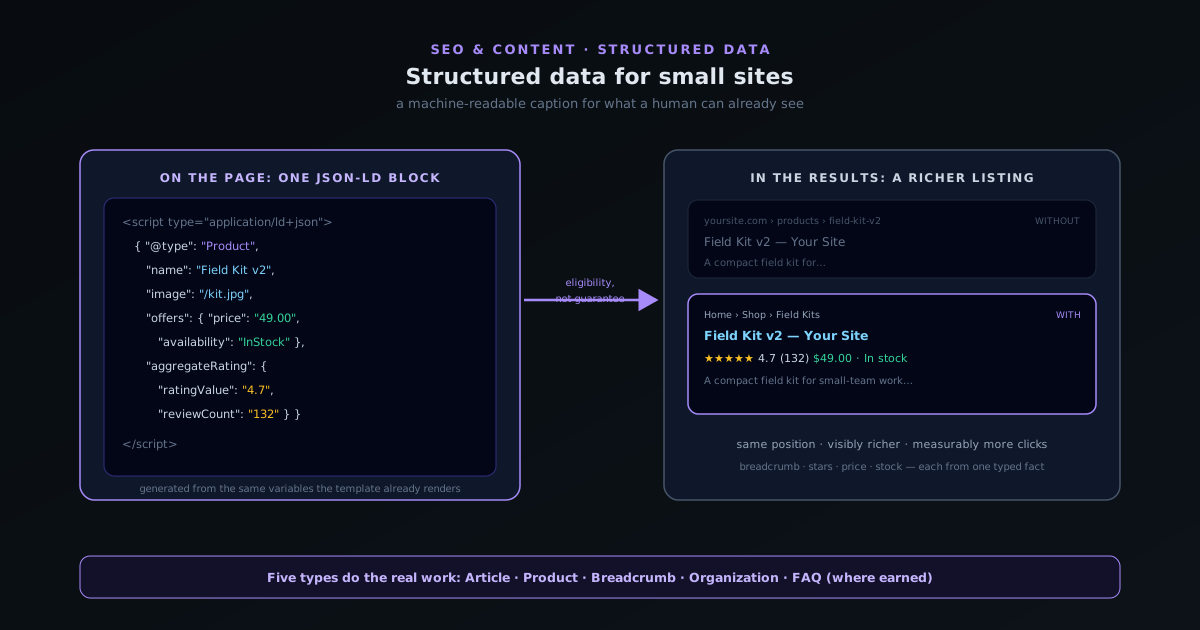
Structured data occupies a strange position in SEO advice: universally recommended, widely misunderstood, and implemented on most small sites as a pile of plugin-generated markup that nobody has ever validated and that mostly does nothing. The core idea is simple. Search engines read your pages as text and guess at meaning; structured data (almost always a block of JSON-LD in the page head) removes the guessing for specific facts: this page is an article, published on this date, by this author; this page describes a product costing this much, currently in stock; these are the steps; these are the questions answered.
What makes the topic worth an afternoon of a small-site owner's time is the payoff channel. Structured data rarely changes where you rank. What it changes is what your listing looks like when you do (star ratings, prices, breadcrumb trails, FAQ dropdowns, recipe cards, event details) and a richer listing wins clicks against a plain one at the same position, sometimes against plain ones above it. That is a real, durable advantage that costs nothing but implementation care. The catch is that the payoff is concentrated in a handful of schema types, while the schema vocabulary contains hundreds, and the time most sites spend marking up everything is time that produces nothing visible. This guide is about the difference.
How rich results actually work: eligibility, not guarantee
The mental model that prevents most disappointment: structured data makes a page eligible for a rich result; it never guarantees one. The pipeline has three gates. First, the markup must be valid and complete enough: required properties present, types correctly nested. Second, it must match a rich result type the search engine actually displays; this is a short, documented list, not the whole schema vocabulary. Third, the engine decides, query by query, whether showing the enhancement is useful, and it routinely declines even for valid markup on indexed pages. Understanding the third gate matters because it reframes failure: markup that produces no rich result after weeks may be fine, just unselected, and the only response is to make sure gates one and two are genuinely passed.
There is also a quieter, second payoff channel worth knowing about: disambiguation. Even when no visible enhancement appears, unambiguous typed facts help the engine model what your page and your site are (which entity you are, what you sell, what the page is about) and that understanding feeds systems beyond the visible listing, including how your brand appears in knowledge panels and how AI-generated answer surfaces describe you. This channel is impossible to measure directly and easy to oversell, so treat it as a side benefit rather than a justification. The honest hierarchy: implement the types with documented visible enhancements first, accept the disambiguation value as a bonus, and never implement a type solely because it theoretically helps the machines understand you.
The short list that earns its keep
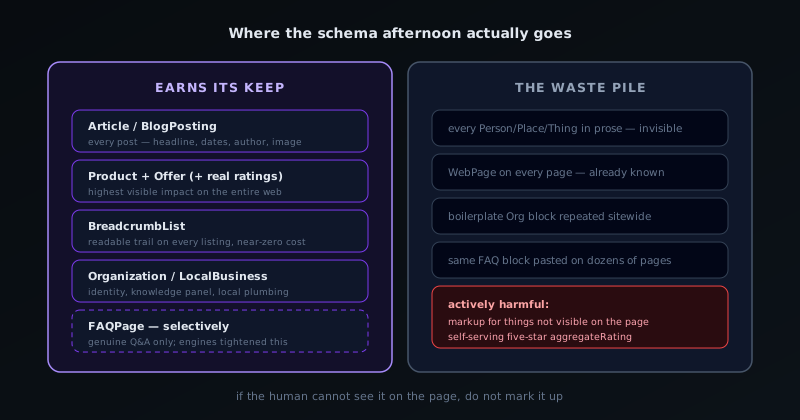
For a typical small site (a business with content, or a content site with something to sell) five types deliver nearly all the visible value. Article (or BlogPosting), on every post, with headline, dates, author, and image: it feeds the article carousels and headline treatments and is the baseline for any content site. Product, on anything purchasable, with offers, price, availability, and aggregateRating where you legitimately have reviews: this is the single highest-impact type anywhere on the web, because price and stars in the listing visibly change click behavior. BreadcrumbList, sitewide: it replaces the raw URL in your listings with a readable trail, a small permanent upgrade on every page at near-zero implementation cost.
Rounding out the five: Organization (or LocalBusiness if you have a physical presence), once, on the homepage or sitewide, with name, logo, and contact points: it consolidates your identity for knowledge panels, and the LocalBusiness variant with address, hours, and geo coordinates is essential plumbing for local search. And FAQPage, selectively, on pages with genuine question-answer content (a page like FAQ & support is the honest source such markup is meant to caption), with the caveat that engines have repeatedly tightened which sites get FAQ treatment after years of abuse, so treat it as a maybe. Beyond the five, add a type only when the content genuinely is that thing: HowTo for true step-by-step pages, Event for real events, Recipe for recipes, VideoObject when video is the content rather than a decoration. The test is always the same: does this type have a documented visible treatment, and is my page honestly that thing?
The waste pile: markup that does nothing
Now the list nobody publishes because it sells no plugins: the schema work that produces nothing. Marking up every entity mentioned in your prose (every Person, Place, and Thing) produces zero visible change and a maintenance burden; the vocabulary supports it, the display systems ignore it. WebPage and WebSite types on every page add almost nothing the engine did not already know (the one exception worth keeping is the site-name markup that can influence how your site's name displays). Sitewide boilerplate stuffed into every page (the full Organization block repeated on every URL, speakable markup, exhaustive sameAs lists of dead social profiles) is noise. And duplicating the same FAQ block across dozens of pages is worse than noise; repeated identical markup across URLs is a documented path to losing the treatment sitewide.
The actively harmful pile is shorter but matters more. Markup describing content that is not visibly on the page (reviews the visitor cannot see, ratings with no rating system, prices that do not match the displayed price, FAQ answers that appear nowhere in the rendered content) violates the cardinal rule (markup must mirror visible content) and is the one schema offense that draws manual penalties. Self-serving aggregateRating, where a business marks up its own five-star opinion of itself, is specifically called out in the guidelines. The rule of thumb that filters all of this: structured data is a machine-readable caption for what a human can already see on the page. If the human cannot see it, do not mark it up. If the human can see it and a rich result type displays it, that is exactly where the afternoon goes.
Implementation: one JSON-LD block, written by the template
Format first: use JSON-LD, full stop. The older approaches (microdata and RDFa attributes woven through your HTML) still parse, but they entangle the markup with the page structure so that every redesign risks silently breaking it. JSON-LD lives in one script block, separate from the visible HTML, generated from the same variables your template already has. That last point is the key implementation insight for any site built on a framework or generator: schema should be a function of your existing page data, not a parallel dataset. The article template already knows the title, date, author, and hero image; the product template already knows the price and stock state. The JSON-LD block is those same variables serialized a second time, which means it stays correct automatically as the content changes.
This is also the honest frame for evaluating plugins and SEO suites that "handle schema." The good ones do exactly what is described above (map your existing fields into typed JSON-LD per template, the way the template-generated pages at Documentation derive their Article and Breadcrumb blocks from the same data that renders the page) and if your platform offers that, use it rather than hand-writing. The bad ones spray boilerplate WebPage and Organization blocks on every URL, mark up things that are not there, and let you toggle types your content does not justify; an hour of validating their actual output tells you which kind you have. For hand-built sites, the work is genuinely small: one schema component per page type, five-ish page types, each a few dozen lines. Nest where the relationship is real (the Product contains its Offer; the Article references its author Person), reference your Organization by id rather than repeating it, and resist every temptation to add properties the documentation does not list as used.
Validation: trust nothing you have not run through the tools
Schema fails silently. Invalid JSON-LD does not break the page, throw an error, or notify anyone: it just gets ignored, sometimes for years, which is why validation is not an optional polish step but the difference between having structured data and having a comment block. Two free tools cover it. The Rich Results Test takes a URL and answers the question you actually care about: which rich result types is this page eligible for, with required-property errors and recommended-property warnings broken out. The schema.org validator checks the markup's structural validity independent of any search engine's display rules. Run both on one live example of each page type, not your local build, the deployed page, because what matters is what the crawler sees after rendering.
Then make Search Console your ongoing monitor. Its enhancement reports track, per rich result type, how many of your pages carry valid markup, list errors and warnings as the crawler encounters them, and, under the search appearance breakdown in the performance report, show you the actual clicks and impressions your rich results earn, which is the closest thing to ROI measurement schema offers. Two habits keep the system honest over time: re-validate one page of each type whenever the template changes (the redesign that drops a field is the classic silent killer), and treat a sudden drop in valid items in the enhancement report as the alarm it is. Errors block eligibility entirely; warnings merely cap the enhancement; fix in that order.
Keeping markup and content in sync
The maintenance failure mode is drift: the page changes and the markup does not. The price drops but the Offer still says the old number; the article gets a substantial rewrite but dateModified never moves; the FAQ section gets trimmed but the FAQPage block still answers eight questions; a product sells out and the availability still reads in-stock. Each drift instance is a small lie to the crawler, and the lies have consequences ranging from withdrawn rich results to eroded trust in the site's markup generally: engines explicitly compare marked-up facts against visible content and against reality (a marked-up price that never matches the checkout price is a known trust signal in the wrong direction).
The cure is structural, not behavioral: never maintain a fact in two places. Every value in the JSON-LD should be read from the same source of truth that renders the visible page: same price variable, same date field, same FAQ array mapped once into HTML and once into markup. Under that discipline drift becomes impossible rather than merely discouraged, and "schema maintenance" stops existing as a chore; you maintain the content, and the markup follows. The audit that proves you are there takes ten minutes a quarter: pick one live page per type, read the JSON-LD side by side with the rendered page, and confirm every claim in the block is visible on the screen. If you ever find yourself editing a schema file to fix a fact, that fact has two homes, and the real fix is consolidating them.
What to expect, honestly
Set expectations before measuring results. Timeline: rich results appear, when they appear, on recrawl-and-reprocess schedules measured in days to weeks for small sites, and eligibility can arrive incrementally: breadcrumbs almost immediately, article treatments soon after, FAQ and review stars selectively or never, at the engine's ongoing discretion. Magnitude: the well-documented effect is on click-through rate, not rank: a listing with stars, price, or a breadcrumb trail draws measurably more clicks than the same listing bare, with the strongest lifts on product and review enhancements. On a small site, that can mean a meaningful relative traffic gain on commercial pages and a modest one on articles. It will not rescue content that does not deserve its position.
The strategic summary fits in a paragraph. Spend one afternoon: implement Article, Breadcrumb, and Organization sitewide from your templates, Product on everything sellable, FAQ where genuinely earned; validate one page of each type; confirm the enhancement reports light up over the following weeks. Spend ten minutes a quarter on the drift audit, and re-validate when templates change. Decline, permanently, the temptation to mark up the rest of the vocabulary. That allocation captures essentially all of the available value, costs less than the time most sites spend choosing a schema plugin, and leaves the energy where rankings are actually decided: content worth ranking and links worth earning. Structured data is the cheap, certain, small win: treat it exactly like one.
- Afternoon one: Article + Breadcrumb + Organization sitewide, Product on sellable pages, FAQ where earned.
- Validate each page type in the Rich Results Test: on the live site, not local.
- Quarterly: ten-minute drift audit; markup must mirror visible content exactly.
- Re-validate after every template change: silent breakage is the default failure mode.
Frequently asked questions
Quick answers to common questions about this topic.
Which structured data actually earns rich results?
The types tied to a visible search feature: FAQPage, HowTo, Breadcrumb, Product, Review, and Article. Adding schema that has no rich-result feature behind it generally does nothing for appearance.
Do I need structured data on a small site?
It is one of the highest-leverage, lowest-effort SEO additions: BreadcrumbList, Article/BlogPosting, and FAQPage are easy to add and make pages eligible for richer search listings.
How do I check my structured data?
Use Google's Rich Results Test and the Search Console enhancements reports to confirm the markup is valid and eligible. Invalid schema simply will not show, so validation matters.
Related troubleshooting
Was this page helpful?
Your answer stays in this browser, it is not sent anywhere and no account or cookie is involved.