2026 · Novus Stream Solutions (hub)About 16 min readNovus Stream Solutions
Sales tax, VAT, and GST for small online sellers (without an accountant)
Consumption tax is money you collect for a government and hand back, not your income. Here is the mental model for US sales tax, EU and UK VAT, and GST, plus the one habit that prevents disasters for a small cross-border seller.
Contents
- 1.Overview
- 2.You are the collector, not the taxpayer
- 3.The United States: per-state sales tax and economic nexus
- 4.Europe and the UK: VAT and the place-of-supply rule
- 5.Canada and Australia: GST, HST, and registration thresholds
- 6.Marketplace facilitators may already be doing this for you
- 7.Register, or stay below the line, on purpose
- 8.Separate the collected tax so you never spend it
- 9.Keep records clean enough to file from
- 10.Let the platform and processor do the arithmetic
- 11.Zero-rated, exempt, and out-of-scope, at a high level
- 12.The one habit that prevents disasters
Overview
There is a quiet panic that hits a lot of small online sellers somewhere between their first hundred orders and their first thousand. The store is working, money is moving, and then a message lands from a platform or a tax authority or a forum thread that says you might owe sales tax in a state you have never visited, or that you should have registered for VAT in a country you cannot find on a map without zooming in. The instinct is either to ignore it and hope, or to freeze and assume you need an accountant on retainer before you sell another thing. Neither reaction is right, and both come from missing the one idea that makes all of this manageable. Before anything else, a short and necessary line: this is general education, not tax advice, and the specifics for your situation, your products, and your locations should be confirmed with a qualified professional or directly with your tax authority, because rules differ by jurisdiction and they change.
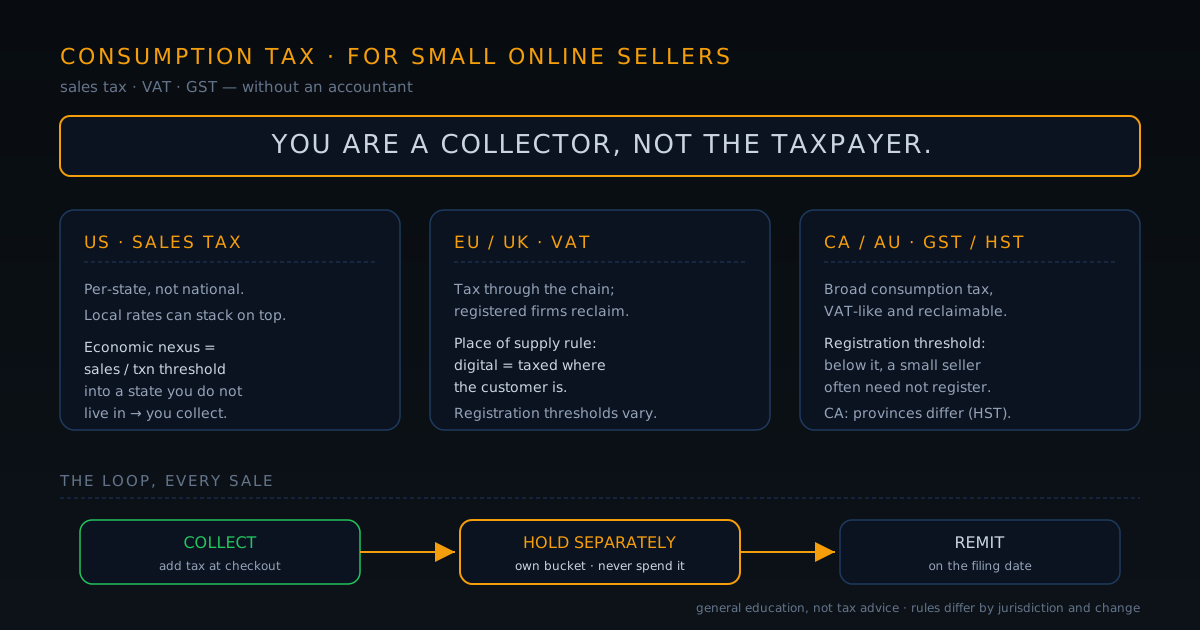
Here is the idea that reorganizes everything. Consumption tax, whether it is called sales tax, VAT, or GST, is not your money. When you charge it, you are acting as an unpaid collector for a government. The customer pays it, you hold it briefly, and you hand it over on a filing date. It never belonged to your business, it is not revenue, and it is completely separate from the income tax you pay on your profit. Once that clicks, the whole topic shrinks from a fog of foreign acronyms into a single repeatable job: figure out where you are obligated to collect, collect the right amount, keep that money apart from your own, and remit it on time. The rest of this post maps the landscape so you can see where you stand, and it ends with the one habit that keeps small sellers out of trouble.
You are the collector, not the taxpayer
Hold onto the distinction because it does more work than any rule you will memorize. Income tax is a tax on your profit, and it genuinely comes out of money you earned. Consumption tax is the opposite in spirit. The economic burden falls on the final customer, and your role is mechanical: you add the tax to the price, you receive it along with the sale, and you forward it to the authority that levies it. If a customer pays you a hundred dollars for a product plus eight dollars of sales tax, you did not make a hundred and eight dollars. You made a hundred, and you are temporarily holding eight dollars that belongs to a state. Treating that eight dollars as income is the single most common way small sellers get themselves into a hole, because they spend it, and then the filing date arrives and the money is gone.
This framing also explains why the rules feel so fragmented. Because the tax follows the customer and the sale rather than your profit, each government wants you to collect according to where the transaction happens and who the buyer is. That is why a US seller worries about individual states, why a digital-goods seller in Europe worries about the customer's country, and why a Canadian seller worries about provincial variations. None of it is arbitrary cruelty aimed at small businesses. It is simply many separate governments each saying the same thing: if you sell to people inside our borders past a certain point, you collect our consumption tax and send it to us. Your job is to find out, for the places you actually sell into, where that point is.
The United States: per-state sales tax and economic nexus
The United States does not have one national sales tax. It has a patchwork run by individual states, and within many states there are local rates layered on top, so the combined rate a customer pays in one city can differ from a town an hour away. For a small seller the headline concept is nexus, which is the connection between your business and a state that obliges you to collect that state's tax. Physical nexus is the old, intuitive kind: you have a presence there, such as a home, an office, an employee, or inventory sitting in a warehouse. That last one matters more than people expect, because storing goods in a fulfillment center can create nexus in that state even if you never set foot in it.
The piece that surprises everyone is economic nexus. After a 2018 Supreme Court decision, states were allowed to require out-of-state sellers to collect tax once they pass a sales or transaction threshold in that state, with no physical presence required at all. The thresholds vary, but a common shape is something like a couple hundred thousand dollars in sales or a few hundred separate transactions into that state in a year. Cross the line and you are expected to register, collect, and remit there. Stay comfortably below it and, for that state, you generally have no collection obligation yet. The practical takeaway is not to memorize fifty rule sets. It is to know that the obligation is triggered by volume into a state, and therefore to keep an eye on which states your sales are concentrating in.
Europe and the UK: VAT and the place-of-supply rule
Value Added Tax works differently and it trips up sellers who assume it behaves like US sales tax. VAT is charged at each stage of a supply chain, and registered businesses can usually reclaim the VAT they paid on their own inputs, so the net tax lands on the final consumer. For a small outside seller the part that bites is the place-of-supply rule, which decides whose VAT applies. For physical goods the location of the goods and the customer matters; for digital products and services the default rule for consumers is that the tax is due where the customer is located, not where you are. That means a digital seller can owe VAT in a customer's country from effectively the first sale, because the usual domestic registration threshold that protects small local businesses does not shield a foreign seller of digital goods in the same way.
There are mechanisms designed to make this survivable rather than impossible. The European Union runs simplified schemes that let a non-EU or cross-border seller register in one place and report sales across member states through a single return, instead of registering separately in every country. There are also import thresholds and rules for low-value consignments that change how VAT is handled on small physical shipments. The United Kingdom, now outside the EU, has its own VAT system with its own registration threshold and its own treatment of imports and digital sales. The honest summary is that if you sell digital products to European or UK consumers in any real volume, VAT is something you must look into early rather than later, and the official tax sites for those regions are where the current numbers live, because they move.
Canada and Australia: GST, HST, and registration thresholds
Goods and Services Tax is the model used in Canada, Australia, and a number of other countries, and conceptually it is close to VAT: a broad consumption tax applied through the chain and reclaimable by registered businesses on their inputs. Canada layers some complexity on top because several provinces combine the federal portion with a provincial portion into a Harmonized Sales Tax, while others run a separate provincial sales tax alongside the federal GST. The reassuring part for a very small seller is the registration threshold. Canada, for instance, has long used a small-supplier threshold in the region of thirty thousand dollars of revenue over a rolling four-quarter period, below which many businesses are not required to register and collect at all. Once you cross it, registration and collection become mandatory.
Australia uses a similar shape, with a GST registration threshold that has sat around seventy-five thousand dollars of turnover for ordinary businesses, and lower or different rules for specific categories. The pattern across all of these systems is consistent enough to lean on: there is a national consumption tax, there is a revenue threshold below which a small operator can often stay unregistered, and there are special rules once you sell across the border into that country. As always, the exact figures and the exact treatment of foreign sellers are published by the national authority and are the thing to verify, not the thing to assume. The Canada Revenue Agency site is the right place to confirm the Canadian numbers; do not rely on a figure you read in a blog, including this one.
Marketplace facilitators may already be doing this for you
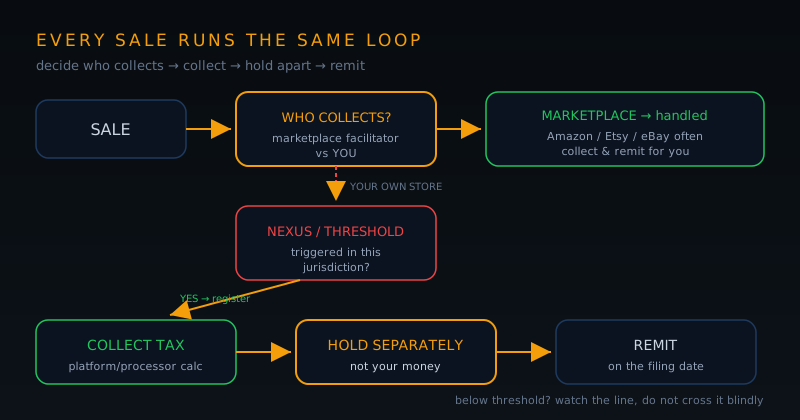
Here is the relief valve that a lot of stressed sellers do not realize they already have. Most large platforms are now treated as marketplace facilitators, which means the law makes the platform responsible for calculating, collecting, and remitting consumption tax on the sales that happen through it. In plain terms, when you sell through Amazon, Etsy, eBay, or a similar marketplace, that platform very often handles the sales tax or VAT on those orders itself. You see the tax collected and remitted on your behalf, and you generally do not file separately for those particular sales. This is genuinely helpful, and it is why a seller who lives entirely on one big marketplace can sometimes operate for a long while without touching the tax machinery directly.
The catch, and the reason this post exists, is that the facilitator only covers sales made on that marketplace. The moment you sell from your own store, through your own checkout, on your own domain, those sales are yours to handle. Nobody is quietly collecting and remitting for you. This split is exactly why a seller can feel safe because Etsy handles it and then be caught off guard when their independent Shopify or self-hosted store crosses a threshold somewhere with no facilitator in the middle. So the practical rule is to draw a clear line between marketplace sales, which are usually covered, and your own-store sales, which are the part you are personally responsible for tracking against thresholds and, when required, registering, collecting, and remitting.
Register, or stay below the line, on purpose
A surprising amount of small-seller anxiety comes from believing you must register everywhere immediately. You usually do not. The whole point of thresholds is that below them, a small operator is not expected to take on the collection burden, and registering where you have no obligation can create work and filing duties you did not need. So the early-stage answer for many jurisdictions is simply this: you are below the line, you are not yet required to collect there, and your job is to watch the line rather than cross it blindly. That is a legitimate, deliberate position, not negligence, as long as you actually know roughly where your sales sit.
There are, though, good reasons to register before you are strictly forced to. In a VAT or GST system, being registered lets you reclaim the tax you paid on your own business inputs, which can be worth real money if you buy a lot of taxable supplies. In some situations registration signals legitimacy to business customers who want a proper tax invoice. And once you can see a threshold approaching, registering a little ahead of the deadline beats scrambling after you have already crossed it and technically should have been collecting. The decision is a judgment call about your volume, your costs, and how close you are to the relevant line, which is exactly the kind of question worth taking to a professional once the numbers get large.
Separate the collected tax so you never spend it
If you remember only one operational habit from this entire post, make it this one, because it prevents the disaster that sinks otherwise healthy small businesses. The tax you collect is not yours, so do not let it sit in the same account as your spending money where it will quietly get used for inventory, ads, or rent. Move it somewhere it cannot be casually touched. The simplest version is a separate bank account, sometimes called a tax bucket, into which you sweep the collected tax on a regular rhythm. When the filing date arrives, the money is already there, and remitting becomes a boring transfer instead of a frightening shortfall. Sellers who skip this step almost always discover, too late, that they spent the government's money and now owe a sum they no longer have.
You can run this discipline at whatever level of formality suits your size. A very small operation might move a rough percentage of each week's sales into the bucket and reconcile it monthly. A larger one might pull the exact collected figures from its platform reports and transfer those precisely. Either way the principle is identical: the moment tax is collected, mentally and physically it stops being part of your usable cash. Treating it as if it were income is seductive because the bank balance looks healthy, but that healthy balance is partly a debt you have not yet paid. Building the separation in early, while the amounts are small and the habit is cheap to form, is far easier than retrofitting it after you are already behind.
Keep records clean enough to file from
Good record-keeping for consumption tax is less about elaborate accounting and more about being able to answer one question at any time: how much did I sell, where did the customers buy from, and how much tax did I collect by jurisdiction. If you can produce that, filing is mechanical, and an accountant you bring in later will charge you far less because you handed them order rather than chaos. The goal is a clean, exportable trail of sales with the location and tax attached to each one, kept somewhere durable rather than scattered across screenshots and memory. This is the unglamorous backbone that makes everything else, from threshold-watching to remitting, possible.
A short, practical checklist of what to retain keeps this concrete:
- A record of every sale with the date, amount, customer location, and tax collected.
- Which channel each sale came through, so you can separate facilitator-handled marketplace sales from your own-store sales.
- Your platform and processor tax reports, exported and saved on a regular schedule rather than left to expire.
- Copies of any registrations, confirmation numbers, and filing receipts for each jurisdiction you collect in.
- A running tally of sales by jurisdiction so you can compare it against the thresholds at a glance.
Let the platform and processor do the arithmetic
You should not be calculating rooftop-level tax rates by hand, and you do not need to. Modern ecommerce platforms and payment processors include tax-calculation features that determine the correct rate for a given customer location at checkout, apply it, and record it in reports you can export. This is one of the strongest reasons to choose a capable platform and processor in the first place, because the difference between a tool that computes and tracks tax for you and one that leaves you to do it manually is the difference between a five-minute monthly chore and a recurring source of errors. Turn these features on, configure them for the places you are registered, and let them carry the arithmetic.
What the software cannot do is decide your obligations for you. A tax engine will happily calculate a rate for any location, but it does not know whether you have crossed a nexus threshold, whether you should be registered somewhere, or whether a particular product of yours is taxed, reduced, or exempt. Those are judgment and registration questions that sit with you. So the right division of labor is clear: the platform and processor handle the computation, collection, and reporting, while you handle the decisions about where you are obligated and what your products' tax status is. Lean on the automation for the parts it is genuinely good at, and keep ownership of the parts that require knowing your own business.
Zero-rated, exempt, and out-of-scope, at a high level
You will eventually meet three words that sound similar and behave differently, and a high-level grasp is enough for most small sellers. Zero-rated means the sale is taxable but the rate applied is zero, which matters in VAT and GST systems because a zero-rated seller can typically still reclaim the input tax they paid; certain exports and specific goods are commonly treated this way. Exempt means the sale falls outside the tax entirely for that category, and crucially an exempt seller usually cannot reclaim input tax on related costs, which is a meaningfully different outcome from zero-rating even though the customer pays no tax in both cases. Out-of-scope means the transaction simply is not within that tax's reach at all, often because of where the supply is deemed to take place.
The reason to know these exist, rather than to master them, is that the category of what you sell can change your obligations more than your sales volume does. Digital products, food, books, children's items, medical goods, and financial services are the sorts of categories that frequently carry special treatment that varies wildly by country. So if your product sits in one of those areas, treat it as a flag to check the specific rules rather than assuming the standard rate applies. For a seller of ordinary physical goods, the standard rate is usually the right default, and the nuance can wait. For a seller of anything unusual, the nuance is exactly where a brief conversation with a professional pays for itself.
The one habit that prevents disasters
Everything above collapses into a single ongoing practice, and it is worth stating plainly because it is the thing that actually keeps small sellers safe. Watch your sales by jurisdiction against the thresholds. Not once, but as a quiet recurring check, because obligations are triggered by crossing a line you can see coming if you are looking. Most messes happen not because a seller decided to ignore the law, but because they never had a running view of where their sales were concentrating, so they sailed past a threshold without noticing and only found out months later when a penalty notice or a backdated bill arrived. The view does not need to be sophisticated. A monthly glance at sales grouped by state or country, set beside the thresholds that matter to you, is enough to give you warning before anything goes wrong.
It helps to be honest about the limits of any guide on this subject, including this one. The numbers change, the rules differ by jurisdiction, and the treatment of foreign sellers is exactly the area where governments keep adjusting. So use this post for the mental model and the habits, and use the official tax authorities and a professional for the specifics that apply to your actual sales. If you internalize that consumption tax is money you collect and hold rather than money you earn, keep it in its own bucket, keep records you could file from, let your tools do the arithmetic, and watch your jurisdictions against the thresholds, you will have done the part that prevents the disasters. The detailed compliance, when your volume justifies it, becomes a manageable task rather than an emergency.
Frequently asked questions
Quick answers to common questions about this topic.
Is sales tax or VAT part of my business income?
No. Tax you collect from customers is money you are holding on a government's behalf and will remit later. It is not revenue and it is separate from the income tax you pay on your profit, which is why you should keep it out of your spending account.
Do I have to register for sales tax everywhere I sell?
Usually not. Most jurisdictions only require collection once you cross a threshold, often measured by sales volume or number of transactions into that place. Below the line you generally have no obligation there yet, so the job is to watch the line rather than register everywhere blindly.
What is economic nexus in the US?
It is a connection to a state created purely by your sales volume into it, with no physical presence required. After a 2018 court decision, states can require out-of-state sellers to collect once they pass a sales or transaction threshold, which vary by state, so you track which states your sales concentrate in.
If I sell on Amazon or Etsy, do I still handle tax myself?
For sales made through those marketplaces, often no, because marketplace facilitator rules make the platform collect and remit on your behalf. But that coverage stops at your own store. Sales through your own checkout are yours to track, register for, collect, and remit where required.
Why is VAT a problem for digital products from the first sale?
Because place-of-supply rules generally tax digital goods sold to consumers where the customer is located, and the small-business registration thresholds that protect local sellers do not shield a foreign digital seller the same way. If you sell digital products into Europe or the UK in real volume, look into VAT early.
What is the single most important habit for staying compliant?
Watch your sales by jurisdiction against the thresholds as a recurring check, and keep the tax you collect in a separate account so you never spend it. Those two habits prevent the most common disaster: crossing a threshold unnoticed and owing money you have already spent.
Related troubleshooting
Was this page helpful?
Your answer stays in this browser, it is not sent anywhere and no account or cookie is involved.