2026 · Novus Stream Solutions (hub)About 13 min readNovus Stream Solutions
How FAQ schema wins rich snippets (and how we rolled it out site-wide)
An FAQ at the bottom of a page, marked up with FAQPage schema, makes it eligible for expandable rich snippets, and expands the page naturally. Here is the whole playbook, from PAA mining to rollout.
Contents
- 1.Overview
- 2.What FAQPage schema actually is
- 3.The eligibility rules that decide whether it shows
- 4.Mining People Also Ask for the right questions
- 5.Writing answers that earn the snippet and serve the reader
- 6.The natural word-count and long-tail benefit
- 7.How we rolled FAQ schema out site-wide
- 8.Validating the markup
- 9.Mistakes that get FAQ schema penalized
- 10.Keeping FAQs accurate as content changes
- 11.Where FAQ schema fits a broader content strategy
Overview
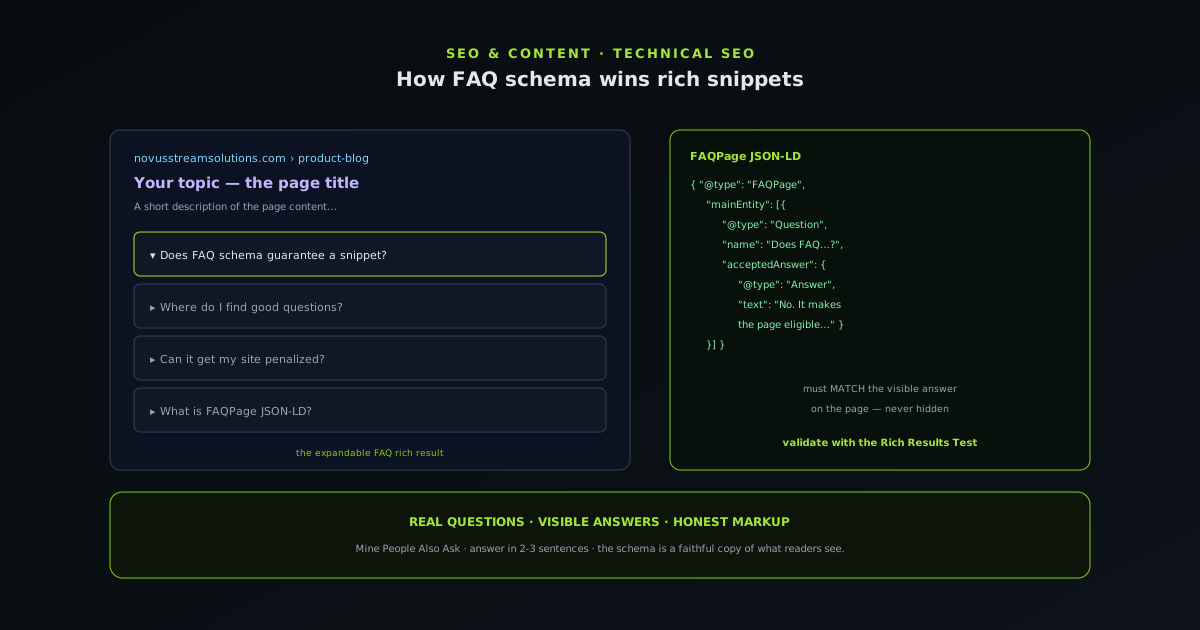
Adding an FAQ to the bottom of a page and marking it up with FAQPage schema is one of the highest-return, lowest-effort things you can do for a page in search. The schema is a small block of structured data that tells Google "this page contains these questions and these answers," which makes the page eligible for an expandable FAQ rich snippet: the accordion of questions you have seen sitting under a search result, taking up more vertical space and answering follow-up questions before the user even clicks. It also has a quiet content benefit: writing genuine People-Also-Ask answers expands the page naturally with the exact phrasing real searchers use. This guide walks the whole playbook, from what the schema is, to the eligibility rules that decide whether it actually shows, to how we rolled it out across every page on this site.
The reason to treat this as a deliberate practice rather than a one-off is that it compounds. Every page that answers real questions, marked up correctly, becomes eligible for richer search treatment and ranks for the long-tail question queries that the FAQ answers verbatim. Across a content library, that is a lot of incremental visibility for a small, repeatable effort per page. The catch is that FAQ schema is easy to do wrong in ways that either fail to qualify or, worse, violate the guidelines, so doing it correctly (genuine questions, genuine answers, matching the visible page) is what separates a durable win from a risk.
What FAQPage schema actually is
FAQPage schema is a type of structured data (machine-readable markup, usually written as JSON-LD in a script tag) that describes a list of questions and their answers on a page. Each entry is a Question with a name (the question text) and an acceptedAnswer with text (the answer), all wrapped in a FAQPage object. Google reads this markup to understand that the page contains a frequently-asked-questions section, and uses it to decide whether to show an FAQ rich result for the page. The markup does not change how the page looks to a human visitor; it is a parallel description aimed at the search engine.
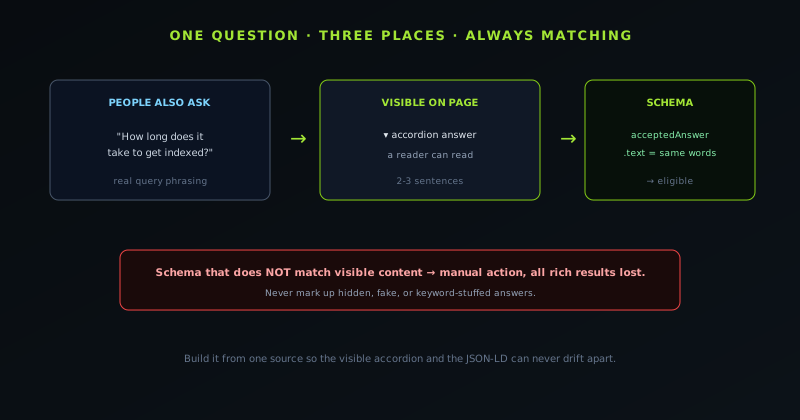
The key principle is that the schema must describe content that genuinely exists and is visible on the page. FAQPage markup is not a place to stuff keywords or invent questions: the questions and answers in the schema must match what a visitor actually sees, because Google checks for this alignment and penalizes mismatches. This is why the right pattern is to write a real, useful FAQ section that appears on the page for human readers, and then describe that same FAQ in the schema. The schema is a faithful machine-readable copy of visible content, not a hidden bonus payload, and treating it that way is what keeps it both effective and compliant.
The eligibility rules that decide whether it shows
Adding FAQPage schema makes a page eligible for an FAQ rich result, but eligibility is not a guarantee: Google decides per query and per page whether to show the enhanced result, and several rules govern whether it can. The questions and answers must be present and visible on the page, not hidden or loaded only behind interactions Google cannot see. The content must be genuine FAQ content (actual questions a user might ask and substantive answers) rather than promotional copy or a way to cram keywords. And Google has, over time, limited which sites and which queries surface FAQ rich results, so even a perfectly marked-up page may not always show the snippet.
The practical takeaway is to do the markup correctly and treat the rich snippet as an upside rather than a certainty. A page with genuine, well-marked-up FAQ content is eligible and will show the rich result when Google chooses to, and even when it does not show the accordion, the page still benefits from the additional content and the long-tail question coverage. Trying to force the snippet with manipulative markup (fake questions, hidden content, keyword-stuffed answers) risks a structured-data manual action that removes all rich results, which is a far worse outcome than simply not getting the accordion. Correct markup of real content is the only durable strategy, and it captures the benefit whether or not the snippet appears on any given day.
Mining People Also Ask for the right questions
The quality of an FAQ depends entirely on asking the questions real people actually ask, and the best free source for those is Google itself, specifically the "People Also Ask" boxes and the autocomplete suggestions that appear when you search your topic. People Also Ask shows the follow-up questions searchers commonly have about a topic, in their real phrasing, and each expanded answer often reveals further related questions. Working through these for your topic gives you a ready-made list of the questions your FAQ should answer, in the exact language your audience uses, which is also the language that matches their search queries.
The discipline is to choose the questions that are genuinely relevant to your page and answer them substantively, rather than grabbing every loosely-related question to pad the list. An FAQ of three to six tightly-relevant questions with real two-to-three-sentence answers is more valuable, to readers and to search, than a sprawling list of marginally-related ones. Autocomplete complements People Also Ask by revealing how searches begin, which surfaces the phrasing and the common qualifiers people attach to your topic. Together these free tools turn FAQ writing from guesswork into a grounded exercise in answering the questions your audience demonstrably has, which is exactly what makes the resulting content both useful and findable.
Writing answers that earn the snippet and serve the reader
A good FAQ answer is concise, complete, and self-contained: it answers the question directly in two or three sentences, gives enough to be genuinely useful, and does not require reading the rest of the page to make sense. This serves both goals at once: a reader scanning the FAQ gets a real answer, and a search engine extracting the answer for a snippet gets a clean, quotable response. Answers that are vague, that dodge the question to push a product, or that trail off without actually answering fail both the reader and the snippet, because neither a human nor a search engine finds them satisfying.
The temptation to over-optimize the answer (stuffing keywords, padding length, or steering every answer toward a sales pitch) works against the snippet and the reader, so the discipline is to write the answer you would want if you had asked the question. Lead with the direct answer, add the essential context, and stop. Where a fuller explanation exists elsewhere on the site, a brief answer can point to it, which both serves the reader and strengthens internal linking. The answers that win snippets are the same answers that genuinely help, which is the recurring theme of doing SEO well: the optimization and the usefulness point the same direction, and writing for the reader is writing for the snippet.
The natural word-count and long-tail benefit
Beyond the rich-snippet eligibility, an FAQ section delivers a quieter but reliable benefit: it expands the page with genuinely useful content in the precise phrasing of real questions, which helps the page rank for the long-tail question queries that the FAQ answers verbatim. A page about a topic that also answers six common questions about that topic covers far more of the ways people actually search for it, and those question-shaped queries are often lower-competition and higher-intent than the broad head term. The FAQ is, in effect, a set of mini-pages targeting specific questions, attached to the main page.
This is why an FAQ is a content win even on pages where the rich snippet never appears. The additional substantive content, written in real query language, gives the page more surface area in search and more reasons to be the answer to a specific question, independent of whether Google shows the accordion. It is the rare optimization that improves the page for readers, expands its keyword coverage, and makes it eligible for an enhanced result, all from one well-written section. The word-count growth is a byproduct of answering real questions well, not padding, which is exactly the kind of expansion search rewards rather than penalizes.
How we rolled FAQ schema out site-wide
On this site, FAQ schema is not a per-page manual task but a built-in pattern, which is what made it feasible to roll out across the whole content library. Each piece of content carries its FAQ as structured data alongside its body, and a shared component renders the FAQ as a visible accordion for readers while emitting the matching FAQPage JSON-LD for search engines from the same source. Because the visible accordion and the schema are generated from one definition, they can never drift out of sync: the answer a reader sees is exactly the answer in the markup, which is precisely the alignment Google requires.
Building it as a shared pattern rather than hand-marking each page had two payoffs. First, consistency: every article, tutorial, and doc gets correct, validating FAQPage markup automatically, with no risk of a malformed block on one page. Second, scale: rolling FAQ coverage across the entire library became a content task (writing the questions and answers) rather than a markup task, since the rendering and schema were handled once. This is the general lesson of doing structured data well at scale: build the markup into the system once, correctly, so that adding it to a new page is just writing the content. The companion piece at Structured data for small sites: the schema that earns rich results (and the schema that does nothing) covers the wider set of schema types worth building in this way, and the live FAQ & support page is the same pattern in production.
Validating the markup
Structured data that is malformed simply does not work: Google ignores invalid markup, so a syntax error or a missing required field means no eligibility, silently. This is why validation is a necessary step rather than an optional one: after adding FAQPage schema, run the page through Google's Rich Results Test, which reports whether the markup is valid and whether the page is eligible for the FAQ rich result. The test catches the common mistakes (a malformed JSON-LD block, a missing answer, a structural error) that would otherwise leave you wondering why the snippet never appears.
Beyond the one-time test, Search Console reports on structured data across the site over time, flagging errors and showing which pages are eligible for enhancements, which is how you monitor that the markup stays healthy as content changes. Validation is the difference between assuming the schema works and confirming it does, and given that invalid markup fails silently, that confirmation is worth the minute it takes. Building validation into the workflow (test a sample after any change to the FAQ rendering, and watch the Search Console enhancements report) ensures the effort of writing FAQs actually translates into the eligibility it is meant to earn, rather than being quietly wasted on markup that does not parse.
Mistakes that get FAQ schema penalized
Because FAQPage markup is powerful, it is also a place where shortcuts get punished, and knowing the failure modes keeps the practice on the safe side. The cardinal sin is schema that does not match visible content: marking up questions and answers that a visitor cannot see on the page, which Google treats as deceptive and can penalize with a structured-data manual action. Closely related is using FAQ markup for content that is not actually a FAQ: stuffing promotional copy, keywords, or arbitrary text into question-and-answer markup to game the rich result. Both invert the purpose of the schema, which is to describe genuine, visible FAQ content.
Other avoidable mistakes include duplicate FAQ markup across many pages with identical questions (which adds no value and can look manipulative), and answers that are thin or evasive rather than substantive. The throughline is that FAQ schema rewards genuine, visible, useful FAQ content and punishes attempts to use it as a keyword-injection or snippet-forcing mechanism. Staying safe is simple in principle: write a real FAQ that helps readers, make it visible on the page, mark up exactly that, and validate it. The sites that get burned are the ones treating the schema as a trick rather than as an honest description of helpful content, which is the same line that separates durable SEO from the kind that eventually gets penalized.
Keeping FAQs accurate as content changes
An FAQ is not a write-once asset, because the answers describe a product, a process, or a topic that changes over time, and an FAQ that drifts out of date becomes both useless to readers and a liability in the schema. If an answer states a price, a limit, a feature, or a fact that later changes, the FAQ now misinforms readers and the schema now describes content that is wrong, and because the visible FAQ and the markup come from the same source, they go stale together. This is why keeping FAQs accurate has to be part of maintaining the content, not a one-time task completed at publication and forgotten.
The discipline is to revisit FAQs when the underlying thing they describe changes: when a product gains a feature, when a limit is adjusted, when a process is updated, the relevant FAQ answers should be checked and corrected. Building FAQ content from a single source that renders both the visible accordion and the schema helps here, because correcting the answer once fixes both the reader-facing content and the markup, with no risk of updating one and forgetting the other. An FAQ that is kept current stays a genuine asset (accurate for readers, valid in the schema, and trustworthy as a search result) while a neglected one slowly becomes misinformation marked up as authoritative. Treating FAQ accuracy as part of ongoing content maintenance is what keeps the rich-snippet benefit from curdling into a source of stale, wrong answers presented with the credibility that structured data lends them.
Where FAQ schema fits a broader content strategy
FAQ schema is most powerful as one piece of a coherent content approach rather than a standalone tactic, because its benefits compound with the other things good content does. An FAQ deepens a page that is already useful, targets the question queries around a topic the page already covers, and links to related deeper content, which means it strengthens a topic cluster rather than sitting in isolation. Adding FAQs across a library of genuinely useful content turns each page into a richer answer and ties the pages together through the internal links the answers naturally include, reinforcing the topical authority the whole library is building.
This is why rolling FAQ schema across an entire content library, as a built-in pattern, returns more than adding it to a few pages would. Every page becomes eligible for richer treatment, covers more of its topic's long-tail questions, and contributes to the interlinked web of content that search rewards. The FAQ is not a bolt-on but an extension of the page's job of being the best answer to its topic, marked up so search engines can recognize it as such. Treating it as part of the content strategy (written for readers, marked up honestly, validated, and rolled out consistently) is what turns a small per-page effort into a compounding, library-wide visibility gain that keeps paying off as the content grows.
Frequently asked questions
Quick answers to common questions about this topic.
Does FAQ schema guarantee a rich snippet?
No. FAQPage schema makes a page eligible for an FAQ rich result, but Google decides per query and per page whether to show it. Correct markup of genuine, visible FAQ content captures the benefit whether or not the accordion appears on a given day.
What is FAQPage JSON-LD?
It is structured data that describes a list of questions and answers on a page, usually in a JSON-LD script tag. Each entry is a Question with an acceptedAnswer, and the markup must match the FAQ content visible to readers on the page.
Where do I find good FAQ questions?
Mine Google's People Also Ask boxes and autocomplete for your topic: they show the real follow-up questions searchers ask, in their own phrasing. Pick the tightly-relevant ones and answer them in two or three substantive sentences.
Can FAQ schema get my site penalized?
Yes, if you mark up questions and answers that are not visible on the page, or use FAQ markup to stuff keywords or promotional copy. Keep the schema a faithful description of a real, visible FAQ section and validate it with the Rich Results Test.
Related troubleshooting
Was this page helpful?
Your answer stays in this browser, it is not sent anywhere and no account or cookie is involved.