2026 · Operating modelAbout 13 min readNovus Stream Solutions
Why we retired Novus Stream Tools: generic utilities that didn't earn their place
Novus Stream Tools was a small collection of streaming utilities we built and then retired. The reason was not that they were broken; it was that they were generic, solving problems that any number of other tools already solved, which is not a reason for a tool to exist.
Contents
- 1.Overview
- 2.What Novus Stream Tools was
- 3.The test they failed
- 4.Why killing something that works is hard
- 5.The crowded-space problem for a small operation
- 6.Buildable is not a reason to build
- 7.Redundancy hides behind functionality
- 8.The question that should have come first
- 9.When shipping another tool is the wrong call
- 10.Generic is not the same as valuable
Overview
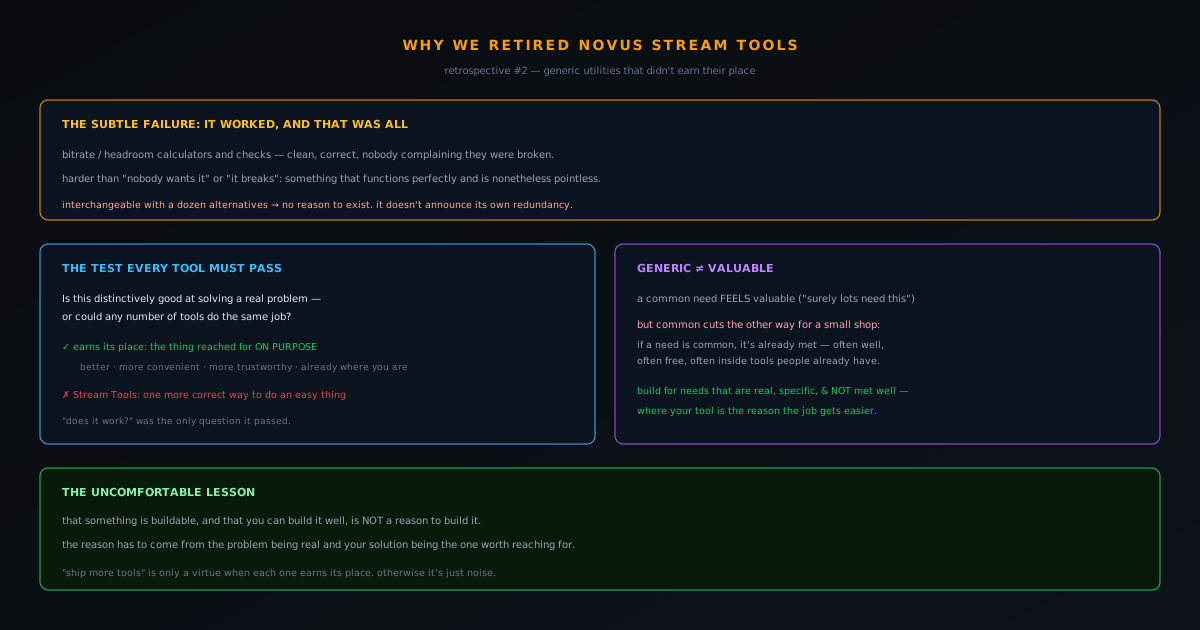
The second retirement is harder to admit than the first, because there was no dramatic problem to point at. Novus Stream Tools (a small set of streaming utilities, the kind of thing that calculates bitrate headroom and helps you sanity-check an upload before going live) worked. The tools did what they said. Nobody was complaining that they were broken. They were retired anyway, and the reason is one that is easy to talk around and important to say directly: they were generic. They solved problems that plenty of other tools already solved, in no distinctively better way, which means they had no real reason to exist. A tool working is necessary but not sufficient; it also has to earn its place, and these did not.
This is a subtler failure than building something nobody wants or building something that breaks. It is building something that functions perfectly and is, nonetheless, pointless: interchangeable with a dozen alternatives, adding nothing to the world that was not already there. That kind of product does not announce its own redundancy. It sits in the portfolio looking like a legitimate offering because it runs and it is real, while quietly failing the only test that actually matters, which is whether it should have been built at all.
What Novus Stream Tools was
Stream Tools was a collection of small utilities aimed at the technical side of going live: things in the territory of bitrate and headroom, the calculations and checks a streamer does to make sure their upload will hold up under real conditions. Each utility was a focused little calculator or checker: give it some inputs, get a useful number or a green light back. As individual pieces of software they were clean and they were correct. If you needed the specific thing one of them computed, it computed it. There was nothing wrong with them at the level of "does this work."
And that was exactly the problem in miniature. "Does this work" was the only question they passed. The harder questions (is this the best way to get this answer, is this something a person would choose this tool for over the alternatives, does this exist for a reason beyond the fact that it was buildable) did not have good answers. The utilities were competent solutions to problems that were already solved competently elsewhere, many times over, often built into the software people were already using. They were a reimplementation of the commonplace, dressed up as a product.
The test they failed
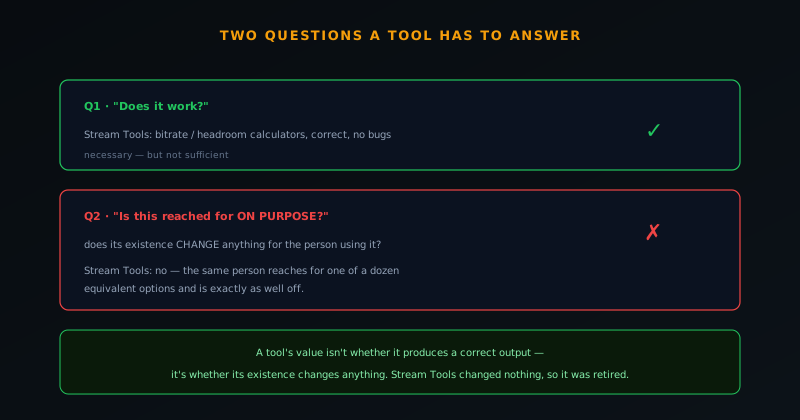
There is a single question that should be asked of any tool before it is built, and it is the question Stream Tools failed: is this solving a real problem that this tool is distinctively good at solving, or could any number of other apps and tools do the same job just as well? If the honest answer is the latter, the tool has no reason to exist, no matter how cleanly it works. A tool earns its place by being the thing someone reaches for on purpose, because it does the job better, or more conveniently, or more trustworthily, or simply because it exists where they already are and the alternatives do not. A tool that is merely one more correct way to do an already-easy thing is not a product; it is an exercise.
Stream Tools failed this test across the board. The problems it addressed were real in the narrow sense that the calculations mattered, but they were not problems anyone struggled to solve, and the tools brought no distinctive advantage to solving them. Contrast that with a tool that does pass the test: the on-device, no-upload approach documented at bgremover.novusstreamsolutions.com/how-it-works is a real "you can only do this this well here"; there was no such claim Stream Tools could make. There was no "you can only do this well here"; you could do this well in many places. That absence is decisive. The value of a tool is not in whether it produces a correct output but in whether its existence changes anything for the person using it, and Stream Tools changed nothing. The same person, without Stream Tools, would reach for one of the many equivalent options and be exactly as well off.
Why killing something that works is hard
There is a specific difficulty in retiring a product that works, which is harder than killing something broken, and naming it helps explain why generic-but-functional products tend to linger. When a product is broken or unwanted, the case for killing it is obvious and the decision, while perhaps disappointing, is clear. When a product works fine (does what it says, has no complaints, runs reliably) there is no obvious problem to point at, which makes the case for killing it feel weak and even perverse. Why retire something that functions? The absence of a visible failure is exactly what lets a pointless-but-working product sit in a portfolio indefinitely, because nothing forces the question of whether it should exist.
This difficulty is why the discipline has to be deliberate rather than reactive. A reactive operation only kills things when they break or generate complaints, which means it accumulates working-but-pointless products that never trigger a reason to reconsider them. A disciplined operation proactively asks whether each product earns its place regardless of whether anything is visibly wrong, which is the only way to catch the products that are failing the real test (having a reason to exist) while passing the superficial one of functioning. Killing Stream Tools required overriding the instinct that says "it works, so leave it," and applying the harder standard that working is necessary but not sufficient. The hardest products to retire are the ones with no obvious flaw, which is precisely why a free-apps studio needs the discipline to retire them on the basis of value rather than waiting for a failure that, for a merely-redundant product, may never come.
The crowded-space problem for a small operation
There is a structural reason generic products are an especially poor fit for a small operation, beyond the general point that they lack a reason to exist: generic needs are, almost by definition, already met, often well and often for free, which puts a new generic tool in the most crowded and least winnable competitive position. If a need is common enough to feel obviously worth building for, it is common enough that many others have already built for it, frequently building the solution into tools people already use. Entering that space with another correct-but-undifferentiated tool means competing on no advantage against established, often-free, already-adopted alternatives, which is the weakest position a product can occupy.
For a small operation specifically, this crowded-space dynamic is fatal because a small operation has no way to win a crowded space through sheer resources. A large company might brute-force its way into a commodity category through marketing or bundling; a one-person operation cannot, so its only viable products are ones with a genuine differentiator or a genuine gap to fill. A generic tool offers neither: it is the fourth identical option in a space that already had three, with no reason for anyone to switch to it. The needs worth building for as a small operation are the specific, under-met ones where a focused tool can be the reason a job gets easier, not the commonplace ones where the tool is one more interchangeable choice. Stream Tools committed the small-operation error of entering a crowded commodity space with nothing to distinguish it, which is a position from which even a perfectly-functioning product cannot succeed.
Buildable is not a reason to build
The uncomfortable lesson at the heart of this retrospective, especially for anyone who enjoys building, is that something being buildable (and buildable well) is not a reason to build it. The pleasure of building creates a bias toward construction: a tractable, well-understood little tool is satisfying to make, and the satisfaction can masquerade as justification. But the question of whether to build something has to be answered by the problem, not by the appeal of the building. A tool that is enjoyable to build and competent when finished but pointless in the world is an exercise dressed as a product, and the enjoyment of making it does not change the fact that it should not have been made.
Separating the urge to build from the decision to build is a real discipline, and Stream Tools is the case that taught it. The right order is to establish that a problem is real, specific, and under-met, and that your solution would be the one worth reaching for, before letting the pleasure of building enter the decision at all. When the justification comes from the problem, building is warranted and the enjoyment is a bonus; when the justification is really just that the thing is buildable and would be fun to make, that is the signal of a product that will function and serve no purpose. The hardest version of this discipline is declining to build something you would enjoy building and could build well, because the problem does not justify it, which is exactly the discipline Stream Tools should have triggered earlier and the one its retirement reinforced. Buildability is a capability, not a reason, and conflating the two is how working-but-pointless products get made.
Redundancy hides behind functionality
The insidious thing about a generic product is that its redundancy is invisible at the level where most evaluation happens, because the product functions correctly and looks like a legitimate offering. When you check whether Stream Tools worked, it passed; when you used it, it did the thing; when you looked at it in the portfolio, it appeared to be a real product among real products. None of those surfaces reveal that the product is redundant, because functionality and legitimacy of appearance are exactly what redundancy hides behind. A working tool does not announce that it duplicates a dozen others; it just works, which is precisely what lets it occupy a place it has not earned.
This is why redundancy is caught only by asking a question that goes beyond functionality: not "does this work" but "does this need to exist given everything else that already does." That question is rarely asked of a working product, because working products do not trigger scrutiny: scrutiny is reserved for things that break or complain. So redundant-but-functional products slip through, accumulating in a portfolio as apparently-legitimate offerings that are actually dead weight. Catching them requires deliberately asking the existence question of products that show no visible problem, which is unnatural precisely because the absence of a problem signals everything is fine. Stream Tools demonstrated that "everything is fine at the functional level" and "this product has no reason to exist" are entirely compatible states, and that distinguishing them requires looking past the functionality that hides the redundancy.
The question that should have come first
The whole Stream Tools episode would have been avoided by asking, at the concept stage, the single question that determines whether a tool deserves to exist: is this solving a real, specific problem that this tool would be distinctively good at, or could any number of existing tools do the same job just as well? Asked early, before building, this question would have surfaced the redundancy immediately: the honest answer for Stream Tools was that the alternatives were plentiful and the tool brought no distinctive advantage, which is a disqualification. The question is cheap to ask and decisive in its answer, and asking it first is the difference between not building a redundant tool and building one and later retiring it.
The reason this question has to come first, before building, is that once a tool is built and working, the sunk cost and the appearance of legitimacy make it much harder to recognize and retire. A redundant tool caught at the concept stage costs nothing to not build; the same redundant tool caught after it is built, functioning, and sitting in the portfolio costs the building effort plus the difficulty of killing something that works. Front-loading the existence question (does this need to exist) is therefore far more efficient than back-loading it into a retirement decision. Stream Tools taught the value of asking it first, as a standard precondition for building anything, so that the redundancy is caught when catching it is free rather than after it has been paid for. The existence question belongs at the start of the build decision, not at the end as a retirement post-mortem.
When shipping another tool is the wrong call
This retrospective is the necessary counterweight to the philosophy of shipping more focused tools, because that philosophy is only a virtue when each tool has a genuine reason to exist, and Stream Tools is the case where it did not. The discipline of preferring a new focused tool over a bigger bloated one assumes the new tool is worth building, that it serves a real, under-met need with a distinctive advantage. When that assumption fails, "ship another tool" stops being good product strategy and becomes mere proliferation, adding redundant products that occupy attention and portfolio space without justifying either. Shipping more tools is good only conditional on each tool earning its place; unconditionally, it is just noise.
Holding both ideas at once (ship more focused tools, but only ones that deserve to exist) is the complete discipline, and Stream Tools shows what happens when the second half is dropped. The tools were appropriately narrow and single-purpose, satisfying the form of the philosophy, but single-purpose toward purposes that did not need a new tool, violating its substance. The philosophy of more focused tools is not a license to build any narrow tool that occurs to you; it is a preference for narrowness conditional on the tool having a reason to exist, and the existence test is what supplies that condition. Stream Tools was the cautionary case that clarifies the philosophy: narrowness is necessary but not sufficient, and the reason-to-exist test is the other half without which "ship more tools" degrades into building redundant utilities. The two retrospectives (this one and the disguised-portfolio one) bracket the philosophy from both sides, showing the failure of building too much under one name and the failure of building too many things that need not exist.
Generic is not the same as valuable
The trap Stream Tools fell into is mistaking generality for usefulness. A utility that does a common, broadly-applicable thing can feel valuable precisely because the thing is common: surely lots of people need this. But commonness cuts the other way for a small operation. If a need is common, it is almost certainly already met, often well, often for free, often inside tools people already have open. Building another generic solution to a well-met common need is competing in the most crowded possible space with no differentiator, which is the weakest position a product can be in. The needs worth building for, especially solo, are the ones that are real and specific and not already met well, where your tool can be the reason the job gets easier, not the fourth identical option.
This connects directly to the discipline of keeping tools single-purpose and shipping more of them: that discipline is only a virtue when each tool has a genuine reason to exist. Shipping more tools is good when each one earns its place; it is just noise when the tools are generic. Stream Tools was the cautionary version: narrow, yes, single-purpose, yes, but single-purpose toward purposes that did not need a new tool. The retirement was the studio correcting that mistake, removing products that occupied attention and a place in the portfolio without justifying either. The honest lesson is uncomfortable for anyone who likes building: that something is buildable, and that you can build it well, is not a reason to build it. The reason has to come from the problem being real and your solution being the one worth reaching for. When it is not, the kindest thing to do with the working tool is retire it. The companion retrospectives cover a product that was secretly several apps and one where the killer was infrastructure cost.
Frequently asked questions
Quick answers to common questions about this topic.
Why were Novus Stream Tools retired?
They were generic utilities with no real differentiation (things users could get anywhere) so they did not earn the attention or maintenance they cost. Retiring them freed focus for tools with a genuine edge.
How do you tell a differentiated tool from a commodity one?
Ask whether it does something meaningfully better or more privately than the alternatives. The Background Remover earns its place with on-device processing and straight-alpha export; a plain utility with no such edge does not.
What is the lesson from retiring commodity tools?
Build where you can be distinctly better, not merely present. A portfolio is stronger with a few differentiated tools than with many interchangeable ones.
Related troubleshooting
Was this page helpful?
Your answer stays in this browser, it is not sent anywhere and no account or cookie is involved.