2026 · Novus Stream Solutions (hub)About 13 min readNovus Stream Solutions
Quarterly reviews for a solo business: ninety minutes that steer the next ninety days
Four times a year I close the laptop to everything except one document and ask what the last ninety days actually proved. This is that ritual: the handful of metrics worth the time, the kill/keep/double-down sort, writing next quarter’s three bets, and the traps that turn reviews into vanity theater.

Contents
Overview
Four times a year I block a morning, close the inbox, silence the phone, and open exactly two documents: last quarter’s review and a blank page. Ninety minutes later the blank page holds the only strategy document this business maintains: what the last ninety days actually proved, which projects live or die, and the three bets the next ninety days will be spent on. It is the highest-leverage recurring appointment on my calendar, and for the first years of this business I skipped it entirely, which is exactly why I can describe what skipping it costs.
Solo operators skip quarterly reviews for understandable reasons. No boss requires one. The word “retrospective” smells of corporate ritual: sticky notes, a facilitator, action items nobody owns. And the weekly rhythm feels like it should be enough: the numbers get looked at, the work gets shipped, the queue stays short. But weekly reviews steer the week, and a business can string together fifty-two well-steered weeks that add up to a badly steered year, because nobody ever climbed high enough to ask whether the road itself pointed anywhere worth going.
What follows is the ritual as I actually run it: why a quarter is the right altitude and the timer is the point, the short list of metrics that earn the meeting, the kill/keep/double-down sort that every project faces without exemption, the one-page document that comes out the other end, the three-bets format that aims the next quarter, and the vanity-retrospective traps that quietly convert the whole exercise into theater if you let them.
The right altitude, and why the clock is the point
A quarter is the shortest period over which a small business generates believable signal. Month to month, the numbers of a small operation are mostly noise: one invoice, one traffic spike, one refund can swing an entire month’s story. Year to year is believable but arrives too late to act on; twelve months is enough time to compound a mistake into a habit. Ninety days sits at the joint: long enough that a trend has to be somewhat real before it shows up, short enough that changing course is still cheap when it does.
The ninety-minute cap matters as much as the ninety-day window. Unbounded reviews fail in one of two directions: they become a wallow through everything that went wrong, or they balloon into a planning fantasy that redesigns the business at a whiteboard until the ambition collapses on contact with the following Monday. The timer forces the review to be a sequence of decisions rather than an experience. I set a literal one, and when it fires I stop, because a review that produced verdicts on eighty percent of the business beats a perfect review that never quite ends.
It stays sane because a different ritual carries the operational load. The weekly hour described in Weekly KPI reviews for operators: one hour that changes decisions watches the gauges (traffic, revenue, queues) and catches problems while they are cheap. The quarterly asks the question the weekly never can: are these the right gauges, on the right vehicle, pointed at the right destination? Different altitude, different questions, and mixing the two is how both get done badly.
The metrics that earn a seat
The metric list is short because the entry test is brutal: a number earns quarterly attention only if a plausible reading of it would change a decision this morning. Revenue passes, but only broken out by stream, because the blended total is where portfolio truths go to hide. This business has had quarters where the headline number sat flat while one stream quietly doubled and another quietly died; the blended view would have said “steady on,” which was the wrong instruction for every single stream individually.
Costs and runway pass the test for the opposite reason: they set the risk budget for everything decided later in the meeting. How aggressive the next quarter’s bets can afford to be is a direct function of how many months the reserve covers; the sizing logic in A cash buffer and emergency fund for business owners is what turns that from a feeling into a number. And hours-by-project passes because time, not money, is a solo operation’s real spend; a project can look profitable right up until you divide by the hours it quietly ate.
Every number gets read as a quarter-over-quarter trend, never as a level, and read with small-sample humility: the discipline from Measuring honestly when the numbers are small applies doubly at review time, when the temptation to narrate noise into story is at its strongest. What never gets a seat: follower counts, cumulative anything, and screenshots of the quarter’s best day. A number that cannot change a decision is decoration, and decoration is what the timer exists to cut.
- Revenue by stream, quarter over quarter: each stream’s trend, never the blended total.
- Costs and months of runway: the number that decides how bold the next quarter can be.
- One demand signal per product: signups, active users, or conversions, chosen in advance.
- Hours spent by project, even roughly: time is the solo operator’s real spend.
- One quality signal (refund rate, support-ticket themes, churn) whichever tells the truth about the product.
Kill, keep, double down: no exemptions
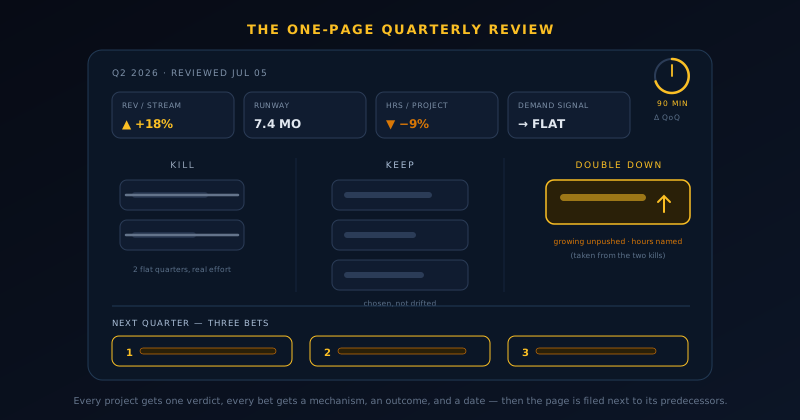
The center of the review is a sort. Every project, product, channel, and recurring commitment gets exactly one verdict (kill, keep, or double down), and nothing is exempt, including the thing I founded the business around and the thing I happen to enjoy most. The power of the exercise is precisely that “keep” must be argued for out loud like the other two verdicts. Unexamined continuation is the natural resting state of a solo business, and it is how a portfolio silently fills up with the walking dead.
Kill has criteria, agreed with myself in advance so the verdict cannot be renegotiated by mood: two consecutive quarters of flat-or-declining results despite honest effort, or a per-hour return sitting at the bottom of the portfolio with no credible story for why next quarter differs. It is the same pre-committed-threshold logic that Validate a business idea before you spend a dollar applies to new ideas, pointed at live ones, and it is harder here, because live projects carry sunk costs wearing sentimental disguises. Killing a mediocre project does not admit failure; it refunds the hours the next bet needs.
Double down has criteria too, because enthusiasm is not evidence: something is growing without being pushed, or its per-hour return sits clearly above the portfolio average, or a visible bottleneck exists that a defined investment would remove. And the verdict arrives with a bill attached: doubling down on one thing requires naming, in the same sentence, where the extra hours come from. A double-down without a named source of hours is a wish, and wishes are what the bets section exists to replace.
Keep is the honorable middle, not the cowardly one: it means deliberately maintaining current effort because the project earns its hours at a steady rate. Most of a healthy portfolio is keeps, most quarters. The distinction that matters is between a chosen keep (reviewed, argued, written down) and a drifted one. The first is strategy in Porter’s old sense, choosing what not to do; the second is just gravity, and gravity never once built a business.
One page, or it did not happen
The review’s output is a single page: the numbers strip across the top, the verdict list in the middle with one sentence of reasoning per verdict, and the three bets at the bottom. Dated, filed next to its predecessors, done. The single-page constraint is not minimalism for its own sake: a page forces verdicts where a document invites narration, and it stays short enough that I will genuinely reread it, which is the entire mechanism by which the ritual compounds from quarter to quarter.
The highest-value ten minutes of the whole ninety happen before any dashboard opens: reading the previous quarter’s page cold. Which bets paid? What did I believe ninety days ago that turned out to be false? Memory is an unreliable narrator with a strong incentive to smooth the story; the page is the deposition. The gap between what I predicted and what actually happened is the most educational data this business produces, and it only exists because the prediction was written down before the outcome arrived.
Format is irrelevant (a doc, a plain-text note, a sheet of paper in a folder), but the constraint is not. When a review wants a second page, that is the tell that describing has replaced deciding, and I cut until the verdicts stand alone. The full history of this business now fits in a folder thinner than one quarter’s receipts, and it is the one document here I would grab in a fire.
Three bets, written like bets
The forward-looking half of the page is exactly three bets, and the word is chosen deliberately. A bet is a falsifiable sentence: “I bet that doing X will produce Y by this date.” Not “focus more on the newsletter,” but “publishing the weekly teardown format for twelve straight weeks gets the list past eight hundred.” The format forces a mechanism, a measurable outcome, and a deadline into the same sentence, which is everything a goal, phrased as a goal, usually gets to avoid.
Three is a capacity statement, not a magic number. A quarter of a solo operation holds perhaps two hundred discretionary hours after the recurring load of shipping, support, and admin, and bets that ignore that arithmetic are fantasies with deadlines attached. The count also disciplines ambition in a useful direction: when only three slots exist, a mediocre idea has to beat a good one to get in, which is a much higher bar than “sounds worth trying.” In practice one bet aims at the double-down verdict from the sort, one aims at the weakest link the numbers exposed, and one is allowed to be exploratory, sized so that failing teaches something real and costs little.
Everything else (the feature ideas, the channel experiments, the someday list) stays on the backlog without guilt. The bets are not a to-do list; they are the answer to “what is this quarter for,” and the operational work continues around them regardless. The test at the next review is binary per bet: did Y happen by the date, or not. Partial credit is where calibration goes to die, so partial credit does not exist on the page.
The vanity retrospective
The failure mode of self-review is not skipping it; it is performing it. The vanity retrospective looks diligent: a highlight reel of the quarter’s best days, cumulative charts that mathematically cannot go down, effort tallied as though hours were output, and a conclusion that everything is directionally fine. It feels like accountability and functions as anesthesia. I know the shape intimately because I produced several before noticing that not one of them had ever changed a single decision, which is the tell that a review has gone decorative.
The structural problem is that the review has an audience of one, and the reviewer is also the defendant. So the fixes have to be structural too. Cumulative charts are banned from the page; only quarter-over-quarter deltas appear. Results get compared against the written bet, never against zero: “grew the list by two hundred” reads very differently sitting next to “the bet was eight hundred.” And the page carries one mandatory line borrowed from the spirit of pre-registration: what am I avoiding looking at? The answer to that line is usually the most valuable sentence on the page.
The last guardrail is a failed-quarter protocol: a bad quarter honestly reviewed is worth more than a good one flattered, because the review’s job is calibration, not motivation. Morale is real and it matters, but it gets managed elsewhere: shipped work, closed deals, actual days off. The one document whose only purpose is telling the truth cannot moonlight as a pep talk; a page that must make me feel good is a page that can no longer inform me.
The agenda, on the clock
For the operators who want mechanics, here is the ninety minutes as it actually runs. The timeboxes are targets rather than law, but the sequence is deliberate: history before data, data before verdicts, verdicts before bets, and logistics last, so that decisions become calendar entries before the meeting is allowed to end. Running the steps out of order breaks the machine in predictable ways: open the dashboards first and the numbers start auditioning for a story before last quarter’s predictions have had their say; write the bets before the sort and they attach themselves to projects the sort was about to kill.
The twenty-minute numbers step carries a dependency worth stating: records that already exist. If assembling the strip takes an hour of spelunking through exports, the fix is not a longer review; it is the weekly habit and tidy books feeding it, so the quarterly can consume numbers instead of manufacturing them. My standing rule is that the review reads systems; it never builds them, and anything discovered missing becomes a task for an ordinary week.
The final ten minutes are the ones that make the meeting real. A kill verdict is work (a product to sunset, pages to redirect, subscribers to inform), and unless that work lands on the calendar before the timer dies, the killed project shambles on for another quarter by pure inertia. The same goes for the review itself: the next quarter’s slot gets booked before this one closes. A ritual that depends on remembering is a ritual that has already ended.
- 0:00–0:10: read last quarter’s page cold, before any dashboard is open.
- 0:10–0:30: fill the numbers strip from existing records; collect, don’t explore.
- 0:30–1:00, the sort: every project gets kill, keep, or double down, plus one sentence of why.
- 1:00–1:20: write the three bets, each with a mechanism, a measurable outcome, and a date.
- 1:20–1:30: file the page, book next quarter’s slot, and calendar any kill logistics.
What a year of pages compounds into
The first review feels thin: one page, some shaky numbers, three bets made with wide error bars. The value arrives around review four, when the folder holds a year: four numbers strips forming an actual trend, four rounds of bets scored against reality, and a written record of what I believed at each point versus what happened next. Patterns emerge that no single quarter could show. My bets on new-audience growth ran systematically optimistic by roughly half; my bets on product improvements paid off earlier than predicted. The following year’s bets were shaped by exactly that, and their calibration measurably improved.
The portfolio effects compound alongside the calibration. Killing gets easier with practice and starts happening earlier, before sunk costs metastasize into identity; the survivors collect the reclaimed hours, and the business consolidates around what demonstrably works rather than what was fun to start. Over a few years the sort has quietly rebuilt this operation (several beloved projects retired, a couple of unglamorous ones promoted into the core), and no individual verdict was ever more than ninety minutes’ worth of dramatic.
Six hours a year. That is the entire cost of the ritual: four ninety-minute appointments that, between them, decide what a business of one is actually for. Everything else in the operating stack (the weekly numbers, the support rhythm, the content cadence) steers the vehicle from inside it. This is the appointment where you pull over and check the map, and it is the cheapest strategy department you will ever run.
Frequently asked questions
Quick answers to common questions about this topic.
How long should a quarterly review take for a solo business?
Ninety minutes, capped with a literal timer. Unbounded reviews fail in two directions: they become emotional wallows through everything that went wrong, or whiteboard fantasies that redesign the business until the ambition collapses on contact with Monday. The cap forces decisions rather than exploration: ten minutes rereading last quarter’s page, twenty collecting numbers, thirty sorting every project into kill, keep, or double down, twenty writing the next quarter’s three bets, and ten for filing and calendar logistics. A review that reaches verdicts on most of the business beats a perfect one that never ends.
What metrics should a solo operator review quarterly?
Only numbers that could plausibly change a decision that morning. Five usually cover it: revenue broken out by stream (never the blended total, which hides portfolio truths), costs and months of runway (they set the risk budget for the quarter’s bets), one demand signal per product chosen in advance, rough hours spent by project (time is the real spend), and one quality signal such as refund rate or support-ticket themes. Read everything as a quarter-over-quarter trend with small-sample humility. Follower counts, cumulative charts, and best-day screenshots stay out; they decorate rather than decide.
What does kill, keep, double down mean in practice?
Every project, channel, and recurring commitment receives exactly one verdict per quarter, with nothing exempt. Kill triggers on pre-agreed criteria: typically two consecutive flat-or-declining quarters despite honest effort, or a bottom-of-portfolio return per hour with no credible turnaround story. Double down requires evidence rather than enthusiasm: unpushed growth, clearly above-average per-hour returns, or a removable bottleneck, plus a named source for the extra hours. Keep means consciously maintaining current effort, argued for like the other verdicts. The point of the exercise is eliminating unconscious continuation, which is the default state of a solo portfolio.
How is a quarterly review different from a weekly review?
Altitude. The weekly review is operational: watch the gauges, catch problems while they are cheap, decide where this week’s hours go. It assumes the current projects and metrics are the right ones. The quarterly review interrogates exactly those assumptions: whether these are the right gauges, on the right vehicle, pointed at the right destination. It kills and promotes projects, rewrites the bet list, and resets what the weekly review will watch for the next ninety days. Mixing the two ruins both: strategy questions bloat the weekly hour, and operational detail eats the quarterly’s ninety minutes.
How do I avoid a vanity retrospective?
Structurally, because willpower loses to an audience of one. Ban cumulative charts from the review page: they cannot go down, so they cannot inform. Compare every result against the written bet from ninety days ago, never against zero. Include a mandatory “what am I avoiding looking at?” line, which usually yields the most valuable sentence on the page. Score bets as binary (the outcome happened by the date or it did not) because partial credit destroys calibration. And keep morale management out of the document entirely; a page that must make you feel good can no longer tell you the truth.
Related troubleshooting
Was this page helpful?
Your answer stays in this browser, it is not sent anywhere and no account or cookie is involved.