2026 · Novus Stream Solutions (hub)About 15 min readNovus Stream Solutions
Pre-orders and pre-selling: fund a first product run without debt
A pre-order is two things at once: the money to pay your supplier and the strongest possible proof that anyone wants what you are making. This is how to run one honestly, what the MOQ math actually looks like, and when pre-selling quietly destroys trust instead of building a business.
Contents
- 1.Overview
- 2.A pre-order is financing and proof of demand in the same transaction
- 3.The MOQ problem that pushes you toward pre-selling in the first place
- 4.The break-even math: how many pre-orders actually cover the run
- 5.Deposit pre-orders versus pay-in-full, and which protects whom
- 6.Fund-or-refund: the threshold that removes your downside
- 7.Setting a ship date you can actually hit, with a real buffer
- 8.Communicating delays early, because silence is what actually destroys trust
- 9.What the law and your customer reasonably expect of a pre-order
- 10.The cash-flow trap: do not spend the money before you have shipped
- 11.When pre-selling backfires and you should not do it
- 12.How this differs from forecasting and from costing a product
Overview
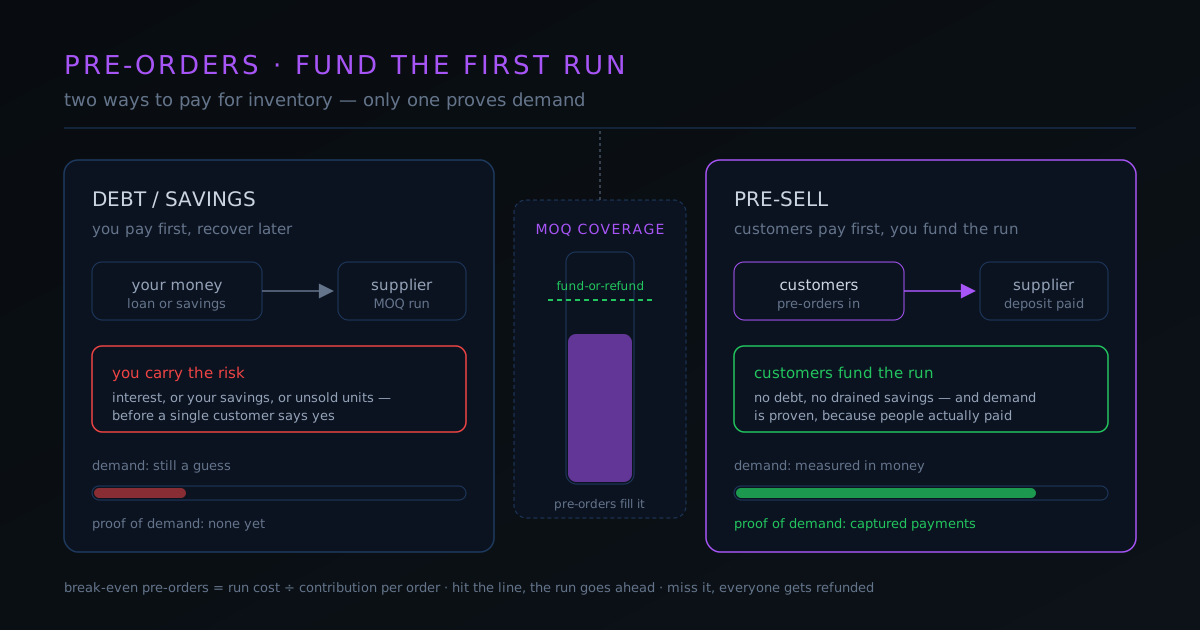
There is a moment early in every physical-product business where the idea is real enough to cost money but not yet real enough to have made any. You have a sample you are proud of, a supplier who will make a batch, and a quote that assumes you order far more units than you can comfortably pay for. The conventional answers are to borrow the money, drain your savings, or shrink the dream until it fits your bank balance. All three put the entire risk on you before a single customer has confirmed they want the thing. There is a fourth path that flips the order of operations: let the people who want the product pay for it before it exists, and use that money to fund the run.
That is pre-selling, and the reason it is so powerful is that a pre-order does two jobs at once. It is financing, because the cash arrives before you owe your supplier the balance. And it is the single strongest form of demand validation you can buy, because nothing proves people want something like the fact that they paid for it. Surveys lie, waitlists inflate, likes mean nothing. A captured payment is a fact. This post is about running that honestly: the math that tells you how many pre-orders you actually need, the structures that protect both you and the buyer, and the specific situations where pre-selling backfires badly enough that you should not do it at all.
A pre-order is financing and proof of demand in the same transaction
Treat these as two separate wins, because most people only notice the first one. The financing win is obvious: instead of paying your supplier from a loan or your own account and waiting months to recover it through sales, you collect the money up front and the customer carries you. Your cash conversion cycle, normally a slow and stressful thing for a product business, briefly runs in reverse. You are paid before you pay. That alone can be the difference between a viable first run and a dream that stalls because nobody will lend an unproven founder a few thousand dollars at a sane rate.
The validation win is quieter but arguably more valuable. Every other test you can run before launch is a proxy. Ad click-through estimates interest, an email signup estimates intent, a smart-survey panel estimates willingness. A pre-order skips the proxies entirely and measures the only thing that matters, which is whether a real person will move real money to own this. If forty people pre-order, you do not have to wonder whether the market is there for the first batch; forty people just told you, in the most expensive language they have. This is why a serious pre-sell belongs alongside the cheaper validation tests rather than instead of them. Run the cheap tests first to decide whether to bother, then let the pre-order confirm it with money.
The MOQ problem that pushes you toward pre-selling in the first place
Manufacturers do not want to make twelve of anything. Setting up a production line, dyeing a batch of fabric, or running an injection mould has fixed costs that only make sense spread across a meaningful quantity, so suppliers quote a minimum order quantity, or MOQ. For a first-time maker that number is often uncomfortably large: five hundred units when you hoped for fifty, a thousand when you wanted a hundred. The MOQ is the wall that turns a fun side project into a real capital decision, because it forces you to buy inventory in a chunk size the market has not yet agreed to absorb.
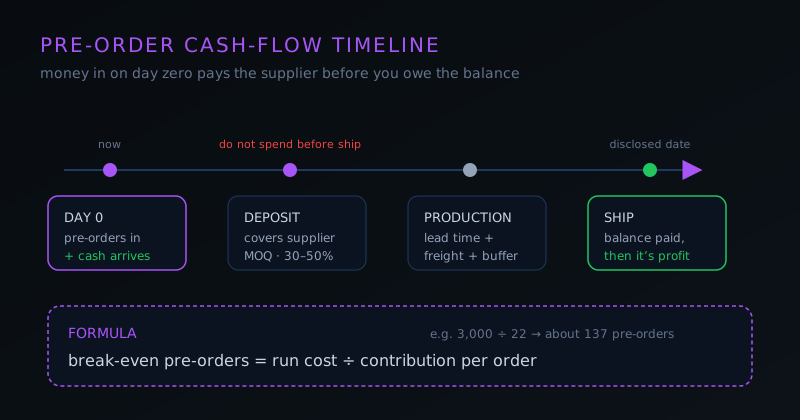
You usually cannot negotiate the MOQ down to nothing, but you can change who pays for it and when. A typical arrangement is a deposit of thirty to fifty percent to start production and the balance due before the goods ship or leave the supplier's control. That split is the hinge the whole pre-order strategy swings on. If you can collect enough pre-order money to cover the deposit, production starts on the customers' dime. If you collect enough to cover the deposit and most of the balance, you may never need to put your own capital at risk at all. The supplier's payment schedule and your pre-order schedule are two halves of the same timeline, and the entire trick is making them line up.
The break-even math: how many pre-orders actually cover the run
Here is the number that decides whether a pre-sell is even worth launching. Take the total cost of the production run, including the units, freight, duties, and any tooling. Then work out the contribution per order, which is the pre-order price minus the per-unit landed cost and minus the variable costs you incur on that specific sale, such as payment processing fees and the eventual shipping to the customer. Your break-even pre-order count is the run cost divided by the contribution per order. That single division tells you the threshold at which the run pays for itself.
Make it concrete. Suppose your run costs three thousand dollars all in. You plan to pre-sell at forty-five dollars, your landed cost per unit is eighteen, and your per-order variable costs (processing plus customer shipping) are about five dollars. Your contribution per order is forty-five minus eighteen minus five, which is twenty-two dollars. Three thousand divided by twenty-two is roughly one hundred and thirty-seven. That is how many pre-orders it takes to fully fund the run from customer money alone. If your MOQ is five hundred units, those one hundred and thirty-seven pre-orders fund the production but leave you holding three hundred and sixty-three units of inventory you now have to sell after launch, which is a separate and real risk. If you only need to cover the deposit to start, the number is far smaller, but so is your protection.
Run that math before you design a single graphic. It tells you three things at once: whether the price you want to charge can ever fund the run, how many people you realistically need to reach to hit the count, and whether your audience is even large enough to make those numbers plausible. A founder with two hundred email subscribers and a break-even of one hundred and thirty-seven is asking for a sixty-eight percent conversion rate, which does not happen. The math will tell you to grow the audience first, or shrink the run, long before the market does.
Deposit pre-orders versus pay-in-full, and which protects whom
There are two honest ways to take pre-order money, and they trade your risk against the customer's. A pay-in-full pre-order collects the entire price up front. It gives you the most cash to work with, makes the funding math simplest, and means buyers are fully committed, but it also puts the customer's whole payment at risk for the longest time and raises the trust bar you have to clear. A deposit pre-order collects a smaller amount now, often ten to twenty-five percent, with the balance charged when you are ready to ship. It is gentler on the buyer and easier to say yes to, but it leaves you exposed if a chunk of depositors do not pay the balance, and it may not cover your supplier deposit on its own.
The right choice depends on how much your audience already trusts you and how solid your supply chain is. A maker with a loyal following and a proven factory can ask for pay-in-full and customers will shrug and pay, because the perceived risk is low. A newer brand is usually better off with a small refundable deposit, because it lowers the barrier to commit while still producing a real, countable signal of demand. Whatever you choose, your payment processor matters here: some let you authorise a card now and capture the charge only when you ship, which is effectively a zero-risk reservation for the customer and a strong yes for you. Decide the structure before you write the offer, because it changes every promise you are about to make.
Fund-or-refund: the threshold that removes your downside
The structure that turns pre-selling from a gamble into something genuinely safe for you is the fund-or-refund threshold, borrowed from how all-or-nothing crowdfunding works. You announce a count and a deadline up front: if at least the break-even number of people pre-order by a certain date, the run goes ahead and everyone is charged or shipped; if you fall short, you refund every deposit in full and nobody is out anything. Kickstarter built an entire platform on this single idea, and you can replicate it on your own store with nothing more than a clear policy and the discipline to honour it.
What this does is remove the scenario that wrecks most first-time pre-sells: ordering a run on faith, falling short of the demand you assumed, and being stuck with a garage full of inventory and a maxed-out card. With a fund-or-refund threshold you never commit your supplier deposit until the customer money that justifies it has actually arrived. The downside case is not a loss; it is a refund, an apology, and a lesson that the demand was not there yet, which is exactly the lesson you wanted to learn before spending money rather than after. The cost is a little ego and the awkwardness of telling backers it did not hit. That is a cheap price for never being the founder with a thousand unsold units.
Setting a ship date you can actually hit, with a real buffer
The fastest way to turn a successful pre-sell into a customer-service nightmare is to promise a ship date you guessed at. Backers anchor hard on the date you give them, and every day past it erodes the goodwill that made them pre-order in the first place. The fix is to build your date from the supplier's real lead time plus an honest buffer, not from optimism. Ask your factory for their production lead time, add the freight transit time (sea freight from Asia to North America commonly runs four to eight weeks on its own), add customs clearance, add the time to receive, inspect, and pack, and then add a buffer on top of all of it for the thing that always goes wrong.
A practical rule is to take your best-case internal estimate and add somewhere between thirty and fifty percent before you publish it to customers. If everything you can see adds up to three months, tell backers four. Under-promising and shipping early is one of the few delight moments available to a small brand, and it costs you nothing but the temptation to look fast. Publishing an aggressive date to seem impressive, then slipping it twice, costs you refund requests, chargebacks, and a reputation you cannot easily rebuild. The buffer is not padding; it is the difference between a delay you absorb quietly and a delay your customers find out about the hard way.
Communicating delays early, because silence is what actually destroys trust
This is the cardinal rule of pre-selling, and it is worth stating plainly: customers will forgive a delay, but they will not forgive being kept in the dark about one. The damage from a late product is almost never the lateness itself. It is the three weeks of silence before the customer had to email you to ask what was going on, the feeling that their money disappeared into a void, the slow conversion of a patient supporter into someone disputing the charge with their bank. The moment you know a date is going to slip, you send the update. Not when you have a new date locked, not when it is convenient, the moment you know.
Good delay communication is specific and unglamorous. Tell people what happened, what you are doing about it, and the new realistic date, and resist the urge to over-apologise or over-explain. A short, honest note that the factory found a defect in the first run and is remaking it, with a new ship window two weeks out, lands far better than a cheerful silence followed by a surprise. Build a simple cadence into your plan from the start: an update when production begins, one when goods leave the factory, one when they clear customs, one when shipping starts. People who feel informed wait happily. People who feel ignored file chargebacks, and a cluster of chargebacks can get your payment account frozen at the worst possible moment.
What the law and your customer reasonably expect of a pre-order
This is education rather than legal advice, and the specifics vary by where you and your buyers are, so treat it as the shape of the obligation rather than the letter of it. Broadly, when you take money for a product you have not yet delivered, consumer-protection norms in most markets expect you to ship within a reasonable and disclosed timeframe, to tell the customer clearly that it is a pre-order rather than a stocked item, and to make refunds available if you cannot deliver what you promised. The unifying principle is that the buyer should not be surprised: if they knew they were pre-ordering and you ship in the window you stated, you are on solid ground.
The practical implications are simple and worth doing whether or not a regulator is watching. State the expected ship window prominently at checkout, not buried in the terms. Keep the pre-order money available to refund rather than treating it as spent, which connects directly to the cash-flow trap in the next section. Honour refund requests promptly and without a fight, because a clean refund preserves a relationship and an obstructed one becomes a chargeback and possibly a complaint. None of this is onerous. It is mostly the same honest behaviour that keeps customers happy anyway, formalised enough that you can point to it if anyone asks. When in doubt about a specific jurisdiction or a large campaign, a short conversation with a local advisor is cheap insurance.
The cash-flow trap: do not spend the money before you have shipped
Here is the failure that has sunk more pre-sells than any supply problem, and it is entirely self-inflicted. The money arrives, the bank balance looks healthy for the first time, and it is intoxicating. So you pay yourself a little, you buy the nicer packaging, you start a second product, you spend on ads to bring in more pre-orders. Then the supplier's balance comes due, or freight costs more than quoted, or a batch needs remaking, and the money that was supposed to fund the run is no longer there. Now you genuinely cannot deliver, and you have converted a funded order into an obligation you cannot meet with other people's money.
The discipline that prevents this is to mentally, and ideally literally, ring-fence pre-order money as a liability rather than revenue. It is not yours until the customer has the product in hand. Keep it where you can refund it. Pay the supplier and the fulfilment costs out of it, and treat anything left over as untouchable until the run has actually shipped. Only at that point does the leftover become real profit you can spend or reinvest.
- A simple test before any pre-order pound or dollar leaves the account:
- Does this spend get product into the buyer's hands? If not, it waits.
- If every depositor asked for a refund tomorrow, could you pay them all back today?
- Have I paid the supplier deposit and reserved the balance before spending on anything else?
- Is this expense in my run cost already, or am I quietly inventing a new one?
- Would I be comfortable explaining this purchase to a backer who is still waiting?
When pre-selling backfires and you should not do it
Pre-selling is not a universal tool, and the cases where it goes wrong are predictable enough to list. The clearest is an untested supply chain. If you have never produced this product with this supplier before, every estimate is a guess, and pre-selling converts your guesses into promises with other people's money attached. Make the first run on your own risk if you possibly can, prove the factory and the freight path work, and pre-sell the second run when your dates are grounded in something real. The other classic failure is timing-sensitive goods: fashion tied to a season, anything perishable, or a product whose appeal expires. A delay that is survivable for a durable good is fatal for a holiday item that arrives in January, and pre-order delays are the norm, not the exception.
The third trap is the one that catches the most enthusiastic founders: pre-selling to an audience that does not exist yet. A pre-order is a conversion event, and you cannot convert people you have not reached. If your entire list is your friends and family, your break-even count is a fantasy, and a public fund-or-refund campaign that visibly fails can cost you the credibility you were trying to build. In that situation the honest move is to spend the season growing an audience and validating cheaply first, then pre-sell once there are enough people to make the math plausible. Pre-selling rewards brands that already have attention; it punishes brands that confuse a product idea with a business.
- Do not pre-sell when:
- You have never run this product through this supplier and freight path before.
- The product is seasonal, perishable, or otherwise tied to a date a delay would blow past.
- You have no audience to convert, so the break-even count is wishful thinking.
- You cannot afford to refund every deposit if the run falls short.
How this differs from forecasting and from costing a product
It helps to place pre-selling next to the other inventory decisions so you know which tool you are reaching for. Seasonal forecasting is what you do once you already sell something and need to predict how much to stock for a known demand pattern, smoothing the year so you neither stock out nor drown in inventory. Pre-selling is the opposite situation: you do not yet know the demand, so instead of predicting it you measure it directly by asking people to pay. Forecasting refines a curve you can already see. Pre-selling discovers whether there is a curve at all.
Costing a product is the prerequisite that makes pre-selling possible rather than an alternative to it. You cannot set a pre-order price, compute contribution per order, or know your break-even count until you have done the honest landed-cost math, the units plus freight plus duties plus the per-order fees that quietly erode every sale. Get the true cost wrong and a successful pre-sell can still lose money on every unit, which is the worst outcome of all because you funded your own losses with customer goodwill. Do the costing first, run the cheap validation, then let the pre-order be the expensive, decisive confirmation that turns an idea into a funded first run without a single dollar of debt.
Frequently asked questions
Quick answers to common questions about this topic.
How many pre-orders do I need before I place the production order?
At minimum, enough to cover your supplier's deposit, but the safer target is your break-even count, which is the total run cost divided by your contribution per order (pre-order price minus landed unit cost minus per-order variable fees). Hitting break-even means the run is fully funded by customer money. Set that count as a public fund-or-refund threshold so you never commit the supplier deposit until the demand to justify it has actually arrived.
Should I charge the full price or just a deposit up front?
It depends on how much your audience trusts you and how solid your supply chain is. Pay-in-full gives you the most cash and the simplest funding math but raises the trust bar and exposes the customer's whole payment for longer. A small deposit is easier for a newer brand to sell and still produces a real demand signal, but may not cover your supplier deposit alone. Some processors let you authorise now and capture on ship, which is effectively zero-risk for the buyer.
What is a fund-or-refund threshold and why use one?
It is a public commitment that the run only goes ahead if you reach a set number of pre-orders by a deadline; if you fall short, you refund everyone in full. It is the same all-or-nothing model crowdfunding platforms use. The point is that it removes your downside: you never spend a supplier deposit on faith, so the worst case is a refund and a lesson rather than a garage full of unsold inventory.
What ship date should I promise pre-order customers?
Build it from real numbers, not optimism. Add up the supplier's production lead time, freight transit (sea freight to North America is often four to eight weeks), customs, and your receive-inspect-pack time, then add a buffer of roughly thirty to fifty percent on top before you publish it. Shipping early delights people; slipping a date you oversold triggers refunds and chargebacks. Under-promise and beat it.
What happens if my pre-order ships late?
A delay itself rarely loses customers; silence about it does. The moment you know a date will slip, send a specific, honest update with what happened and a new realistic window, and never wait for customers to chase you. Build a simple update cadence into the plan from the start. People who feel informed wait happily; people who feel ignored file chargebacks, and a cluster of those can get your payment account frozen at exactly the wrong time.
When should I not pre-sell at all?
Avoid it when your supply chain is untested and every date is a guess, when the product is seasonal or perishable so a normal delay would blow past its window, when you have no audience to convert and the break-even count is wishful thinking, or when you could not afford to refund every deposit if the run fell short. In those cases, fund the first run on your own risk if you can, grow your audience, and pre-sell the next run when the numbers are grounded in something real.
Related troubleshooting
Was this page helpful?
Your answer stays in this browser, it is not sent anywhere and no account or cookie is involved.