2026 · Novus Stream SolutionsAbout 10 min readNovus Stream Solutions
From freelancer to agency: the leverage ladder and what breaks at each rung
Every busy freelancer hears the same advice: hire someone, become an agency. The margin math is real, and so is the list of things that break on the way up. A clear-eyed map of the ladder.
Contents
- 1.Overview
- 2.Rung zero, revisited: the ceiling that starts the conversation
- 3.Rung one: subcontracting, the underrated middle
- 4.Rung two: the first employee, and the math nobody quotes
- 5.Rung three: the small agency, where systems are the product
- 6.The rung math, in actual numbers
- 7.The decision framework: climb, stay, or productize
- 8.Altitude is a choice, not a verdict
Overview
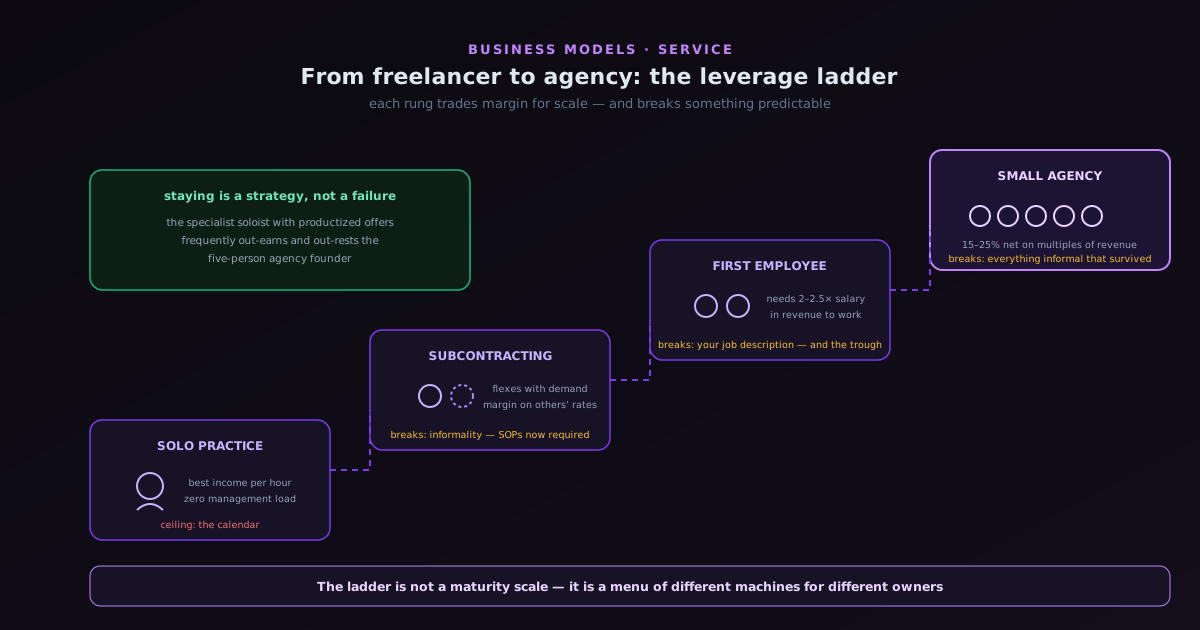
The successful freelancer's dilemma arrives on schedule, usually in year two or three: the calendar is full, the rates have been raised twice, demand still exceeds capacity, and every adviser, podcast, and peer says the same word: hire. Become an agency. Stop selling your hours and start selling other people's. The advice is not wrong; agencies built this way mint genuine wealth for their founders, and the leverage math is real. What the advice omits is the fine print: each rung of the ladder trades margin for scale, replaces work you chose with work you did not, and breaks, predictably and at known points, the systems and identity that made the solo practice succeed.
This article maps the ladder honestly: what each rung pays, what it costs, what breaks at the transition, and the criteria for climbing versus the legitimate, undersold strategy of staying deliberately small. The framing assumption from the rest of this series holds: there is no correct altitude, only correct matching between the structure and what the founder actually wants the business to do for their life.
Rung zero, revisited: the ceiling that starts the conversation
The solo practice's economics are covered elsewhere in this series, but the ceiling deserves a precise description because it is what every climb is escaping. A full-calendar freelancer has exactly three growth levers: raise prices, work more hours, or deliver faster. Prices have a market ceiling that arrives eventually; hours have a biological one that arrives sooner; and delivery speed (the productization lever) is powerful but bounded. Past those limits, revenue is structurally capped, and more demand just means longer waitlists and harder choices about which good clients to decline. The cap is comfortable for many practices: a specialist billing well, working reasonable hours, with zero management load, is one of the best lifestyle businesses that exists.
The cap chafes in specific, diagnosable situations, and checking the diagnosis before climbing saves years. It chafes when demand is durably rather than seasonally above capacity, evidenced by months of declined work at full rates. It chafes when clients need adjacent services you keep referring away, leaving money and relationship control on the table. And it chafes when the founder genuinely wants to build something bigger than a practice: an organization, an asset that operates without them, the valuation outcomes this series has covered. Notice what is absent from the list: a slow quarter, an inspiring conference talk, or generic ambition. Climbing to escape boredom or to imitate peers is how freelancers end up running agencies they resent, at margins worse than they left.
Rung one: subcontracting, the underrated middle
The first rung is not hiring; it is subcontracting, bringing trusted peers into your projects at a day rate while you hold the client relationship, the quality bar, and the margin between their rate and yours. The economics are gentler than employment in every direction: no fixed payroll, capacity that flexes with demand, specialists rented only for the projects that need them, and a markup that fairly prices your selling, management, and risk. The structural change is bigger than it looks, though, because the moment another person delivers under your name, the business has changed species: you are no longer selling your craft; you are selling your judgment about other people's craft, warrantied by your reputation.
What breaks at this rung is informality. The solo practice ran on the founder's internal standards; subcontracted delivery needs those standards externalized (the briefs, checklists, and review steps of the SOP playbook) or quality becomes a lottery the client eventually loses. The relationship architecture matters too: clear subcontractor agreements covering ownership, confidentiality, and non-solicitation; transparent-enough framing with clients (most care about outcomes, not org charts, but surprises discovered later read as deception); and the discipline of paying subcontractors promptly and well, because the freelancer economy runs on reputation in both directions. Many practices should stay at this rung far longer than the hire-fast narrative suggests: it captures most of the leverage at a fraction of the commitment, and it is the cheapest possible test of whether you actually enjoy the management work the next rung is made of.
The craft of the rung is the subcontractor bench, and it rewards deliberate building. The best subcontractors are found before they are needed: peers whose work you have seen, kept warm with occasional small projects so the relationship exists when the big one lands. Pay them promptly and at rates they consider fair, because in the freelance economy your reputation as a client travels exactly as fast as your reputation as a provider, and the subcontractor who feels squeezed delivers squeezed work to your client under your name. Brief in writing, always: the half-hour spent writing a real brief (context, deliverable, examples, deadline, the quality bar stated plainly) saves the revision cycles that quietly consume the markup. And maintain redundancy at the skills you subcontract most, because a bench of one is a single point of failure wearing a friendly face. Run this way, the rung is not a stepping stone so much as a stable species of business in its own right: the founder sells and assures quality, a trusted bench delivers, and the whole arrangement scales down to zero overhead the moment the founder wants a quiet quarter.
Rung two: the first employee, and the math nobody quotes
Employment changes the arithmetic in ways the optimistic spreadsheet misses. An employee's true cost runs meaningfully past salary (payroll taxes and statutory contributions, benefits, equipment, software seats, and the recruiting and training investment) while their billable yield runs meaningfully below a freelancer's, because employees carry internal time: meetings, training, the bench time between projects that you now pay for instead of them. A standard planning heuristic in professional services is that an employee must generate roughly two to two and a half times their salary in revenue for the agency model to work, covering their loaded cost, their share of overhead, and a margin that makes the enterprise worth its risk. Founders who hire at one-to-one math discover they have purchased a colleague with their own former income.
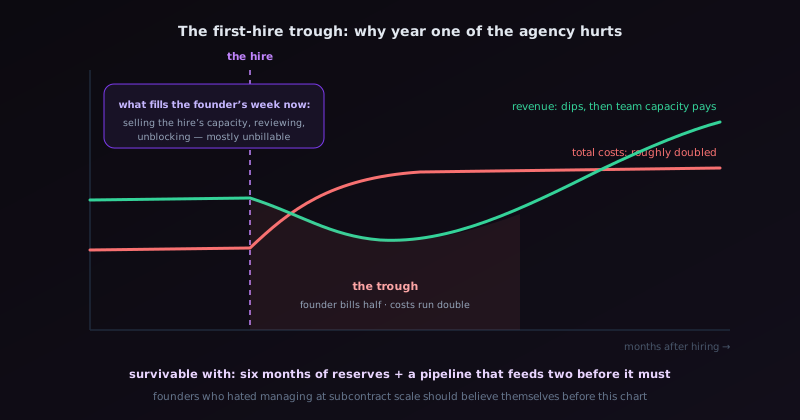
The deeper cost is the founder's utilization collapse, and it deserves to be planned rather than discovered: selling the employee's capacity, managing their work, and running the now-real company consumes founder hours that used to bill. The standard trough sees the founder's billable time halve while total costs double, which is why the first hire is so often described as the worst financial year of an agency's life, survivable only with a cash buffer (the reserve discipline from this series' finance articles) and a pipeline strong enough to keep two people fed. What breaks at this rung is the founder's job description: the craft that built the business becomes a minority of the week, replaced by selling, reviewing, and unblocking. Founders who hate that trade at subcontracting scale should believe themselves; employment only deepens it.
Rung three: the small agency, where systems are the product
Somewhere between three and eight people, the business crosses into being an actual agency, and the leverage finally compounds: multiple delivery streams running simultaneously, the founder priced out of production and into strategy and sales, revenue decoupled from any single person's calendar, eventually including the founder's. The margin structure matures too: agencies at this scale typically target net margins in the fifteen-to-twenty-five percent range, thinner than a soloist's but on a revenue base several multiples larger, and attached to an asset that, per the valuation articles, can actually be sold, because it finally runs on systems rather than on one person's heroics.
What breaks at this rung is everything informal that survived the earlier ones. Pipeline can no longer be the founder's network alone: feeding a team requires marketing systems (the positioning, content, and referral machinery covered throughout this series) that produce leads on schedule. Delivery can no longer be reviewed by the founder personally: quality lives in process, training, and the first delegated layer of review, which is its own act of trust-building. Culture becomes a real variable: the first bad hire at a four-person shop is a quarter of the company. And cash discipline graduates from virtue to survival: payroll is the most unforgiving fixed cost in business, client concentration becomes existential (one anchor client at forty percent of an agency's revenue holds its payroll hostage), and the reserve targets from the finance playbook stop being conservative and start being minimal. The founder's job re-forms one more time: from doing the work, to managing the work, to building the machine that manages the work.
The rung math, in actual numbers
The ladder's tradeoffs sharpen when worked through with a concrete figure, so take a freelancer billing a hundred dollars an hour at twenty-five billable hours a week, forty-five weeks a year, roughly a hundred twelve thousand of annual revenue, nearly all of it margin after modest overhead, for a working identity that is ninety percent craft. The subcontracting rung: the same founder keeps fifteen billable hours, spends ten on selling and reviewing, and runs two subcontractors at sixty dollars an hour billed out at a hundred: revenue climbs toward two hundred thousand while take-home lands around a hundred forty, a meaningful raise for a meaningful new job description. The pleasant surprise in the math is the flexibility: when demand dips, subcontractor hours dip with it, and the founder's downside looks almost exactly like their old solo practice.
The employee rung resets the equation harshly before it improves. A sixty-five-thousand-dollar hire costs perhaps eighty-five fully loaded; the founder's billable hours halve during the training and selling crunch; and the first year frequently nets less total profit than the solo year did: the trough from this article's chart, rendered in salary. The repayment arrives in year two if the pipeline holds: two producers at healthy utilization push revenue past three hundred thousand, and the founder's margin on the employee's work stacks on whatever they still bill themselves. At the small-agency rung the arithmetic becomes the fifteen-to-twenty-five percent net margin the industry actually reports: a five-person shop doing seven hundred fifty thousand nets the founder somewhere between a hundred ten and a hundred ninety thousand: real money, attached to payroll obligations, management hours, and an asset that, unlike the solo practice, could someday be sold. Three rungs, three defensible incomes, three completely different jobs: the numbers do not pick for you, but they make the choice honest.
The decision framework: climb, stay, or productize
Standing at any rung, the honest evaluation runs through a short set of questions, and "stay" is a fully legitimate answer to all of them:
- Is demand durably above capacity at full rates, for months, or is this a good season being extrapolated?
- Have you tested management at subcontracting scale, and did you like the work itself, not just the margin?
- Does the cash buffer cover the first-hire trough: six-plus months of doubled costs at halved founder billables?
- Is the pipeline systematic enough to feed mouths other than yours, on schedule, without heroics?
- Is the delivery documented enough that quality survives your absence from production?
- Would productizing (more leverage from packaging, none from headcount) serve the actual goal better?
- And the real question: what do you want the business to do for your life: income, asset, organization? The ladder serves the third best, the first worst.
Altitude is a choice, not a verdict
The agency-growth narrative carries a silent moral ranking (bigger as better, headcount as scoreboard) and it deserves explicit rejection, because the data of real lives keeps contradicting it. A specialist soloist billing strongly with productized offers and no payroll frequently out-earns, out-rests, and out-lasts the five-person agency founder managing pipeline anxiety and two underperformers. The ladder is not a maturity scale; it is a menu of different machines: the practice optimizes income per founder-hour, the subcontracting studio optimizes flexibility, the agency optimizes enterprise value. Each is the right machine for a different owner, and the costliest career mistake in services is climbing to an altitude someone else chose.
For those who do climb, the through-line of this entire series is the survival kit: documented systems before each rung needs them, cash reserves sized for the trough ahead, client diversification before any single relationship can hold payroll hostage, and pricing that respects the margin each rung must fund. The ladder rewards the boring disciplines and punishes improvisation, exactly like every other structure this series has mapped. And for those who stay (at solo, at subcontracting, at four people forever) the staying is not a failure to scale. It is the most underrated move in business: knowing precisely what the machine is for, and refusing to break it in pursuit of a bigger one you never wanted.
Frequently asked questions
Quick answers to common questions about this topic.
How do you go from freelancer to agency?
By climbing a leverage ladder: raise rates, productize your offer, then delegate delivery to contractors or staff so the business is no longer just your hours. Each rung trades more management for more capacity.
What breaks when a freelancer starts hiring?
Usually quality control and process: work that lived in your head now has to be documented and reviewed. The freelancer becomes a manager, which is a different job than the craft that got them there.
Do I have to build an agency to grow?
No. Productizing or raising rates can grow income without a team. An agency is one path to leverage; it is worth it only if you want to manage people and process.
Related troubleshooting
Was this page helpful?
Your answer stays in this browser, it is not sent anywhere and no account or cookie is involved.