2026 · Novus Stream Solutions (hub)About 12 min readNovus Stream Solutions
Error handling and alerts for no-code flows
A no-code flow that has no plan for failure is not finished; it is just untested. This is the field guide to the failure half: retries that back off instead of hammering, a dead-letter path for what cannot be saved, alerts you will actually read, and the small set of cases where the right move is to hand the problem to a human.
Contents
- 1.Overview
- 2.Retries with backoff: be patient, not aggressive
- 3.Dead-letter handling: somewhere for the unsavable to go
- 4.Alert routing that is not noisy
- 5.What to log, and what not to
- 6.Human-in-the-loop fallbacks: when the right answer is a person
- 7.How the five mechanisms fit together
- 8.A short checklist before you ship
Overview
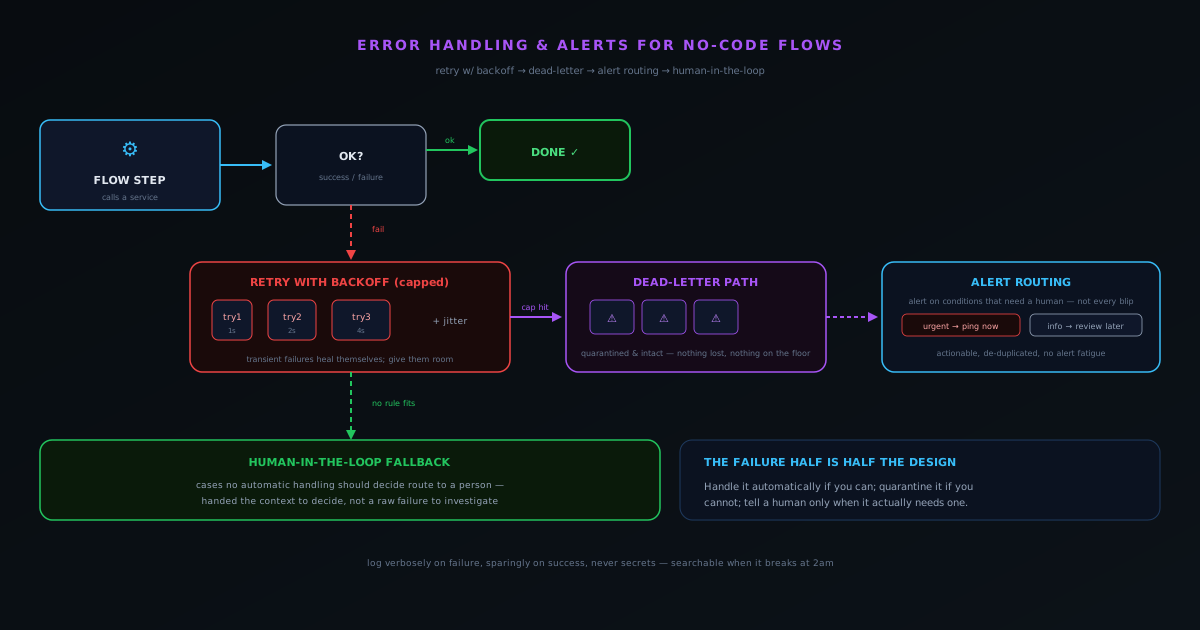
A no-code flow that handles the happy path is roughly half a flow. The other half (what happens when a step fails, when an API is down, when the input is malformed, when something simply does not make sense) is the part that decides whether the automation is trustworthy or merely lucky. Most flows that feel flaky are not actually flaky in their logic; they are flaky in their failure handling, which is to say they have none, so the first unexpected condition either crashes the run or, worse, silently does the wrong thing and tells no one. The work of making a no-code flow reliable is mostly the work of deciding, deliberately, what happens when things go wrong.
This guide walks through that failure half in the order you tend to need it. Retries with backoff handle the transient problems that fix themselves. Dead-letter handling catches the problems that do not, so they are quarantined rather than lost. Alert routing makes sure you find out about the failures that matter without being buried under the ones that do not. Logging gives you the breadcrumbs to understand a failure after the fact. And human-in-the-loop fallbacks cover the cases where the honest answer is that no automatic handling is correct and a person should decide. Get those five right and a no-code flow stops being a thing you hope keeps working and becomes a thing you trust.
Retries with backoff: be patient, not aggressive
A large share of automation failures are transient: a momentary network blip, a downstream service that was briefly busy, a rate limit you brushed against. These resolve on their own in seconds, which means the correct response to many failures is simply to wait a moment and try again. A flow with no retry treats every transient hiccup as a hard failure, which makes it far less reliable than it could be for the cheapest possible fix: trying twice. Adding a retry is often the single highest-return change you can make to a fragile flow, because it converts a whole class of self-healing problems from outages into non-events.
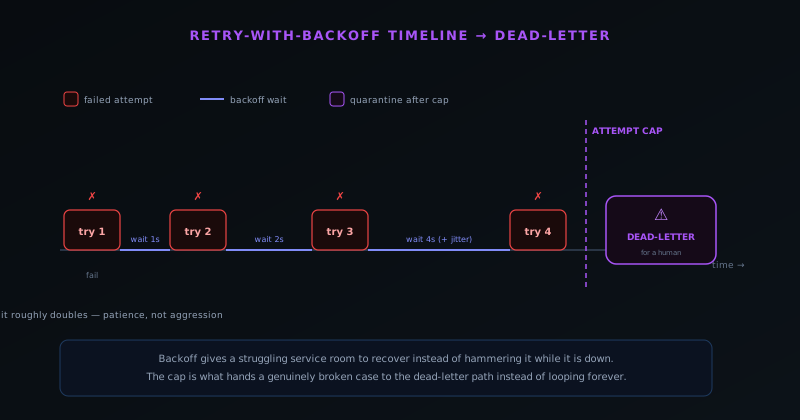
But the way you retry matters enormously, and the naive way makes things worse. Retrying immediately and repeatedly hammers a service that is already struggling, which can turn a brief slowdown into a sustained outage and can get you rate-limited or blocked for being abusive. The fix is backoff: wait a little before the first retry, longer before the second, longer still before the third. Exponential backoff is the standard, where each wait roughly doubles. Backoff gives the downstream problem time to clear instead of piling on while it is fragile, and it makes your flow a good citizen rather than the thing that kicks a service while it is down. Patience, structured as increasing waits, is the difference between a retry that helps and a retry that compounds the failure.
Two refinements make backoff genuinely robust. Add a little randomness to the wait (jitter) so that if many jobs failed at once they do not all retry in lockstep and re-create the same thundering pile-up. And cap the number of attempts, because not every failure is transient and retrying forever just turns a permanent problem into an infinite loop that never escalates to anyone. Backoff handles the transient; the cap is what hands the genuinely broken case off to the next mechanism instead of hiding it in an endless retry.
Dead-letter handling: somewhere for the unsavable to go
Once retries are capped, you face the case retries cannot fix: a job that has failed every attempt and is not going to succeed by being tried again. The malformed input, the genuinely-down dependency, the request that hits a real bug. The instinct is often to drop it (log a line and move on), but dropping failed work is how automations lose data quietly, which is the worst failure mode there is, because nobody notices until someone goes looking for something that should have happened and did not. The professional answer is a dead-letter path: a place where work that has exhausted its retries goes to wait, intact, for a human to look at.
A dead-letter destination (whether a literal dead-letter queue, a table, a folder, or a flagged list) does three valuable things at once. It preserves the failed work so nothing is lost and it can be reprocessed once the underlying problem is fixed. It separates the failures from the healthy flow so one poison input cannot block everything behind it. And it creates a single, reviewable place where failures accumulate, which turns "did anything fail?" from an unanswerable question into a glance. The dead-letter path is the safety net under the retries: backoff catches the transient failures, the attempt cap catches the permanent ones, and the dead-letter destination catches them gently rather than letting them hit the floor.
The discipline that makes a dead-letter path actually work is that it must be looked at. A dead-letter destination nobody reviews is just a slower way to lose data, with the added insult that the data was right there the whole time. So the dead-letter path and the alerting are linked: something should tell you when items are accumulating there, because a growing dead-letter pile is one of the clearest signals that something is genuinely wrong rather than briefly hiccuping. The net only works if you check it.
Alert routing that is not noisy
Alerting is where most error-handling efforts quietly fail, and the failure is almost never too few alerts: it is too many. An automation that alerts on every transient blip, every retried-and-recovered failure, every minor anomaly, trains you to ignore it. This is alert fatigue, and it is genuinely dangerous, because the alert that finally matters arrives into an inbox you have already learned to skim past. A noisy alerting setup is arguably worse than none, because none at least does not give you false confidence that you would hear about a problem. The goal is not maximum alerting; it is alerting you will actually read, which means ruthless about what is worth interrupting you for.
The principle that keeps alerts quiet-but-trustworthy is to alert on conditions that need a human, not on individual failures. A single failure that the retry recovered does not need you: the system handled it, and telling you is noise. What needs you is a pattern that the system cannot resolve on its own: items piling up in the dead-letter path, a failure rate that has jumped, a job that has been stuck for too long, a dependency that has been down past a threshold. These are signals that the automatic handling has reached its limit and human attention is genuinely required. Alerting on the limit-reached conditions rather than on every failure is what makes an alert mean "you actually need to look" instead of "something happened, as usual."
A few practical rules keep routing sane. Send different severities to different places, so the genuinely urgent reaches you immediately while the merely informative goes somewhere you review on your own schedule rather than interrupting you. Make every alert actionable: an alert you can do nothing about is pure noise and should be a log entry instead. And give related failures a way to collapse into one notification rather than a hundred, so a single broken dependency produces one alert that says "this is broken" instead of an avalanche that buries the next real problem. Every alert that fires should, ideally, be one you are glad arrived.
What to log, and what not to
Logging is the difference between debugging a failure in minutes and reconstructing it from guesses. When a no-code flow fails, the log is your only witness to what happened, and a good log answers the questions you will inevitably ask: what was the flow doing, what input was it working on, what step failed, and what was the actual error. A log that records only "an error occurred" is barely better than silence, because it tells you that something broke without giving you any thread to pull. The aim is enough context to understand and reproduce the failure without having to have been watching when it happened.
The temptation, having been burned by too little logging, is to log everything, and that is its own failure. A flow that logs every detail of every successful run produces a haystack so large that finding the one failing needle becomes its own chore, and the volume can quietly cost money and attention. The discipline is to log richly around failures and sparingly around success: when things go well, a concise record is plenty; when things go wrong, capture the full context. This asymmetry (verbose on failure, terse on success) gives you the detail exactly where you need it without drowning the signal in routine noise.
Two cautions matter especially for no-code flows wiring together real services. Never log secrets or sensitive personal data: the convenience of having it in the log is never worth the exposure, and once it is in a log it is in a place you probably are not securing as carefully as you think. And log in a way you can actually search, because a log you cannot query when something breaks at an inconvenient hour is a log that helps you only in theory. Structured, searchable, failure-focused, and free of anything sensitive is the combination that makes logging earn its place.
- Capture the four questions on failure: what was running, on what input, which step failed, and the real error.
- Log verbosely around failures and sparingly around success so the signal is not buried.
- Never write secrets or sensitive personal data to a log.
- Make logs searchable: a log you cannot query at 2am is a log that helps only in theory.
Human-in-the-loop fallbacks: when the right answer is a person
Some failures are not transient and not simply broken; they are cases where no automatic handling is correct, because the situation genuinely requires a judgment the flow cannot make. The input is ambiguous, the request is unusual in a way the rules did not anticipate, the cost of guessing wrong is high. For these, the right design is not a cleverer rule or a more aggressive retry: it is to hand the case to a human. A human-in-the-loop fallback is the deliberate decision that, when the flow hits a case it should not decide on its own, it routes that case to a person rather than forcing an automatic answer that might be wrong.
The key word is deliberate. The failure mode this avoids is an over-automated flow that confidently makes a wrong decision on a case it had no business deciding, because the designer wanted full automation and treated falling back to a human as a defeat. It is not a defeat; it is the correct handling of cases that should not be automated, and a flow that knows its own limits and escalates gracefully is more trustworthy than one that automates everything and is sometimes confidently wrong. The art is drawing the line in the right place: automate the cases where automatic handling is clearly correct, and route to a human the cases where it is not, rather than pretending the second category does not exist.
A good human-in-the-loop fallback also makes the human's job easy. When the flow escalates a case, it should hand over the context the person needs to decide (what happened, what the flow was unsure about, what the options are), so the human is making a decision, not starting an investigation. A fallback that dumps a raw failure on a person is technically a human-in-the-loop step and practically a burden. The fallback that works is the one that treats the human as the final, best-judgment step in the flow and equips them accordingly, so the handoff is the system working as designed rather than the system giving up.
How the five mechanisms fit together
These five pieces are not a menu to pick from; they are a layered system where each catches what the one before it could not. A failure first meets retries with backoff, which resolve the transient majority quietly. What survives the retry cap meets the dead-letter path, which quarantines the genuinely-broken so nothing is lost and one bad input cannot block the rest. Alert routing watches the dead-letter path and the failure patterns, surfacing the conditions that have exceeded automatic handling so a human finds out at the right moment and only the right moment. Logging records enough context, around failures especially, that the human who responds can understand what happened. And the human-in-the-loop fallback covers the cases that should never have been automated in the first place.
Read top to bottom, the layers form a clean escalation: handle it automatically if you can, quarantine it if you cannot, tell a human when automatic handling has reached its limit, give that human the context to act, and route to human judgment the cases that needed it from the start. Each layer reduces what the next has to deal with, so the human at the end is seeing only the genuinely hard, genuinely necessary cases, not the transient blips the retries absorbed, not the noise the alert routing suppressed. That funnel is the entire point: it concentrates scarce human attention on the small set of failures that actually require it.
The throughline of the whole guide is that error handling is not an afterthought bolted on once the happy path works: it is half the design, and the half that determines whether anyone can rely on the flow. A no-code automation with a thoughtful failure half is one you can trust to run unattended, because you know that transient problems heal themselves, permanent ones are caught and held, you will hear about the failures that matter and only those, and the cases that need a person reach one. That trust is the actual deliverable. The companion guide on scheduling and queues covers the reliability foundation these mechanisms sit on, and the human-in-the-loop piece deserves a deeper treatment of its own.
A short checklist before you ship
As with any automation, a few deliberate questions before going live prevent most of the failures that would otherwise find you later. Each question maps to one of the five mechanisms, asked plainly so none gets answered by accidental default. A flow where each has a real answer is one you can leave running and stop worrying about, which is the only kind of automation worth having.
- Do transient failures retry with backoff and jitter, and is the attempt count capped?
- When the cap is hit, where does the failed work go, to a dead-letter path or the floor?
- Does anything tell me when the dead-letter pile grows or the failure rate jumps, without alerting on every recovered blip?
- On failure, does the log capture what ran, on what input, which step failed, and the real error, while capturing nothing sensitive?
- Are there cases that should not be automated at all, and do they route to a person with enough context to decide?
Frequently asked questions
Quick answers to common questions about this topic.
Why use backoff instead of retrying immediately?
Immediate, repeated retries hammer a service that is already struggling, which can extend a brief slowdown into a real outage and get you rate-limited. Backoff waits a little before the first retry and progressively longer after each, giving the downstream problem time to clear and making your flow a good citizen rather than the thing kicking a service while it is down.
What is a dead-letter path and do I need one?
It is a place where work that has exhausted its retries goes to wait, intact, for a human to look at: a queue, table, folder, or flagged list. You need one if losing failed work silently would be a problem, which it almost always is. It preserves the data, keeps one bad input from blocking the healthy flow, and gives failures a single reviewable home.
How do I keep alerts from becoming noise?
Alert on conditions that need a human, not on individual failures. A failure the retry recovered does not need you; a growing dead-letter pile, a jumped failure rate, or a long-stuck job does. Route severities to different places, make every alert actionable, and collapse related failures into one notification so a single broken dependency does not produce an avalanche.
What should a no-code flow log when it fails?
Enough to understand and reproduce the failure without having been watching: what the flow was doing, what input it was working on, which step failed, and the actual error. Log verbosely around failures and sparingly around success, keep logs searchable, and never write secrets or sensitive personal data into them.
When should a flow hand off to a human instead of handling it automatically?
When no automatic handling is correct: the input is ambiguous, the case is unusual in a way the rules did not anticipate, or guessing wrong is costly. Falling back to a person is not a defeat; it is the right handling for cases that should not be automated. Hand over the context so the human is deciding, not starting an investigation.
How do retries, dead-letter handling, alerts, logging, and human fallback fit together?
They form a layered escalation. Retries with backoff resolve the transient majority; the dead-letter path quarantines what survives the retry cap; alert routing surfaces the conditions that exceeded automatic handling; logging gives the responder context; and the human-in-the-loop fallback covers cases that should never have been automated. Each layer reduces what the next must handle.
Related troubleshooting
Was this page helpful?
Your answer stays in this browser, it is not sent anywhere and no account or cookie is involved.