2026 · Novus Stream Solutions (hub)About 14 min readNovus Stream Solutions
Choosing an ecommerce platform: hosted vs open-source vs headless
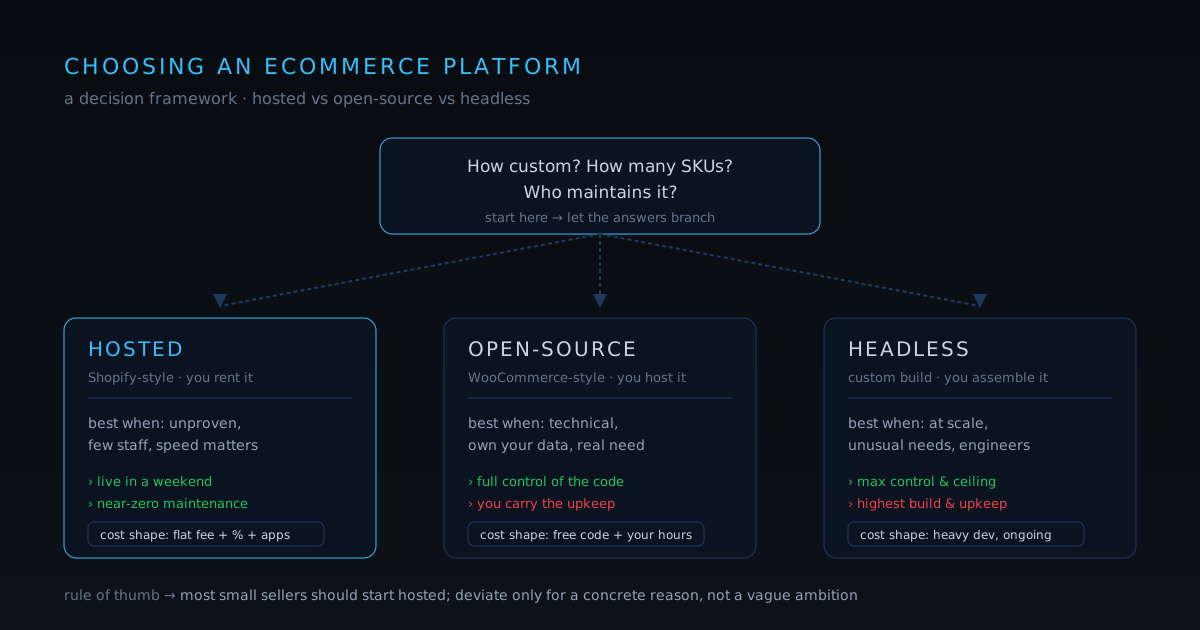
Hosted, open-source, and headless are not better or worse than each other; they trade control for maintenance in different proportions. This guide gives you a decision framework based on total cost of ownership, time-to-launch, and migration risk so you can match a platform to your real situation instead of the loudest marketing.
Contents
- 1.Overview
- 2.Three archetypes, not three brands
- 3.Total cost of ownership is the only honest comparison
- 4.Time to launch, and what a slow start really costs
- 5.Control versus maintenance: the trade you cannot escape
- 6.A side-by-side view of the three archetypes
- 7.Lock-in and the migration bill you pay later
- 8.Who each archetype genuinely suits
- 9.The case against premature headless
- 10.Marketplaces are a different question, and a sensible default
Overview
There is a question I get asked in some form almost every week, usually from someone who has just decided to sell something online and has spent an evening reading platform comparisons until everything blurred together. The question is always a version of 'which ecommerce platform should I use,' and the honest answer is that it depends on things the comparison articles rarely ask about. Most of those articles are really brand shootouts: this product versus that product, feature checklist against feature checklist, with a tidy winner at the bottom. That framing is comfortable because it ends in a single name you can act on. It is also close to useless, because the right platform for a knife-sharpening side business with forty products is almost never the right platform for a venture-backed apparel brand planning to do ten thousand orders a month, and the feature checklist hides exactly the differences that matter.
So I want to do something different here. Instead of ranking products, I want to give you a decision framework built around three archetypes rather than three brands. Almost every platform you can buy or build falls into one of three buckets: hosted software you rent, open-source software you host yourself, and a headless or custom build you assemble. Each archetype trades control for maintenance burden in a different proportion, and each has a cost shape that only becomes visible over a year or two of operating. Once you can see the archetype clearly, the individual product names sort themselves out. The goal of this piece is to leave you able to say not just which platform but why, and just as importantly, when a tempting option is the wrong one for where you actually are.
Three archetypes, not three brands
Start by ignoring product names entirely and looking at who is responsible for keeping the lights on. A hosted platform, the Shopify-style archetype, is software you rent. The company runs the servers, ships security patches, keeps the checkout working through a traffic spike, and stays compliant with the payment-card rules so you do not have to think about any of it. You pay a monthly subscription, you usually pay a per-transaction percentage on top, and you frequently pay again for apps that add capabilities the core product leaves out. In exchange you get the fastest path from idea to a working store, and you give up a measure of control over how the system behaves and where your data lives. This is the archetype most small sellers are quietly looking for even when they think they want something more elaborate.
The second archetype is self-hosted open-source software, the WooCommerce or Medusa style. Here the software itself is free to download and you own it outright, but you are now the company that runs the servers. You choose the hosting, you apply the updates, you handle backups and security, and when something breaks at an inconvenient hour it is your problem to solve or your contractor's invoice to pay. The third archetype is headless or fully custom commerce, where the storefront and the commerce engine are decoupled and often partly built from scratch. It offers the most control and the best performance ceiling, and it carries the highest build and maintenance cost by a wide margin. Almost everything else in this article is about how those three cost shapes play out over real time, with real money, for a real small business rather than a hypothetical one.
Total cost of ownership is the only honest comparison
The single most expensive mistake I see is comparing platforms on their sticker price. A hosted plan that costs thirty to three hundred dollars a month looks expensive next to a piece of free open-source software, and that comparison talks a lot of people into a self-hosted store they are not equipped to run. The number that actually matters is total cost of ownership, which means everything you will spend to keep the store operating for a year, not the line item on the pricing page. For a hosted store that total is the subscription, plus the transaction percentage the platform skims if you do not use its in-house payments, plus the monthly fees for the third-party apps you inevitably add to cover subscriptions, reviews, shipping rules, or tax. Those app fees are the part newcomers forget, and on a busy small store they can quietly equal or exceed the base subscription.
For a self-hosted open-source store the software is free, but the total cost of ownership is hosting plus your time plus developer hours, and that last item is the one people systematically underprice. A few hours a month of maintenance does not sound like much until you cost it at a contractor's rate, or until you value your own hours honestly and notice you are doing unpaid systems administration instead of selling. The thing to internalize is that money you do not pay a platform you usually pay in labor, and labor is the most expensive and least visible cost a small business carries. When you compare archetypes, force every option onto the same footing: estimate the realistic annual total, in actual money, including a fair price on the hours you or someone else will spend keeping it alive.
- Subscription: the monthly or annual platform fee, the only cost most people actually compare.
- Transaction fees: a percentage of every sale, charged by the platform on top of your payment processor's own cut.
- App and plugin subscriptions: the recurring fees for the add-ons that cover gaps in the core product.
- Hosting and infrastructure: servers, a content delivery network, backups, and a staging environment for self-hosted stores.
- Developer and maintenance hours: setup, updates, security, and the fix-it work that lands at the worst possible moment.
- Migration cost: the future expense of moving off the platform, which you pay later but should price in now.
Time to launch, and what a slow start really costs
Time-to-launch is the axis where hosted platforms win most decisively, and for an unproven business that advantage is worth more than it looks. On a hosted platform a competent owner can have a real, payment-accepting store live in a weekend, sometimes in an afternoon, because the hard parts are already built and tested. A self-hosted open-source store is a project measured in days to weeks once you account for choosing and configuring hosting, installing and theming the software, wiring up payments and shipping, and testing it all under conditions that resemble real traffic. A headless build is measured in weeks to months, because you are assembling a system rather than configuring one, and every piece you connect is a piece you now own.
The reason this matters so much for small sellers is that the first version of your store is almost certainly wrong about something, and you want to discover that quickly and cheaply. Every week you spend building before you sell is a week without the feedback that tells you what to fix. A store live in three days starts teaching you about your customers in week one; a store that takes three months to build teaches you nothing until month four, by which point you have sunk real money into assumptions you never tested. There is a reason I tell most people to start hosted: it is not that hosted is technically superior, it is that getting to your first hundred orders quickly is worth more than almost any feature, and the platforms that get you there fastest are the rented ones.
Control versus maintenance: the trade you cannot escape
Every platform decision is fundamentally a single trade dressed up in different clothes: how much control do you want, and how much maintenance are you willing to carry to get it. These two move together and you cannot cheat the relationship. Hosted platforms give you the least control and demand the least maintenance, which is precisely why they are restful to run. You cannot rewrite the checkout flow from scratch, you live within the platform's data model, and occasionally you hit a wall where the thing you want simply is not possible without an app or a workaround. In return you never patch a server, never get woken by a security advisory, and never spend a Saturday recovering a site that fell over during your busiest sale. For most small operators that is a fantastic trade, because their scarce resource is attention, not control.
Open-source self-hosting flips it. You can change anything, because you have the code and the server, but now everything is yours to maintain: the operating system, the database, the caching layer, the plugin that breaks when the core software updates, the certificate that expires at 2am. Headless takes both dials to the extreme, offering near-total control at the cost of maintenance that genuinely requires an engineer or an agency on call. Be ruthlessly honest about which resource you are short of. If you are short of money but rich in technical skill and time, self-hosting can pay off. If you are short of time and attention, which describes nearly every solo operator I have met, paying a platform to absorb the maintenance is not laziness; it is the correct allocation of a scarce resource toward the work that actually earns money.
A side-by-side view of the three archetypes
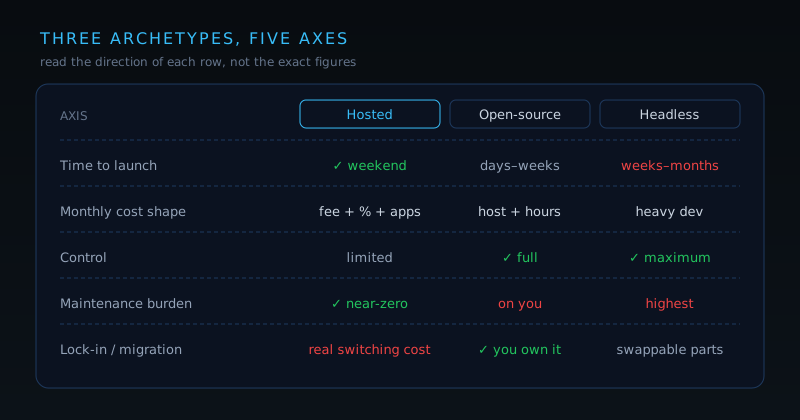
It helps to see the three archetypes laid out on the same axes at once, because the trade-offs are easier to reason about side by side than one paragraph at a time. The comparison below is deliberately coarse, using cost shapes rather than precise numbers, because the precise numbers depend entirely on your sales volume and your hourly rate. What stays true across almost every situation is the direction of each row: as you move from hosted to open-source to headless, time-to-launch lengthens, control increases, maintenance burden rises sharply, and the cost of getting out later grows. Read it as a map of which way each lever moves, not as a quote.
The pattern that should jump out is that the headless column is worse on nearly every axis a small business cares about and better only on control and a performance ceiling that most small stores will never approach. That is the whole case against premature headless in a single picture. Hosted is the boring, low-risk default; open-source is the considered choice for a specific technical owner; headless is the specialized tool that earns its keep only under unusual conditions. If your situation does not clearly point away from the first column, the first column is almost certainly your answer, and the table is there to make that visible at a glance rather than burying it in prose.
Lock-in and the migration bill you pay later
Lock-in is the cost that does not show up until you try to leave, and it is the reason I push back when someone dismisses it as a non-issue for a brand-new store. On a hosted platform your data, your theme, your apps, and often your customer relationships live inside a system you do not own, and while the better platforms let you export the essentials, exporting raw data is not the same as moving a working store. You will rebuild integrations, re-theme, re-establish your search rankings on new URLs if they change, and re-learn the parts of your operation that were quietly handled for you. None of this makes hosted a trap; it makes it a commitment you should enter with open eyes, knowing that switching later will cost real money and real disruption even when the export button works perfectly.
Self-hosted open-source scores best on this axis precisely because you own the code and the database, so in principle nobody can hold your store hostage. In practice that ownership is only as portable as the work that surrounds it, and a heavily customized self-hosted store can be just as painful to move as a hosted one, because the customizations are tied to a particular stack. Headless is a mixed bag: the decoupling that makes it complex also makes individual pieces swappable, which is genuinely valuable at scale and largely irrelevant below it. The practical move is to price migration in now even though you will pay it later. Keep clean exports, avoid leaning on a single proprietary feature for something core, and treat any platform as a place you might leave in three years rather than a marriage.
Who each archetype genuinely suits
Hosted suits the overwhelming majority of small sellers, and I say that having watched plenty of capable people talk themselves out of it. If you are selling physical or digital products, you have a handful to a few hundred SKUs, you do not have a developer on staff or a standing budget for one, and your competitive edge is your product or your marketing rather than your technology, hosted is the right home. It lets you spend your scarce hours on the things that move revenue and lets someone else carry the parts that only ever cost you time. The people who should look past it are not beginners who feel ambitious; they are owners with a concrete, specific reason the rented box cannot hold them.
Open-source self-hosting suits the owner who is genuinely technical or has reliable, affordable technical help, wants to own their data and infrastructure for real reasons rather than ideological ones, and has a customization need the hosted platforms cannot meet. Headless and custom commerce suits a much narrower group: businesses at meaningful scale where performance and flexibility translate directly into money, teams with unusual requirements that no off-the-shelf product serves, and operations that already employ the engineers needed to keep the thing running. If you do not see your own situation clearly described in the hosted paragraph, read the other two carefully before you assume you belong there, because most people who think they need open-source or headless are reaching for control they will pay for monthly and use almost never.
The case against premature headless
Headless commerce has a gravitational pull on a certain kind of ambitious founder, and it is worth naming why so you can resist it when resisting is the right call. The pitch is intoxicating: total design freedom, blazing performance, no platform telling you no. The trouble is that all three of those benefits are answers to problems that small stores do not yet have. Design freedom matters when a constrained theme is measurably costing you conversions, which is rare below real volume. Performance matters when milliseconds move money, which happens at scale, not at fifty orders a week. Freedom from platform limits matters when you have actually hit a limit, not when you imagine you might someday. Building headless to solve problems you do not have means paying the highest maintenance cost in commerce to protect against hypotheticals.
There is a subtler cost too, which is the engineering attention headless permanently consumes. A hosted store can be run by a non-technical owner indefinitely; a headless store needs someone who can keep a distributed system healthy, and that person is either an expensive hire or you, spending nights on infrastructure instead of growing the business. I have watched promising small companies stall not because their product failed but because they spent their first year building a platform instead of a business. The pattern to avoid is treating your storefront as a software project when it should be a sales channel. If you reach the scale and the specific needs where headless genuinely pays off, you will know, because you will have concrete revenue numbers and concrete limitations rather than a feeling that the simple thing is beneath you.
Marketplaces are a different question, and a sensible default
Before you finish choosing among these three archetypes, it is worth stepping back to notice that all of them assume you want your own storefront in the first place, and that is a separate decision worth making consciously. Selling through a marketplace instead of, or alongside, your own store is a genuinely different choice with its own economics around fees, audience, and how much of the customer relationship you actually own, and I have written about that trade-off in its own piece on marketplaces versus your own store. Many small sellers are best served by starting on a marketplace to find demand, then opening a hosted store once they have proven there are buyers, which sidesteps the platform question entirely until you have evidence it is worth answering.
When you do answer it, let the framework do the work. Estimate the realistic annual total cost of ownership for each archetype with an honest price on your own hours. Weigh time-to-launch heavily if the business is unproven, because speed to feedback beats almost every feature. Be clear-eyed about whether your scarce resource is money or attention, and let that decide how much maintenance you are willing to shoulder for how much control. Price in the eventual migration even though it is years away. For most people reading this, those inputs point to the same place: start hosted, get to your first hundred orders, and revisit the decision only when a specific, concrete need, not a vague ambition, pulls you toward owning more of the stack. That is not a compromise; it is the move that keeps your attention on the part of the business that actually pays.
Frequently asked questions
Quick answers to common questions about this topic.
What is the single most important factor in choosing an ecommerce platform?
Total cost of ownership measured over a year, with an honest price on your own time. Sticker price alone is misleading because free open-source software can cost far more in hosting and maintenance hours than a paid hosted plan, while a hosted plan's real cost includes transaction fees and app subscriptions on top of the base price.
Should a brand-new small store start with hosted, open-source, or headless?
Almost always hosted. The fastest path to your first hundred orders is worth more than any feature when the business is unproven, and hosted platforms get you live in a weekend while absorbing the maintenance that would otherwise eat your hours. Deviate only when you have a specific, concrete reason the hosted product cannot meet, not a general sense of ambition.
Is free open-source software actually cheaper than a paid hosted platform?
Not necessarily. The software license is free, but you take on hosting, security, backups, updates, and the developer hours to handle them. Once you price your own time fairly, a self-hosted store often costs as much or more than a hosted plan, and it costs you in the scarce resource of attention rather than the more replaceable one of money.
When does headless commerce genuinely make sense?
At meaningful scale where performance and flexibility translate directly into revenue, or when you have unusual requirements no off-the-shelf product serves and you already employ the engineers to maintain a decoupled system. Below that, headless means paying the highest maintenance cost in commerce to solve problems a small store does not yet have.
How much should I worry about platform lock-in?
Enough to plan for it, not enough to be paralyzed. Every platform carries some switching cost, and even when an export button works perfectly you still rebuild integrations, themes, and rankings. Treat any platform as somewhere you might leave in three years: keep clean data exports and avoid building anything core on a single proprietary feature.
Are marketplaces a substitute for choosing one of these platforms?
They are a different decision entirely. Selling on a marketplace trades fees and a thinner customer relationship for instant audience and zero platform maintenance, and many sellers start there to prove demand before opening a hosted store. Decide whether you even want your own storefront before you decide which kind of storefront to run.